But still curvy.
Pharyngula
Evolution, development, and random biological ejaculations from a godless liberal

Every year around this time, we can expect a sudden eruption of clouds of mayflies to emerge, as Gwen Pearson describes. There have been a few times I’ve been out driving when caught in it, and the car gets coated with brown dead bug smears, to the point where visibility is a serious problem.
But she also shows a video I found even more terrifying: this is a dying mayfly floating on the water, and she constantly dribbles out eggs, making a big pool of them on the bottom. And then one minute in, they start hatching!
Now I study an animal which develops very rapidly, the zebrafish, but this was shocking — you mean they go on a mating flight, drop to the water, and spew out eggs that develop into larval hatchlings in minutes? Impossible! Laws of thermodynamics! Cellular interactions and pattern forming mechanisms! The biochemistry couldn’t go that fast! Cell cycle times must be in milliseconds! Inconceivable! My brain is melting!
Fortunately, I read more closely.
Most mayflies lay their eggs immediately after mating; the eggs then take anywhere from 10 days to many months to hatch. Cloeon cognatum is an exception. This species is ovoviviparous, which means that a mated female holds her eggs internally until embryonic development is complete (about 18 days), after which she lays them in water and they hatch immediately. This female was dropped onto the water surface moments before the video started.
Whew. That’s better. And 18 day development time? Easy peasy. I guess I don’t have to hover around the margins of local lakes trying to catch a few minutes of development, once a year, after all.
By the way, here’s a photo of my car from last year, when I got caught driving by Lake Minnewaska one night:


This bird, over many generations, has warped the poor Centropogon‘s flower into that bizarre curve.

I think the engineers are just trying to wind me up, again. Joe Felsenstein tackles a paper published in an applied physics journal that redefines evolution and tries to claim that changes in aircraft design are a good model for evolution. It’s a terrible premise, but also, the execution is awful.
But permit me a curmudgeonly point: This paper would have been rejected in any evolutionary biology journal. Most of its central citations to biological allometry are to 1980s papers on allometry that failed to take the the phylogeny of the organisms into account. The points plotted in those old papers are thus not independently sampled, a requirement of the statistics used. (More precisely, their error residuals are correlated). Furthermore, cultural artifacts such as airplanes do not necessarily have a phylogeny, as they can borrow features from each other in massive “horizontal meme transfer”. In either case, phylogeny or genealogical network, statistical analysis requires us to understand whether the points plotted are independent.
The paper has impressive graphs that seem to show trends. But looking more closely we notice that neither axis is actually time. If I interpreted the graphs as trends, I would conclude that birds are getting bigger and bigger, and that nobody is introducing new models of small airplanes.
And they really do redefine evolution.
Evolution means a flow organization (design) that changes over time.
I’m going to redefine bridge construction as gluing together lots of matchsticks. Hire me, everyone, to help fix your infrastructure problems! I can probably underbid everyone!
But it’s just kind of amazing that they’ve defined evolution without any mention of populations or shifting allele frequencies or any of the processes (which don’t include design) that lead to changes in genotype, or even a recognition of how these processes derive from a core unity and lead to diversity. Design done did it.
My big gripe is that they got this paper published that is all about allometry with scarcely any understanding of the concept. Here’s the abstract of The evolution of airplanes
.
The prevailing view is that we cannot witness biological evolution because it occurred on a time scale immensely greater than our lifetime. Here, we show that we can witness evolution in our lifetime by watching the evolution of the flying human-and-machine species: the airplane. We document this evolution, and we also predict it based on a physics principle: the constructal law. We show that the airplanes must obey theoretical allometric rules that unite them with the birds and other animals. For example, the larger airplanes are faster, more efficient as vehicles, and have greater range. The engine mass is proportional to the body size: this scaling is analogous to animal design, where the mass of the motive organs (muscle, heart, lung) is proportional to the body size. Large or small, airplanes exhibit a proportionality between wing span and fuselage length, and between fuel load and body size. The animal-design counterparts of these features are evident. The view that emerges is that the evolution phenomenon is broader than biological evolution. The evolution of technology, river basins, and animal design is one phenomenon, and it belongs in physics.
Isn’t it cute how they claim biology as a small subset of physics? Blech.
But they only address a very narrow part of allometry. There is a functional constraint on form: you won’t survive if you have a human-sized body and a mouse-sized heart; if you scale the diameter of your legs linearly with your height, you won’t be able to walk; for a given metabolic rate and mass, you need a certain amount of respiratory surface area. That’s interesting stuff to a physiologist, but it’s also purely defined by necessity.
A developmental biologist might be more interested in how the relative sizes of different body parts change over time. Again, relative growth rates of different parts of your body are not linearly related; imagine being six feet tall with the same proportions as a baby. There are regulatory constraints on development that impose different rates in different areas.
But these guys are talking about evolution and allometry…and they treat it as a simple function of physics, where you need an engine of size X to propel a plane of size Y. Then how come every animal of the same size don’t look identical? Why doesn’t every passenger plane that carries a certain number of customers look the same (well, they do kind of blur together for me, but I’m sure any aerospace aficionado can tell me about all the differences between Boeing and Airbus. But many of these differences in animals are a result of inherited patterns, and phylogeny is essential to understand them.
For example, here’s a plot of brain mass relative to body mass (yeah, ugh, “lower” and “higher” vertebrates; let’s call them anamniotes and amniotes instead).
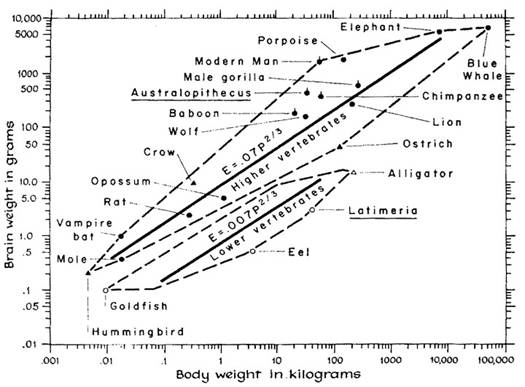
Notice that there are two lines drawn. Both show an upward trend, with a slope that’s proportional to the 2/3 power of the body size (that N2/3 shows up a lot in allometric growth plots). But given a fish (an anamniote, or “lower” vertebrate) and a mammal (an amniote, or “higher”) of exactly the same body mass, the mammal will have a relatively and absolutely much larger brain.
Explain that, engineer, with nothing but algebra and no concern about phylogenetic relationships. It takes more to understand evolution than physics alone, and you have to take into account history, environment, inherited properties, selection, and chance as important parameters.
Oh, well, I’ve learned that physics must be really simple. I can design a plane from the ground up if I simply postulate a spherical 747. Ha ha, all those fools getting engineering degrees when they could just bring in a clever biologist to solve all their trivial little problems.

It’s Tuesday…that must mean it’s “Let’s point out flaws in the academic system!” day.
Here’s another example: some investigators did a study of the value of screening cancer patients for distress — they asked whether such screening actually contributed to patient’s feelings of well-being and willingness to follow medical recommendations, and whether it was cost-effective. Their answer was no on all counts. Kudos to the Journal of Clinical Oncology for publishing a negative result.
Raspberries to the Journal of Clinical Oncology for what they did next, though. They brought in a proponent of screening to write a dismissal of the study.
Hollingsworth and colleagues were surely disappointed to discover that their article was accompanied by a negative editorial commentary. They had not been alerted or given an opportunity to offer a rebuttal. Their manuscript had made it through peer review, only to get whomped by a major proponent of screening, Linda Carlson.
After some faint praise, Carlson tried to neutralize the negative finding
despite several strengths, major study design limitations may explain this result, temper interpretations, and inform further clinical implementation of screening for distress programs.
And if anyone tries to access Hollingworth’s article through Google Scholar or the Journal of Clinical Oncology website, they run smack into a paywall. Yet they can get through to Carlson’s commentary without obstruction and download a PDF for free. So, easier to access the trashing of the article than the article itself. Doubly unfair!
Why we need open access, reason #21035.
I also found it interesting that the critical opinion piece had references…but most were to the author, or lab groups that had published with the author. Signs of a circle-jerk in the citations are always a warning sign.
The opinion piece also talks at length about problems with the Hollingworth paper’s protocols. I think it’s important to point out such failings, but shouldn’t they be done by editors and reviewers before publication? And why nitpick at studies that disagree with you, while ignoring major methodological flaws in your own approach?
Try this experiment: Ignore what is said in abstracts of screening studies and instead check the results section carefully. You will see that there are actually lots of negative studies out there, but they have been spun into positive studies. This can easily be accomplished by authors ignoring results obtained for primary outcomes at pre-specified follow-up periods. They can hedge their bets and assess outcome with a full battery of measures at multiple timepoints and then choose the findings that make screening looked best. Or they can just ignore their actual results when writing abstracts and discussion sections.
Especially in their abstracts, articles report only the strongest results at the particular time point that make the study looked best. They emphasize unplanned subgroup analyses. Thus, they report that breast cancer patients did particularly well at 6 months, and ignore that was not true for 3 or 12 month follow up. Clever authors interested in getting published ignore other groups of cancer patients who did not benefit, even when their actual hypothesis had been that all patients would show an improvement and breast cancer patients had not been singled out ahead of time. With lots of opportunities to lump, split, and selectively report the data, such results can be obtained by chance, not fraud, but won’t replicate.
Oh, boy, another of my peeves: fishing with statistics, gaming with your data.

New genetic disorders pop up all the time — each one represents a child who may face incredible challenges, or even be doomed to death. A child named Bertrand exhibited some serious symptoms — profound developmental disabilities — shortly after he was born, and no one could figure out what was wrong with him. So they took advantage of 21st century biotechnology and sequenced his genome, and the genome of both of his parents, and asked what novel mutations the child carried.
For years, sequencing was too expensive for common use—in 2001, the cost of sequencing a single human genome was around a hundred million dollars. But by 2010, with the advent of new technologies, that figure had dropped by more than ninety-nine per cent, to roughly fifty thousand dollars. To reduce costs further, the Duke researchers, including Shashi and a geneticist named David Goldstein, planned to sequence only the exome—the less than two per cent of the genome that codes for proteins and gives rise to the vast majority of known genetic disorders. In a handful of isolated cases, exome sequencing had been successfully used by doctors desperate to identify the causes of mysterious, life-threatening conditions. If the technique could be shown to be more broadly effective, the Duke team might help usher in a new approach to disease discovery.
For their study, Shashi, Goldstein, and their colleagues assembled a dozen test subjects, all suffering from various undiagnosed disorders. There were nine children, two teen-agers, and one adult; their symptoms included everything from spine abnormalities to severe intellectual disabilities. The researchers began by sequencing each patient and both biological parents—what’s known as a parent-child trio. There are between thirty and fifty million base pairs in the human exome; the average child’s exome differs from each of his parents’ in roughly fifteen thousand spots. The researchers could dismiss most of those variations—either they corresponded to already known conditions, or they occurred frequently enough in the general population to rule out their being the cause of a rare disease, or they were involved in biological processes that were unrelated to the patient’s symptoms. That left a short list of about a dozen genes for each patient.
In Bertrand’s case, they narrowed it down to one likely gene responsible for his condition — one gene that they also found that each of his parents carried variants for, although paired in both cases with normal functional alleles. Bertrand was unlucky: he inherited one bad copy from his mother, and another bad (but different) copy from his father.
Then there was Bertrand. The Duke team thought it was likely that mutations on one of his candidate genes, known as NGLY1, were responsible for his problems. Normally, NGLY1 produces an enzyme that plays a crucial role in recycling cellular waste, by removing sugar molecules from damaged proteins, effectively decommissioning them. Diseases that affect the way proteins and sugar molecules interact, known as congenital disorders of glycosylation, or CDGs, are extremely rare—there are fewer than five hundred cases in the United States. Since the NGLY1 gene operates in cells throughout the body, its malfunction could conceivably cause problems in a wide range of biological systems.
The article points out that one of the things that has made tracking down the genetic cause of this disorder is academic competition. Lots of people are born with novel genetic disorders, and they go to their high-powered geneticist/MD, and they get parts or their entire genome sequenced, and then the sequence is kept private. This is now the doctor’s discovery: making it open knowledge would also make it likely that someone else would use it and publish it, and that they wouldn’t get credit for it. That doesn’t help patients, but it does help careers.
And that’s the next step. It’s clear that Bertrand has an anomalous form of NGLY1, but that doesn’t demonstrate that that is the cause (remember, he’s got 15,000 other variations from his parents’ genome). The clincher would be to find other kids with similar phenotypes who also had NGLY1 variants, and then you’d be relatively certain you’d found the cause. If you had lots of sequence data, you might also find people who had the NGLY1 variants but none of the disease symptoms, which would rule out NGLY1 as the cause. It’s a real problem that information gets locked up in little academic kingdoms, and is difficult to pry out without promising authorship on a paper…and who wants to be the 63rd author on a paper that has 200 contributors, anyway?
So the article ends up pointing out a flaw in poor Bertrand’s genome, and another flaw in the institution of science.
I have to point out another problem, though, and this one has been known about in genetics for a long, long time: the high visibility of mutations of large effect, and how they skew our perception of how the genome works. These mutations exist, and Bertrand’s case is an excellent example: a single point mutation wreaks global havoc on the system, causes profoundly disruptive symptoms, and draws a bulls-eye around itself to attract the attention of geneticists. But the overwhelming majority of allelic variants do nothing detectable at all — again, witness Bertrand’s 15,000 differences that were ruled out as causal — yet we can’t rule out the possibility in other genetic disorders that multiple genes are required to be messed up to trigger the problem, and that focusing on them just one at a time means you miss the causes.
We know this is the case in cancer, for instance. There are central players that frequently end up mutated to cause oncogenesis — myc, ras, and p53, for instance — but no cancer is caused by just one genetic change, and it requires multiple steps to initiate. Further, there are multiple components, each with their own likely cause: proliferation is different from suppression of apoptosis is different from metastasis, and every patient has a different genetic profile. That’s why you’re not going to find any responsible doctor claiming that they found THE gene that causes cancer and have THE cure.
But here’s another example: a large genetic study that used similar techniques to those applied to Bertrand, looking for the heritable cause for a more complex and subtle disorder, schizophrenia. They didn’t find one. They found a hundred.
One clue to this complexity, and how schizophrenia as a disease is "built", has come this week in new research published in Nature which looks at the genetic basis for the illness. In one of the largest genetic studies of its kind, a team of scientists from around the world compared the genomes of 36,989 people with schizophrenia with 113,075 control participants. They identified 128 independent genes in the people with schizophrenia, 83 of which were not known about until now.
Although this is an important study, it would be false to say that genomics work will lead to an imminent breakthrough in terms of a cure for mental illnesses. What we can do with this information is to ask better questions about what to research next in this field, for example some of the new genes identified are involved with immune processes, which provides the first real evidence for a long-held hypothesis that connects schizophrenia with immune system problems.
The medical team studying Bertrand got lucky and found a single gene as the likely source of his problems (Bertrand is not lucky at all, though: that we know what’s wrong with him is a world away from being able to fix him). What makes people tick is a constellation of genes interacting cooperatively with one another, and you generally can’t map single genes to single phenotypic traits.
It’s going to be hard to figure that out. That’s why we need more biologists!

This flower, over many generations, has warped the poor buff-tail sicklebilled hummingbird’s beak into that bizarre curve.

Princeton physicist William Happer is still getting invited on television to say stupid things.
I keep hearing about the "pollutant CO2," or about "poisoning the atmosphere" with CO2, or about minimizing our "carbon footprint." This brings to mind another Orwellian pronouncement that is worth pondering: "But if thought corrupts language, language can also corrupt thought." CO2 is not a pollutant and it is not a poison and we should not corrupt the English language by depriving "pollutant" and "poison" of their original meaning….CO2 is absolutely essential for life on earth.
Did you know oxygen, while not a poison at standard concentrations, is highly reactive and will kill you at high concentration? Or that CO2 is vital for plants and is measured to regulate your breathing, but too much and you’ll suffocate?
What makes a substance poisonous is how much of it there is. Paracelsus figured this out in the 16th century. So Princeton physicists are unaware of developments and explanations that predate even Newton? That’s kind of amazing.
Maybe CNBC and other networks ought to take a lesson from the BBC on ginned up controversies and false dichotomies, and cut this bozo Happer from their invitation list.

Chris Clarke has published a short excerpt from his upcoming Joshua tree book. It’s good. It promises great things to come. It’s also mildly sorrowful, but then, that’s what you’re going to get with good environmental journalism.
There’s also a deal where you can sign up for weekly stories on the desert, in return for a reasonable donation. I signed up for a year’s worth — you might want to consider chipping in, too, if you can afford it.

Jesus. He’s written a climatological ‘Dear Muslima’ for Scientific American, defending Bjorn Lomborg. It feeds directly into a common Republican trope: ‘sure, climate change occurs, and maybe humans contribute to it, but it’s just too costly do what is necessary’. He lists a bunch of problems, and then does a “cost-benefit analysis”.
The ranking is based on a cost-benefit analysis. For example, an investment of $300 million “would prevent the deaths of 300,000 children, if it were used to strengthen the Global Fund’s malaria-financing mechanism.” Another $300 million would deworm 300 million children, and $122 million would lead to total hepatitis B vaccine coverage and thereby prevent another 150,000 annual deaths. Low-cost drugs to treat acute heart disease would cost just $200 million and save 300,000 people.
This doesn’t mean we shouldn’t do more about climate change. But what? Both books posit technological solutions: Lomborg’s Copenhagen experts recommend spending $1 billion for research on planet-cooling geoengineering technologies; Oreskes and Conway have humanity saved by the creation in 2090 of a lichenized fungus that consumes atmospheric carbon dioxide. Whatever we do about climate, we should recognize that the world has many problems. If you are malnourished and diseased, what the climate will be like at the end of the century is not a high priority. Given limited resources, we should not let ourselves be swept away by the apocalyptic fear generated by any one threat.
I fucking hate “cost-benefit analysis” — it’s always accomplished by sweeping a lot of costs under the carpet to reach the desired conclusion. It’s such an easy way to create imaginary books that you can fudge without consequences. Do they factor in the cost of losing New Orleans and Miami? Wanna bet everything is lowballed?
The argument about other problems is bogus, too: if we could wrest government out of the control of goddamned Libertarians and Republicans, we could talk about rational policy making and trying to fund all of those projects. Does anyone really believe progressive politicians are arguing we can’t save those children because we’ve only got money for ONE project, and we can’t prioritize to support humanitarian goals? Does anyone seriously believe for one second that if we follow the Libertarian dream and spend less on carbon reduction (as if we spend enough now), that suddenly the wretched conservatives in congress will decide they can invest a few hundred million dollars to prevent the deaths of foreign children?
NO ONE is claiming that we need to stop everything else and deal only with climate change right now. But they are arguing that we need to carry out an appropriate, necessary, and immediate change in our carbon consumption habits — which we are not doing, thanks to obstructionists and pseudo-scientific rationalizers for the status quo, like Shermer. Pretending that climate scientists want everyone to be “swept away” to deal with “one threat” is simply dishonest. Reprehensibly dishonest. What they’re doing instead is explaining how the long term costs of climate change represent a far greater concern than phony ‘cost-benefit analyses’ allow.
And citing Oreskes and Conway…they wrote The Merchants of Doubt, which is all about how industry assholes have connived to lie to us about the scientific consensus on tobacco, ozone, acid rain, and climate change — Oreskes does not agree with Lomborg. Yet here Shermer lumps Conway and Oreskes into the same camp with Lomborg. And what is this nonsense about ‘lichenized fungus’ in 2090? Nobody can make that absurd claim now, nor give it a date of arrival, let alone a couple of historians of science. What are they going to do, switch to molecular biology and develop it themselves? Why should we trust magic bullet solutions to complex problems?
Simply citing the discredited conservative hack Lomborg is grounds for suspecting Shermer’s ability to judge the quality of the arguments. He might have been well off reading Scientific American’s 12 year old demolition of Lomborg’s credibility. I don’t know what has happened at SciAm that they continue to encourage a Libertarian crank to publish in their once respectable journal…and this after his bogus article on a liberal war on science, and his more recent lying with statistics to dismiss concerns about wealth inequity. Do they simply not care any more?