Eat and live

I’ve been a distracted mess lately, with all this PT stuff as well as a week of administrative malarkey, but I did notice a a provocative comment that I feel compelled to respond to.

Upon accepting the risk of dispensing an unpopular remark: One day, we shall have to set nature in order using genetical engineering.

No creature should devour any other.

Wow. That makes no sense. We humans are obligate heterotrophs — we must obtain certain vital molecules by consuming other organisms. For example, we cannot synthesize valine, isoleucine, leucine, methionine, phenylalanine, tryptophan, threonine, histidine, or lysine, so we have to consume other organisms that contain those substances, or we die. I guess we can define “creature” to escape the problem, which is the vegetarian solution. We don’t eat meat from animals by making the decision that plants don’t count. It’s very convenient to say that killing carrots or yeast or lettuce is ethically OK, but if you think about it all deeply, even a carrot is a product of processes that kill insects with pesticides. Do insects count? What about protists? The lines are all arbitrary and we each draw our own lines.

Is our solution to genetically modify humans so they can synthesize every molecule we need? Or are we going to build factories to create all these essential substances as supplements?

But deeper still, the planetary biome is built on dependencies contingent on death and consumption, in every food web that exists. For example, sea otters eat sea urchins; sea urchins eat kelp; when sea otters are eliminated, the kelp forests die. How do we genetically engineer “devouring” out of the system without necessarily deleting entire ecologies? The only way any of this can happen is by magic.

Nature is already in order, reordering it to your preferences is silly.

An epic humble brag

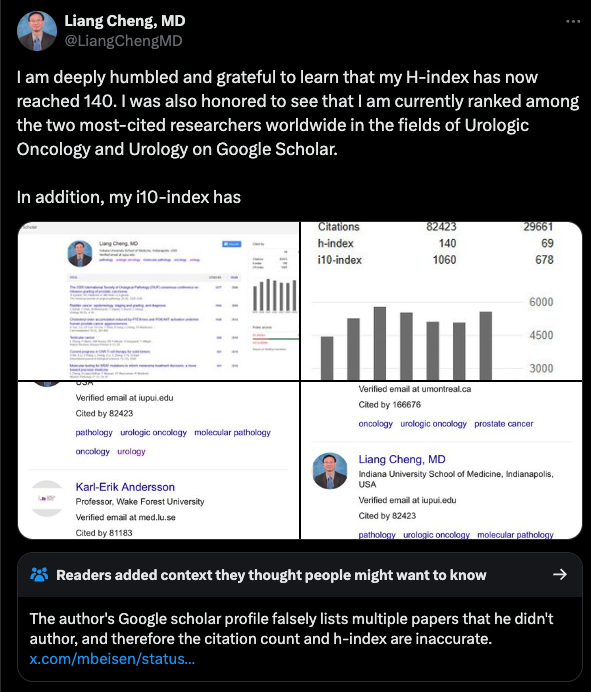
Liang Cheng is an oncologist a Brown University. I’d never heard of him before, but I am told that he is incredibly famous by Liang Cheng, as he announced himself on LinkedIn.

I am deeply humbled and grateful to learn that my H-index has now reached 140. I was also honored to see that I am currently ranked among the two most-cited researchers worldwide in the fields of Urologic Oncology and Urology on Google Scholar.

In addition, my i10-index has reached 1060; that is, one thousand and sixty publications each cited at least ten times. I was told that this may represent a world record – what an extraordinary honor!

Nonetheless, these numbers are far less important than the people, mentorship, friendships, and collaborations behind them. This milestone is truly a triumph of team science. I owe immense gratitude to my mentors, colleagues, collaborators, residents, fellows, medical students, and friends who have inspired and supported me throughout this journey over the past two decades.

Academic medicine is never an individual accomplishment. It is ultimately about advancing science and medicine, educating future generations, and improving patient care. If our work has contributed even in a small way toward those goals, then I feel extraordinarily fortunate and grateful.

Thank you for being part of this journey. The best is yet to come!

I hate to be the one to tear him down, but no one cares about your H-index and i10-index except, maybe and importantly, administrators and fellow H-index chasers. Anyone else remember that scene in American Psycho where Patrick Bateman and several of his cronies are comparing business cards, noting the quality of the stock and the embossing and the inks? Yeah, that’s what it’s like seeing someone brag about their indexes. Don’t care.

It’s also because those numbers are thoroughly gamed. I looked him up on PubMed, and it’s true, his name is on a lot of papers: papers that have 10 or 20 or more authors, and there he is, somewhere in the middle of a sea of names, rarely first or last. He really does owe a lot to his “mentors, colleagues, collaborators, residents, fellows, medical students, and friends” who have been tacking his name unto their papers! And further, his publication rate, that is, the rate at which his name gets plugged in to a long list, is approximately a paper every two days, which is insane. This is authorship by rubber stamp.

I think it is valid that many research endeavors nowadays require a large team, and he may have been an indispensable member of such a team, but then to use that cooperation to brag that he is #1 or #2 in his field is unseemly. It’s also dangerous, Dr Tall Poppy. He was spamming his ‘accomplishment’ on every social media site he could find, and on Xitter, Michael Eisen noticed.

The author’s Google scholar profile falsely lists multiple papers that he didn’t author, and therefore the citation count and h-index are inaccurate.

Whooops.

I do enjoy seeing a braggart taken down a peg, but Liang Cheng is a symptom of a greater problem: we’re drowning in artificial metrics, amplified by AI slop.

Over the last few decades, science has undergone a “citation revolution.” Scientific life used to be structured by personal reputation and mutual acquaintance; now it is defined by quantitative assessments derived from citations.

And this reward system has warped scientific life in dramatic ways. It has resulted in the obvious and widespread gaming of citation metrics; but, more insidiously, it has pushed scientists toward risk-averse, incremental, and above all unambitious research. The logic of institutional science has become increasingly divorced from actual knowledge and discovery. In a system governed by these perverse incentives, the inevitable endpoint is simply AI-generated slop at scale.

Now, with AI, we’ve built a remarkable new technology that opens up dramatic new horizons for scientific work. But we’re deploying that technology within an institutional structure that incentivizes, above all else, the maximization of metrics that don’t have much to do with real science. The underlying problem is not with AI, but with the institutions and incentives that define modern science.

That is an excellent article, everyone should read it. It actually ends on a promising note, regarding AI as a tool that could break us out of the dead-end, grasping competition for a magic ranking number, as exemplified by the case of Liang Cheng.

The citation index was designed in the 1950s and ‘60s as a solution to the information crisis engulfing scientific life. It ended up becoming much more than that: a regime that reshaped what science was, how it was rewarded, and what kind of science got done. Now that regime is collapsing under the weight of its own contradictions. I think it’s a fantastic opportunity to build something better.

This is where we’re at

A scientist has been denied access to his lab…because he supported his Chinese students.

A faculty member at Indiana University (IU), who has sharply criticized the government’s recent prosecution of several Chinese scientists accused of smuggling biological materials into the United States, has been locked out of his laboratory by the school in response to a request by one of his federal funders.

IU plant microbiologist Roger Innes says the move Thursday evening is the latest instance of retaliation for a letter he wrote last fall on behalf of Yunqing Jian, a plant scientist postdoc at the University of Michigan who had pled guilty to smuggling biological material and making false statements. The letter to Jian’s attorney, intended to be used at her sentencing, argued that what the Chinese postdoc had transported was not dangerous, but she was still ultimately deported. Her conviction triggered an investigation of Youhuang Xiang, a Chinese postdoc in Innes’ lab, that led to Xiang also pleading guilty last month to smuggling loops of DNA known as plasmids. He was also deported.

Oh no, never criticize the US government.

This sounds like overreach by government agents trying desperately to find excuses to deport Chinese scientists, and taking out an American scientist as collateral damage. If I had foreign students, I would defend them without question, but apparently that will get you shut down in America.

I would love to know the rationale for excluding the PI from the lab, even if his post-docs were guilty of importing nefarious plants. Do they suspect him of plotting to attack the US from his lab in Indiana with evil weeds from China?

Interesting touch: the chair of Innes department is Armin Moczek, an eco-evo-devo guy I know of. He’s going to be watering Innes’ plants while he’s locked out.

Oh no, last week of classes

It’s the perfect storm, and I have myself to blame. I gave the fourth exam of the semester yesterday, and many of the students bombed. This happens every year, and it’s because the fourth exam is the hardest of them all: everything accumulates in this course, and it’s the combination of lots of math and understanding the topology of weird chromosomes entangled and swapping bits around that breaks their brains. Couple the fact that these are generally smart, high-achieving students with the shock of getting a 40% on an exam, and it’s going to get ugly. I’m going over the answers with them this afternoon.

Also, we have a major lab report due next week, and an in-class presentation. It is a high stress situation.

Students are already emailing me with requests for a point here and there on back assignments and exams. I’m going to spend my weekend with spreadsheets recalculating all their old assignments and putting together a final assessment, which will inspire a further frenzy of grade-grubbing.

If I drank anymore, this would be the weekend I’d finish off a bottle of good whisky, but I don’t drink at all anymore. I’d rather talk about genetics than grades, but the system will not allow that.

The loons have been handed the control of science

I lost all respect for Matt Ridley years ago, when I wrote:

Matt Ridley is definitely a smart guy, and he also writes well. I enjoyed some of his earlier books, like The Red Queen and Genome, but I became less appreciative as he became more openly libertarian, and espoused a Whiggish view of the world that was only a rationalization for why he was so wealthy and privileged (he’s kind of the British version of Pinker, only worse). He’s the 5th Viscount Ridley, don’t you know, he is to the manor born (Blagdon Hall, Northumberland, specifically), he’s a member of the House of Lords, he endorsed Brexit, he owns coal mines, he used to own a bank, but he ran it into the ground and it was taken away from him and nationalized. On climate change, he’s argued that global warming is going to be a net benefit, increasing rainfall and the growing season, and that human ingenuity will overcome any minor disruptions. He even coauthored a book with Anthony Watts and Bjorn Lomborg and a host of the usual denialist suspects, Climate Change: The Facts 2017, which ought to alarm anyone who wants to think he’s just being objective. I guess that comes of owning coal mines and being an enthusiastic endorser of fracking — when your prosperity is a product of spewing as much fossil carbon into the atmosphere as you can, your very smart brain will work very hard to find excuses.

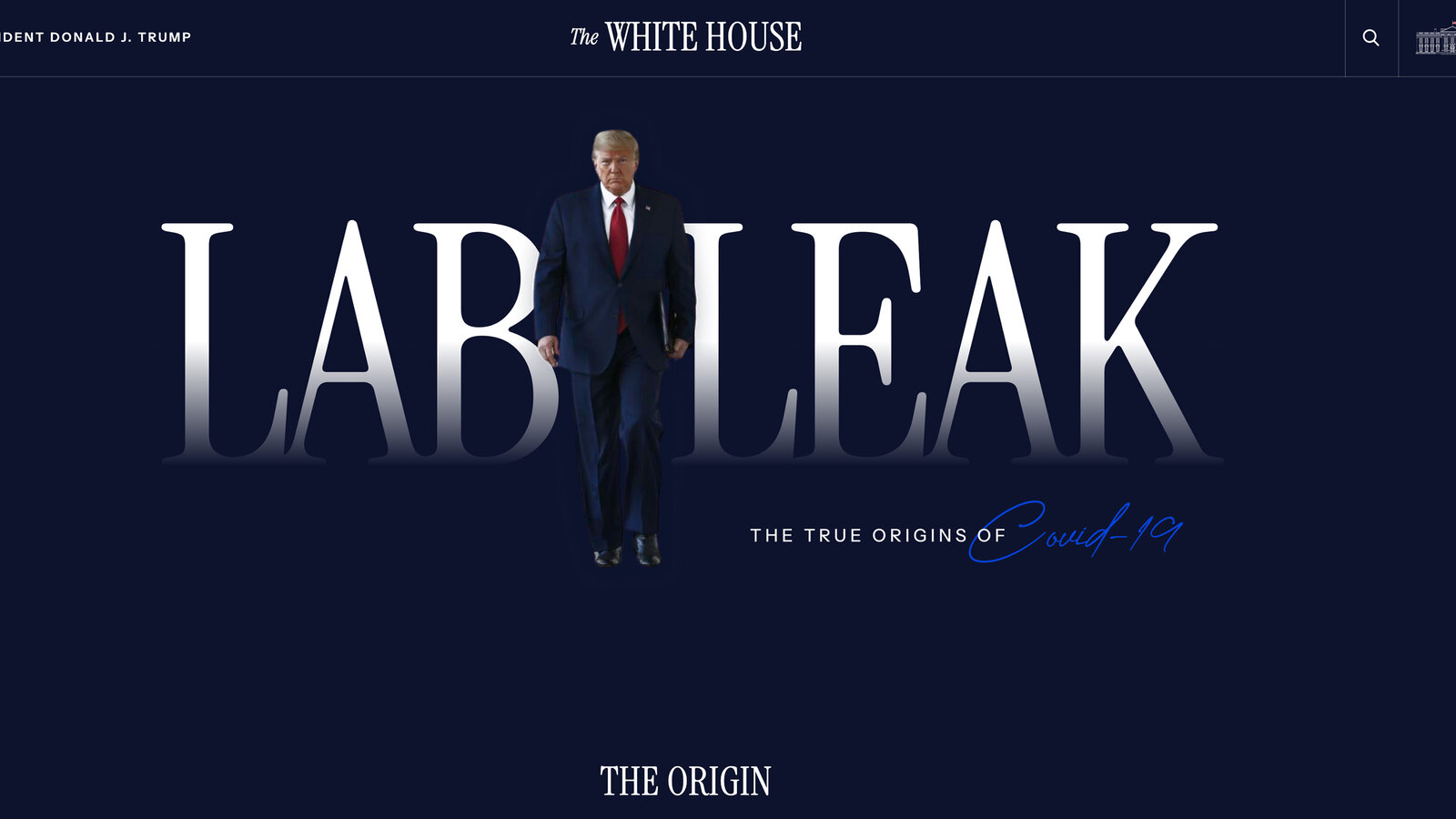
At this point, he is an irredeemable kook — but a well-connected and wealthy one, who gets invited to all kinds of events hosted by the corrupt, criminal kooks in charge of the US government. He was recently invited to address the NIH on the “lab leak” hypothesis, the discredited conspiracy theory that China intentionally engineered the COVID virus to wreak havoc on the West, but accidentally released into their home territory of Wuhan. It’s absurd. No one who knows anything about virology or molecular genetics thinks it is at all plausible, or credits it as valid in the face of all the evidence that it originated naturally from wild populations, or zoonosis.

Nevertheless, Ridly got invited to present his innuendo, lack of evidence, and leaps of illogic at a major meeting of the formerly prestigious NIH.

Must Trump get his face put front and center of everything?

Don’t trust me that the “lab leak” is a garbage hypothesis? Larry Moran and Lindsay Beyerstein both shredded these “lab leak” claims years ago, but conspiracy theories seem to be invulnerable to little things like evidence and reason.

Add another critic to the long list of knowledgeable scientists who find Ridley risible: Angela Rasmussen. She gives five really strong reasons why the “lab leak” nonsense is wrong, and also seems to have even less respect for Ridley and Bhattacharya than I do.

I don’t know Ridley’s motivation besides being a pompous literal coal baron who led the UK into the 2007 financial crisis with the first run on a British bank in 130 years, and who expects to be taken seriously despite the fact that he seems like a foppish secondary antagonist in a forgettable Dr. Who episode. Unfortunately, Ridley is taken seriously by his fellow pompous, insubstantial windbags, and even more unfortunately, they are the windbags in charge who invited him.

It is no mystery why Podcast Jay [Bhattacharya] rolled out the red carpet for the distinguished Viscount despite his lack of qualifications or relevant expertise on the topic. He knows that Matt Ridley is writing fiction. He shows up to launder conspiracist lies through an indignant upper class British accent in service of Bhattacharya’s ultimate goal: to declare all NIH research reckless, dangerous, and absolutely the worst thing we could possibly do. Better redirect the money for these irresponsible Alzheimer’s, HIV, and diabetes treatments to the White House. President Donald Trump and Office of Management and Budget Director Russell Vought will know what to do with all those funds.

I don’t see enough news and criticisms of Bhattacharya — he’s in charge of the NIH, he’s an idiot, he’s busy dismantling the American scientific institutions, but mostly what gets into the press are the disastrous decisions of the bigger fools in the cabinet. Make no mistake, though, he’s one of the nastier parasites gnawing at the foundations of our science establishment.

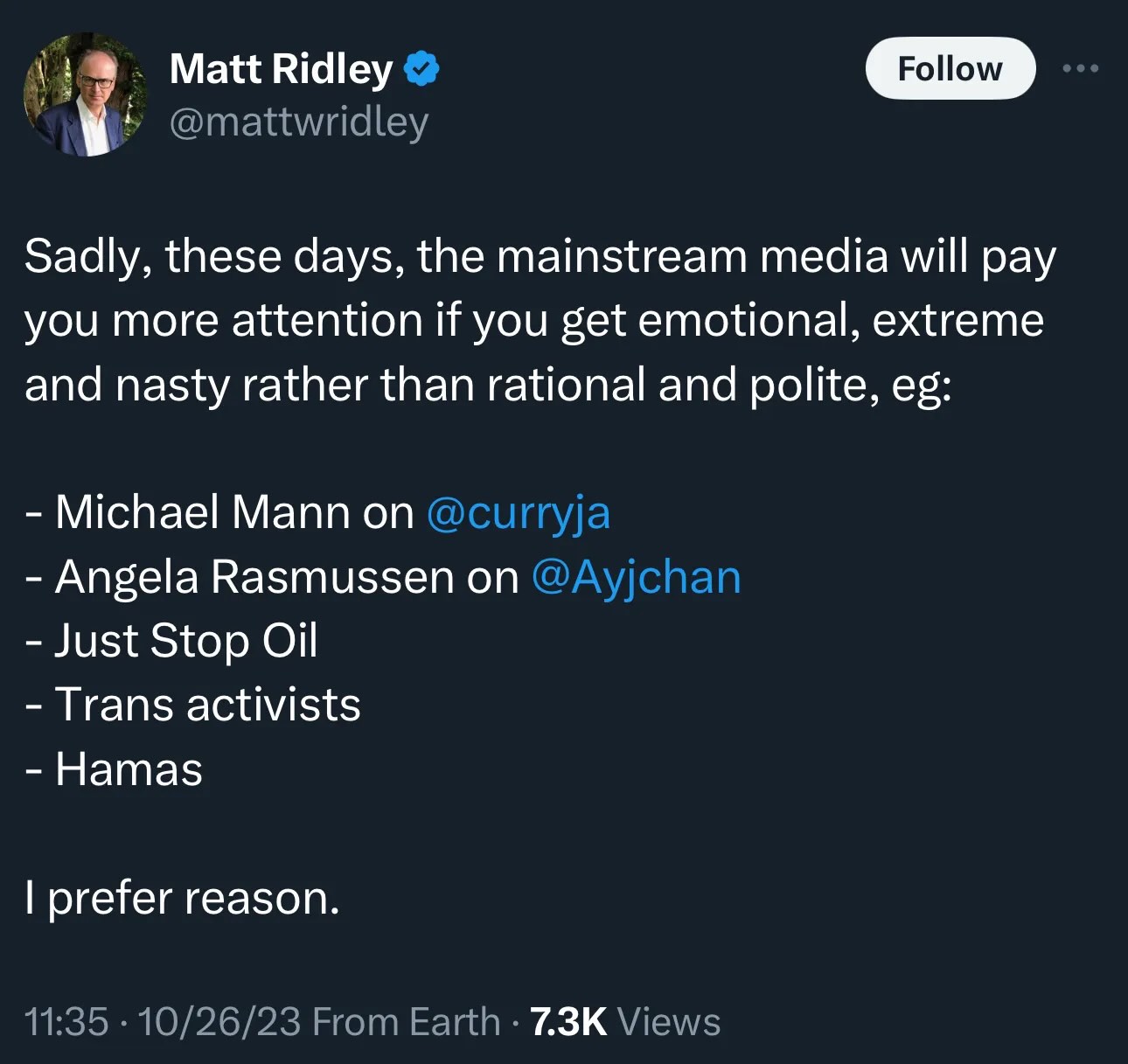
And now he invited Ridley to speak. The Ridley who makes these kinds of ludicrous accusations:

You can tell what kind of man he is by the people he lumps together as enemies with Hamas: a couple of credible, qualified scientists and trans people. His right-wing politics are showing.

Kudos to my 2026 Genetics students!

They have just completed the first half-semester experiment, a complementation test with two loci in flies, and we sat down in lab and did an analysis of the data. Perfect execution! We got the expected result (the genes complemented each other) and all of the students are now officially masters of basic fly breeding.

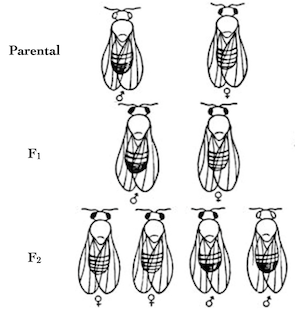
Then, just because the F1s from that cross were all heterozygotes at two loci, we went ahead and did another cross with them, your classic dihybrid cross, which should result in 4 phenotypes with a ratio of 9:3:3:1, according to that old guy Mendel. It did! It’s always thrilling to do these simple experiments that we all take for granted and see that, by god, Mendelian genetics actually does work under these specific conditions, and even a gang of undergraduates who’d never looked at Drosophila before can do it.

We’ve got another experiment in progress, a mapping cross that we started before spring break — we have to overlap experiments a little bit so we can get them all done in a single semester. I’m impressed with this bunch, though. They’ve got the potential to be fabulous geneticists. So hire them after they graduate!

(I don’t actually expect most of them to want to go on to careers in genetics, but they could. They have the potential.)

A good maggoty morning to you, too

Even though it is officially Spring Break, I had to trudge through the snow (yeah, it snowed again) to the lab to take care of my students’ flies, since they’re away doing splendidly fun things and couldn’t be bothered to come into the lab and maintain their experiment themselves, and I had to do it all. Which wasn’t much…they set up their crosses last week, and I just had to come in and kill their parents before they had an opportunity to commit incest.

I am happy to report that their bottles were mostly full of maggots, some had entered the wandering stage and crawled up the sides of the bottles, but none had pupated yet. Our timing is perfect — I expect they’ll be eclosing this weekend, so the students will return to buzzing bottles full of purebred Drosophila adults for the next stage of the cross.

I’m sure they were all concerned so I just sent them all a note to read on their holiday, reminding them of what’s next.

Does China know something we don’t?

I kinda sorta envy Chinese science policy.

The Chinese government is ramping up its support for science, announcing plans to boost two key budgets at the country’s biggest political meeting called the Two Sessions.

China has proposed to increase its overall research and development (R&D) expenditure by at least 7% per year over the next five years, which translates to billions of extra dollars each year. This typically covers government and private-industry spending on basic research, applied research and experimental development.

China’s R&D expenditure has skyrocketed over the past 20 years. Last year, it exceeded 3.9 trillion yuan (US$567 billion). For the past five years, it has has increased by at least 8% a year.

They had me at “support for science.” I don’t have an unqualified envy — the USA has been gutting science in this country, which I’d like to see stop — but there’s more to improving science than throwing money at it. China is going to direct money by dictating how it should be spent, and I’d rather see science supported by informed, peer-directed investment.

Unfortunately, the US approach is to slash the science budget and put it under the control of an asylum full of demented lunatics who know nothing about science. We’ve chosen the very worst science policy possible!

Darwin was not the final authority on anything

Sal Cordova is promoting this very silly book review on Reddit, which is the only reason I’ve seen it. The International Journal of Organic Evolution published a review of a book titled Rereading Darwin’s Origin of Species: The Hesitations of an Evolutionist, which is taking a deep historical perspective, comparing Darwin’s idea of evolution with the modern theory, and noting serious conflicts between the two. This is totally unsurprising. The reviewer, Alexander Czaja, adds an odd twist to it, though, title the review An approaching storm in evolutionary theory, threatening dire consequences if evolutionary biology continues to promote the cult of Darwin and his flawed theory.

For about 10 years, something important has been brewing in the world of evolution, a great storm that, unfortunately, has so far only made itself felt among a few biologists, historians, and philosophers of biology and evolution (Jablonka & Lamb, 2005, 2020; Laland et al., 2014; Müller, 2017; Pigliucci & Müller, 2010; Skinner, 2015). Reading the work of most practicing biologists, one hardly sees any sign of this gathering storm. On the contrary, in standard textbooks and popular literature, no winds of resistance have been felt, and the ship known as the Modern Theory of Evolution (MTE) sails safely and undisturbed from its usual academic course. It remains to be seen how strong the storm will ultimately be.

Dramatic, much? It’s hard to take the author seriously when he is pushing such an extremely distorted version of modern science. The Modern Theory of Evolution is unconcerned about Darwin’s theory of evolution because we don’t read the Origin anymore. It’s out of date, obsolete, and no longer relevant to the study of evolution. I was never assigned to read the Origin at any point in my academic career, and I’ve never assigned it to my students ever since. It’s a well-written text in an old Victorian style, but since we’re not studying changes in literary English over the last 150 years, it’s not really relevant to an education in biology.

The theory of evolution has evolved significantly since 1859, so it’s no surprise that looking back on the original idea we see discrepancies.

To get straight to the point: The book has no intention of capsizing the MTE ship or to unseating the modern theory but puts forth some provocative theses against the generally accepted view that Darwin was the first modern evolutionary thinker in history: the authors try to demonstrate that there is a wide gap between Darwin and evolutionists today. The most daring of their theses states that Darwin was not an evolutionist in the modern sense of the word. Indeed, the authors question the appropriation of Darwin by proponents of the MTE, who have always placed him and his Origin of Species at the conceptual center of their own model. The book provides compelling arguments that the MTE is based on a highly distorted and anachronistic picture of Darwin, both of his time and main work. Having set forth their case for a fresh look at the Origin, the authors delve deep and meticulously in Darwin’s main work, by uncovering its neglected ambiguities and contradictions. After years of collective Darwin euphoria, in which—as the authors self-critically note—they themselves actively participated, it is now time for a more critical approach. The authors call it “returning Darwin to the human dimension” (p. x) and they wonder “[w]hy has it taken so long for us to realize that Darwin’s commitment to evolutionism was incomplete?” (p. 6)

I fail to see how anyone can claim that “the MTE is based on a highly distorted and anachronistic picture of Darwin”, since it is not based on Darwin at all. Like any scientific theory, it changes to accommodate the evidence, and there has been an astonishing amount of evidence incorporated into the MTE. We don’t worship Darwin, we don’t regard the Origin as holy writ, and we know that Darwin had doubts and errors: witness his reaction to Fleeming Jenkin’s objection that evolution was incompatible with his model of blending inheritance, or the sad debacle that was his promotion of the idea of gemmular inheritance.

We’ve had bigger “storms” than anything modern science has come up with: Darwin missed out entirely on genetics, population genetics, molecular biology, and genomics, and now you want to tell us we’ve been slavishly following a 19th century version of evolution? Psssht, get out of here, ya looney.