

Well, sort of. Researchers in the College of Biological Sciences on the Twin Cities campus have created a synthetic cell from scratch that has many of the properties of evolved cells, but they also have significant limitations. Kate Adamala and Aaron Engelhart have combined 7 plasmids in a lipid bubble, that they’ve called a spudcell, that can do many of the cool things that natural cells can do.
This is likely the most exciting project I’ve ever worked on,” said Adamala. “We’ve replicated in chemistry what only used to be possible in biology: the complete set of behaviors of a cell. It proves that the most fundamental functions of life, like growth and replication, do not need a mysterious magical spark.
You can almost hear the mad cackle. So what can it do?
Among the characteristics of SpudCell:
• Replicates a biological cell’s life cycle: SpudCell is capable of selection, genome replication, growth, resource acquisition via feeding, and genetically encoded division.
• Cell division without a cytoskeleton: Natural cells divide using internal scaffolding called a cytoskeleton, which has been a bottleneck in synthetic cell research. SpudCell sidesteps the need for a cytoskeleton with proteins that crowd together on the membrane surface until the mechanical stress makes the membrane split.
• Selection and competition: Researchers introduced a genetic change that increased production of the fusion protein, resulting in cells that grew faster and produced more offspring. After five generations, the faster-growing variant had outcompeted the original. Under nutrient scarcity, the advantage increased, demonstrating selection and competition operating in a fully synthetic chemical system.
It’s basically a minimal, defined biochemical system in a liposome, with a tiny genome. It doesn’t have any organelles (other than ribosomes), and is a uniform soup of enzymes, which is why I think they called it a SpudCell, because it’s got all the character of a potato. You can read a preprint which gives all the details.
The system contains 36 purified enzymes, a 90,000 base pair genome spread across nine separate DNA molecules, and a lipid membrane. SpudCell is able to grow, replicate its genome, divide, and undergo selection and competition across multiple generations.
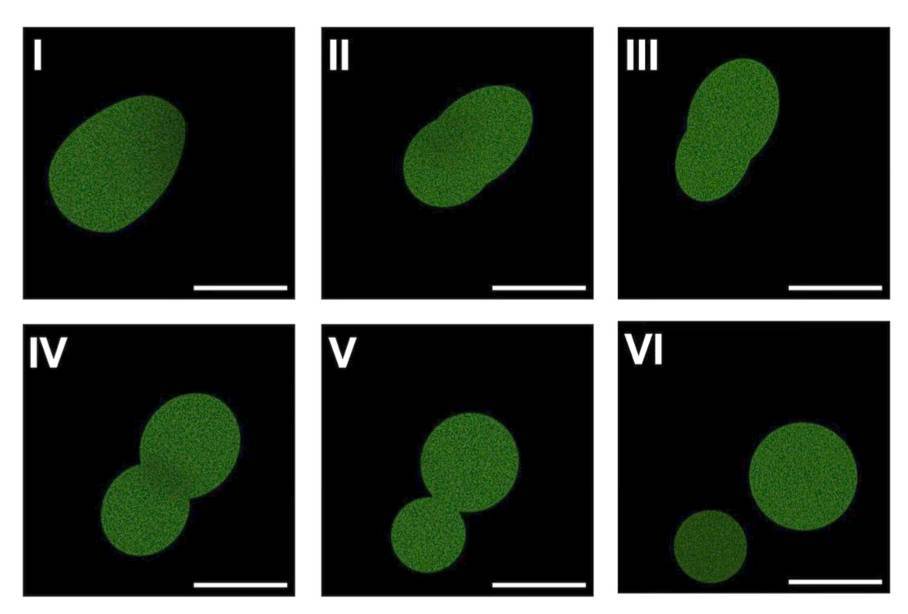
The preprint also discusses some of the major limitations of this system. It’s not going to compete with natural cells, and it will die out within a few generations if released. It needs to be fed specially prepared liposomes filled with nutrients that can spontaneously fuse with the cells, which is kind of cheating. But also…
• Building ribosomes from genetic instructions. SpudCell currently uses ribosomes from E. coli bacteria. Without the capability to remake ribosomes, SpudCell runs for 5-10 generations before the machinery degrades. Building ribosomes from scratch means synthesising dozens of proteins and RNA molecules, then getting them to assemble in the right order.
• Improving genome distribution. After five generations, about 30% of daughter cells have the complete set of seven DNA plasmids. Natural cells solve this with cytoskeletal machinery that pulls chromosomes apart during division. SpudCell does not have that yet, and better genome inheritance will need more sophisticated division mechanisms.
• Reducing dependence on external feeding. Nutrient-carrying liposomes have to be added regularly, and division requires streptavidin and molecular linker proteins from outside. Making the system more autonomous will require building metabolic pathways that can synthesize components from simpler starting materials.
It’s not sophisticated enough to assemble its own ribosomes, which is a major limitation. It’s going to need at least an order of magnitude more complexity to do that.
I’m more interested in the lack of a cytoskeleton. You’ve got 23 pairs of chromosomes in your cells, and the cytoskeletal machinery in mitosis works to guarantee that each daughter cell inherits the same 23 pairs; there are cells that don’t have that cytoskeleton, and they can do just fine with a single strand of circular DNA, but these SpudCells have at least 7 separate plasmids that have to be sorted. They rely on chance distribution of the plasmids to daughter cells, so they have to point out that after 5 generations 70% are nonviable.
What it’s good for is that it’s greatly reduced, bare-bones cell where every component is precisely known so you can track every molecule for at least a few generations. There are toy cells, but good educational toys.

Thanks for the interesting article, PZ.
But, will such cells survive the climate catastrophe fossil fuel fools are perpetrating on this planet better than humans?
I’m concerned.
From our vantage point in northern scarizona, if this weather trend truly becomes climate, within a few years this entire country (and planet?) will likely be burned to the ground and flooded.
Hmmm, Kata Adamala, who I knew but not well, was the first author of a PNAS paper that made some use of my work without crediting me in any way.
I’ve left her name mostly out of my complaint, focusing on the PI, Ed Boyden, as well as Sally Kornbluth and MIT’s willful negligence in ignoring and refusing to even engage with the evidence I presented.
I’m engaged with the NAS, NSF, and NIH, now, but I’ll be escalating over their heads by the end of the summer, I expect.
Anyway, just had to share. I don’t have any particular reason to doubt the science, but Kate and most anybody coming out of that lab is shady af, so any claim of any kind her lab makes ought to be taken with an extra grain or two of salt.
Well as some guy once said: “Your scientists were so preoccupied with whether they could that they didn’t stop to think if they should.”
I don’t know. I’m leery about H. sapiens wielding the “create designer life on demand” gun.
I don’t know her at all, so I can’t comment. The dog-eat-dog world of science isn’t what I like, either.
I think it’s great. Shows it’s no biggie, doesn’t need a deity to accomplish.
PZ, that’s a very interesting article. I wish, however, that they’d named it “Mr. Spudhead Cell”.
drsteve@2, I’m so sorry to hear about that.
From my long-ago acquaintance with MIT professors, I can say that most of them then were arrogant assholes, and that the admin was much, much, worse even than that.
So, I hope that those people are better now, and that your complaint goes well.
I’ve thought sometimes that there is an occupational hazard to being a professor or admin at Harvard or MIT, which is, your egos getting overblown with the idea that you are the most important, highest-status, people in the city and the kings of everything.
Because, Boston isn’t a large city, no world-famous Big Tech or Big Pharma headquarters or Big Billionaire Bros. Professors and admins can come to believe that they truly are the most important and powerful group in the city, like Yertle the Turtle declaring “I am the master of all I survey!”
Now, in NYC, for example, of course no professor or admin can delude themselves that they’re very important or have high status in the city at all. All they have to do is look at who’s living on the Upper East Side and who’s currently running Wall Street.
So, sorry about the MIT admins, perhaps they have succumbed to this disease.
So long as they aren’t grey, gooey, and don’t make paperclips.
@garnetstar Thanks, I appreciate it. That’s an interesting idea you have there and there may be something to it. I do think of MIT as having become effectively an outpost or satellite of Silicon Valley (and I assume the same is true of Harvard. It’ s certainly true of George Church, one of whose companies I worked for, for about month in SF).
But with the center of venture capital so far removed from the researchers whose work they’re monetizing, I can imagine the PIs are even more out of touch with reality regarding the value the money people actually see in them. That’s how Epstein was so easily able to manipulate Church, and also apparently Joi Ito, late of Boyden’s Media Lab base.’
My complaint will be making its way to six or eight offices of Senators and Reps presently—I’m aiming for the end of this month—after which point I’ll have to be satisfied that I’ve done my civic duty.