Everyone gets cancer, some forms are less worrisome than others

I visited a dermatologist last week for a routine yearly examination. This is a ritual debasement in which I have to strip down and a doctor scans every inch of my pasty flesh, looking for anomalies. Like she usually does, she scanned me and said I was boring, nothing exciting at all (this is the comment I always get from women.) Then she noticed something…

“What’s this circular brown spot on your abdomen?”

“Oh, it’s nothing — I got spattered by some hot liquid in the kitchen…”

“OK, nothing to worry about then,” as she turned to fill in some forms.

“…a couple of years ago.”

She perked right up at that. Something interesting at last! It hasn’t healed up at all well over the last few years, so something is going on there.

She quickly whipped out a hypodermic and numbed the skin, and then did a shave biopsy, which was not fun. It wasn’t particularly painful, but now I’ve got this small wound I have to wash and bandage every day, and it hurts. Nothing at all debilitating, more annoying than anything.

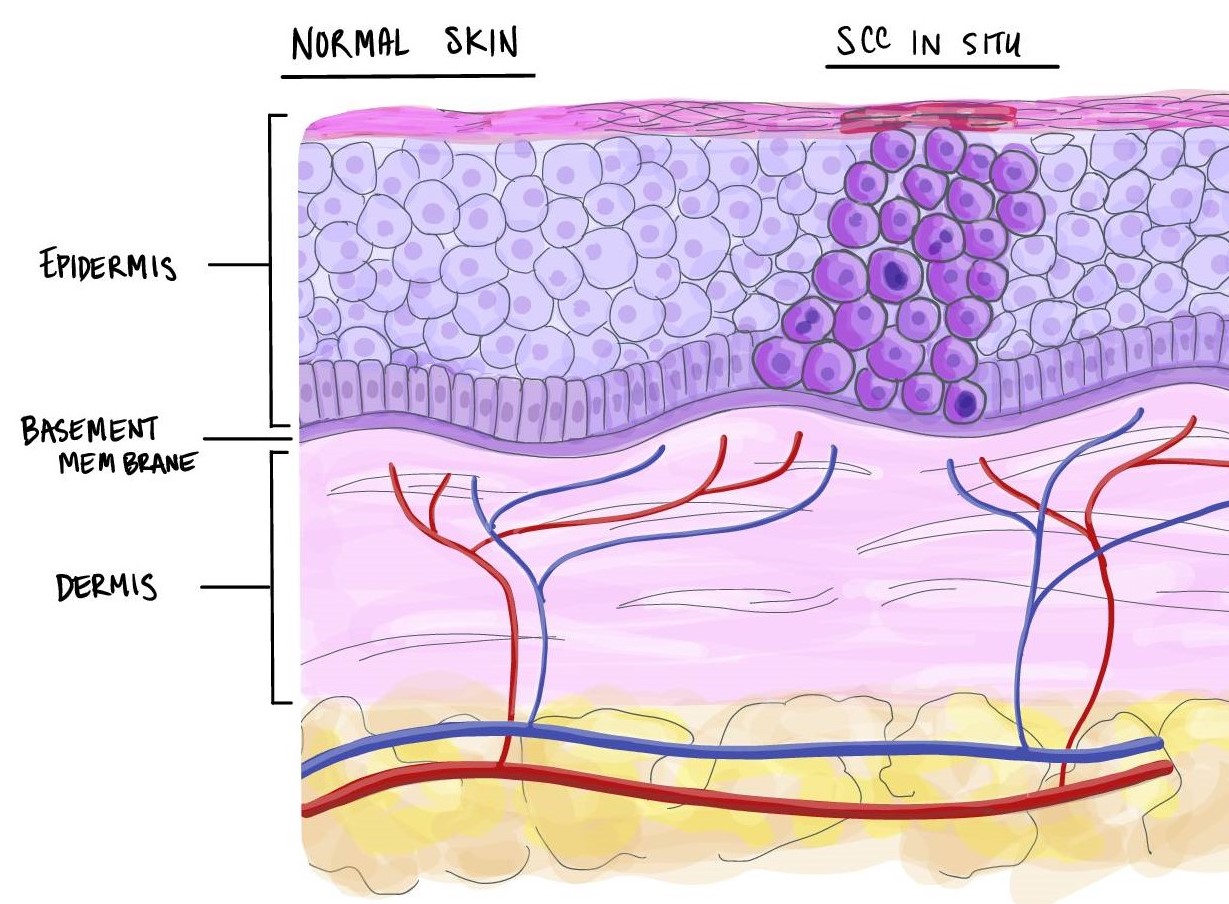
I got the results from the lab yesterday. It’s a benign squamous cell carcinoma in situ.

Gross Exam:
Received in 10% NBF is a shave biopsy that measures 6 x 5 mm. The specimen is divided into 2
sections. All of the tissue is submitted for processing.

Microscopic Exam:
There is hyperkeratosis and acanthosis, but no significant dysplastic changes within the
epidermis. The dermis contains a mild, nonspecific inflammatory cell infiltrate.

Fortunately, I have taught cancer biology for years, so I know all the lingo. There’s nothing to panic over.

To be on the safe side, though, I have been scheduled for in-patient surgery for mid-August, after the biopsy damage has healed. They’re going to scrape off a big patch of skin, about a centimeter across, to scour out all the nasty little cancerous cells. That’s the part I dread: if this little biopsy slice is hurting right now, that bigger extirpation is going to hurt even more.

Boy, this summer sucks.

The Temu State Fair

It’s the great American humiliation: Donald Trump wanted to put on an ambitious demonstration of America’s success over the past 250 years, but all he could do was put up some cheesy cardboard cutouts and hire some third-rate musicians (many of whom bailed out when they learned how they were being used), and now nobody is showing up. It was all a grift, where he undermined a sincere bipartisan effort to celebrate American history, and instead he substituted this phony demonstration and sucked $126 million out of the budget.

Donald Trump and his allies have seized control of the bipartisan 250th anniversary celebration and substituted it with a Trumpified series of events, at the public’s expense. Our analysis of federal contracts and corporate sponsorship deals related to the 250th anniversary reveals that:

  • The Trump administration has awarded nearly $103 million in federal contracts and grants for the 250th anniversary celebrations to a network of politicized entities under the control of Trump administration officials and political allies.
  • The recipients include entities controlled or influenced by Interior Secretary Doug Burgum, as well as Chris LaCivita (Trump’s former campaign manager) and Meredith O’Rourke, Trump’s former presidential campaign finance director.
  • These grants represent the vast majority (about 80%) of the nearly $126 million in federal contracts awarded since October 2025 to fund this summer’s 250th-anniversary celebrations, which have devolved into a celebration of Trump himself.
  • Private funding has also flooded the anniversary celebration, often from corporations with regulatory issues before the Trump administration. As of June 11, 20 corporate sponsors are funding the Trump administration’s preferred anniversary organization, Freedom 250, compared with the 62 sponsoring the original, bipartisan celebration, dubbed America 250 (12 companies sponsor both).

For example, take a closer look at Trump’s Arch, sitting in the middle of an empty grassy field. It looks cheap. It’s badly assembled. It’s fate after this affair is to be chopped up and burned in a landfill (foreshadowing the fate of our country.)

I’m confident that Trump initiated this abomination with the goal of being “classy”…but he has such poor taste and lacks focus and is so incompetent at the execution that all we get is this embarrassing shitshow to join the reflecting pool debacle, the defeat in an Iran war that shouldn’t have happened, and all the corruption surrounding this presidency.

Spiders evolved, get over it

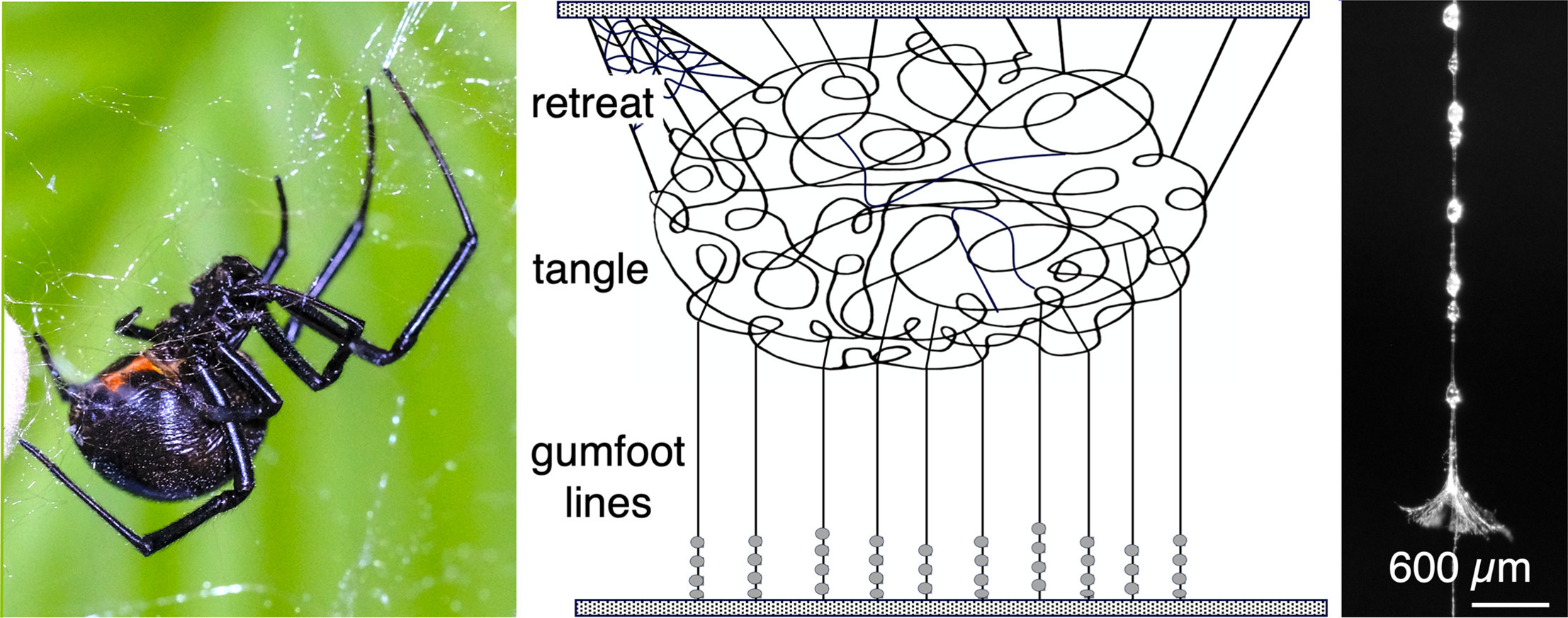
I study spiders in the family Theridiidae, which you’ve probably seen many times. Sometimes they’re called cupboard spiders, or cobweb spiders, or combfooted spiders after specialized limb structures they use to tease the silk they spin. They are also somewhat specialized to capture ground insects, making something called a gumfoot web, which is a sticky line under tension that is attached to the ground. Prey that contact the gumfoot line get snared, break the tension, and then get yanked up into the air. It’s a brilliant innovation.

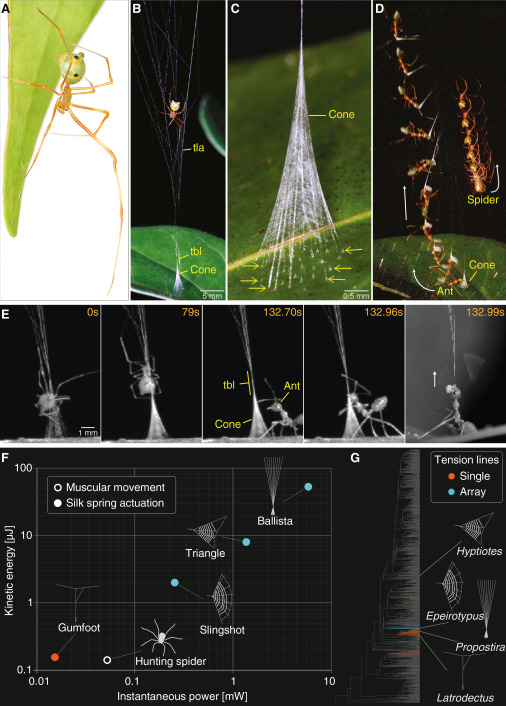
Some theridiidae have taken this to an extreme: Propostira, the ballista spider, has reinforced the gumfoot line to such a degree that it snaps prey up into it’s tangle web.

Propostira sp. (Theridiidae) was found on trees close to the foraging trails of O. smaragdina, a locally abundant, arboreal, highly aggressive and territorial species5. On trees occupied by these ants, the ballista spider took refuge during the day on the underside of leaves and ventured out from their refuge 30 minutes after sunset. Upon leaving its refuge, the spider began an exploratory phase during which it descended on a silk line to substrates up to 50 cm away. When it landed on a suitable substrate, it laid down an anchor point and returned to the core web by laying a tension line. Repetition of this process resulted in a fan shaped array of 15–60 tension lines that were bundled close to the substrate (Figure 1B and Video 1 at https://bit.ly/4cKtVGT) where the lines were laid out in a scaffold in the shape of a small cone. In the final phase, the cone scaffold was densely wrapped with a thinner type of silk . The spider then retreated to a position several centimeters above the cone. Very soon after the cone was wrapped (5–55 seconds; n = 12), O. smaragdina ants were attracted to it. Within milliseconds after probing the cone with its antennae, the ant displayed aggressive behavior, elevated its gaster, and bit the silk cone. The ant’s aggressive behavior is similar to that exhibited towards non-nestmates. The biting destabilized the cone and detached it from the substrate within 42.12 ± 16.09 ms (n = 5), leading to a rapid contraction of the tension lines. While still holding the cone with its mandibles, the ant was pulled off the substrate and propelled into the core web, reaching distances of up to 28.19 cm from the substrate (mean ± s.d. = 13.37 ± 8.57 cm, n = 5), with peak accelerations of 1367 m/s2 (mean ± s.d. = 1108.96 ± 166.14 m/s2; n = 5) and maximum velocities of 4.36 m/s (mean ± s.d. = 3.83 ± 0.68 m/s, n = 5, Video 3 at https://bit.ly/4cKtVGT). The spider moved only after the ant had been hauled up and was no longer in contact with the substrate. The spider then moved upwards on the web and waited until the ant was fully entangled before approaching to wrap it in silk. In one of 12 instances, the ant triggered the snare but was not hauled up; without the added mass of the ant, the snare accelerated at 4732.89 m/s2 and reached a maximal velocity of 13.47 m/s.

That’s amazing.

But you know what else is amazing? This is plainly an evolutionary adaptation, an extension of known, familiar behavior of related species that you don’t have to live in Sri Lanka or the Cape York peninsula to witness; black widows and false widows do the same thing, with less extraordinary power. But that power is a product of combining more strands to amplify the force. It’s analogous to an actual ballista, where multiple strands of fiber are twisted to make great tension that can propel boulders, rather than ants, great distances with great force.

It’s a real evolutionary success story, in that we can see a continuum of small variations that accumulate to produce this one remarkable innovation. The ballista spider is a product of its evolutionary history.

So why is Ken Ham trumpeting this story?

But spiders spinning intricate webs to snag other insects for dinner and ants blasting formic acid at their enemies brings up a question, “Why is God’s creation filled with creatures who look designed to kill or avoid being killed?” Genesis gives us the answer!

God graciously provided for his creation, giving them what they would need to survive and thrive in a world broken because of sin.
God’s original creation was “very good” (Genesis 1:31), and humans and animals were created to be vegetarian (Genesis 1:30), though it’s unclear if insects fall into the animal category. (See this article on nephesh life and whether insects were on the menu prior to the fall. Interestingly, there’s even a vegetarian spider in today’s fallen world!) But when Adam and Eve sinned, creation fell, and now all of creation groans from the effects of sin. Some animals now eat other animals, and everything tries to avoid being eaten, and even insects are now a source of pain, difficulty, and even death for humans. It’s not the way it was designed to be—slingshot spiders and aggressive ants remind us that it’s a fallen world. God graciously provided for his creation, giving animals and even insects what they would need to survive and thrive in a world broken because of sin.

Genesis gives us no answer. He claims his god arbitrarily conjured this spider ability in response to an ape eating fruit in his garden, which is no explanation at all, while biologists see this as a consequence of natural evolutionary processes that don’t require extraordinary magical events. Ham is simply stealing scientific explanations to paper over the superstitious nonsense he peddles.

Not my VBS

I never formally attended Vacation Bible School, but my house was across the street from the Lutheran church, so sometimes I was tempted. There were kids playing outside! They were playing a beanbag game! So I wandered over a few times, and I was encouraged by the sunday school to do so. Forgive me, for I sinned.

It was mostly harmless, I think — the theme was just to have fun while under the umbrella of the church. That’s all. I guess the church has gotten more aggressive nowadays.

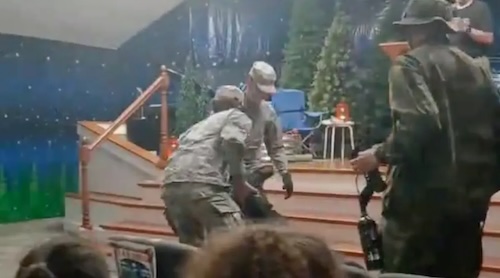
In a bizarre, disturbing scene that’s gone viral on TikTok, a church appeared to stage a fake execution of a man—involving realistic-looking guns and military uniforms—during Vacation Bible School. As the man is being murdered, the children are cheering in unison, “Take him out! Blow him up!” The military men then take the body outside (and out of view), where it’s suggested by the pastor they’re going to “blow him up.”

It’s disturbing that children were not only watching this scene, they were encouraged to cheer on the players machine-gunning the victim. Is this where a faith centered on the public execution of a disruptor of the status quo leads us?

The preacher at that church rationalizes the scene by saying that murdered man represented sin or satan, so it was OK to kill them. I’m sure Jesus would agree that children should be taught to kill sinners. They deserve death, after all.

I wonder if this church teaches that LGBTQ+ people are sinners?

Everything is the way it is because it got that way

My favorite quote/concept of all time is this one:

Everything is the way it is because it got that way.

D’Arcy Wentworth Thompson
(allegedly)

It affects everything I look at, and it’s the perfect sentiment for a developmental biologist/evolutionary biologist. It’s what I do for a living: see something, ask how it got that way (because that is the most important question), and try to track down the causal events that led to this outcome. It’s also the fundamental flaw in creationism, because they look at things and don’t care about the how or the process or the mechanism, it’s always explained by “god did it” with no interest in how their god did it.

But the quote always bugged me, too, because it’s not in On Growth and Form, Thompson’s awesome summary of his perspective. It’s a perfect expression of Thompson’s vision, so I continue to use it and think it, but it sure would be nice to know where it came from.

Fortunately, Glenn Branch tracked it down over a decade ago.

As far as I can tell, the line is actually due to Kenneth E. Boulding (1910–1993), whose obituary in The New York Times described him as “a much-honored but unorthodox economist, philosopher[,] and poet … renowned less for a single contribution to economics than for a large number of interesting intellectual and moral insights that both charmed and challenged his fellow social scientists.” In his 1953 “Toward a General Theory of Growth,” Boulding referred to “the D’Arcy Thomson [sic] principle … that at any moment the form of any object, organism, or organization is a result of its laws of growth up to that moment” (emphasis in original), citing On Growth and Form. (Boulding was a prolific writer, so there may be earlier statements of the principle that I missed.) By 1968, if not earlier, Boulding was using the familiar vernacular formulation, although he always credited the insight, if not the words, to Thompson.

It’s not hugely important — I’m not into hero-worship, although Thompson comes close to being a hero — but it’s nice to tidy up the record.

Muggy. Buggy.

I’ve always wanted to visit France, I guess I’m getting a taste of it today. I went for my morning walk — big mistake. It’s cloudy and gray, but temperatures are climbing into the mid-30°C range, and humidity is sky high. I walked into a coffeeshop with AC, and the windows were opaque sheets of condensation. The mosquitos realized I was loose in nature and attacked me in swarms on the way home.

Dinner tonight will be served cold: iced smoothies. That will be our reward for finally hooking up the window AC unit in our bedroom.

Tickled by a reference

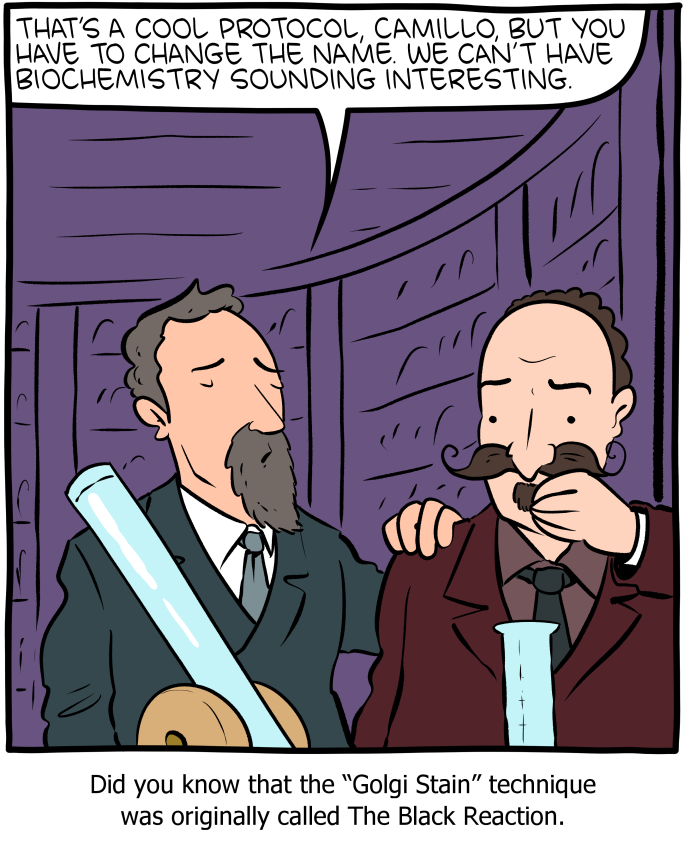
Cool. As a certifiable nerd, this semi-obscure (to most people) reference provokes a lot of memories.

I’ve used the Golgi staining technique. It’s a silver stain that precipitates black deposits in a subset of neurons, producing a sample of stained cells and allowing you to visualize neuronal architecture. It is a somewhat mysterious procedure — I was treating slabs of brain tissue in an arcane series of reactions over days to get the effect, and it was so exciting when my first prep actually worked. It produces these gorgeous black-on-red-gold images, and there was a time when I’d spend hours on a microscope measuring synaptic bouton density. It’s weird to see it in a joke, though. How many people will get it?

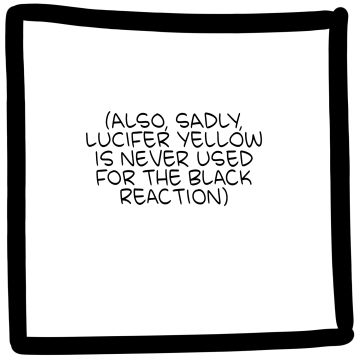
And then, Weinersmith brings up Lucifer Yellow in the red button panel:

I’ve also used Lucifer Yellow a lot! It’s a small fluorescent probe that glows very brightly, and I’ve injected it into many neurons to visualize their arbors and also assess connectivity — it diffuses freely through gap junctions.

Again, I have to ask who this joke for? Neurobiologists and histologists and historians who recognize this guy.

You’re never going to tap into that Garfield money at this rate, Zach.

Predators at work

Cruising around the garden, which is currently swarming with flies, we found a couple of happy arthropods chowing down on the bounty.

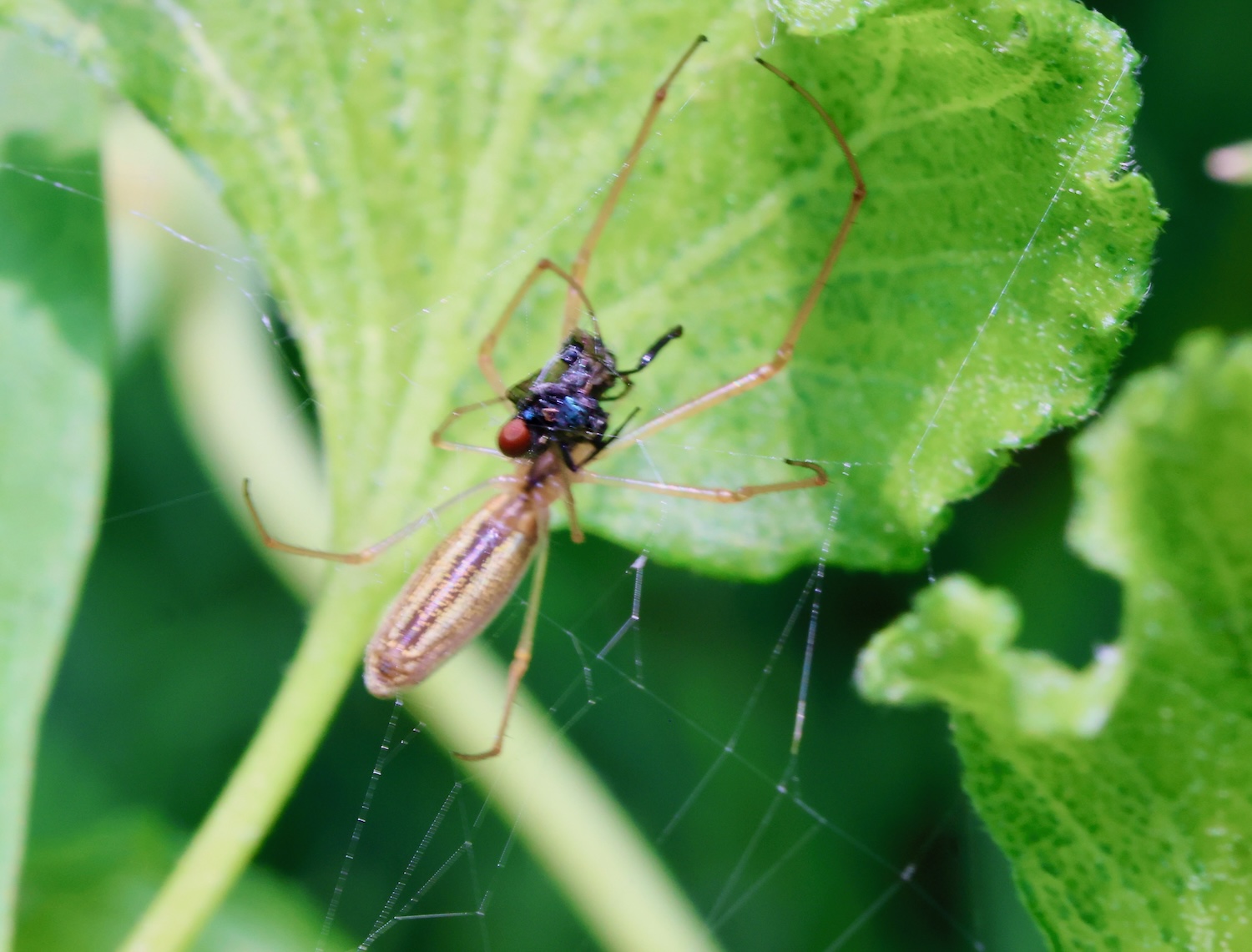
Here’s Tetragnatha with the mangled corpse of some kind of fly:

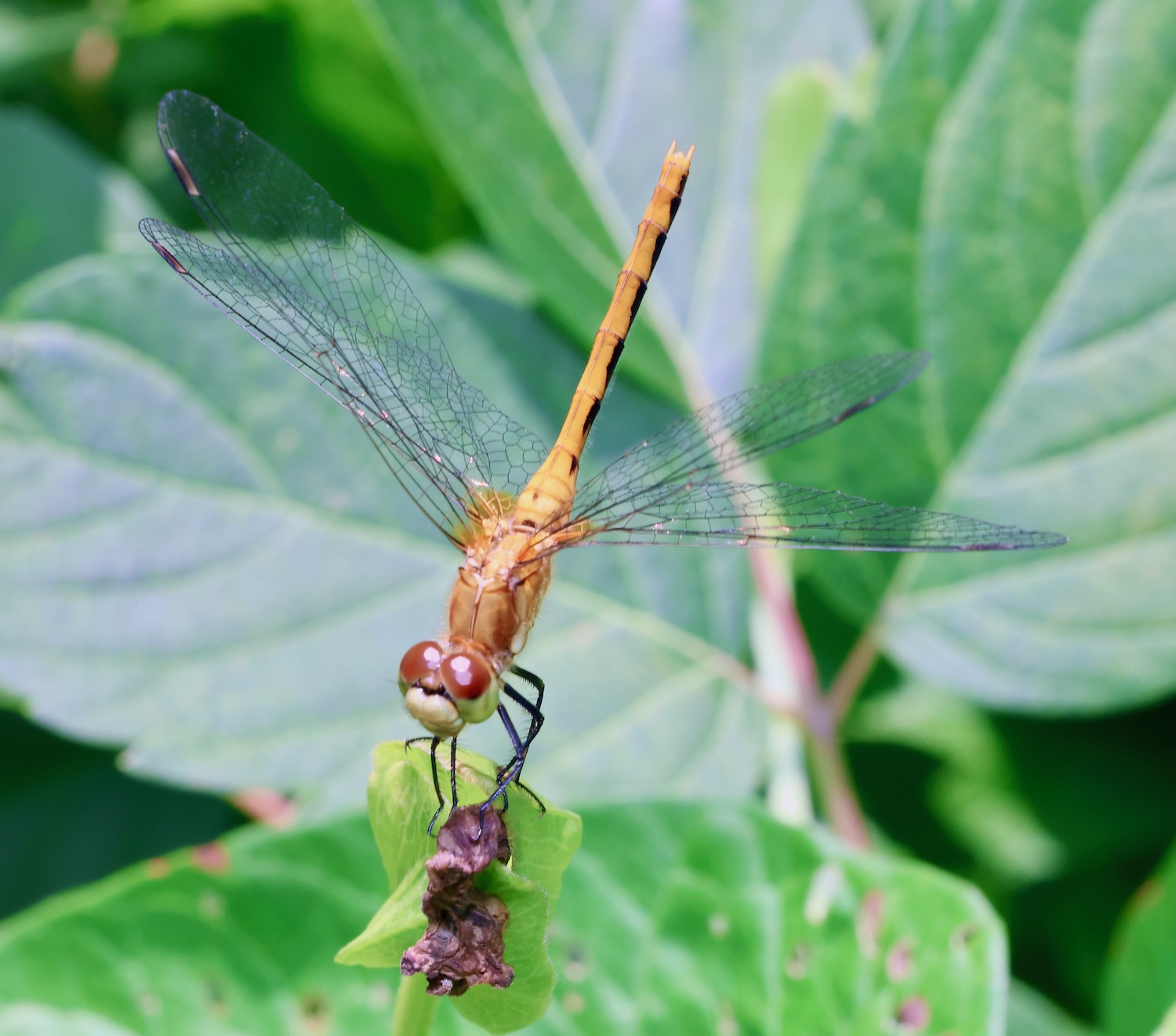
A meadowhawk was standing on some horrible, unrecognizable mass.

There are still plenty of flies available for feasting!