Mother of spiders!

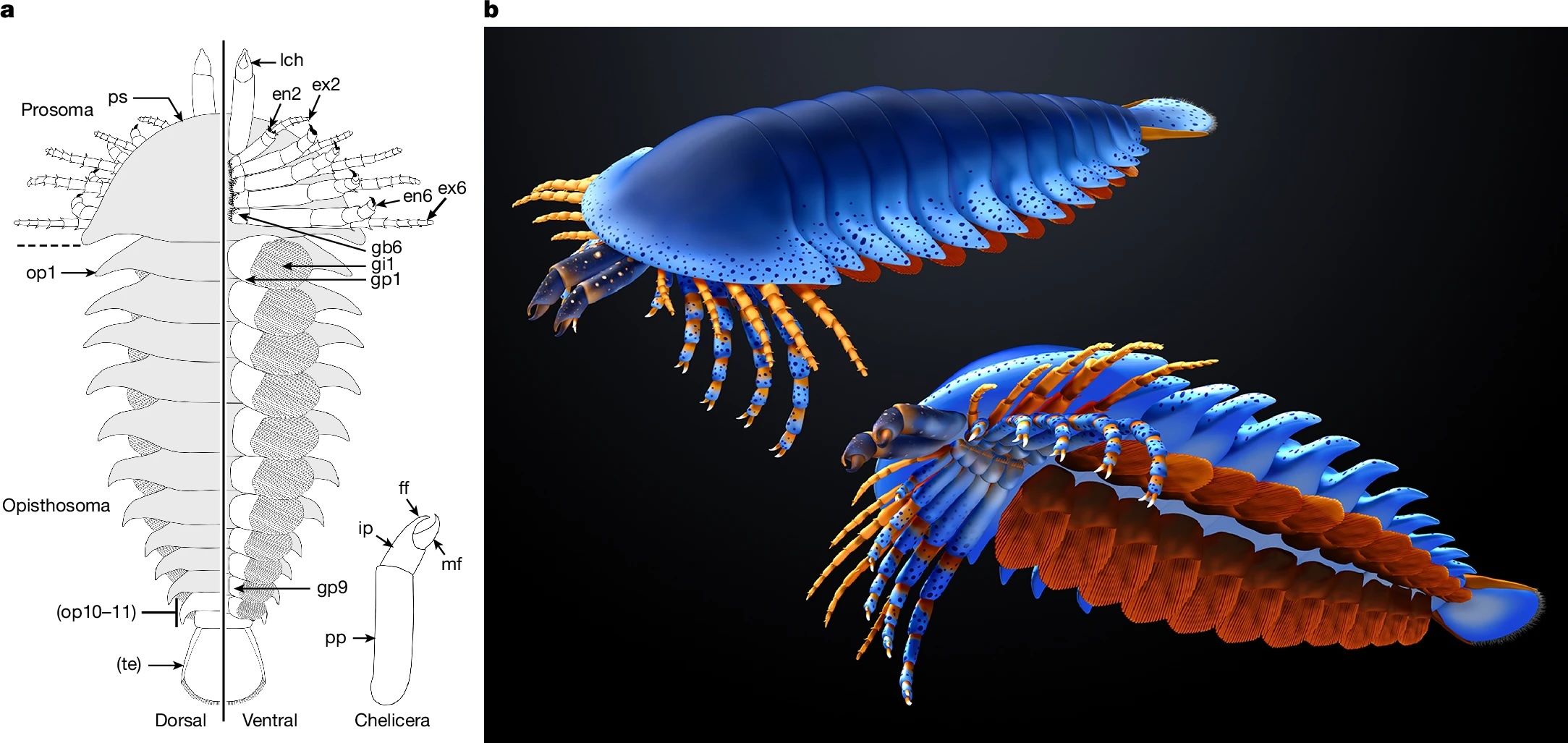
Show me a 500 million year old chelicerate, and I’ll be happy for a day. Look at this beauty, Megachelicerax cousteaui, excavated from a Utah fossil bed.

Anatomic reconstructions of the dorsal (left) and ventral (right) morphologies. b, Artistic reconstructions by M. Hattori illustrating oblique views of the dorsal (top) and ventral (bottom) morphologies. The sanctacaridid-like morphology of the posteriormost body region is speculative. gi, gill (that is, a set of gill lamellae); te, telson.

Pretty cool, right? The best part of it is that pair of appendages at the very front of the animal — those are chelicerae, the biting/chomping/chewing/venom-injecting bits of a modern spider, that make them distinct from insects, which only have antennae at that end. That makes this the oldest known chelicerate ever discovered. It was a swimming marine animal, and doesn’t have the legs we associate with spiders — chelicerae evolved first, legs much later.

Also, this isn’t just the mother of spiders, but is also the mother of a huge family of cousins: horseshoe crabs, eurypterids, as well as spiders.

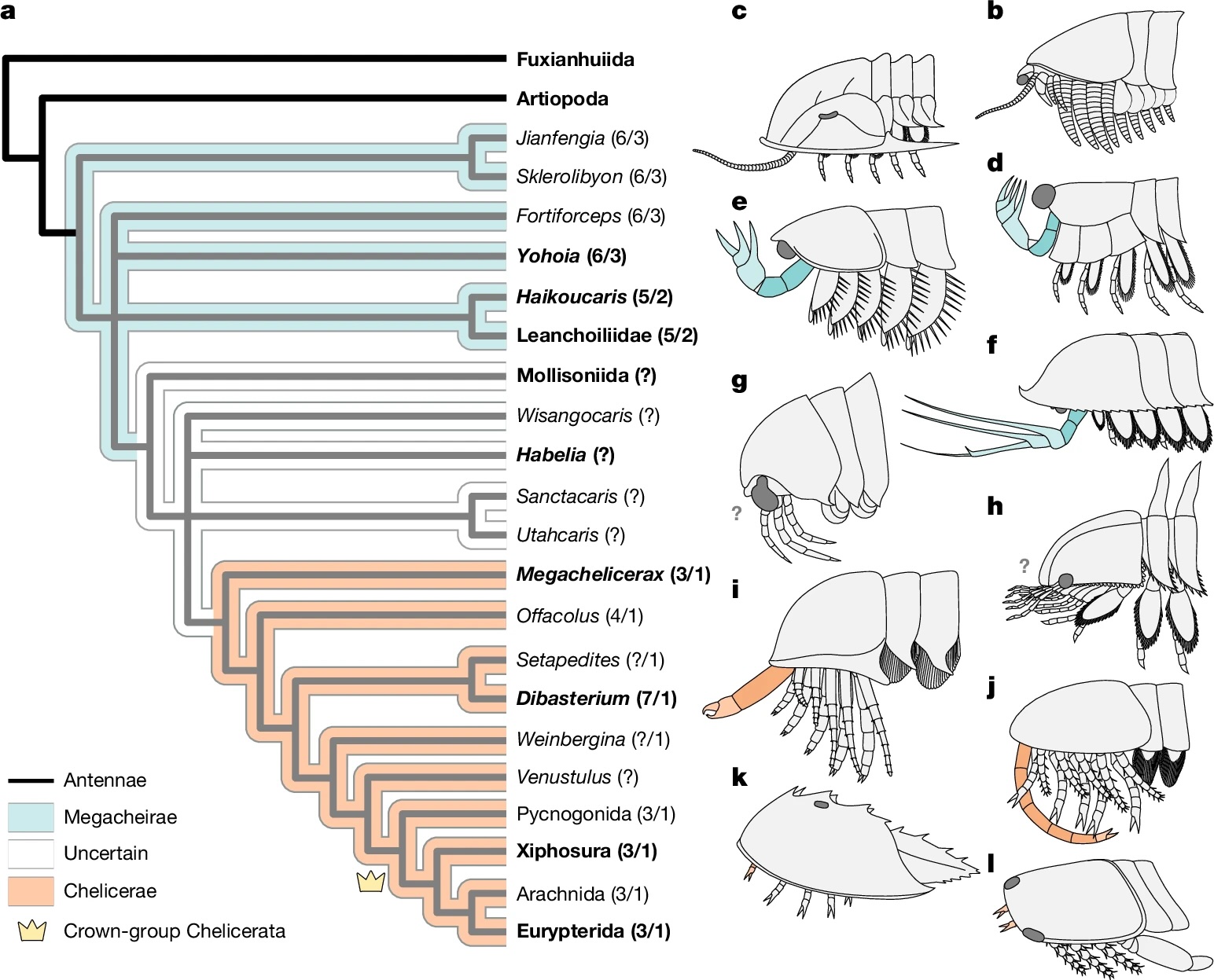
Megachelicerax documents the oldest stratigraphic occurrence of chelicerae (that is, uniramous, unichelate deutocerebral appendages) and bridges the simple body and limb organization of Cambrian megacheirans with the more derived anatomy of post-Cambrian synziphosurines and crown-group chelicerates. a, Simplified consensus topology based on Bayesian analysis (Mk model, 4 chains, 5,000,000 generations, 1/1,000 sampling resulting in 5,000 samples with 25% burn-in resulting in 3,750 samples retained); detailed results and comparison with parsimony provided in Extended Data Fig. 6. The numbers in parentheses correspond to the total number of podomeres and the number of chelae, respectively, present in the deutocerebral appendage. Taxa whose names are in bold font are illustrated in b–l. b–l, The morphology of the anterior body region in select taxa. b, Fuxianhuiid Chengjiangocaris kunmingensis (Cambrian, Stage 3). c, Artiopod Olenoides serratus (Cambrian, Wuliuan). d, Megacheiran Yohoia tenuis (Cambrian, Wuliuan). e, Megacheiran Haikoucaris ercaensis (Cambrian, Stage 3). f, Megacheiran Leanchoilia superlata (Cambrian, Wuliuan). g, Mollisoniid M. plenovenatrix (Cambrian, Wuliuan). h, Habeliid Habelia optata (Cambrian, Wuliuan). i, M. cousteaui (Cambrian, Drumian). j, Synziphosurine Dibasterium durgae (Silurian, Wenlock). k, Xiphosurid Limulus polyphemus (recent). l, Eurypterid Slimonia acuminata (Silurian, Llandovery–Wenlock).

That is one wildly successful tree. It just goes to show that you can go on to do great things even if your face looks like a nest of spiky clawed jointed tentacles.


Rudy Lerosey-Aubril, Javier Ortega-Hernández. A chelicera-bearing arthropod reveals the Cambrian origin of chelicerates. Nature, 2026; DOI: 10.1038/s41586-026-10284-2

Life from space? I have questions

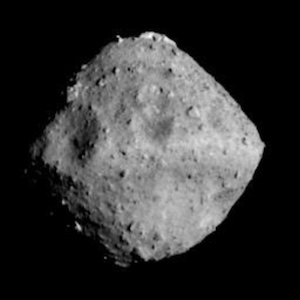
Samples have been analyzed from two carbonaceous chondrites in space, Ryugu and Bennu, and they’ve been found to contain common organic molecules, specifically, the building blocks of DNA. That’s cool, not particularly surprising, and it’s good stuff to know…but then we get all these pop science articles speculating that life came from space. No, no, no — it tells us that these organic molecules are universal, that they can be assembled by all kinds of physical/chemical processes, and that nucleotides (for instance) do not require synthesis by living organisms. Chemistry is everywhere, but biology isn’t. Unfortunately, these kinds of observations always provoke people to babble about life, or at least the ingredients for life, falling from space. I don’t buy it.

Scientists have discovered all five nucleobases—the fundamental components of DNA and RNA—in pristine samples from the asteroid Ryugu, according to a study published on Monday in Nature Astronomy. The finding strengthens the case that the ingredients for life are abundant in the solar system and may have found their way to Earth from space, according to a study published on Monday in Nature Astronomy.

OK, yes, it’s quite likely that some organic molecules fell to Earth from outer space. But please, think a little bit quantitatively. There are clouds of organic molecules in space, but they are incredibly diffuse and poorly concentrated. There are asteroids that are made of condensed lumps of carbon with richer concentrations of these molecules, but they are drifting in the vast empty volumes of space, and only occasionally falling to Earth, adding droplets of nucleotides to the Earth’s oceans.

Meanwhile, the Earth itself is a gigantic crucible containing 1,386,000,000 cubic kilometers of water, with a complex pattern of heating and cooling, and immeasurable interactions with minerals and other organic molecules. It is a far weightier contributor to biochemistry than a thin, almost undetectable, vapor of scattered molecules in space. But these stories always get excited about the thin vapor rather than the fact that Earth itself is a rich churning cauldron of geochemistry that is going to be far more responsible for the wealth of biologically relevant chemistry we find ourselves swimming in.

This is not to discount how interesting these asteroid analyses are. They’re telling us that natural, unguided mechanisms can produce the biomolecules that make up life. The asteroids, though, are not likely to be where they originated here, on planet Earth, which is already a great place for building them.

The article says something else that irritated me.

Now, following the discovery of all five nucleobases in the Bennu pebbles, Koga and his colleagues have found the complete set in Ryugu. The findings lend weight to the so-called “RNA world” model of abiogenesis. In this hypothesis, early life on Earth depended solely on RNA as a self-replicating molecule, laying the biological groundwork for later, more complicated systems that involved DNA and protein-based organisms. The extraterrestrial samples from Ryugu and Bennu provide evidence that at least some of the nucleobases that made up these early lifeforms came from outer space.

No, this observation says nothing relevant to the RNA World hypothesis. It neither confirms nor refutes it. Nucleobases exist, we’ve known that for a long, long time, but I don’t believe that the earliest life on Earth depended solely on RNA, and finding nucleobases in a lifeless rock is not evidence that life was solely spawned from those few components. Were there no other molecules in them? No sugars, no amino acids, no polycyclic aromatic hydrocarbons, no carboxylic acids? There are a great many complex organic molecules found bubbling in the soup of our oceans, aren’t they a more likely source of life than a dead lump that’s been floating in space for billions of years?

Sorry. It’s a good bit of science, but I get cranky when I read these ill-informed unwarranted speculations that ignore more substantial science.

Why do creationists shy away from gene duplication?

A new review article on Evolutionary causes and consequences of gene duplication has dropped. It’s nothing novel to well-informed biologists, but it’s another nail in the coffin of creationism. Not that they will care; we’ve been explaining that common genetic mechanisms can routinely increase the information content of the genome, and that we can witness how new genes with new functions arise, and it never sinks in.

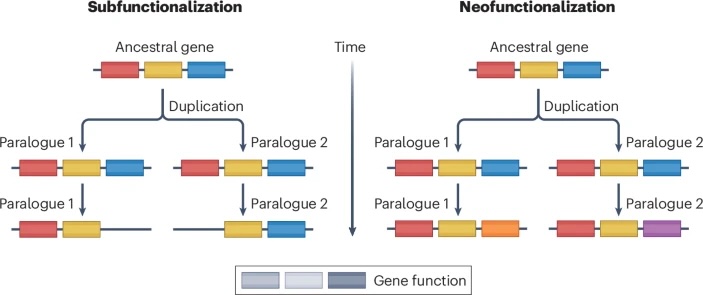
Gene duplication is the primary mechanism by which new genes emerge. Models and empirical studies have shown that paralogous genes are maintained because of dosage benefits, the partitioning of ancestral functions or the acquisition of new functions. However, the underlying molecular mechanisms and the relative importance of the factors driving evolution towards one fate or another have remained difficult to quantify. Recent advances in experimental and computational methods, such as gene editing, deep mutational scanning and ancestral sequence reconstruction, have enabled molecular analyses of duplicated gene evolution across timescales. Combined, these approaches are revealing how adaptive and non-adaptive evolutionary forces shape the modern fates of gene duplicates.

I imagine some might leap on the phrase “remained difficult to quantify,” but that’s the point of the paper: new techniques have been developed that allow us to quantify those details. The review specifically brings up multiple examples.

Divergence in interaction specificity following duplication has profound consequences on cell biology. For instance, the neofunctionalization of steroid receptors, a family of hormone-activated transcription factors with roles in development and stress responses, evolved following multiple rounds of WGD[whole genome duplication] in vertebrates. Although one paralogue maintained its ancestral interactions, the other acquired mutations, conferring on it the capacity to bind different hormones and DNA motifs. Studies of transcription factors in plants, yeast and other organisms have identified many paralogues that diverged in their specificity for transcription factor binding sites and distal regulatory elements. Such divergence in interaction specificity has enabled multiple species to acquire novel regulatory modules over time.

The conclusion discusses some of those mechanisms.

Evolutionary biologists have long been interested in the fate of duplicated genes. Long-standing questions include which factors promote the fixation or long-term retention of duplicates, and their divergence in terms of sequence, expression, interactions and function. Multiple emerging technologies have enabled directly testing how adaptive and non-adaptive forces drive the evolution of paralogues. For example, fitness functions derived by tuning expression level with synthetic biology tools have enabled testing whether increases in protein abundance due to duplications are beneficial or not. Deep mutational scanning and comparisons between extant and reconstructed pre-duplication ancestral sequences facilitate the identification of mutations that alter a particular function. In particular, comparisons between different paralogues have shown that the fixation of function-altering mutations is often contingent on the presence of other mutations that originally had no effect on fitness. Similarly, other paralogues can become dependent on each other if their heteromers become the only functional unit. Therefore, multiple sources of evidence highlight the role of non-adaptive processes in the evolution of duplicated genes.

Continuing to combine and develop new methodologies will help to address open questions about the fates of paralogues. Although the likelihood of functional divergence between paralogues increases with the age of the duplication, the time required to reach functional divergence might vary depending on the pair of paralogues. In fact, multiple underlying factors may contribute to variation in the rate of functional divergence, such as the type of function performed by the paralogues. In turn, progressive changes in functions such as catalysis and binding specificity are likely to modify the fitness functions of the paralogues, allowing natural selection to distinguish between them. Ultimately, assaying such subtle and progressive mutational effects on gene function will help to better trace the evolutionary history of paralogues and the forces that shaped them.

It’s a nice summary of the problems and potentials for studying evolutionary gene duplications. I’m adding it to my list of papers to study in greater depth.

Creationists will pretend it doesn’t exist.

Angel F. Cisneros, Soham Dibyachintan, Frédéric Bédard, Simon Aubé, Pascale Lemieux & Christian R. Landry (2026) Evolutionary causes and consequences of gene duplication. Nature Reviews Genetics https://doi.org/10.1038/s41576-026-00935-5.

Phenotypic plasticity is part of evolution, too

This is a cool short video that will annoy phrenologists and “race realists”. Analysis of a 12,000+ year old skeleton of a young native American woman, now named Naia, who fell into a cenote and died were initially interpreted to imply evidence of multiple migrations into the Americas — the morphologically distinct shape of her skull was used to suggest that she was not ancestral to modern American Indians, but belonged to a separate branch of the family tree.

I’ve heard similar arguments about Kennewick Man, the 8,000+ year old skeleton found in Washington state. His remains looked “caucusoid,” therefore could not be Native American, and therefore laws that protected native remains did not apply. DNA showed otherwise. It turns out that “looks like” is a poor criterion for assigning genetic relatedness.

Same with Naia. DNA testing showed that she really was related to modern South American natives.

Why was her skull so different from the people she was genetically related to? Scientists once thought that distinctive skull shapes were rigid markers of separate ancestries, implying that robust ancient populations in America, and even Australia and Europe, must be genetically distinct from the populations that came later. But Naia proved that the two population theory was wrong. The dramatic differences in skull shape were not due to different blood lines, but to rapid evolutionary adaptation. Scientists now realize that skull shape is highly plastic and changes based on what we do.

I hope that there is a growing appreciation of the concept of phenotypic plasticity — we are products of both our genes and our environment.

Wanna see a beautiful fossil?

I know that a pile of bones of Tyrannosaurus or Triceratops gets all the attention and popular press, but what gives me a thrill is seeing a well-preserved Cambrian invertebrate, especially if it represents an early developmental stage. Here’s a real beauty, the phosphatized larva of Youti yuanshi, from Yunnan, China.

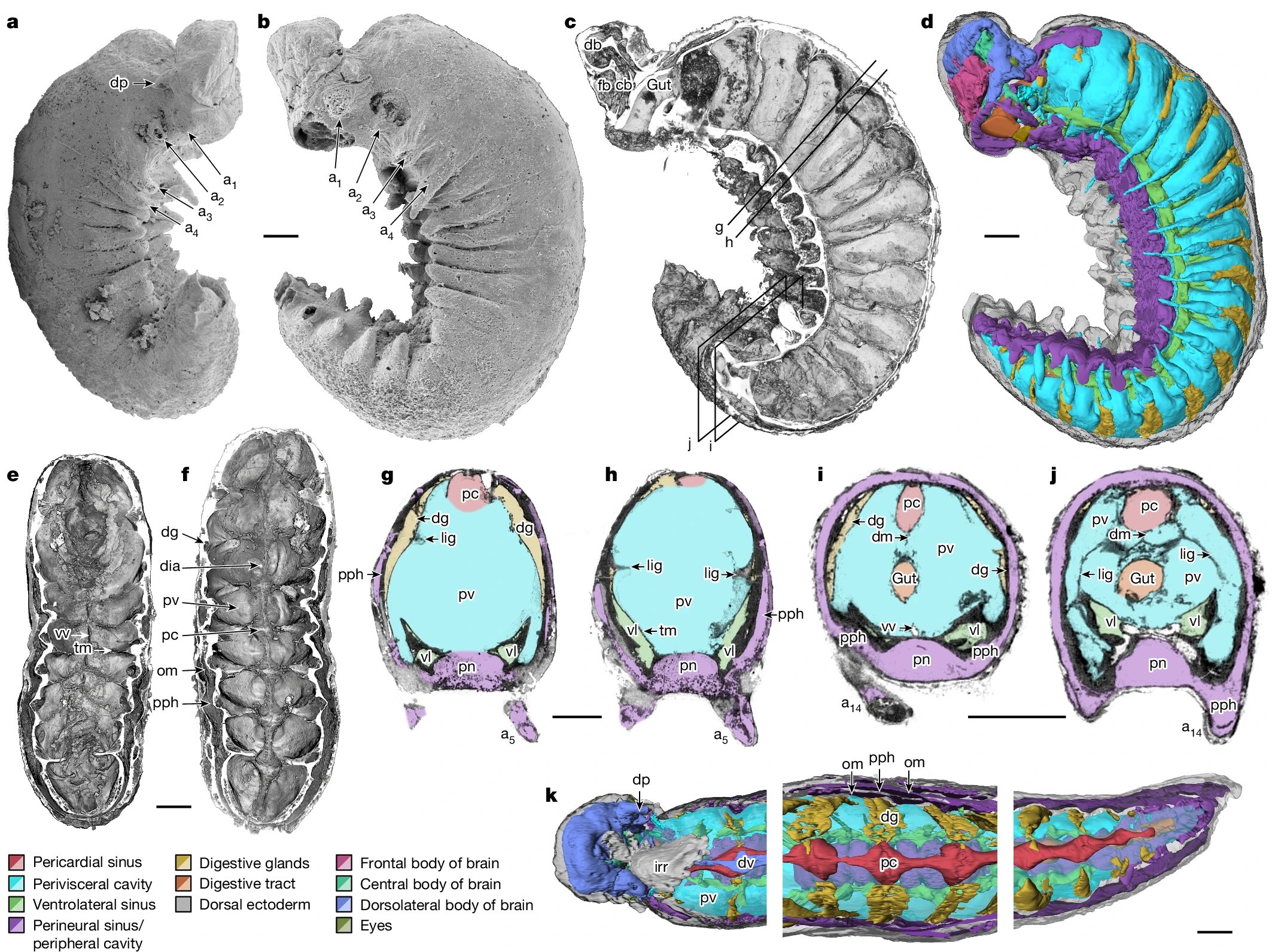
YKLP 12387. a, External scanning electron microscopy, right side. Damage to posterior epidermis exposes lining of perivisceral cavity, demonstrating blind gut. b, External scanning electron microscopy, left side. c,g–j, Median virtual dissection from X-ray computed tomography (XCT) data (c), showing location of transverse slices intersecting digestive glands (g,i) and transverse membrane (h,j). d, Semi-manual segmentation of internal chambers from XCT data, viewed from the left side. Dorsolateral aspects of the peripheral cavity are omitted for clarity. e,f, Virtual dissection parallel to coronal plane, looking ventrally (e) and dorsally (f), showing digestive glands, pericardial sinus, transverse membranes within perivisceral cavity, and oblique membranes within peripheral cavity. g–j, XCT sections at positions indicated in c at position of digestive glands (g,i) and at position of ventrolateral lacunae and transverse membrane (h,j). g,h, Sections close to the anterior trunk, reflecting segments at late developmental stage. i,j, Sections close to the posterior trunk, showing superior preservation of internal tissue. k, Segmentation of internal chambers from XCT data, viewed from the dorsal perspective at anterior, middle and posterior trunk. Aspects of peripheral cavity are omitted for clarity. a, appendage; cb, central body of brain; db, dorsolateral body of brain; dia, diagenetic grain; dg, digestive gland; dm, dorsal membrane; dp, dorsal projection; dv, dorsal vessel; fb, frontal body of brain; irr, irregular chamber; lig, ligament; om, oblique membrane; pc, pericardial sinus; pph, peripheral cavity; pn, perineural sinus; pv, perivisceral cavity; tm, transverse membrane; vl, ventrolateral sinus; vv, ventral vessel. Scale bars, 200 μm.

Superficially, it looks like a grub you might dig up in your garden, but this was found in marine sediments and was less than 4mm long, so you’d be unlikely to find anything like it today. It’s from a paper titled Organ systems of a Cambrian euarthropod larva by Martin R. Smith, Emma J. Long, Alavya Dhungana, Katherine J. Dobson, Jie Yang & Xiguang Zhang. The specimen is so well preserved that it can be studied at the level of organs and organ systems.

The Cambrian radiation of euarthropods can be attributed to an adaptable body plan. Sophisticated brains and specialized feeding appendages, which are elaborations of serially repeated organ systems and jointed appendages, underpin the dominance of Euarthropoda in a broad suite of ecological settings. The origin of the euarthropod body plan from a grade of vermiform taxa with hydrostatic lobopodous appendages (‘lobopodian worms’) is founded on data from Burgess Shale-type fossils. However, the compaction associated with such preservation obscures internal anatomy. Phosphatized microfossils provide a complementary three-dimensional perspective on early crown group euarthropods, but few lobopodians. Here we describe the internal and external anatomy of a three-dimensionally preserved euarthropod larva with lobopods, midgut glands and a sophisticated head. The architecture of the nervous system informs the early configuration of the euarthropod brain and its associated appendages and sensory organs, clarifying homologies across Panarthropoda. The deep evolutionary position of Youti yuanshi gen. et sp. nov. informs the sequence of character acquisition during arthropod evolution, demonstrating a deep origin of sophisticated haemolymph circulatory systems, and illuminating the internal anatomical changes that propelled the rise and diversification of this enduringly successful group.

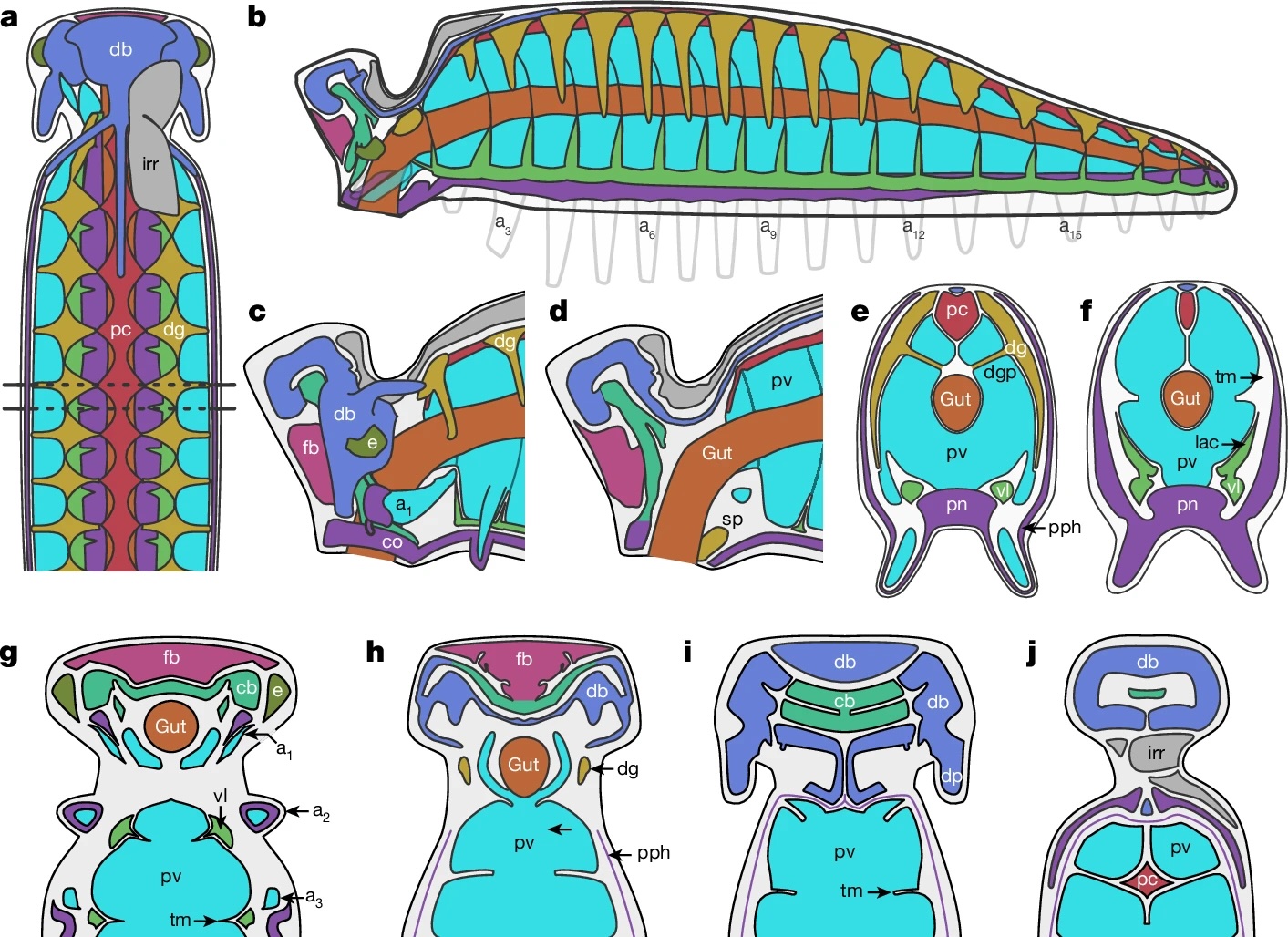
Here’s a helpful diagram to help sort out what’s going on inside the worm.

a, Organ system disposition in sagittal view. Dotted lines denote location of sections shown in e,f. b, Organ system disposition in transverse view. c,d, Head, from lateral perspective (c) and as medial transverse section (d). e,f, Transverse sections through trunk at location of digestive glands (e) and transverse membranes (f). g–j, Coronal sections through head, from ventral (g) to dorsal (j) planes. Colour scheme as in Fig. 1.

Most interesting is the comparative analysis with other Cambrian organisms, especially with regards to the organization of the nervous system.

Phylogenetic analysis situates Youti yuanshi within the AOPK clade containing Anomalocaris, Opabinia, Pambdelurion and Kerygmachela. Under our preferred model, the circumoral brain ring of cycloneuralians corresponds to the panarthropod prosocerebrum, which innervates the first appendage pair (onychophoran antennae, tardigrade stylets or euarthropod labrum). We interpret the archicerebrum as a distinct development dorsal to the prosocerebrum, associated with sensory receptors: specifically the eyes, and the dorsal projections (Kerygmachela rostral spines, tardigrade cirri, crustacean frontal filaments or anterior paired projections of stem euarthropods; homology with the anteriormost onychophoran lip papillae is plausible, but may not be parsimonious). The taxa depicted in this figure are selected in order to depict the evolutionary context of Youti; the relationships shown are recovered under all analytical conditions.

Over half a billion years ago, the oceans were filled with diverse wormlike animals that were exploring different arrangements of their squishy bits — it was a complex ecology and every individual discovered should fill us with awe. Each of these forms has a deeper history that we need more fossils to decipher.

De novo genes in the news

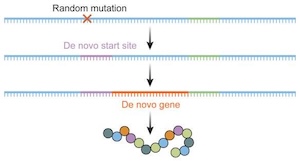
I recently posted — and made a video about — a story about how de novo genes are made. I guess I was more timely than I expected, because The Scientist just posted on article on the same topic. It’s specifically about the work of Li Zhao, who is interested in the birth of new genes with novel functions, and is building on some other work done at UC Davis.

But around the same time Zhao began her research, new evidence challenged this longstanding view [that new genes don’t appear very often] with an alternative path. Population geneticist David Begun at the University of California, Davis (UC Davis) identified several de novo genes—genes originating from scratch, or non-coding DNA—in Drosophila melanogaster, the common fruit fly. Of the five genes, four occurred on the X chromosome and predominantly expressed in the testes, possibly under sexual selection pressures.

One other thing I should mention: my previous article focused on de novo genes in humans, who are terrible experimental subjects. Li Zhao is working on Drosophila, and there’s a reason flies are a premier model system for this kind of work — you can get multiple generations fast, you can do all kinds of genetic manipulations on them, and you can compare different lineages to evaluate the effects of the presence or absence of a specific gene. Or hundreds of genes, as she is finding.

By characterizing the transcriptomes of six previously sequenced D. melanogaster strains in the testes, Zhao and her colleagues uncovered potential de novo candidates. Of these, they identified 142 polymorphic (which segregated and evolved under selection) and 106 fixed (which remained consistent since the split from a common ancestor) de novo genes. Most of these candidates were regulated by cis elements, with expression driven by regulatory sequences just upstream of the new transcripts. The vast majority contained open reading frames (ORFs)—sections that could potentially produce proteins, marked by start and stop codons—of at least 150 base pairs. When comparing these sequences to ancestral genomes and non-expressing Drosophila strains, the same ORFs appeared, suggesting that the gene expression was driven primarily by regulatory changes.

Zhao and her colleagues proposed that these de novo genes may have undergone natural selection, as highly expressed genes were generally longer and more complex than those expressed at lower levels. However, whether these sequences were translated into proteins or served other functions remained unclear at the time. “Biology is more complex than what we imagine,” said Zhao.

Cool. But I’m going to don my skeptical hat, and suggest that I’m not seeing evidence that these novel genes are significant. The mechanisms for generating them are so easy that we shouldn’t be surprised that new genes are bubbling up out of the mostly chaotic junk in the genome, but when you don’t know what role those genes are playing in the organism, it’s a reach to suggest that they are important. I’m also unconvinced by observations of tissue-specific regulation during development — it’s also not difficult for regulatory sequences to be attached to a gene. Is it significant that so many of these novel genes are expressed in the testes? Male patters of gene expression in the gonads is a special case, and spurious expression could persist there because it has specific effects on sperm maturation that aren’t reflected in adult survival.

It’s still interesting stuff. I like the idea that entirely new genes trickle into populations and could contribute to variation in surprising ways.

How to make a seahorse

Seahorses are weird animals. They depart from the typical streamlined torpedo shape of your average fish to construct this unusual twisted shape with dermal armor, toothless jaws, and a dependence on fins for propulsion — they’re just weirdos all around. How did they get to be this way?

One suggestion is that it is an extreme example of paedomorphosis, as presented in this paper: An embryonic arrest shapes the Syngnathid body plan: Insights from Seahorses, Pipefishes, and their Relatives.

The Syngnathidae (seahorses, seadragons, pipefish, pipehorses) exhibit a remarkable, enigmatic body plan, challenging conventional explanations for their fused jaws, toothlessness, cartilaginous skeleton, fin loss, male pregnancy, and their distinctive morphology, which includes the acute head-trunk angle of seahorses and the family’s unique curling, often prehensile, tail. We propose a unifying, parsimonious hypothesis, termed “pharyngulation,” that the entire lineage originated from a profound paedomorphic arrest (retention of juvenile traits) during a specific embryonic pharyngula stage. This arrest, likely driven by ancestral Hox gene cluster disintegration, fundamentally halted morphological progression in a common teleost ancestor. This single event explains their entire suite of primary characteristics–including universal low body mass and volume and unique A-P locomotion. It also establishes a framework to differentiate these foundational family-defining traits from ancestral features shared with the broader Syngnathiformes order (such as the elongated snout, as exemplified by Trumpetfish) and from later adaptive refinements, such as the leaf-like appendages in seadragons. Our “pharyngulation” hypothesis offers a novel, testable model for macroevolutionary innovation, demonstrating how a singular, profound alteration to a conserved developmental program can rapidly forge a new, viable body plan. This concept, synthesizing evidence from genomics, the fossil record, and developmental biology, is of broad interest to evolutionary biologists and developmental biologists alike.

Unfortunately, this paper only presents a hypothesis — no methods, no experiments, no substantial comparative data. I’ll forgive that since it does introduce the term “pharyngulation” into the scientific literature.

I was provoked to dig a little deeper, and found this paper: A comparative analysis of the ontogeny of syngnathids (pipefishes and seahorses) reveals how heterochrony contributed to their diversification. It supports some of the ideas of the first paper — heterochrony is right there in the title — and also includes some beautiful photos of syngnathid embryos.

Segmentation and early organogenesis development in examined syngnathids. Nerophis ophidion (A-F), Syngnathus typhle (G-K), and Hippocampus erectus (L-Q), respectively. In this period, species-specific characteristics develop more clearly. Arrowheads: blue = hind brain vesicle, green = pigmentation, rufous = mandibular arch, orange = dorsal fin condensations, white = hypertrophic hindgut, black = fin fold. Scale is 500 μm; dpm = days post mating

That’s a stage close to what we’d call the pharyngula stage (which doesn’t have a single discrete marker), and they look familiar — they look like longer, skinnier, more slowly developing zebrafish embryos, where the 19 day syngnathid looks like a 19 hour zebrafish. We have to wait a week or more to see an embryo that is comparable to, but very different from, a 24-48 hour old zebrafish embryo.

Organogenesis to release development in examined syngnathids. Nerophis ophidion (A-D), Syngnathus typhle (E-I), and Hippocampus erectus (J-O), respectively. The last prerelease period is characterized by snout elongation, continued pigmentation and the conclusion of allometric fin outgrowth. Arrowheads: black = fin fold. Scale is 500 μm; dpm = days post mating

And that’s where I see the problem with the paedomorphosis explanation. This is not simply a case of developmental arrest. There are clear differences in growth prior to the pharyngula stage, and the pharyngula stage is, at best, a point of divergence in development, and so much of what is happening at that point and thereafter is the appearance of evolutionary novelties. It’s not so much that the pattern stops, as that there are a whole host of additions to the organization of the syngnathid body plan in embryogenesis.

Also, data is always pretty.