
.jpg)
The Probability Broach, chapter 18
Win and Lucy are twiddling their thumbs in the meeting chamber, waiting for the Continental Congress to formally convene. Win is upset about how flippant everyone seems to be acting, given the scale of the crisis:
“But it should be taken seriously,” I finally protested. “It’s only the seventh Continental Congress in—”
“Even so, I’ll bet more folks’re watching that Mike Morrison western on channel 962 tonight. Everybody’s got a right to ignore the state and be safe doin’ it. Makes up for fanatics, like me.”
This is a clear demonstration of why anarcho-capitalism is a have-your-cake-and-eat-it-too fantasy. Smith believes everyone should have a right to ignore the state, and be safe doing so.
Obviously, this is impossible. It’s pure wishful thinking. The reason we have a state is that there are collective-action problems that affect everyone and that can’t just be ignored or wished away. Someone has to organize an evacuation if there’s a flood or a wildfire; to set up quarantine and contact tracing in case of a plague. This whole book is another example: the prospect of an invasion by a Hamiltonian army with nuclear weapons.
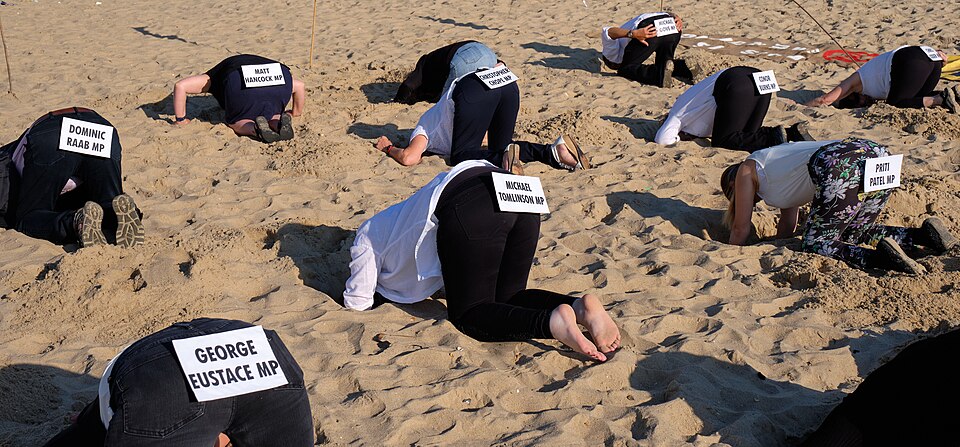
You can’t make a problem like that go away by ignoring it. But if you do choose to ignore it, you can’t insist that you have a “right” to be safe from it regardless. Dangers don’t disappear just because you stick your head in the sand so you can’t see them.
As more time drags on, Win gets impatient. He fears for the lives of his friends who’ve been kidnapped by the Hamiltonians, and it’s exasperating that the Continental Congress seems to be in no hurry:
New names blinked onto the screen, the room gradually filled. Important-looking people stopped by to greet Lucy like a long-lost friend. Apparently I’d underestimated this batty little old lady. We ordered a meal. More nothing happened. Finally: “When does this show get on the road anyway?”
… “Ain’t no certified regulation starting time. How could there be?”
“God damn it, Lucy! Clarissa and Ed are prisoners! Maybe dead already.” I cringed inwardly at the words. “And we’re sitting here on our—”
“I know. But whatever happens—even to them—is gonna happen right here, and not until at least nine-tenths of North America’s represented.”
As Lucy explains, the Continental Congress can’t begin until 90% of North America is represented, either as in-person attendees or virtually by proxy votes. Win checks the big board:
I looked: 0.83901256. “Eighty-three percent?”
“Closer t’eighty-four, and no Congress till it hits ninety.”
I brought this up last week, but I’ll reiterate it here: It’s glaringly obvious that this can’t possibly work in Smith’s anarchist politics.
The only way to know if 90% of people are represented is if there’s an authoritative record of how many people live in the North American Confederacy. But Smith has consistently said that no such thing exists. In fact, people there are so fanatical about privacy that they’d shoot a census-taker on sight.
This is a problem that’s dogged the entire book, like with Smith’s discussion of traffic fatalities, or his belief that large, heavily armed corporations would voluntarily obey an unfavorable ruling from a private arbitrator. It’s cargo cult anarcho-capitalism: he assumes that the state can vanish, but all the state functions that he takes for granted would persist as before.
(Also, who decided 90% was the threshold? Everyone treats that number as suspiciously official. Why not 95%, or 85%?)
Win frets that this could take weeks, but Lucy says to give her some credit. She and Jenny Smythe, president of the NAC, have been working behind the scenes for weeks to wrangle enough delegates to get this show on the road. Sure enough, just as she says it, the number hits 0.9:
Jenny entered without fanfare, punching in at her terminal.
Her image appeared overhead as she said softly, “The Seventh Continental Congress of the North American Confederacy is now in session. Mr. Parliamentarian, may I have the protocols?”
Win is eager to speak, but unfortunately, he and his friends aren’t the only ones who have agendas to bring before the Congress. There are other people who get time, too, as Lucy explains:
“I thought we called this Congress to warn—”
“That’s where you’re wrong. This is just us good ol’ folks, whose number ‘happens’ to be ninety percent, remember?
…everyone’s entitled to speak, and in practice, they reserve space on Jenny’s agenda, in case we ever have a Congress. Some been waiting for decades, carried over from her predecessors’ lists. Offering ’em this rare shot helped us put it together. Lucky there ain’t ten times as many.”
Win grouses, but sits impatiently as other delegates take their turn at the podium. One group (the “Franklinites”) wants Congress to agree to meet every year – a notion that’s roundly booed and quickly voted down. The next to speak is a woman who identifies as the leader of the Dissolutionist faction:
“Madame President,” said a pretty, honey-haired girl with a wry smile, “I move that Congress adjourn—”
Catcalls and curses filled the room.
Shouting over the tumult, Jenny exclaimed, “I’ll remind the delegates that a motion to adjourn is always in order! Second?”
“Madame President! May I be allowed to finish my motion?” She was still on her feet, others around her standing in their chairs. The noise died down—what can you add to a motion to adjourn? “Madame President, delegates assembled, I move that this body adjourn—permanently!”
These people are the anarchists’ anarchists. They believe there should be no legislature at all, even this vestigial one, and they’re proposing that it be dissolved permanently. They either don’t know—or, more likely, don’t care—about the threat of nuclear annihilation. It’s head-in-the-sand politics at its finest.
What should be shocking is that Lucy votes for them, despite knowing the stakes:
Lucy had leaped up, shouting, “Second, Second!” Now she came back to herself, grinned sheepishly, and sat down. “Always did have a radical streak, I guess.” She relit her cigar. The Dissolutionists lost, three to one, but for some reason they cheered again, and Lucy beamed.
She treats this as a noble effort that deserves support, even though she was one of the people who worked to get this Congress together – and knowing that if the Dissolutionists succeed in abolishing it before it can do anything, her kidnapped friends will be killed and her world will be annihilated by nuclear bombs. Yet again, Smith’s characters put ideology over common sense.
One more group, the “Neoimperialists”, want the NAC to go to war with any remnants of government left anywhere in the world:
“Nothin’ new,” Lucy explained. “The Neos, mostly war vets, start with a good enough idea. Government’s morally repugnant to any decent person. But how’d they avoid killing a lot of the very folks they’re liberating? Just won’t wash.”
A very common tactic on the right wing – from evangelical Christians to right-wing libertarians – is that they refuse to admit the existence of moral philosophies other than their own. They treat good-faith disagreement about what’s right and wrong as equivalent to vicious indifference to right and wrong.
This passage is an example of that. Lucy says that government is repugnant to “any decent person”. Because the author holds that view, he writes as if it’s the only possible view. Although he wants this book to be a work of persuasion, he’s not trying very hard to appeal to anyone who doesn’t already agree with him.
New reviews of The Probability Broach will go up every Friday on my Patreon page. Sign up to see new posts early and other bonus stuff!
Other posts in this series:
Is there any suggestion that Lucy is just playing politics here? Supporting a measure she knows won’t pass because it makes her look good. Even though Lucy was one of the organizers of this congress appearing to be on the anti-congress side is politically advantageous in Smith’s world.
This is one of the behaviors libertarians say they dislike about politics but Smith has his characters do it. It could be Smith is making a point about the practical necessity of such politics even when ugly but I see no signs of it. If Lucy is playing politics here it looks more like Smith being oblivious about his side playing politics as a game while being opposed to it when the other side does the same thing.
Yeah. As you say here, and have said multiple times, and has been noted in even greater detail in some of the comments… so much of this is just straight out magical thinking from someone who has only ever studied a very cherry-picked view of history and is willing to completely ignore the evidence of human nature. There is just this underlying assumption that all the actual products of government are somehow natural phenomena that will continue without pause if government is eliminated.
It’s the sort of belief that’s only really possible for someone who has lived in a place with a relatively stable government for their entire lives, and who has never really been on its bad side, and so he can afford to ignore it 90% of the time and thus treats the most minor of inconveniences as if they were personal insults.
As someone put it elsewhere online, that’s what decadence is: a conviction life is so easy that we don’t need to worry about disease (screw vaccines), religious wars (screw the first amendment), etc. We’ve made the world safe (obviously not for everyone) and so we don’t need to work on maintaining it.
If I recall correctly, the “Franklinites” are led by a certain Buckley F. Williams, which gives you an idea of the razor-sharp satire going on here.
It’s cargo cult anarcho-capitalism: he assumes that the state can vanish, but all the state functions that he takes for granted would persist as before.
I’ve always compared libertarians to a two-year-old boy who stands on his daddy’s shoulders and thinks he himself is eight feet tall and can do anything and take on anyone.
Although he wants this book to be a work of persuasion, he’s not trying very hard to appeal to anyone who doesn’t already agree with him.
Just as well – the world does not need more Randian sermons.
It would be interesting to learn what the other petitions are, the ones who’ve been waiting years. What problems do they think government can solve? How does it react? Does Smith tell us?
Are you sure it’s meant as persuasion? Because it comes off as preaching to the choir (though bear in mind that many libertarians and anarchists would also disagree with Smith).
A lot of right-wing attempted persuasion comes off as preaching to the choir.
I’d say that’s probably true for most of it, wherever attempts are on the political spectrum. A lot of them are just lectures wrapped in a plot (often a very thin one) from what I’ve seen. Even those whose politics I agree with can be quite tiresome, and often unreadable.
Your mention that other libertarians disagree with Smith is (I think) a clue to what this book is – it’s intended to persuade other kinds of libertarians to adopt Smith’s view of what proper libertarianism is. Naturally, this flies over our heads, like an attempt to persuade me that day-age creationism is better than young-earth, or gap-theory creationism.
Ah, you’re probably right about that. Even during my regretful time in those circles I heard about Smith only vaguely though. I don’t think he had much influence. Perhaps even they could see his novel was quite absurd in many ways, but that’s just a guess.
Or he could be just bad at it, like most people.
I have, on a handful of occasions, engaged in “debate” with religious fundamentalists online. It seems that they’re quite convinced that the only reason why someone would be an atheist is because they “haven’t considered” certain things. (I have met a few who went on the “you just want to sin” route, but those weren’t the ones I debated.) Most of it was things which atheists usually have considered and rejected. They don’t seem to really understand the reasons for rejecting them. The rest is things which most people would never consider because they don’t even make sense outside of the speaker’s particular brand of fundamentalism (and in most cases I didn’t understand at all what they were getting at until years later, particularly if they were using words differently than most other people). I suspect that most attempts to “get through” to people like that are equally ineffective, for similar reasons.
That’s also certainly possible. I no longer attempt to persuade anyone, and especially not debate online. From my experience that has been fruitless and just a waste of time, not to mention very annoying.
We see three long standing petitions described above:
1) to have Congressional meetings regularly (those people think that government is good, but are taking an incremental approach, I think (Franklinites)).
2) to abolish Congress entirely
3) to declare war on the rest of the world’s governments.
One more (if I recall correctly) is mentioned in this section of the book – to allow Greenland to join the NAC. This one passes.
Judging from what Lucy says, there’s probably a petitioner asking to move the capital to Death Valley or Ketchican, Alaska
I guess that proves how perfectly Smith’s world works — nobody needs Congress to exist, case closed, checkmate liberal fools!
Speaking of heads in the sand, has someone mentioned this https://volokh.com/2011/02/15/asteroid-defense-and-libertarianism/
“I agree with Jonathan below that the Constitution (through the spending power) allows Congress to spend tax money to protect the Earth from an asteroid.
On the other hand — and at the risk of confirming Mark Kleiman in his belief that libertarians are loopy — I don’t speak for all libertarians, but I think there’s a good case to be made that taxing people to protect the Earth from an asteroid, while within Congress’s powers, is an illegitimate function of government from a moral perspective. I think it’s O.K. to violate people’s rights (e.g. through taxation) if the result is that you protect people’s rights to some greater extent (e.g. through police, courts, the military). But it’s not obvious to me that the Earth being hit by an asteroid (or, say, someone being hit by lightning or a falling tree) violates anyone’s rights; if that’s so, then I’m not sure I can justify preventing it through taxation.”
Yeah, you got things like that from some libertarians. At one of the Libertarian Party USA candidate debates Gary Johnson served as the sole exception as the rest hilariously (though also scarily) railed against driver’s licenses being a huge violation of people’s rights. Would anyone volunteer to drive on a license-free road however? I wonder.
What’s to stop the “let’s invade all other countries and convert them to our style of un-government” Neo-Imperialists from trying it anyway? Obviously there are some benefits to getting approval from Congress, otherwise they wouldn’t bother, but it’s not like Congress would act against them with any real speed or take much if any direct action. If it’s a moral imperative, and you have the means, why not take action? It’s at least plausible that lack of approval would run the risk of sand in the gears and damaged reputations, while approval would grease the wheels and make everything smoother. I obviously haven’t read the book, but I suspect his worldbuilding doesn’t go into enough detail to determine how plausible this is or how much difference it would actually make, but given that he’s trying to portray even this very minimal government as basically useless…
“She treats this as a noble effort that deserves support,” It would make more sense if she were doing it to trade favors with the Dissolutionists but I guess Smith’s politicians are above such things.
A new question has occurred to me: