The Probability Broach: Make the desert bloom

Dry, barren, cracked land

The Probability Broach, chapter 17

Win Bear and his friends are traveling on a high-tech airship. Smith makes a big deal out of the fact that this anarcho-capitalist society prefers this means of air travel, because zeppelines are more strictly peaceful than jet planes:

U.S. airlines are subsidized; every one of those big tin birds can be instantly converted to some military use, blueprints on handy file at your friendly neighborhood airport. Airships have no such potential; they’re vessels of peace, big, fat, and vulnerable to uniformed strangers with evil intentions. Ask Lucy, who wound up touring Europe by shanks’ mare.

But Smith’s own writing contradicts this. In the Prussian war (this timeline’s equivalent of World War I), the NAC did send a fleet of airships as an invasion force. Lucy’s airship was shot down in a dogfight with the Red Baron, as she mentioned, but that doesn’t change this fact. (Or was Lucy just a military ignoramus who went to battle in a patently unsuitable vehicle? Nothing in Smith’s depiction of her character implies this.)

Ed and Win circulate through the cabin, meeting some of their fellow passengers. To judge from this passage, news of the Hamiltonian world-conquest plot has spread, and people are gossiping about it. You’d think that would make the two of them heroes or celebrities, since they’re the ones who brought it to the populace’s attention. But if they’re the focus of any special interest, Smith never says so:

Naturally not all of them were human. Nuclear blackmail concerned every being on the continent—the entire planet, to judge from languages I heard around me. Some felt more threatened than others: Hamiltonians hold that animals have no place in society except as slaves and breakfast. A quarter of the Congress would be chimpanzees.

Bookmark it for later: You’ll want to remember this passage when Win arrives at the Continental Congress.

To pass the time, Ed and Win take some time to admire the scenery. Their zeppelin, the San Francisco Palace, is like a skygoing cruise ship. It’s huge enough to have casinos and shopping malls on board:

We circled around the gambling tables, plunking ourselves down where we could look outside. Half the Palace, more or less, is a tough, transparent skin stretched over titanium bones. These great windows ran from floor to ceiling, twelve feet. Scenery unrolled beneath us as we plowed northward: “Wyoming” now, a barren cattle-dotted plain in my world, a lushly irrigated breadbasket here.

I’ve previously discussed the paradoxical nature of these fictional libertarian utopias. They have no central government, yet somehow they have roads, bridges and other massive public works, none of which have ever existed in the real world without a government to organize and direct the construction.

In an earlier chapter of this book, I talked about this with reference to the North American Confederacy’s road system. It’s implausible that such a thing can exist in a world where private property rights are absolute and a single stubborn property owner who stands in the way can scuttle the entire project.

Air travel would also pose some issues. With no FAA requiring airlines to file flight plans, who’s to ensure planes don’t collide with each other in midair?

But this line about Wyoming being a “lushly irrigated breadbasket”, which L. Neil Smith treats as a tossed-off reference, is the biggest implausibility of all.

What river would you divert to irrigate Wyoming? The most likely candidate is the Green River, which is a tributary of the Colorado River. But who decided it would be Wyoming, rather than a different region, which gets that water? Who planned this project? Who paid to build the dams, the canals, and the other infrastructure necessary for irrigation? And after all that investment, what would they do if someone else wanted to divert the river in a different direction to water their crops instead?

Deciding how to allocate scarce natural resources is a serious challenge in the real world, so an anarchist world would have to wrestle with it as well. And since Smith set most of this book in Colorado, there was a perfect example at his fingertips.

The Colorado River is the major source of water for the southwestern United States. It’s used for irrigation for agriculture, for hydroelectricity generation, and as a source of drinking water for tens of millions of people.

With so much demand, there’s constant wrangling over how to allocate the river’s water among the seven states it flows through (Utah, Colorado, New Mexico, Wyoming, Arizona, California, and Nevada), plus Mexico. The overarching agreement is a 1922 compact that sets out how the water should be divided.

The problem is that this agreement was made during a historically wet period. Now, with climate change causing hotter temperatures and shrinking mountain snowpacks, the amount it allocates to each of these states adds up to more water than there is.

As you can imagine, this has led to years of tense negotiations that may soon escalate into legal battles. So far it’s been deadlocked, because no state wants to give up its ration of water for its neighbors’ sake. No governor wants to tell angry farmers they have to let their crops wither, or tell angry suburban voters they won’t be able to flush the toilet or brush their teeth.

The stalemate has led to a looming crisis: water levels at the river’s two major reservoirs, Lake Powell and Lake Mead, are dropping so low that the hydroelectric turbines in the Hoover and Glen Canyon Dams could soon stop working. That wouldn’t just be an inconvenience, but a huge economic hit and possibly a humanitarian disaster.

This is a hard enough problem in a world with a government. How could you possibly solve it in an anarchist society like the North American Confederacy?

Defenders of the NAC might say that they could reach a water-sharing agreement through private arbitration. The problem is that, even if an agreement was worked out, it would be purely voluntary; nothing would make it binding. Once all the dams and canals were in place, people could just cheat and take more water than they agreed to. Who would know?

Also, what about people who came along later and weren’t party to the original agreement? Why would they regard themselves as bound by a contract they had no hand in negotiating? The river is right there, after all. What would stop them from just digging a side channel and diverting it for their own use, and too bad for everyone who lives downstream?

In a society where selfishness is the rule and there’s no central authority to enforce conservation agreements, this kind of cheating is all but inevitable. People who live upstream would hoard the water for themselves, turning arid lands into gardens, building shimmering swimming pools and planting lush green lawns. The poor people who live downstream would be screwed. By the time the river reached them, it’d be no more than a silty trickle, if that.

And if you were one of those people and you trudged upstream to protest, you’d undoubtedly be met by a heavily armed force of private security guards. When they have the guns and the water too, how could you hope to fight them?

Smith’s vision of Wyoming becoming an agricultural “breadbasket” is a libertarian fantasy. It might happen in a more eco-conscious world, but in his world, the water wouldn’t be fairly distributed or go to the best overall uses. It would go to the richest, the most powerful, and/or those most willing to cheat or use violence to get what they want.

A more realistic outcome, for an ancap society, would be a cluster of mansions owned by the ultra-rich that take all the water for themselves, turning their walled estates into pleasure gardens, while the rest of the state becomes a parched and barren hellscape.

As I’ve often mentioned, libertarians follow a philosophy that can be called “cornucopianism“. It claims, implicitly or explicitly, that natural resources are infinite and so they don’t need to be rationed or conserved. Their ideology forces them to believe this, because the only alternative is an enforceable agreement for who gets what: in other words, a government, with all the laws, taxes and everything else they despise. But the real world isn’t nearly so obliging, and it doesn’t comply with their rosy vision of limitless resources.

New reviews of The Probability Broach will go up every Friday on my Patreon page. Sign up to see new posts early and other bonus stuff!

Other posts in this series:

New on OnlySky: Hungary says “Igen!” to democracy

I have a new column this week on OnlySky. It’s about the democratic triumph of Hungary’s elections.

Hungary is a small and geopolitically insignificant country, but it has an outsized presence in global politics. Its longtime prime minister, Viktor Orbán, pioneered a style of illiberal, right-wing authoritarian governance that’s inspired conservative autocrats all over the world. Over sixteen years in power, Orbán steadily chipped away at Hungary’s democracy and tilted the playing field more and more in his favor and against any potential opposition, all without firing a shot. He oppressed LGBTQ+ people, slammed the doors on immigration, and repeatedly frustrated the European will to aid Ukraine. Donald Trump, Vladimir Putin, and many other dictators and wannabe dictators cheered for him – and took notes.

But the Hungarian people fought back this month. In a closely watched election, Orbán and his allies were thrown out of power in a landslide, despite everything they did to rig the system on their own behalf. This is great news for Europe, great news for Ukraine, and great news for democracy all around the world.

Read the excerpt below, then click through to see the full piece. This column is free to read, but members of OnlySky also get special benefits, like member-only posts and a subscriber newsletter:

For the last sixteen years, Orbán held near-absolute power in Hungary. He struck a pose as a defender of Christianity and traditional values, claiming he would protect the West from scary threats like Muslim refugees and LGBTQ+ people.

His party, Fidesz, advocates hard-right, Christian nationalist politics. Its agenda includes banning same-sex marriage and adoption by gay couples; banning pride parades; prohibiting people from legally changing their gender; rolling back anti-discrimination laws; and opposing multiculturalism and blocking immigration, with the goal of making the country racially and culturally homogeneous. (For example, Orbán has said, “We do not want to be a diverse country”).

You might say that this sounds like what the Republican party wants to do in America, and you’d be right. In many respects, Hungary pioneered the anti-democratic politics that’s been embraced by the right wing in the U.S. and around the world. American conservatives saw what Orbán was doing and loved him for it.

Continue reading on OnlySky…

The Probability Broach: The self-rescuing hostage, part 1

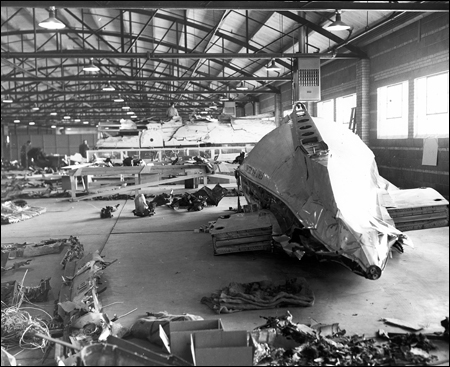
The wreckage of a bomb-destroyed plane in a hangar

The Probability Broach, chapter 17

Win Bear and his friends are en route to the Continental Congress via cross-country airship. Win is still incredulous, as he might well be, that people in this world are allowed to bring guns on airplanes:

“Look, friends,” I said, once we’d cleared security, “I know you’re enthusiastic about weapons, but haven’t you heard about hijacking?” I had to explain.

“Silly way to commit suicide.” Ed laughed. “And if you lived, you’d be paying restitution for the rest of your life!”

… “What about capturing the crew?” I insisted.

“Like to see ’em try that on my ship!” Lucy, our former combat pilot, said. “One of these big balloons, they’d just switch over to auxiliary control, while the regular crew mopped your brains off the dashboard.”

“Security’s pretty good, these days,” Ed added. “Crew-country bulkheads are titanium. No one gets in unless invited. Besides, the minute you ban handguns, criminals will take up less detectable and less discriminating weapons. Bombs, for instance.”

Once again, Smith doubles down on his bizarre belief that terrorists only resort to bombs because airports ban guns.

This book was written before 9/11, but that doesn’t mean that airplane bombings were unknown to him. One example is the 1949 crash of Canadian Pacific Air Lines Flight 108, in which a disgruntled man named Albert Guay sent his wife on a plane with a time bomb hidden in her luggage. His goal was to blow up the plane and kill her so he could marry his mistress. The bomb did go off, the plane crashed, and Guay’s wife died along with everyone else on board, but he didn’t get away with it. His guilt was quickly discovered, and he was convicted and executed.

There are many other examples as well. In all of these cases, the perpetrators didn’t resort to bombs because they first tried to hijack the plane with a gun and failed. The bombing was the plan from the start, whether to assassinate a specific person, or just to spread terror and destruction as a way of getting revenge on a country they had a grudge against.

Smith has no answer at all to these kinds of crimes. All the armed passengers and crew in the world won’t help when a bomb goes off at 30,000 feet and ruptures your airship’s helium envelope like a popped balloon.

Given the extremely light security he envisions, it would be very easy to smuggle explosives on board one of the North American Confederacy’s airships. As we’ll see later in this chapter, you can depart by shuttle while it’s between stops, so it wouldn’t even be a suicide mission. Just set a timer and leave the bomb on board when you go.

Indeed, you have to ask why the bad guys don’t do this more often. Given that the Hamiltonians want to force this world to adopt centralized government, why don’t they commit some spectacular terrorist attacks, to make more people afraid for their lives and persuade them that they need a government for protection?

Win is supposed to be the skeptical outsider, probing for flaws in this system so that the other characters can easily dispatch his objections with their common-sense political philosophy. But he never asks about this, most likely because Smith doesn’t let him pose questions that his belief system doesn’t have an answer for.

I persisted. “But what happens if I point a gun at the passenger sitting next to me, and threaten to blow his head off if they don’t take me, say, to Algeria?”

“Algeria?” Lucy asked. “Isn’t that somewhere at the bottom of the Sahara Sea?”

“Come on, you’re stalling! What happens if I take a hostage?”

“The hostage kills you,” Clarissa said, and that seemed to be that.

It’s not a spoiler to say that this exact scenario plays out in this chapter, just a few pages from now, and it doesn’t go the way Smith’s characters claim it would. In fact, hostage-taking is a highly effective strategy in this anarcho-capitalist society.

This is just what we should expect. It’s unrealistic to imagine that giving a gun to an ordinary civilian would transform them into a badass action hero who can competently defend themselves in a sudden life-or-death situation. (That’s why it’s so stupid for gun-loving conservatives to suggest that teachers should be armed to deal with school shooters.)

A more realistic expectation is that most civilians would freeze, panic, fire blindly, or make other terrible decisions in a crisis. A hardened criminal—let alone a gang of criminals—would easily overpower them. That’s the glaring flaw in Smith’s world, which asserts that you have to rescue yourself from muggers, hostage-takers and murderers because no one else will.

Image via Wikimedia Commons

New reviews of The Probability Broach will go up every Friday on my Patreon page. Sign up to see new posts early and other bonus stuff!

Other posts in this series:

The Probability Broach: Fly the heavily armed skies

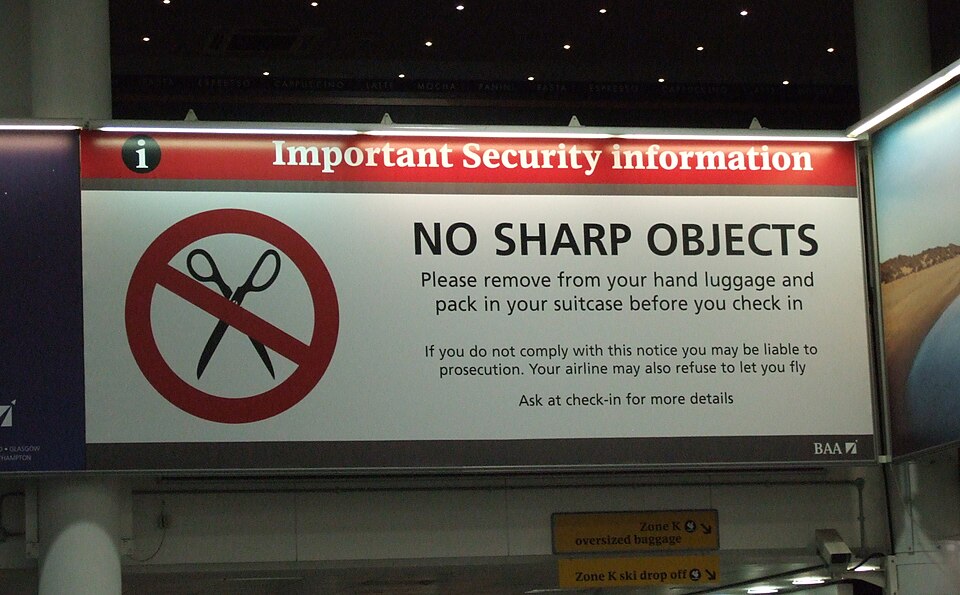
Airport security sign reading "No Sharp Objects"

The Probability Broach, chapter 17

This chapter begins with another of the fake quotes L. Neil Smith loves. This one is attributed to his fictional anarchist philosopher Mary Ross-Byrd:

Nine tenths of everything is tax. Everything you buy has a complicated history of robbery: land, raw materials, energy, tools, buildings, transport, storage, sales, profits. Don’t forget the share you contribute toward the personal income tax of every worker who has anything to do with the process.

Inflation by taxation: there are a hundred taxes on a loaf of bread. What kind of living standard would we enjoy if everything cost a tenth of what it does? What kind of world? Think of your home, your car, your TV, your shoes, your supper—all at a 90% discount!

Government can’t fight poverty—poverty is its proudest achievement!

—Mary Ross-Byrd
Toward a New Liberty

We’ve been over this before, but this quote offers an especially vivid example of Smith’s ideologically-driven economic illiteracy. He thinks that all the money we pay in taxes vanishes into a black hole, providing no value in return.

How did that loaf of bread get to the market or to my house? By truck? Those trucks travel on highways, bridges and tunnels—how did those get built? Who paid the costs of construction? When it snows, who plows the roads to keep them open? When there’s a pothole, who fills it? When there’s an accident, who clears it?

Was there any kind of food safety inspection at the bakery, to make sure they’re not putting toxic alum, chalk or sawdust in the dough to save money? Or do you just have to take the company’s word for it?

Where does the factory get electricity to keep the lights on and run the appliances? Who generates it and how? Who regulates the utilities to make sure their reactors don’t melt down and they don’t spill toxic waste into the drinking water?

Even in a hypothetical scenario where there’s no government and private corporations perform the same services, those services have a cost that isn’t zero. Why wouldn’t those costs be built into the price of bread in the anarcho-capitalist utopia, just like they are now?

Smith’s assertion that everything would cost “a tenth of what it does” if not for government is pure magical thinking. It’s on a level with saying all the money we pay farmers is wasted because crops just spring out of the ground on their own.

In this chapter, Win and his friends are doing their best to alert the world to the Hamiltonian threat, and their efforts have borne fruit. The North American Confederacy’s version of Congress has agreed to meet, and our protagonists are traveling to the seat of government (which isn’t Washington, D.C., as we’ll see shortly) to testify in person.

Rather than one of the NAC’s jet liners (“thousand-passenger fusion-powered titanium monsters that bash their way through near-space at five times the speed of sound”), they’re taking a zeppelin, because zeppelins are cool. Smith describes them as enormous and luxurious—a mile long, like floating cruise ships with lavish suites, shopping malls and restaurants on board, with power supplied by fusion reactors which also generate helium for buoyancy.

However, there’s a tiny problem. As you may remember, everyone in this anarcho-capitalist world goes heavily armed at all times. How does that work with air travel?

Riding the corridor to the elevators, we encountered a security setup not too different from the ones back home. Ed bellied up, drew his Browning, pulled the clip and chamber round. Lucy’s horse-pistol materialized from some region of her person, and Clarissa unsheathed her Webley Electric. Following their example, I unholstered my Smith & Wesson, wondering what would happen next.

At home, the officer would lose control of her sphincters, and forty thousand federal marshals would trample in and haul us away for the next several eons…. Whatever happened to the Fourth and Fifth Amendments at U.S. airports? Or the First, for that matter?

This is one of those spit-take moments you keep running into while reading this book. Smith thinks people have a constitutional right to carry guns on airplanes? On zeppelins, even?!

Note that he mentions the Fourth Amendment—i.e., the right to privacy—implying that it’s a violation of his rights to be searched, even at an airport security checkpoint.

“Excuse me, sir,” the attendant said politely. “Is your ammunition in compliance with aeroline policies?”

Ed nodded. “Frangibles, at under nine hundred feet per second.”

Even a gun-worshipping fanatic like L. Neil Smith recognizes the problems that would ensue if people started blasting away in an airplane cabin. This is his answer to that. In his ancap utopia, you’re allowed to bring guns on planes, but only if they’re loaded with special ammunition that kills people but won’t damage the structural fabric of the vehicle.

Everyone’s weapon passes the safety check except Win’s pistol, which is an antique by the standards of this world:

The official took a hard look at my revolver. Naturally, she couldn’t find it in any of her references. “I’m terribly sorry, sir, would you mind if we took your, er, gun, until you reach your destination?”

Ed grinned smugly. “See the trouble that museum piece causes? Use the cartridges in the yellow box.”

…I reloaded cylinder, speed-loaders, and my derringer—which caused another round of dithering—with this new stuff: bright-yellow plastic bullets. They’d explode into harmless powder on aerocraft-tolerance materials.

Thank goodness. Now we can riddle other passengers with bullets without causing midair explosive decompression. Much better.

Note, however, that the attendant makes only a cursory effort to verify this. She asks them to take out their weapons, inspects them, and asks if the ammunition they’re loaded with is compliant with airline policy. No one gets patted down; no one has to go through a security scanner or send their luggage through an X-ray machine. It all seems to be voluntary.

It’s fair to assume that people who outright refuse to cooperate with inspection would be denied boarding. But if you wanted to bring a noncompliant weapon on board, could you just keep it under your coat and not produce it when asked, like teenagers smuggling outside snacks into a movie theater? Or what if you took regular ammunition, but in the box of a frangible brand? Would anyone check or be able to tell?

In the real world, air rage is a problem every airline has to grapple with: angry, disorderly passengers assaulting each other or the crew. It’s almost inherent to the industry. Expensive tickets, stressful travel plans, uncomfortable seats, jet lag, and alcohol create a pressure-cooker environment in which some people’s worst impulses explode. There’s no scenario in which this gets better if everyone is armed, even if Smith makes the token concession of ensuring they can’t accidentally shoot down the entire aircraft.

Much like the section on traffic regulation (or lack thereof), these are wildly dangerous policies that would cause mass death and devastation if they were ever implemented in the real world. But Smith waves these problems away through the power of authorial fiat, scripting a world where they (somehow) lead to greater safety and security, and then holding that world out as an appealing place where we should want to live. It’s a circular argument, using a fictional scenario as proof of itself.

Image credit: Edward Betts, released under CC BY-SA 3.0 license

New reviews of The Probability Broach will go up every Friday on my Patreon page. Sign up to see new posts early and other bonus stuff!

Other posts in this series: