
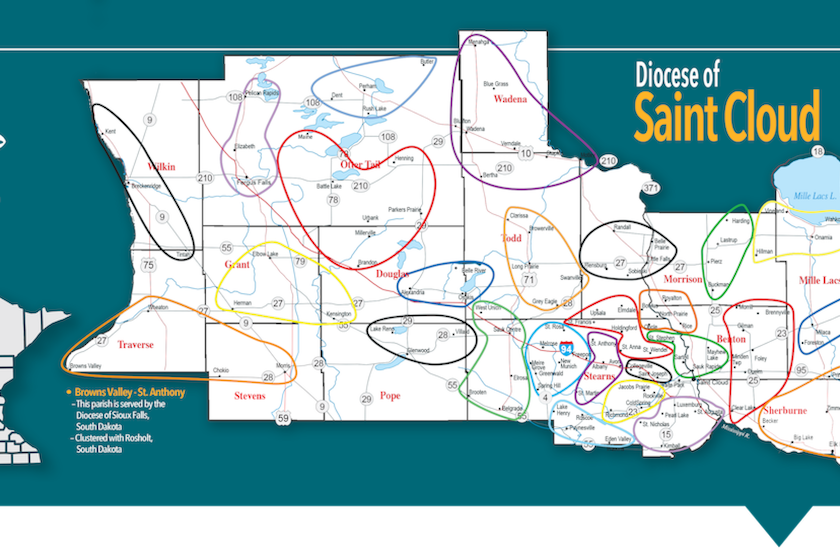
You may have the impression that Minnesota is chock-full of Scandinavian Lutherans, but that’s not so: German Catholics make up an even larger proportion of the state population. There is a band running east-west in the center of the state that is very Catholic, centered on the city of St Cloud, about an hour west of Minneapolis. This is the Diocese of St Cloud.
The good news is that many Catholics are falling away from the church.
The change is part of the diocese’s plan to consolidate its 131 parishes into just 48, a dramatic reshuffling of religious and community life in this historically Catholic region of central Minnesota.
Church officials say a declining Catholic population, lower Mass attendance and a shortage of priests leave them little choice.
That’s the way I want to see it happening: not blowing up churches, not punishing believers, just a slow, steady, and entirely voluntary departure of believers from the folly of religion. (Although I would like to see an end to religious tax exemptions; we shouldn’t punish people for believing, but we also shouldn’t be rewarding them for it.)
We can simply sit back and wait as religious belief slowly sublimates and eventually disappears. Catholicism is just one subset of fading religions.
The changes also reflect broader religious trends in Minnesota and the U.S.
Across the country, Catholic dioceses are grappling with similar challenges. According to the Pew Research Center, about 40 percent of U.S. Catholics seldom or never attend Mass.
While the population within the St. Cloud Diocese has grown by about 7 percent since 2010, the number of Catholics has fallen from 22 percent to 16 percent, according to diocesan figures. During the same period, Mass attendance has declined by one-third.
Some churches are less than half full on Sundays, Kresky said. At the same time, insurance, maintenance and operating costs continue to rise, she said. And some churches in the diocese are just a few miles or even a few blocks apart.
The churches they have left are all propped up on the benefit of tax exemptions. Let’s accelerate their fade into irrelevance, leaving behind nothing but some interesting empty architecture. Bye-bye!
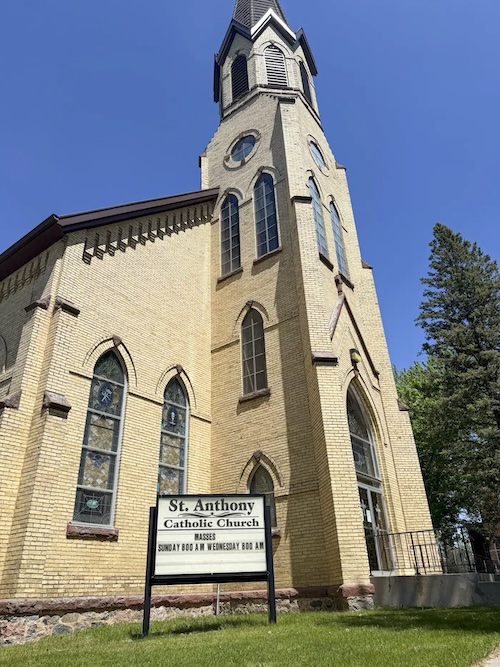

Those buildings can often make very decent venues for gigs, as we all know; and for art exhibitions, community centres/meeting halls, dance and exercise classes etc. etc. etc. Always a pleasure to see some perfectly nice-looking architecture – sometimes very soundly built, depending on the date – put to good use at last :-)
I have always liked church architecture and the music, even if, as Tim Minchin puts it:
“Some of the hymns that they sing have nice chords, but the lyrics are dodgy.”
One time, a friend and I took a couple of hits of acid and wandered around the St. Paul Cathedral admiring all the art while tripping balls.
I guess technically, it was a ‘religious experience’, but I wasn’t motivated to sign up for their newsletter…
The Basilica in Minneapolis is pretty cool, also.
The worry I always have seeing these stories of shrinking parishes is that they’re shifting elsewhere. Better disinterested Catholics that fervent converts to some branch of Evangelical.
@opposablethumbs:
Very true: the Randolph Theatre here in Toronto (previously the Bathurst Street Theatre) was originally a Wesleyan Methodist Church, and still very much looks like a late 1800s church building. (It was both for a while; they rented out the building as a theatre starting in the 1950s, but it was still an active church into the 1980s when they sold the building.)
For that matter, the Trinity-St. Paul’s United Church a little north of there (which is where the Bathurst Street congregation meets now after the sale of the original building) is also the home of the Tafelmusik Baroque Orchestra and Chamber Choir.
If more churches were like the United Church of Canada, there would probably be a lot less antipathy towards churches. (The first legal same-sex marriage in Ontario was performed in 2001 at a United Church, before they were actually allowed by statute; the Church had read out the banns, and the Government Registrar probably didn’t realize both names were women when the marriage was registered.) The United Church was basically formed as an answer to ‘there are a lot of towns springing up out West, and we (Presbyterians, Wesleyans, other non-denominational) can’t all afford to open up churches out there, and we honestly have more commonalities than differences, so let’s create an umbrella organization that lets us do bulk purchases and together we can just open up one church per town’, so from its founding it has been very much a ‘we’re not here to quibble the details, everyone is welcome’ church.
In case you were wondering:
Biography of Saint Cloud
He was a person, not an actual cloud!
The believers do pay taxes. Even the preachers, pastors, etc, pay taxes on their income though they have some dodges. The churches don’t pay taxes on income (donations) and probably don’t pay property taxes. Churches can own rental property and I assume they don’t pay income taxes or property taxes on that but don’t know for sure.
Preachers can have low incomes but then have the use of the parish house, a car, various services, and even jets that probably don’t count as income. So there are ways for them to work around the system.
When I was young, we lived in a rather slummy part of town, in one of a battery of old homes owned by the Catholic church, so yes, buying up rental properties tax-free was one of the ways the church could profit.
I remember often being asked by my father to run an envelope of cash, our rent payment, to the house of Mr Levesque, the property manager. I was shocked by how opulent, in a garishly Catholic way, his house was.
The “Johnson Amendment” (aka Section 501(c)(3)), though basically unenforced by Dems & Rips alike, has kept a lot of churches from actively involvement in political campaigns, and I suggest it has more than paid for itself in the process.
With churches having to pay taxes, we’d have a lot more demand for taxpayer support for church schools and other activities, more church-supported office-holders demanding prayer at public events, lots of creationism, gender dogma, and worse.
@8 citation needed, I don’t believe that that law has slowed them down politically in any way at all.
And maybe I’m just grumpy this morning, but I wish people would stop saying how nice the architecture of cathedrals is. Not that it’s wrong, taste is arbitrary after all, but I have not yet seen acknowledged what these stupid, hideous things cost. Sometimes they took centuries to build, usually with labour that was either heavily coerced for the really expert stuff, or free. Plenty of peasants died building them, or were starved when resources that could have kept them alive were poured into these things. What they represent, just in the construction of them is horrible, let alone the everything else they have been a venue for ever since.
The recent FIFA world cup in Qatar made some pretty architecture too. But if I stopped there, I would rightly be termed a monster. Because, even as it was being built, large, loud, and high pitched whistles were being blown the appallingly unsafe and slave conditions the whole thing was underpinned by.
Cathedrals look like what they look like, they agree with your taste or not. To note only what they look like, or even their occasional engineering brilliance, without even a cursory glance at what it took to get them there in the first place though? This should be seen as unforgivably vapid and irritating. It must change. For mine.
Same goes for Pyramids!
[related]
Back in the mid 70s, I remember there were ‘local’ newspapers — freebies with lots of advertising and a token news content. They advertised cheap cars. Datsuns, low-end Holdens.
The local church distributed the Catholic newspaper, but not for free.
Prayers, religious news, that sorta thing.
Noticeably, the cars advertised were Mercedes and BMWs and high-end Holdens.
So. That’s the hypocrisy right there, and it was right in my face.
Re#3:”Better disinterested Catholics that fervent converts to some branch of Evangelical.”
There’s the problem. Nothing short of nuclear Armageddon will shift Trump-worshipping fundangelicals and Armageddon would make them Rapturous.
indiana jones
The same does not go for the pyramids of Egypt, there has been a lot of archaeology showing that the artisans who worked on the pyramids, and on the furnishing of them, were skilled and well paid
indianajones @ # 9: @8 citation needed, I don’t believe that that law has slowed them down politically in any way at all.
How do you expect me to come up with a citation for a purely hypothetical scenario?
I did speak with an attorney in a medisum-sized southern town who advised the segregation academy of the wealthiest faction in that town not to seek tax-exempt status due to concerns about the 501(c)(3) regulation, but I don’t think they posted his advice or their compliance online anywhere. The boogeyman numerous Repubs & political preachers long before Trump have made of the “Johnson amendment” does imply that it had a widespread impact.
@13 I mean you did compare political activity before and after, but I don’t mean to be adversarial here, I think I was a little sour this morning, sorry about that.. Your example will do me. Good news!
@12 Again, Glad to hear it, happy to be wrong about the Pyramids. Still an enormous waste of resources IMO, but I’m glad that the equivalent to billionaire class of the time weren’t the only ones to benefit after all.
I wonder if they will continue the priests, bishops, archbishops, cardinals, and pope, even after their finances have shrunk considerably. Perhaps an active community support organization, with the roles of the officials benignly merging into focusing on living a healthy balanced loving productive life (as individual defines it).
indianajones and Jazzlet.
What of the Roman Pantheon? the Parthenon of Athens, and innumerable other structures around the world, ancient and modern?
How about the license-plates in the US? They are largely stamped out by the resident prison workforce (slaves) across the states for mere pennies on the hour.
I can appreciate the technical skill involved in the construction of the scissor-arch at Wells Cathedral AND at the same time appreciate the costs of construction borne by the local human populace as well as the displaced species as thousands of trees were cleared for scaffolds and falseworks.
I think a lot of the work on medieval cathedrals was also done by skilled artisans.
Amen..er, I mean Ramen ..to that! Likewise here. To all religions.
@5. Reginald Selkirk : “He was a person, not an actual cloud!”
Ah but did he wander lonely as a .. *
https://en.wikipedia.org/wiki/I_Wandered_Lonely_as_a_Cloud
umm, person?
That poetic line never actually makes sense to me given clouds aren’t usually lonely or associated with loniliness. Gotta say that just strikes as weird.
A man named Mr (or Saint) Cloud being lonely OTOH makes a lot more sense but I guess “I wandered lonely as Mr Cloud.” doesn’t rhyme or sound that great either especially if Mr Cloud isn’t famous or especially known for beig lonely.
.* Via that wikipage :
Subjective obvs but yeah I agree those are its best lines and didn’t know that.
Religion is a second-order phenomenon, but it’s hardly universal.
Same thing as ‘meaning of life’.
Crutches for some, pointless for others.
But an expression of wishful thinking.
Imposed on us all as ‘religion’ or ‘morality’ or ‘manners’ or whatever.
So. Human nature, just not all humans.
Formalised wishful thinking to make sense of the world and to imagine/determine some purpose, for those who want such.
(Forcibly imposed on the rest of us who don’t care about that shit, because of course it is)
—
Thing is, no biggie the other way. :)
[OT]
StevoR @19, Romantic similes don’t work that way. The line isn’t about clouds having emotions; it’s about the appearance of a solitary cloud drifting across the sky matching the feeling of solitary wandering.The actual sentiment is akin to “I felt desolate in the way a lone cloud drifts, drifting, detached”.
Poesy, eh?
—
People often imagine I don’t get non-literalness, but that is not the case.
(Also, I tend to abuse alliteration)
@ StevoR, Morales
Actually, clouds or fog are metaphors for things that can’t be touched, you just pass through.
The meaning is, “I wandered lonely as one untouched by human interaction”. But good on Morales for taking a stab at understanding. X-D
BTW, people don’t think you misunderstand non-literarism. That would be fine. It’s that you pretend not to understand to manufacture disagreement. (Trolling.)
@ ^ The literal one that gets me most ios the one where people talk about clouds having a silver linings forgetting the implications of the reqired temperatures* to have silver in gaseous form. Maybe on some hot Jupietr – but not on this planjet people!
.* See :
https://en.wikipedia.org/wiki/Silver
BTW I cannot be the only one finding Morales boasting about being superior to us mere rabble because he is immune to “wishful thinking” so hilariously ironic it’s almost performance art, right? X-D
@ ^ Then there’s the thought of it raining molten silver which has to be at least 962 degrees Celsius!
To think folks thought acid rain was bad!* ;-)
.* Which it is.. especially when its very acidic.
@ Silentbob : I’m sure I’m not the only on wishing you’d just leave John Morales be and ignore him rather than constantly attacking him.
Idk, I personally disqualify any religious believer i know about from getting my vote at least. If angels, demons or miracles are on the table in their model of the universe – all bets are off.