
Liang Cheng is an oncologist a Brown University. I’d never heard of him before, but I am told that he is incredibly famous by Liang Cheng, as he announced himself on LinkedIn.
I am deeply humbled and grateful to learn that my H-index has now reached 140. I was also honored to see that I am currently ranked among the two most-cited researchers worldwide in the fields of Urologic Oncology and Urology on Google Scholar.
In addition, my i10-index has reached 1060; that is, one thousand and sixty publications each cited at least ten times. I was told that this may represent a world record – what an extraordinary honor!
Nonetheless, these numbers are far less important than the people, mentorship, friendships, and collaborations behind them. This milestone is truly a triumph of team science. I owe immense gratitude to my mentors, colleagues, collaborators, residents, fellows, medical students, and friends who have inspired and supported me throughout this journey over the past two decades.
Academic medicine is never an individual accomplishment. It is ultimately about advancing science and medicine, educating future generations, and improving patient care. If our work has contributed even in a small way toward those goals, then I feel extraordinarily fortunate and grateful.
Thank you for being part of this journey. The best is yet to come!
I hate to be the one to tear him down, but no one cares about your H-index and i10-index except, maybe and importantly, administrators and fellow H-index chasers. Anyone else remember that scene in American Psycho where Patrick Bateman and several of his cronies are comparing business cards, noting the quality of the stock and the embossing and the inks? Yeah, that’s what it’s like seeing someone brag about their indexes. Don’t care.
It’s also because those numbers are thoroughly gamed. I looked him up on PubMed, and it’s true, his name is on a lot of papers: papers that have 10 or 20 or more authors, and there he is, somewhere in the middle of a sea of names, rarely first or last. He really does owe a lot to his “mentors, colleagues, collaborators, residents, fellows, medical students, and friends” who have been tacking his name unto their papers! And further, his publication rate, that is, the rate at which his name gets plugged in to a long list, is approximately a paper every two days, which is insane. This is authorship by rubber stamp.
I think it is valid that many research endeavors nowadays require a large team, and he may have been an indispensable member of such a team, but then to use that cooperation to brag that he is #1 or #2 in his field is unseemly. It’s also dangerous, Dr Tall Poppy. He was spamming his ‘accomplishment’ on every social media site he could find, and on Xitter, Michael Eisen noticed.
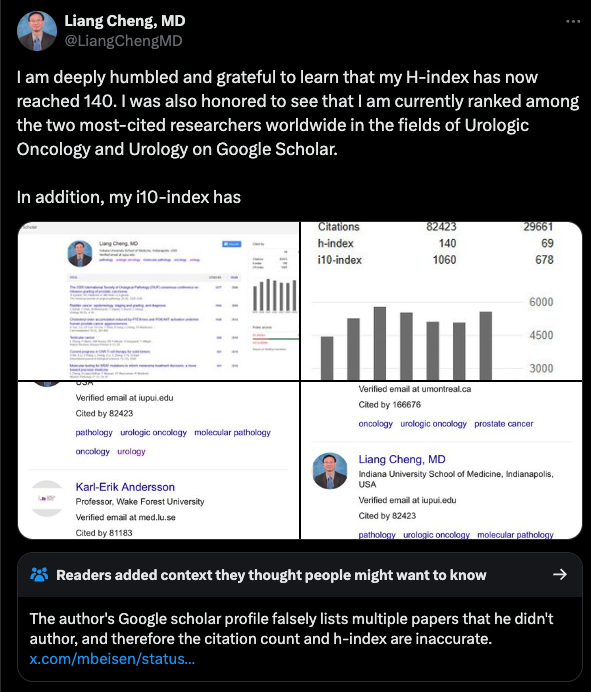
The author’s Google scholar profile falsely lists multiple papers that he didn’t author, and therefore the citation count and h-index are inaccurate.
Whooops.
I do enjoy seeing a braggart taken down a peg, but Liang Cheng is a symptom of a greater problem: we’re drowning in artificial metrics, amplified by AI slop.
Over the last few decades, science has undergone a “citation revolution.” Scientific life used to be structured by personal reputation and mutual acquaintance; now it is defined by quantitative assessments derived from citations.
And this reward system has warped scientific life in dramatic ways. It has resulted in the obvious and widespread gaming of citation metrics; but, more insidiously, it has pushed scientists toward risk-averse, incremental, and above all unambitious research. The logic of institutional science has become increasingly divorced from actual knowledge and discovery. In a system governed by these perverse incentives, the inevitable endpoint is simply AI-generated slop at scale.
Now, with AI, we’ve built a remarkable new technology that opens up dramatic new horizons for scientific work. But we’re deploying that technology within an institutional structure that incentivizes, above all else, the maximization of metrics that don’t have much to do with real science. The underlying problem is not with AI, but with the institutions and incentives that define modern science.
That is an excellent article, everyone should read it. It actually ends on a promising note, regarding AI as a tool that could break us out of the dead-end, grasping competition for a magic ranking number, as exemplified by the case of Liang Cheng.
The citation index was designed in the 1950s and ‘60s as a solution to the information crisis engulfing scientific life. It ended up becoming much more than that: a regime that reshaped what science was, how it was rewarded, and what kind of science got done. Now that regime is collapsing under the weight of its own contradictions. I think it’s a fantastic opportunity to build something better.

My DGAF index is off the charts.
There is another researcher in a field closely related to mine, with exactly the same name. If you naively use google scholar to compute my h-index, you get a very impressive result.
I propose a simple improvement for scores such as H index and I-10 index: citations which include the same author do not count.
I didn’t know what these index numbers were until I looked it up. MEH.
Some numbers I do care about: 11 years ago I had my cancerous prostate removed and believed I was home safe. Two years later my PSA started climbing so I got shuttled off for a P.E.T. scan. That revealed more cancerous cells in my prostate wall. 44 radiation treatments later my PSA was undetectable until 3 years ago when it started going up again. Another P.E.T scan revealed cancerous prostate cells in a lymph node in my lower abdomen. That required 5 more radiation treatments. PSA is currently undetectable again, so fingers are crossed that they got it all this time.
Albert Einstein’s H index is 129.
Big Boppa @ 4
Good luck.
By simply staying alive your future keeps getting brighter as we see an increasing harvest of applications from the improved understanding of cancer.
“The emperor of maladies” may finally yield during the life spans of those young today.
.. .. .. .. ..
House of El has a 18 minute video of how many companies are messing up their AI investments, but also of great potentials for using AI.
“Companies Put AI In Charge. Now They’re Paying For It”
.https://youtube.com/watch?v=Jbh8QteVM5g
I am part of a large physics collaboration and get my name on a lot of papers. In the field, everyone knows how to read the author list: It’s one or a few first names followed by an alphabetical list of collaborators. The first one or a few names are those (often for their thesis) who did the analysis (which can take years of dedicated work) and brought the paper into publishable form. The alphabetical list that follows is of people who have contributed in some manner– building detectors, writing software, etc.
We understand that only the first authors can claim some form of “this is my paper”. For the rest of us, it is good CV fodder, but I (and I assume others) go out of my way to make it clear that my name is appearing as part of a large collaboration, typically not even including my name in the list of pubs, just: “First author names, et al”).
That way, I believe I have taken reasonable steps to avoid the academic fraud of the OP.
In biology, first author is the actual author of the work, and last author is usually the project lead. Either one is considered a major author.
@ 7, 8
There are exceptions. In my field, usually the person who did the bulk of the work is first, the PI of the lab is last, and everyone else who contributed goes in the middle. I am not personally familiar with the alphabetic order thing.
When the bulk of the work was done by more than one person, you can add an asterisk with a note about “these authors contributed equally.” This asterisk gets ignored when the paper is cited, since no one ever goes back to read the original work. So if you are the second or third “equal author,” you basically get screwed.
Yabbut the order of authorship has nothing to do with the H index. It’s only noticed when they scrutinize your CV for re-appointment or promotion.
In mathematics, the convention is always alphabetical order.
PZ @ 11
I figured it would be by the numbers. : )
@7: Yeah, I know a guy whose name appeared (among about 150 others) on a couple of the important early papers that came out of CERN — because he did some calculations that went into the design of some piece of that gigantic machine, while he was a grad student. He liked to cite this as a self-deprecating joke. He also wound up working in different field.
To use trite, but appropriate phrases:
He’s a legend in his own mind
and
He’ll lie and the AI slop will swear to it
And, what PZ relates seems to be more indications of the deterioration of the world of published ‘scientific’ papers.
What happened with the citation index is a common pattern. You have a problem, so you invent a tool. The tool doesn’t solve the problem, but it helps, a lot. Because the tool helps, you use it, a lot. But then the tool’s defects, including all the time you spend using it, become major problems. The evolution from solution to problem, repeats again and again.
Science and medicine (going off on a tangent)
.
PZ, as your speciality is embryology, can you explain to Ken Paxton (the Republican nominee for the senate) that a god (having been carved out from the firmament) is unlikely to have functioning gonads?
Paxton is stuck at the issue of divine gender.
.https://youtube.com/watch?v=2apIwFqkrEA
.
Presumably, God shaves every morning. Or walks around with a beard, like the pagan gods. I favor the version of God in South Park
.https://youtube.com/watch?v=OWtO4soet0c
Stephen Hawking once said “People who boast about their IQ are losers.”. I’m guessing the same can be said of H-index and i10-index.
On AI, an epic read here https://www.wheresyoured.at/the-revenge-of-the-business-idiot
The fact that Peter Higgs of Higgs boson fame published some absolute landmark papers in the 60s and then only 10 more papers in the entire remainder of his career is more of a landmark to me. He worked and thought deeply and dedicated the required time to make the work and the contribution to knowledge truly impactful.
I stopped reading a lot of the chemistry research literature a while ago, even some of the important journals, because the literature had become so risk-averse, incremental, and above all unambitious.
In oher words, extremely boring and valueless.
Chemists also have the Least Publishable Unit to boost our CVs or citatons, where the smallest bit of data that will be accepted is published, followed by the rest of the research in many papers chopped up into the smallest possible units. No one follows the research because being released bit by bit is so boring.
Chemistry doesn’t really have a standard system of listing authors. The PI usually is the first or the last, but has the asterisk. The grad student whose PhD work it is is usually first author. But really, anything goes.
Citation index is one of the worst things that ever happened to science. If your research is really ground-breaking and original, for a long while no one will cite it, because you’ve invented a new field that no one else is working in yet. So, actually a metric of originality and novelty is how few citations it gets.
Many journals like Nature, Science, ELsevier jounrals allow or even demand statements regarding author contributions and IMHO this should be a rule.
Back in the days when I was active the rule in our labs was that everybody who provided data contributing to a figure or a table was named as a co-author.
Things changed with new technologies and the amount of data that could be generated therewith. E.g., the guy who did chip hybridization and transcriptome anaylses (which was actually running some comercial programs) always got co-authorship co-author and the guy who has been sitting for hours to isolate tiny populations from cells collected from several mice by FACS ended up in the ackowledgements.
H-index, i10 index; those are nothing. I was Time Magazine’s Person of the Year in 2006. Seriously, look it up.
@ 11 PZ Myers
Ah ha. Hence the famous mathematician Aaron Aardvark.
This recent piece in the Retraction Watch offers some insights into the ways that researchers have been gaming the citation system to boost their h-index.
https://retractionwatch.com/2026/05/27/h-index-citation-networks-retractions-special-issues/#more-134993
phillipbrown @17, that is epic alright.
An epic fail.
Nothing but jaundiced opinion, and quite ignorant at it.
[checking]
https://www.newsweek.com/what-stephen-hawkings-iq-score-late-physicist-called-people-who-care-losers-843895
↓
The interviewer pressed him on how the world could know if he really is a genius physicist, as was often said.
“The media need superheroes in science just as in every sphere of life, but there is really a continuous range of abilities with no clear dividing line,” Hawking said.
“Are you saying you are not a genius?” asked the interviewer.
“I hope I’m near the upper end of the range,” Hawking replied.
My H-index is only 3, but it’s a girthy 3.
cervantes @5,
For comparison:
Charles Darwin — 101
Isaac Newton — 73
Aristotle — 41
Moses — 5
And now we can cease debating the relative intellectual greatness of these men forever.
Prax, are you being subversive?
“And now we can cease debating the relative intellectual greatness of these men forever.”
I think you are.
Can an H index be a negative number?
chigau, by definition it’s the largest non‑negative integer h such that a researcher has h papers with at least h citations each.
(https://en.wikipedia.org/wiki/H-index)
So, no. Only natural numbers.
Dang.
I think negative H’s would be more interesting.
But it might involve aliens or time-travel.
Now I’m thinking about Kevin Bacon.
Need to use film credit system.
Person x played role y.
Stars first then supporting cast in alphabetical order.