
The director the FBI seems like someone who never successfully made the transition from frat boy to adult. One example is his antics in the locker room of the US hockey team during the Olympics where he whooped it up it up in a manner that would have embarrassed even John Belushi’s over-the-top character Bluto in Animal House.
So it was hardly a surprise to me when The Atlantic magazine for published an article by Sarah Fitzpatrick about his heavy drinking that seriously impaired his job performance. He was already in trouble with his bungling and impulsive prior behavior that had prompted speculation earlier this month that he would be fired around the same time as Pam Bondi was, because Trump was annoyed with all the distractions surrounding him.
The charges made against Patel are pretty serious. His paranoid behavior and rashness was visible when he panicked when he could not log on to his computer and frantically told many people that he had been fired, when all the time it was just technical issue of the kind that happens to all of us. As Fitzpatrick writes:
The IT-lockout episode is emblematic of Patel’s tumultuous tenure as director of the FBI: He is erratic, suspicious of others, and prone to jumping to conclusions before he has necessary evidence, according to the more than two dozen people I interviewed about Patel’s conduct.
They said that the problems with his conduct go well beyond what has been previously known, and include both conspicuous inebriation and unexplained absences. His behavior has often alarmed officials at the FBI and the Department of Justice, even as he won support from the White House for his eager participation in Trump’s effort to turn federal law enforcement against the president’s perceived political enemies.
Several officials told me that Patel’s drinking has been a recurring source of concern across the government. They said that he is known to drink to the point of obvious intoxication, in many cases at the private club Ned’s in Washington, D.C., while in the presence of White House and other administration staff. He is also known to drink to excess at the Poodle Room, in Las Vegas, where he frequently spends parts of his weekends. Early in his tenure, meetings and briefings had to be rescheduled for later in the day as a result of his alcohol-fueled nights, six current and former officials and others familiar with Patel’s schedule told me.
…Officials said that Patel has been an irregular presence at FBI headquarters and in field offices, and that he has compounded the agency’s existing bureaucratic bottlenecks. Several current and former officials told me that Patel is often away or unreachable, delaying time-sensitive decisions needed to advance investigations. On several occasions, an official told me, Patel’s delays resulted in normally unflappable agents “losing their shit.”
…Patel has held on to his job in part because of his commitment to using the federal government to target political or personal adversaries of the president.
So what did Patel do in response to this article? He dutifully followed the practices of his leader Trump and sued the magazine, seeking $250 million in damages. In press conferences he has carefully avoided giving categorical denials of his drinking.
But The Intercept reported that Patel has twice been arrested for intoxication and public urination, undercutting his defense.
Two decades later, as Patel pushes back against allegations that drinking is impairing his leadership of the nation’s top law enforcement agency, these arrests show how Patel’s alcohol use has been subjected to scrutiny before in his professional life.
…“We went to a few of the local bars and consumed some alcoholic drinks,” he wrote.
When they walked home, they made a bad decision.“In a gross deviation from appropriate conduct, we attempted to relieve our bladders while walking home,” Patel said in the letter. “Before we could even do so, a police cruiser stopped the group. We were then arrested for public urination.”
…During an earlier incident in 2001, Patel wrote that he was arrested for public intoxication for drinking underage as a college student at the University of Richmond in Virginia. Patel helped run the Richmond Rowdies, a student fan group, and attended a home basketball game to help lead cheers. In his letter, Patel wrote that he was escorted out of the arena by a school officer due to excessive cheering.
“Upon exiting the arena,” he wrote, “the officer placed me under arrest for public intoxication, as I was not yet of 21 years of age.”
Patel said in his letter that he’d had two drinks and paid a fine following the arrest. According to NBC News, which previously reported his 2001 public intoxication arrest, Patel was found guilty on a misdemeanor charge days after the incident.
These recent revelations are hardly likely to persuade a judge and jury that Patel is a model of sobriety.
His rush to file the lawsuit itself may well turn into yet another example of his rash behavior that will return to haunt him. (You can read his legal complaint here.)
It appears that the lawsuit is ill-conceived and has little chance of success.
This suit alleges one count of defamation. It not only claims that The Atlantic article contains specific false statements about Patel but that the magazine’s editors knew that the statements were false before they published them.
…But a plaintiff can’t simply assert, without any backup, that the publisher lied. Courts have held that a complaint must also point to specific plausible facts demonstrating that the publisher knew the article was false. Knowing this, Patel’s lawyers have taken pains to show that in the case of Atlantic Patel’s lawyers, however, seem to misunderstand how the law (or logic) works. They assert that The Atlantic must have known that the allegations in the article were false for a host of reasons: because Patel had denied the allegations; because Patel had taken fewer vacation days than other directors; because The Atlantic had published negative pieces about Patel in the past, allegedly showing that they were biased against him; and because some sources were likely politically opposed to Patel. Of course, none of those claims plausibly establish that either The Atlantic or Fitzpatrick had reason to doubt the dozens of sources cited in the piece.
Most embarrassingly, Patel claims that The Atlantic should have known that the article was false because he had already sued [Frank Figliuzzi, a former assistant director for counterintelligence at the F.B.I] who had made a similar claim on MSNBC about his spending time in night clubs… Patel promptly sued Figliuzzi in federal court in Texas, and Patel’s lawyers hammered this fact in their complaint against The Atlantic. As a matter of logic, it’s less than airtight. Worse, however, was that on Tuesday, a day after the suit against The Atlantic was filed, the Texas court dismissed the case against Figliuzzi, stating that Patel hadn’t met the standard for a defamation claim. As we lawyers say, ouch.
…The complication that The Atlantic faces, and which Patel’s lawyers are well aware of, is that virtually all the sources it relies on are anonymous. This should not be a problem for the actual-malice analysis. The Atlantic may (and no doubt does) believe that the many sources Fitzpatrick spoke to were telling the truth, even if they insisted on anonymity. The issue becomes one of proof at trial: if The Atlantic refuses to reveal the identity of the sources, it can potentially face a difficult burden in proving to a jury that they were credible. Clearly, the editors of The Atlantic felt that the story was important enough to take that risk.
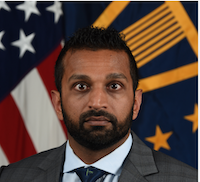 But the problem for Patel is that much of his drinking was in public in nightclubs in Las Vegas and Washington DC. At trial, the defense can call on staff and other guests at those places to give testimony. It also does not help that he has the bug-eyed look of a drunk.
But here’s the real kicker.
In an interview with The Atlantic‘s Hanna Rosin, on April 23rd, Sarah Fitzpatrick said that she stood by every word of her piece and that, since publication, she has been inundated with new sources reaching out to her to corroborate the story.
Patel is an immature idiot. I think he has cooked his own goose. He is an obnoxious person and there are probably many people who have worked for him or otherwise have had interactions who would really like to see him gone.
He clearly realizes that his tenure as head of the FBI is hanging by a thread and has been desperately sucking up toTrump, praising him lavishly, such as after the recent WHCD shooting. But the question is for how long Trump, susceptible as he is to flattery, will tolerate someone who is widely perceived as a loser and creates such a distraction.
For The Orange Turd, the distraction is probably the most appealing thing. He bounces from one failure to another with the intent that the latest failure will distract from the previous failure. And always, the point is to keep us from insisting that the Trump-Epstein Files be released. It is failure all the way down. That Patel is not a woman has probably saved his ass from being fired up to this point.
> “Upon exiting the arena,” he wrote, “the officer placed me under arrest for public intoxication, as I was not yet of 21 years of age.”
>
> Patel said in his letter that he’d had two drinks and paid a fine following the arrest.
I do not think anything as innocuous as two drinks when 20 years old should be held against someone 20 years later.
That said, I’ve had plenty of drinks at that age (legally, in my country) but I’ve never been arrested for “excessive cheering” at a sports game. I suspect a lot more than two drinks need to be involved before the cheering becomes so much more than the usual excessive cheering at a sports game that the police need to get involved.
But even without the aged student drunkenness examples, I think there’s enough evidence to show a problem…
The only thing that his minions can be certain of is that at some point Trump will throw them under the bus.
Template for all members of the Trump administration:
“[dotted line for name] is an immature idiot”.
.
Hegseth is another weirdo. He thinks he is performing in professional wrestling, every statement is overblown and cringy. The hypermasculine amateur performance makes my brain melt every time I watch and hear him blathering.
.
Then we have Stephen Nosferatu Miller and JFK Jr, the latter possibly one of those shape changing space lizards David Icke thinks are among us. He is trying and failing to emulate human behaviour.
Gross grandpa Giuliani still keeps popping up on occasion.
.
Wossname fat bald bastard who called Jimmy Kimmel a name is either a golem or a zombie.
.
Lindsey Graham is technically not a part of the administration. Or do Trump’s catamites count?
(I am not venting. I am actually holding back.)
Patel should never have gotten near any job that involves public service. He is indeed a disgraceful human being. I will be glad when he goes. But I am certain that any replacement, while different in the details, will be as bad or worse.
Good lord, in that photo he has the bug-eyed look of Gowron, son of M’Rel, Chancellor of the Klingon Empire. I fear he will not bring glory to his house.
“Patel is the perfect Head of the FBI. All the mob Bosses are saying so. They gather round MY table, each with a tear in their eye, as they compliment ME at the ongoing growth of the Criminal-Industrial Complex*. Then I stand and each one kneels and kisses the Ring. FUCK!, it’s great to be KING.”
.
.
* gives new meaning to C-in-C
Every accusation is an admission.
Obviously they lie a lot. So much so I almost didn’t even think to mention it. Feels almost like saying there’s air in the atmosphere. But the accusation that it’s all political feels a lot like a backhanded acknowledgement that Patel is a partisan hack who is running the place like some minor fiefdom in service to king Trump.
In the article it’s kind of a throw-away line that is only mentioned twice. But if we ever want to be a nation of laws again then we can’t lose sight of how aberrant that is.