
A pair (not really a pair, they were of two different species) spent a few months on the International Space Station. The article about them says “Two ‘spidernauts’ were studied to see how they adapted to microgravity – with surprising results,” but doesn’t bother to say what the surprise was.
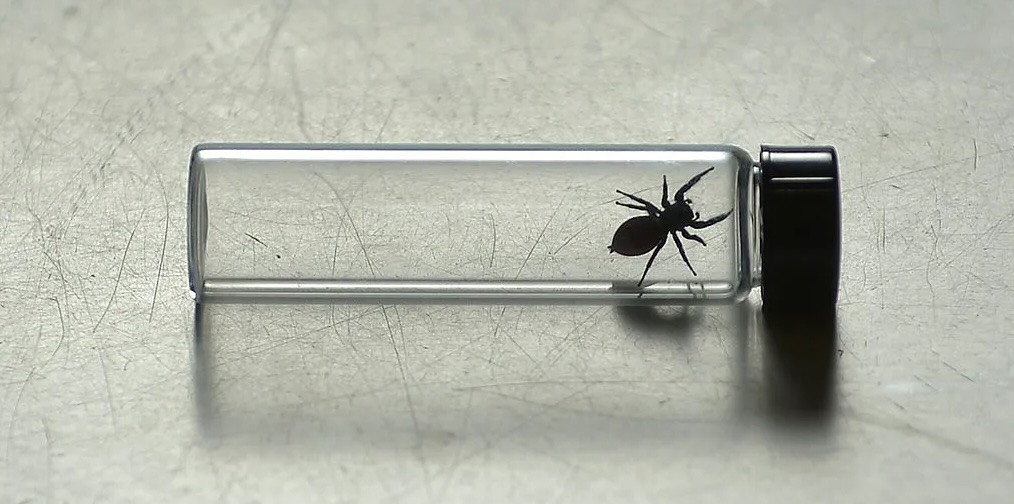
WASHINGTON, DC – NOVEMBER 29:at the Smithsonian National Museum of Natural History on November 29, 2012 in Washington, D.C. Nefertiti, the Johnson jumping spider, has found a new home at the Insect Zoo in the Museum of Natural History, after a 100 day voyage in space as a resident aboard the International Space Station. (Photo by Ricky Carioti/The Washington Post)
I think the surprise was that there was no surprise — they adapted to microgravity easily, which is what I’d expect. These are two animals who go through life constantly tethering themselves to their environment with a silken dragline. Of course they were able to cope with a space environment. They orient themselves with tactile senses, and were probably just surprised at how much easier and more effective their jumping was.
Sadly, they did not last long on return.
The mission set a record for longest time spent in space by a spider (100 days). While Cleopatra died on returning to Earth, Nefertiti would also become the first spider to survive the voyage home, and successfully readjusted to gravity.
After her marathon mission, she was destined for a long, cosy retirement. She was put on display at the National Museum of Natural History in Washington, where she was placed in a custom enclosure and died four days later.
Again, this is not surprising. Jumping spiders are not long-lived species even when not launched up into orbit on a rocket.
However, I do not appreciate hearing about death shortly after retirement, with my own retirement only a year away.

They need to send somebody to the space station that knows how to take care of spiders.
PZ, you’re not doing anything next year.
Given your recent accidents, I would for the time being recommend against going to space. That in itself might significantly increase your survival chances after retirement.
The common factor in the demise of those spiders was a space flight. You’ll be OK just don’t become an astronaut.
@2. drdrdrdrdralhazeneuler : Actually microgravity and weighlessness would probly be very good for the knees and feel pretty great albiet a few minor side effects which don’t matter if you stay in space.
Coming back to gravity afterwards OTOH is when things won’t feel so good..
StevoR, ahem. Not really.
https://en.wikipedia.org/wiki/Effect_of_spaceflight_on_the_human_body#Bone_and_muscle_deterioration
Preparation for my secret plan to put little space suits on spiders so they can build webs in space to capture space debris. In zero gravity, as long as we crank up the oxygen a bit, we should be able to grow really big spiders.