
Oooh, pretty.
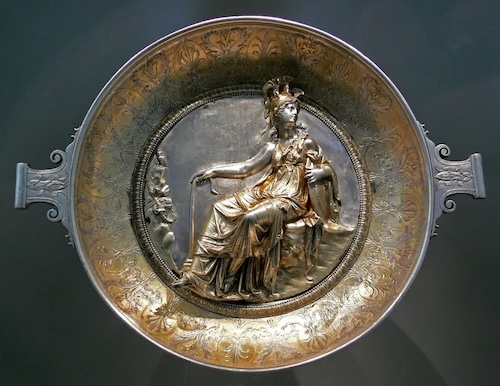
That’s something called the Athena Bowl, a treasure recovered from a buried hoard in Germany.
In 1868, soldiers from an Imperial Prussian Army regiment discovered a hoard of dozens of ancient silver artifacts while constructing a new shooting range near the city of Hildesheim in central Germany. The Hildesheim treasure included elaborate and expensive tableware, including the Athena bowl, that may have belonged to Publius Quinctilius Varus or another Roman military commander who fought against Germanic tribes in the first century.
Fortunately, it ended up in a museum. If I found it, I’d be proudly serving soup in it. In my neighborhood, though, all we ever dig up is the occasional fossil and worthless old rocks.

Looks like a quaich (https://en.wikipedia.org/wiki/Quaich).
So I’d be drinking beer out of it?
WHERE ARE MY LEGIONS?!?!
Makes me want to visit the Old Museum again. But the best exhibits are still in the penis room or the ancient Byzantine rolling ball sculpture.
Given the classical context, it’s probably safer to equate this vessel to the Greek kylix (a handled bowl for drinking wine) or the Roman patera (a bowl or saucer, usually for libations of wine, though technically those don’t have handles), rather than a specifically Celtic type of drinking vessel. Give the clear depiction of a goddess never associated with making merry, I’d be surprised if this wasn’t a religious item for ritual offerings, rather than domestic or party ware. A Dionysus, maenad or pan would probably be more usual for drinking vessels of the sort used at a symposium or cena. That we have Athena (Minerva) here probably lends a little weight to the notion that this was owned by a military man, though it’s far from certain. Minerva’s military aspect was widespread, but she was a patron of so much else that it’s unsafe to assume an entirely military context for this. It’s just as likely to be a craftsman’s master-piece giving thanks to a goddess of handicrafts and technical skill.
Of course, it is entirely possible that frontier communities at the edge of the Graeco-Roman world had very different opinions on the uses of traditional Greek and Roman religious imagery than someone back in the cultural heartlands would. Or not. It is quite plausible that wealthy Romans or Romanising elites on the frontiers would try to be as ostentatiously Roman as possible to assert their cultural identity. I am reminded that most of the best pottery depictions of Greek theatre come not from Athens but from the fringes of Magna Graecia in southern Italy, a marker of belonging to the Hellenic cultural sphere in opposition to the native Italic one.
The wikipedia page for the so-called “Kensington Runestone” says the scientific consensus is that it is a 19th century hoax, but goes on to snidely say:
Yeah, I’ve been to the Runestone museum. It’s embarrassing.
P Z it is now your task to bury, and “accidentally” find, something that looks like a pre-columbian Antikythera mechanism.
That is a fantastic bit of silversmithing, though I don’t know where Celtic applies since that is clearly Roman.
Burying treasure hordes is a Germanic tradition, and my genes smile at the idea it was taken from Varus.
Come into the forest my pretties. Arminius has a surprise for you.
Linguists stating facts is not snide. I too would find it annoying to repeatedly debunk the notion that Vikings somehow made it to Minnesota. It would be in younger Fuþark runic script, if authentic to that period.
Since it is written in 19th century Swedish it is clearly not a Viking age artifact.
Oh, that’s pretty snide by Wikipedia standards — more like what I’d expect from RationalWiki. Is there, in fact, any decent evidence that the Norse got further west than L’Anse-aux-Meadows (which I’ve been to, and I heartily recommend to anyone who gets to Newfoundland, which I also heartily recommend. Especially if you’re a geo-nerd — seriously, Mistaken Point, two GSSPs, and the whole place is the debris of a stupendous tectonic collision — how can you not have that on your bucket list?)
There are other hoax rune stones found in North America. It is very cool that archeologists have confirmed that Vikings did indeed sail all the way to Newfoundland and smelted some iron while they were here.
Vikings spoke Old Norse, which is an entirely different language than Swedish. YouTube is full of people that make woo-filled claims about runes and Vikings. I expect it’s just as infuriating to linguists as all the misinformation about ancient aliens is Archeologists.
https://www.sudbury.com/columns/back-roads-bill/wawa-runestone-reveals-mysterious-viking-era-carvings-in-ontario-11783948#
Now that’s a super bowl!
A super bowl for wisdom – or at least the Goddess thereof..
Nice find indeed and if only wisdom was respected as much or more than so many other things that those in the USoA do seem to worship.
Sigh.
Runestones are so common. I want to hear that PZ has found moroni’s gold plates in his backyard!
One more thought: if it’s a ‘drinking bowl’ the design is very thoughtful since the two handles will make it easier to hold onto if you’ve already had a couple of bowls-full.
@12 StevoR couldn’t refrain from nasty blanket insults of everyone in our country: ‘if only wisdom was respected as much or more than so many other things that those in the USoA do seem to worship.’
My partner was reading this and remarked, ‘insulting us all like that, I hope he gets kicked in the head by a kangaroo. Oh, wait, maybe he already has.
@ ^ shermanj : I was referring to the Trumpists and their cult with its ugly orange idol, about the various other Christianist cults eg televangelists and especially here the Superbowl and American football / Gridiron (?) sport being worshipped over wisdom which, yes, was a generalisation, yes. Guess I’d should have used “many people in” rather than those but then I’d be accused of being too verbose so I can’t really win?
One I think a lot of Americans including many others commenting here would agree with me about. It’s not exactly secret that US culture has long had a heavy strain of anti-intellectualism running through it. Dunno why you feel the need to take that personally when it wasn’t referring to you personally & thought it was a pretty commonly held view elsewhere.
[meta]
No. Difference between a particular and an universal, is what it is. ∀ vs ∃
‘many of’ or ‘some of’ is not exactly over-verbose, either.
By Americans you mean “those in the USoA”, right?
See? Different term, same sense. This time you quantified it (‘a lot of’), and it works!
(Other than South Americans are also Americans, as are Mexicans (who also are United States), and even Canadians. But we know you mean USAnians)
Your blanket condemnation of everyone in the entire country where we live is very clear. Trying to weasel word it to not mean what you exactly said is disingenuous. Such muddled self-contradictory commenting leads me to think maybe you were kicked in the head by a kangaroo.
While I have a friend there who created a wonderful version of Linux, Australia is not without it’s xtain terrorist rightwingnuts, either.