We know a lot about the sexy bits of male cephalopods — ask about hectocotyl arms and spermatophores sometime — but would you be surprised to learn that we don’t know much at all about squid ladybits? Of course you wouldn’t.
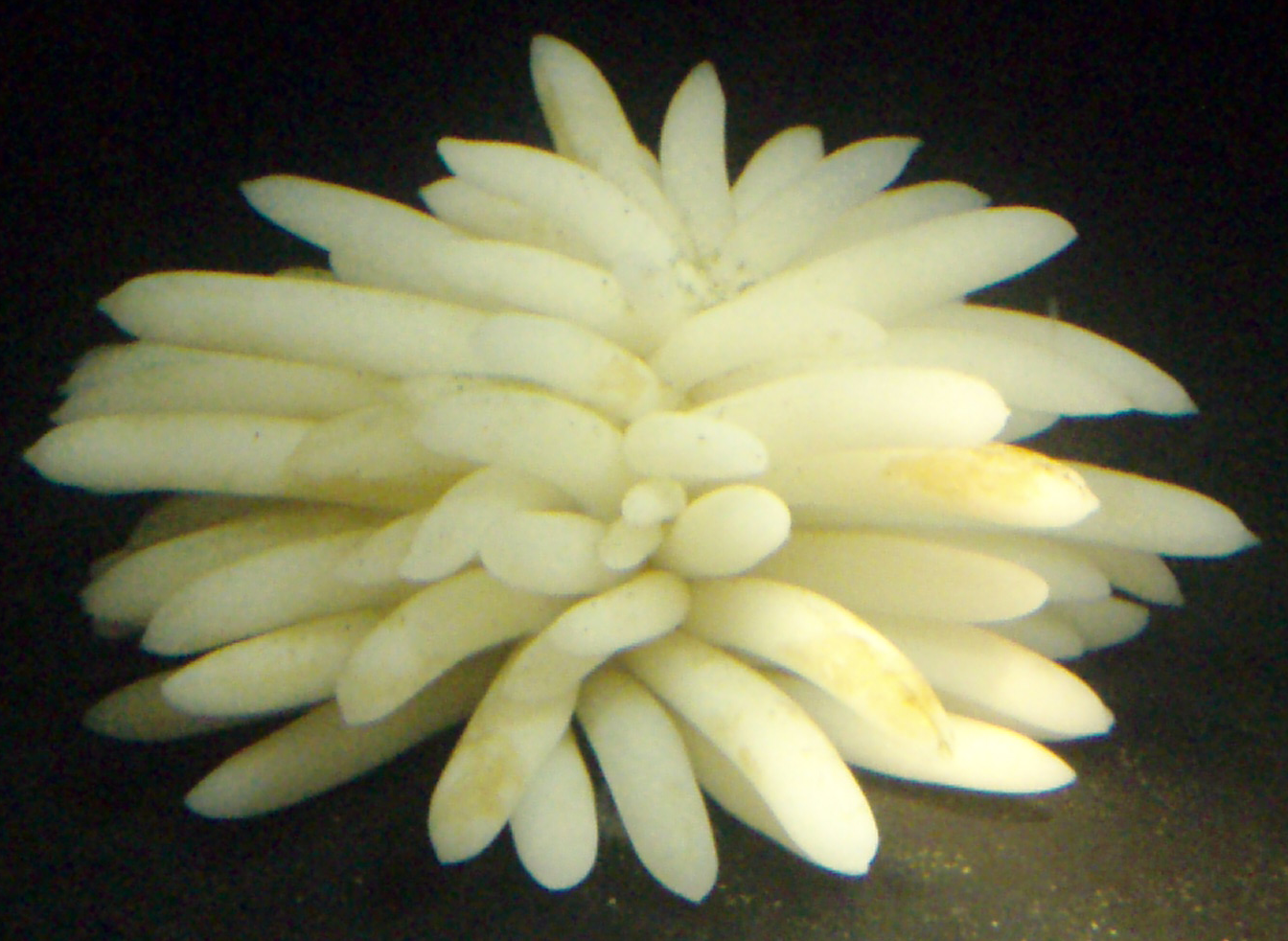

We know a lot about the sexy bits of male cephalopods — ask about hectocotyl arms and spermatophores sometime — but would you be surprised to learn that we don’t know much at all about squid ladybits? Of course you wouldn’t.

Here, have a nice comic that explains the situation in Lake Erie.
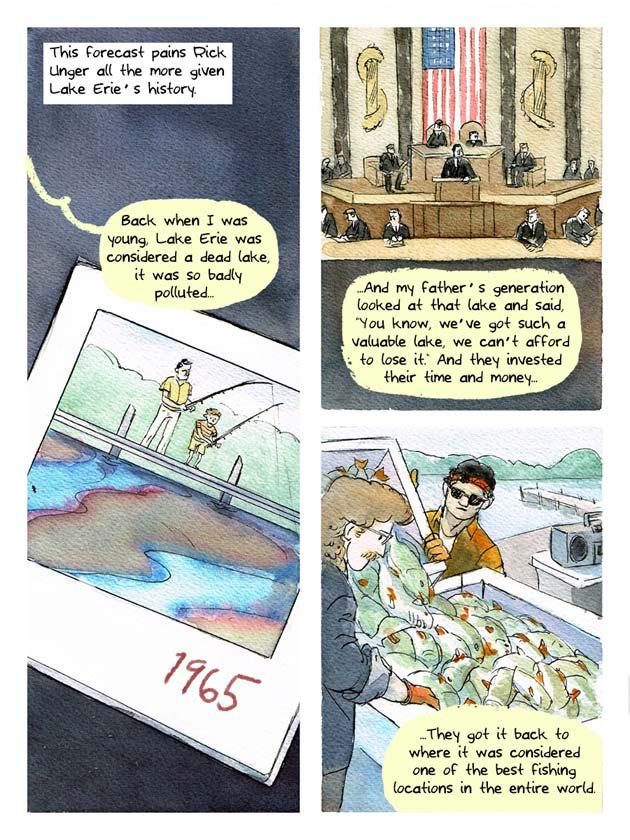

When I was a kid, Lake Erie was a joke: it was a polluted cesspool with rivers that caught on fire. Places like Erie and Love Canal were the punchlines of a national sense of disgust with abuse of the environment, and amazingly, people got together and changed things: new tighter regulations, clean up of the worst cases (well, that was begun but never finished), and in general, we saw a reduction in pollution around the country.
Then…fucking Ronald fucking Reagan fucking fucked everything up. Trees cause pollution. Regulation is bad for the economy. And every Republican since has followed the same script, right up to “drill baby drill”. Even the Democrats are getting in the act.
And the end result is that everything is turning to shit again.

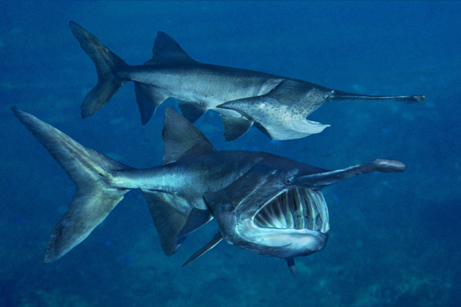
I have never seen a paddlefish in the wild, although I’ve seen young adults and embryos in the lab — they are quiet, secretive beasts, cruising gape-jawed through our regional rivers to dine on plankton, and growing to immense size without ever troubling anyone. They are gloriously weird animals. But they are in danger of extinction because they also produce voluminous quantities of eggs, also known as caviar. A large female can carry $40,000 worth of eggs, so they are fished up, ignominiously slit open and disemboweled, and left to rot on the river bank.
It’s a real shame. Once again, we hunt a spectacular North American native species to extinction, all because of greed.

Lenar Whitney, Republican congressional candidate from Louisiana, dared to use that line from Orwell while accusing virtually every climate scientist in the world of lying.
Practically every word in that monolog is a lie, or a product of exceptional ignorance. And the terrifying thing is that she knows it.
… when I pressed Whitney repeatedly for the source of her claim that the earth is getting colder, she froze and was unable to cite a single scientist, journal or news source to back up her beliefs.
To change the subject, I asked whether she believed Obama was born in the United States. When she replied that it was a matter of some controversy, her two campaign consultants quickly whisked her out of the room, accusing me of conducting a “Palin-style interview.”
Unbelievable. But these are the people dominating the Tea Party right now.
By the way, here’s the summary of the recent IPCC report (pdf), if you want to see the data that Whitney pretends doesn’t exist.

This could be bad. For years I’ve been hearing about the nightmare scenario of global ocean warming rising to a level that triggers the release of methane hydrates locked up deep in the ocean, which then lead to a major accumulation of greenhouse gases. It basically tips over the rate of warming from one regime into another, faster period of heating, very abruptly.
Well, guess what…
Vast methane plumes have been discovered boiling up from the seafloor of the Arctic ocean on the continental slope of the Laptev Sea by a dream team of international scientists. Over the last decade a warming tongue of Atlantic ocean water has been flowing along the Siberian Arctic ocean’s continental slope destabilizing methane ice, hypothesize the team of Swedish, Russian and American scientists. The research team will take a series of measurements across the Siberian seas to attempt to understand and quantify the methane release and predict the effect of this powerful greenhouse gas on global and Arctic warming. Because the Siberian Arctic contains vast stores of methane ices and organic carbon that may be perturbed by the warming waters and Arctic climate, Arctic ocean and Siberian sea methane release could accelerate and intensify Arctic and global warming.
It’s like humans are blithely giving the little nudges that start an avalanche, and then afterwards we’ll look at each other and say “I didn’t do it, it was deep ocean methane!” Or rather, we’ll try to say that while struggling to keep from drowning or cooking.

Our new residents are getting a bit cocky — they strolled up to my back door and were peering into our dining room. And then when I rapped on the window, they sucked their teeth at me and went about their business.
They may be plotting a takeover.

It’s been 25 years since Gould’s Wonderful Life: The Burgess Shale and the Nature of History
Gould’s answer was no — that the role of chance was too great, and because the forms of life do not represent optimum ideals built by perfectly plastic forms, but rather are kludges built atop limiting and enabling prior adaptations. Some people, like Simon Conway Morris, argue otherwise that there are ideal forms (including us bipedal anthropoids) upon which life will tend to converge. I favor Gould’s view rather strongly — it’s absurd to talk about evolution without an appreciation that all organisms are the product of history, and that what traits we have now are almost entirely contingent on what traits our ancestors had.
My favorite example of the error of limited thinking about adaptive ideal forms is a comparison of bony fish and squid. Both are fast swimming, active predators that are torpedo shaped in motion (physics constrains that!), but in detail everything is completely different. If the pre-Cambrian ancestor of all chordates were accidentally squashed, there is no reason to assume that the pre-Cambrian ancestor of all molluscs would then evolve a line of torpedo-shaped predators with brainy skull at the front and an undulating muscular body for propulsion. Why should they? They have a demonstrated capacity in our universe to evolve into torpedo-shaped predators with tentacles at the front and propulsion via a jet of water squirted out of a muscular mantle cavity.
The body plan of the ancestor dictates what capacities the descendant will have. There is no reason to assume that the world as we see it now was inevitable — that’s simply a failure of imagination and reason.
An article by Zach Zorich explores other examples of evolutionary contingency. Much of it is dedicated to that fascinatingly concrete example of actually being able to roll back the tape of life, the Lenski experiments, in which populations can be frozen and restarted at any time. In that case we seen on a molecular level that the evolution of specific biochemical problems is not inevitable at all, but depends entirely on the presence of prior mutations. History, and your parents, matter!
But I also like this example.
“Not everything is possible,” no matter the process, Wake explains. “Organisms evolve within the framework of their inherited traits.” Organisms can’t pass on mutations that kill them or prevent them from reproducing. In the case of Hydromantes salamanders, their ancestors had to overcome a serious limitation: To acquire their ballistic tongues they had to lose their lungs. That’s because their tongue partly derives from muscles that their predecessors instead used to pump air into the lungs. Now, that formerly small and weak muscle is much larger and stronger. It wraps like a spring around a tapered bone at the back of the mouth, and when the muscle squeezes, the bone generates the force that fires the tongue along with its bones out of the mouth. So, Hydromantes’ ancestor did not simply acquire a mutation and evolve a fast ballistic tongue. Instead, the adaptation followed a series of mutations that first enabled the creature to overcome its reliance on lungs for oxygen and buoyancy control. Each change was contingent on the one before it.
Chameleons, on the other hand, retain their lungs. Instead of re-tooling their lung anatomy, they have evolved a piece of collagen that allows them to catapult their tongues at prey. On the surface, salamander and chameleon tongues converge, but not upon closer inspection. It takes a chameleon 20 milliseconds to shoot its tongue at its prey, a positively glacial pace when compared to the Hydromantes’ five-millisecond firing time. Why are chameleons stuck hunting with such slow tongues? The answer is that they have encountered a kind of obstacle to convergent evolution. The chameleon’s tongue is fast enough to ensure their survival, but they lack the “framework of inherited traits” to evolve the salamanders’ deadlier ballistic anatomy. The chameleons have reached what biologists call an “adaptive peak.”
Before anyone says that ballistic tongues represent an example of convergence, too, I’ll agree…but with the caveat that this is an example of modifying extant traits in the tetrapod toolkit. Two vertebrates evolved ballistic tongues, because they share the trait of having tongues. Squid also have a high speed prey capture mechanism, only lacking tongues, they use a pair of arms.
As D’Arcy Wentworth Thompson put it, “Everything is the way it is because of how it got that way.” You can’t appreciate evolution unless you also recognize the path it takes…it’s all about the trajectory.

If you’ve been following the world of Twitter (cue chorus of people who insist they’d never ever use stupid ol’ Twitter), you know that there’s been one of those epic corporate missteps: The CEO of Twitter, Dick Costolo, volunteered to answer questions sent to…a hashtag on Twitter, #askcostolo. What followed was amusingly voluminous, as the angry horde of Twitter users rose up as one to flood the hashtag with their anger at the incompetence of the company in providing tools to deal with abusers. As currently configured, Twitter makes it easy to sign up willy-nilly for anonymous accounts and for users to make racist and misogynistic threats without fear of punishment, or to create accounts solely for the purpose of stalking people online…and there are thousands of Dennis Markuzes out there, fulminating obsessively and hiding behind a flurry of throw-away accounts, all happily enabled by the mostly male engineers at Twitter.
And that’s the real problem, that Twitter won’t even take the basic steps of making it possible for users to block repeated harassers. It’s not clear why; it is clear that they don’t seem to think rape threats are actionable issues.
Anyway, one person made some simple suggestions for the least Twitter could do.
Block all users whose accounts are less than 30 days old
This is easy—it takes an arrow out of the quiver of serial harassers who use alternate accounts generated as needed.
Block all users whose follow counts are less than whatever threshold users set
Google used the social proof of “back links” to establish credibility and ranking for content over 16 years ago. This is old hat by now. Users should be able to block anyone who can’t convince other people to follow them.
Rings of followers created just to subvert this will have to be detected.
Again, hire a Google engineer. They’ve cracked this one.
Block new users whose @replies include any words the user decides
Users who are on the receiving end of harassment face startlingly unimaginative adversaries. The same slurs and threats are used over and over. Brand new account with no followers using the n-word? Block!
That’s stupidly easy to express algorithmically.
Block any user who has been blocked by more than N people I’m following
Let’s also share the load. If all your friends block someone there’s a decent chance you’ll want to also.
Auto-blocks are opaque
There should be no feedback when a behavior triggers these measures. The harasser should believe that everything is working as normal.
The first two suggestions are a bit problematic in that there are easy ways to get around them: the obsessed stalkers will just build up a small population of sock puppet accounts that will also link merrily to each other. It’s a bit of work and requires long term planning, but really…that’s what these loons do. They also put up barriers to brand new users.
But the others…wow. Do you realize that Twitter lacks even the most basic functionality of enabling keyword filters? We’re talking 1990s technology here, and the brilliant minds at Twitter corporate are unable to grasp the concept. They also violate basic security concerns: if you are being harassed, and you block an account, the owner knows right away to switch to one of his backup sock puppets.
One example: If you follow @AngryBlackLady, who writes about reproductive justice and racism, you know that she has been harrassed nonstop for two years by a goon who makes new twitter accounts just about every day, specifically to dun her with racist slurs and misogynistic noise:
Some of the smartest ppl in tech work at twitter, yet they won't/can't fix the abuse problem. #askcostolo #assholster pic.twitter.com/mwePtNBSQ7
— Imani ABL (@AngryBlackLady) August 3, 2014
This is basic. This is easy. Any idiot could provide functionality that would reduce this problem. Twitter, apparently, only employs exceptional idiots.

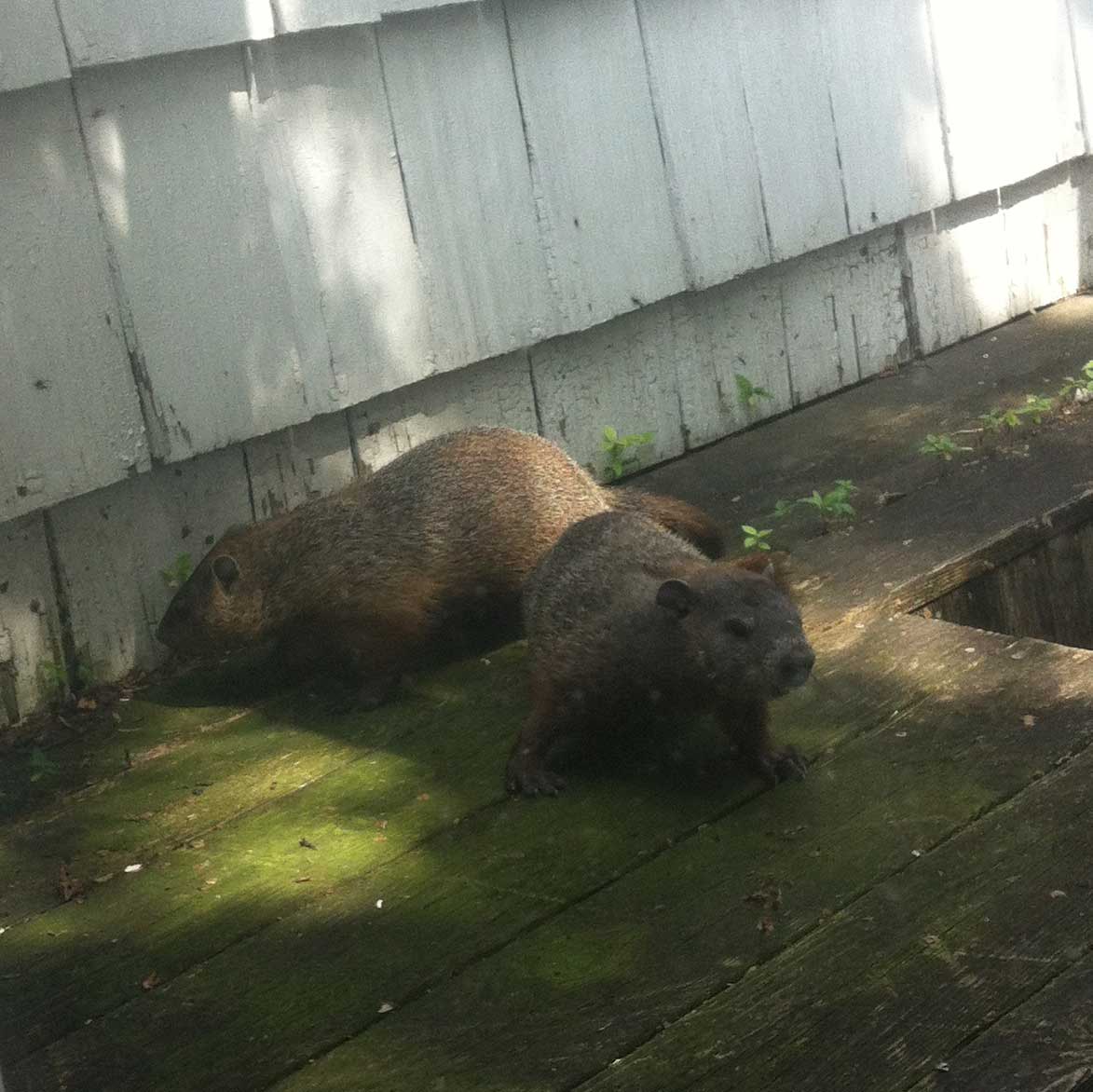
We’ve been invaded by a pair of groundhogs who have taken up residence under our deck, and are apparently dining grandly on our weedy overgrown backyard. They’re evasive, though, and I’ve only got this one poor shot of one of them resting in the dappled shade.

OK, here’s a clearer shot of what they look like from the web.
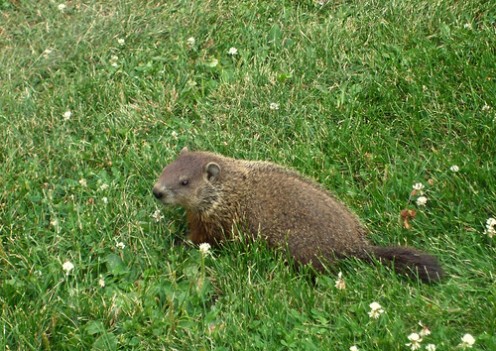
These two are big beasts, and they probably outweigh our cat, who claws frantically at the door to the deck when they make an appearance. I have mixed feelings about their presence — on the one hand, they have gnawed on things in the past, and now we’ve got a mating pair — but on the other hand, they are native Minnesotans. Maybe I should leave them be.
On the third hand, they do look rather plump and meaty, and if we weren’t all vegetarian, might be tempting to toss in a stewpot…

He’s been catching some flak for his comments on GMO foods, but I agree whole-heartedly with what he says here (except I don’t think “non-perennial” means what he seems to think it means…astronomers, geez).
Ten days ago, this brief clip of me was posted by somebody.
It contains my brief [2min 20sec] response to a question posed by a French journalist, after a talk I gave on the Universe. He found me at the post-talk book signing table. (Notice the half-dozen ready & willing pens.) The clip went mildly viral (rising through a half million right now) with people weighing in on whether they agree with me or not.
Some comments…
1) The journalist posted the question in French. I don’t speak French, so I have no memory of how I figured out that was asking me about GMOs. Actually I do know some French words like Bordeaux, and Bourgogne, and Champagne, etc.
2) Everything I said is factual. So there’s nothing to disagree with other than whether you should actually “chill out” as I requested of the viewer in my last two words of the clip.
3) Had I given a full talk on this subject, or if GMOs were the subject of a sit-down interview, then I would have raised many nuanced points, regarding labeling, patenting, agribusiness, monopolies, etc. I’ve noticed that almost all objections to my comments center on these other issues.
4) I offer my views on these nuanced issues here, if anybody is interested:
a- Patented Food Strains: In a free market capitalist society, which we have all “bought” into here in America, if somebody invents something that has market value, they ought to be able to make as much money as they can selling it, provided they do not infringe the rights of others. I see no reason why food should not be included in this concept.
b- Labeling: Since practically all food has been genetically altered from nature, if you wanted labeling I suppose you could demand it, but then it should be for all such foods. Perhaps there could be two different designations: GMO-Agriculture GMO-Laboratory.
c- Non-perennial Seed Strains: It’s surely legal to sell someone seeds that cannot reproduce themselves, requiring that the farmer buy seed stocks every year from the supplier. But when sold to developing country — one struggling to become self-sufficient — the practice is surely immoral. Corporations, even when they work within the law, should not be held immune from moral judgement on these matters.
d- Monopolies are generally bad things in a free market. To the extent that the production of GMOs are a monopoly, the government should do all it can to spread the baseline of this industry. (My favorite monopoly joke ever, told by Stephen Wright: “I think it’s wrong that the game Monopoly is sold by only one company”)
e- Safety: Of course new foods should be tested for health risks, regardless of their origin. That’s the job of the Food and Drug Administration (in the USA). Actually, humans have been testing food, even without the FDA ,since the dawn of agriculture. Whenever a berry or other ingested plant killed you, you knew not to serve it to you family.
f- Silk Worms: I partly mangled my comments on this. Put simply, commercial Silk Worms have been genetically modified by centuries of silk trade, such that they cannot survive in the wild. Silk Worms currently exist only to serve the textile industry. Just as Milk Cows are bred with the sole purpose of providing milk to humans. There are no herds of wild Milk Cows terrorizing the countryside.
5) If your objection to GMOs is the morality of selling non-perennial seed stocks, then focus on that. If your objection to GMOs is the monopolistic conduct of agribusiness, then focus on that. But to paint the entire concept of GMO with these particular issues is to blind yourself to the underlying truth of what humans have been doing — and will continue to do — to nature so that it best serves our survival. That’s what all organisms do when they can, or would do, if they could. Those that didn’t, have gone extinct extinct.
In life, be cautious of how broad is the brush with which you paint the views of those you don’t agree with.
Respectfully Submitted
-NDTyson
