Learn to love your spiders!

Well, this is discouraging.

Scientists asked almost 1,800 people to rate 25 species of animals according to how much fear and disgust a photo of each one elicited. The spider got equally high rankings for both fear and disgust from more people than any other animal. The spider was also deemed the scariest and nearly the grossest as well.

I find myself snuggled up in the top right corner of that chart. No wonder nobody likes me.

But there are some words of hope.

Ecologist and self-proclaimed spider ambassador Bria Marty tested whether learning about spiders can change how people feel about them for her master’s thesis project at Texas State University in San Marcos. She recruited college students to find and identify spiders using an illustrated guide and then upload photos to iNaturalist. Marty, currently a PhD student at Texas A&M University-Corpus Christi, surveyed participants before and after the activity, and one thing jumped out: Afterwards, people reported being far less likely to react negatively to a spider. “Doing an activity like this really does help a lot around fear,” she says.

This kind of change has been known to happen to iNaturalist users, says Tony Iwane, the platform’s outreach and support coordinator and a self-described spider lover. He pointed me to a thread on the site’s discussion forum about how contributing to iNaturalist helped people overcome their fear of spiders, with users sharing the “gateway spider” species that changed how they felt. For @mira_l_b, it was the particularly tiny Salticid (jumping spider) species Talavera minuta. “If I am finding myself confronting life-long fears and cooing sweetly to tiny Salticidae,” she wrote, “then there’s hope for us all!”

The author is advocating a big spider counting exercise for everyone, which sounds like a good idea to me. Except this is not the best time of year for it — spiders are making themselves scarce right now, hiding from the winter onslaught, but you can still find lots of spiders in your houses.

So go find them and say hello!

Is Eric Hovind trying to provoke me?

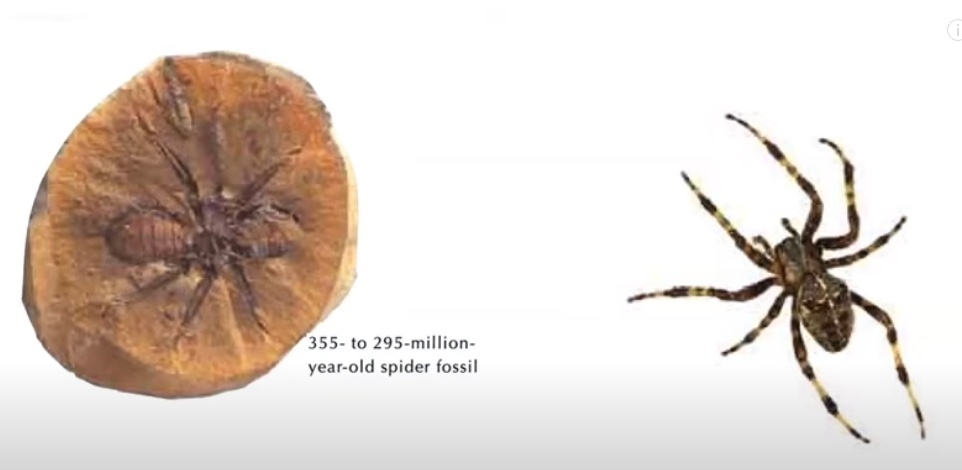
He’s succeeding. He has this new series of videos titled “Beyond Darwin,” in which he tries to claim that fossils disprove evolution. It’s warmed-over Harun Yahya bullshit. You know, show a picture of a fossil, then show a picture of a modern animal, and declare, A-ha! There’s no difference between them!

It’s all perfectly ignorable nonsense, except he roused me from my slumber with this: SPIDERS DISPROVE EVOLUTION!

What a pitiful effort. Let’s scrutinize his example of failed evolution, shall we?

On the right, that’s a familiar beast: that’s a modern Araneus diadematus, or European garden spider, a big ol’ common orb weaver. It is most definitely a true spider.

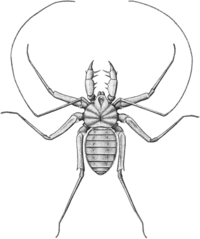
On the left is a grainy photo of a fossil. It took me a moment to figure out what that is — you might look at it and notice that it seems to have only 6 legs. Actually, it has 8, but the 2nd pair is thin and attenuated. It also has a segmented abdomen, unlike most modern spiders, and there’s something going on with it’s mouthparts. It’s an arachnid all right, but it’s not a spider. That’s a fossil whip scorpion, Weygoldtina. Here’s a reconstruction that will clarify the details.

So here’s dumbass Hovind showing us a photo of two animals with radically different morphology, coming from two different distinct orders, the Araneae and the Amblypygi, and trying to tell us they look completely the same. Then he says Maybe evolution didn’t work on that one, or it just evolved as high as it can go, two excuses that aren’t valid evolutionary concepts. He riffs absurdly, pointing out that spiders still die, as if that’s something that wouldn’t happen under evolution.

Hey, Eric, does the fact that you’re still ignorant mean that education doesn’t exist? Do you think The Atlas of Creation is a biology textbook, rather than a religious scam written by a convicted con man? This approach didn’t work out so well for him, or your dad, you know.

I guess the rotting apple hasn’t fallen far from the dying corrupted tree, I guess.


Wait! I just watched the full video from Eric Hovind (the clip above is just an excerpt), and would you believe…he comes right out and cites The Atlas of Creation at the 21 minute mark and credits it for his ideas!

He is literally pulling out examples and photos from that discredited and blatantly silly book and quoting them as evidence that we have to move beyond Darwin. (Here’s a hint, Eric: we have. Darwin didn’t have genetics or molecular biology as tools.)

Sacrifices made in the name of lust

Some spiders have a serious problem: runaway evolution sometimes produces maladaptive conditions. Here’s a spider, Tidarren sisyphoides, that exhibits extreme sexual dimorphism — males have about 1% of the mass of the females.

Male and female T. sisyphoides in copula. The minute male (indicated by the arrow) on the female’s ventrum is ≈1% of the female’s mass. (The scale bar represents 1 mm.)

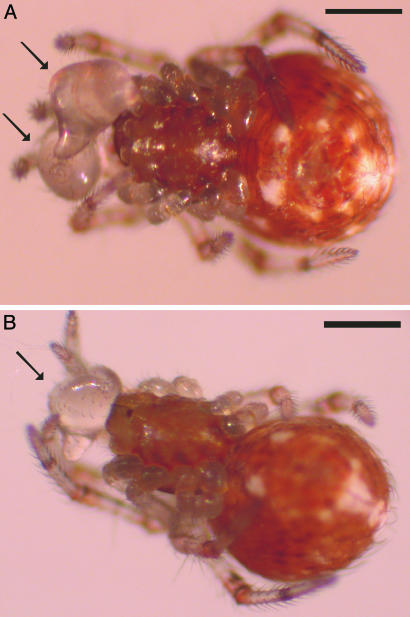
That’s not the problem, though. The problem is that the males maintain a massive pair of palps. Really gigantic. They probably clang when they walk. Look at these two big boys, and the monster intromittent organs dangling from the front of their faces.

You may notice that the top spider has the normal two palps, which are so large that they’re interfering with each other. The bottom spider has only one palp. The surprise is that this is a product of self-mutilation.

During copulation, males generally use both pedipalps in an alternating fashion to inseminate the paired spermathecae in the female. In Tidarren, however, one pedipalp is removed (either left or right pedipalp, seemingly at random) before sexual maturation which has also been described for another spider of similar size and closely related to Tidarren (Echinotheridion). Just after molting to the penultimate instar, the male secures one of its pedipalps to a silk scaffold and then twists it off by turning in circles and pushing the bulb with the third and fourth pairs of legs.

Ouch. There’s a reason for their partial emasculation, though.

We found that, for male Tidarren sisyphoides, maximum speed increased (44%) significantly and endurance increased (63%) significantly after pedipalp removal. Furthermore, spiders with one pedipalp moved approximately 300% greater distances before exhaustion and had a higher survival after exertion than those with two pedipalps. Removal of the pedipalp may have evolved in male Tidarren because of enhanced abilities to search for females (higher endurance and survival after exertion) and to out-compete rival males on the female’s web (higher maximum speed). Our data also highlight how the evolution of conflicts can result in the evolution of a novel behavior.

Not recommended for humans, unless your testicles are the size of basketballs.


Ramos M, Irschick DJ, Christenson TE (2004) Overcoming an evolutionary conflict: removal of a reproductive organ greatly increases locomotor performance. Proc Natl Acad Sci U S A 101(14):4883-7.

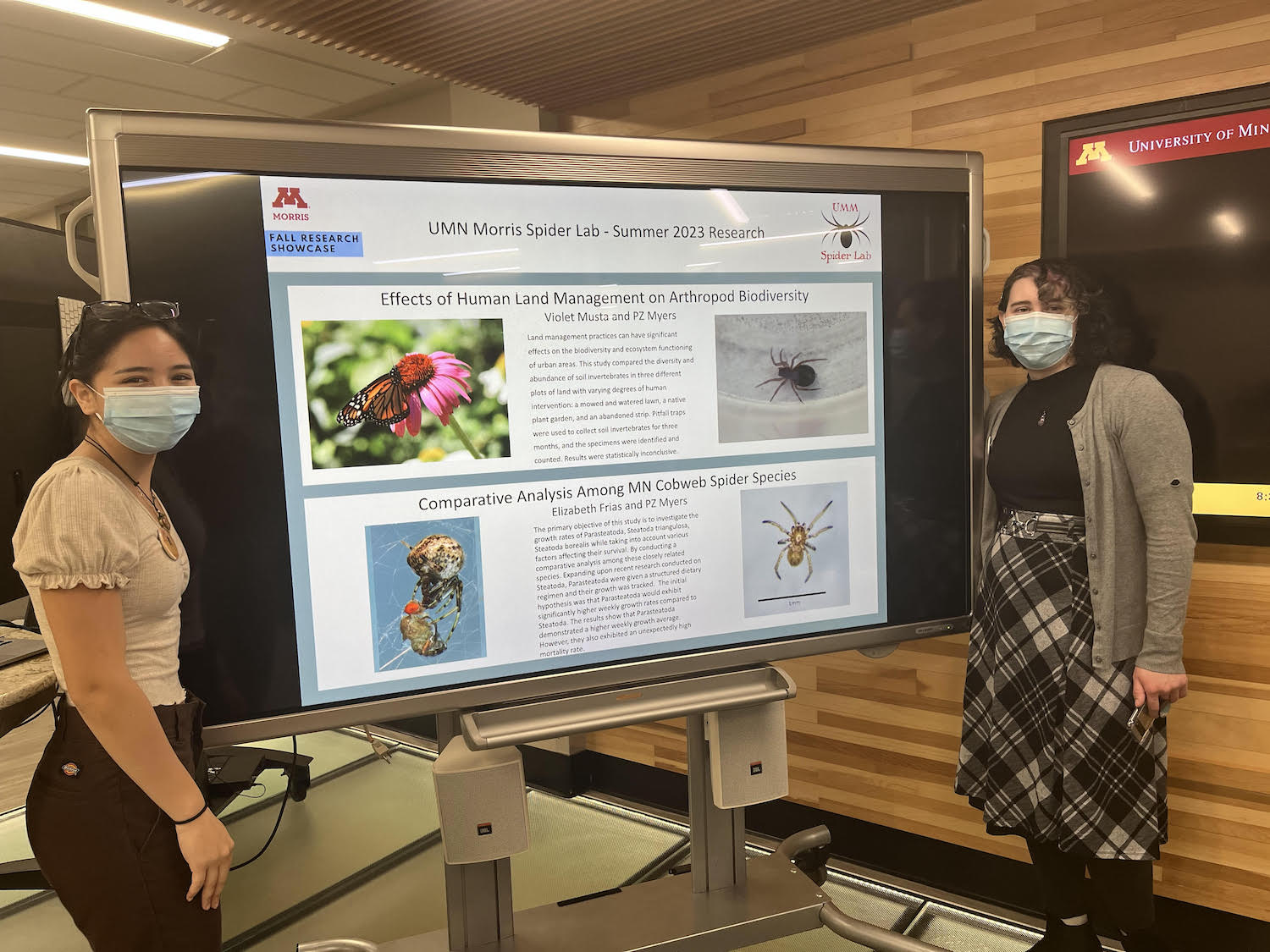
Summer research presentation time!

My students talked about their work today — this picture was taken before the crowds put them to work.

Violet took full advantage of the medium, a big screen connected to a laptop, and instead of a static display, the ‘poster’ rotated through a big collection of images. They had the prettiest poster of the group, as long as spiders are considered to belong to the category “pretty”.

MORE SPIDERS

I saw the mommy spider spin the egg sac on 21 August, and this morning, the 6th of September, they finally emerged. These are Parasteatoda tepidariorum — note the leopard pattern on the abdomen. That’ll turn into a more complex mottling as they get older. Also see how the legs are mostly pale, but with distinct bands.

Steatoda triangulosa has a longer incubation time of 30 days, and the spiderlings emerge with pale abdomens and black, hairy legs.

The important thing about this is that we can nail down how long the incubation period for both species is under our specific culturing conditions. Now we wait for the Steatoda borealis egg sac to hatch out so we know its incubation period. Then…comparative embryology!

By the way, the lab was hectic this morning, with 150 tiny baby spiders, each about 3/4 of a millimeter long, emerging all at once and immediately trying to disperse. There was a cloud of barely visible dots all radiating out instantly from the locus of their home vial, while I was frantically trying to gather up individuals and put them in separate containers. Some, I’m sure, escaped.

Hmmm, is it ever a good thing when a scientist says that?

Since I avoid posting spiders here, you’ll have to go to Patreon or Instagram to see the baby picture.

Shoes allow me to better serve my ravenous masters

I am pleased to report that for the first time in almost a month I am wearing shoes and socks, and have stuffed the ugly ol’ immobilizing boot in a closet. It feels like real progress at last. Next, I’m going to gingerly walk over to the lab and set up some class stuff and tend to my little beasties.

I know that this is the least exciting news you’ve ever heard — some guy is wearing shoes and socks! NY Times, get a reporter on that! — so here’s something that’s almost as newsworthy: false widow spiders kill and eat mammals larger than themselves.

The video shows a noble false widow’s web, located outside a bedroom window of the house in Chichester, with a small mammal ensnared in the silk. Later analysis of the mammal’s remains helped researchers identify it as a pygmy shrew.

The shrew was still alive in the web, the researchers report, although it was only seen making a few slight movements near the beginning of its ordeal. That’s probably due to the spider’s powerful neurotoxic venom, which is known to cause rapid neuromuscular paralysis.

The spider was seen moving back and forth between the shrew and the rafters above the window, using silk to hoist the shrew upward about 25 centimeters, the researchers report.

After 20 minutes, the spider had lifted its prey into the rafters, partially out of view. It wrapped the shrew in silk, fed on it for three days, and then dropped what was left out of its web.

According to the researchers, “the remains of the shrew were nothing but fur, bones, and skin”.

Now you know why, despite my recent travails, I still made the effort to guarantee the few hundred false widows in my lab a twice-weekly feeding. I don’t feed them rodents, but they do love big juicy mealworms that are at least fifty times their mass. They got fed yesterday, and today Igor…I mean, me…must extract the drained corpses. Next feeding on Tuesday.

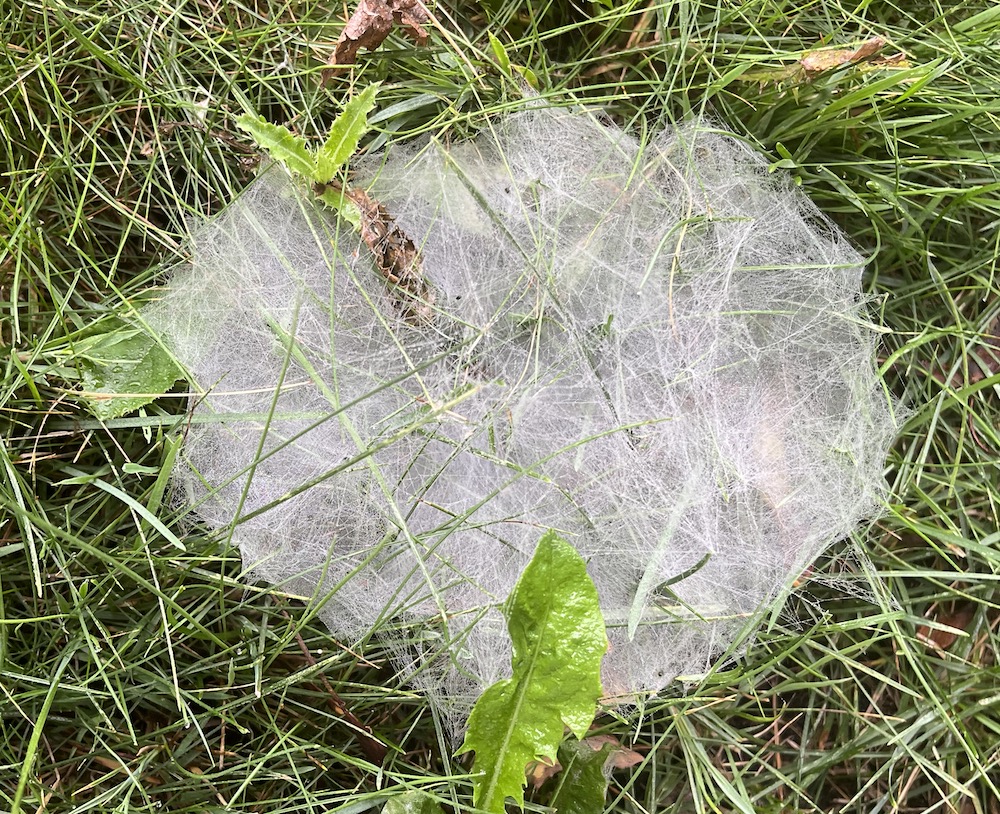
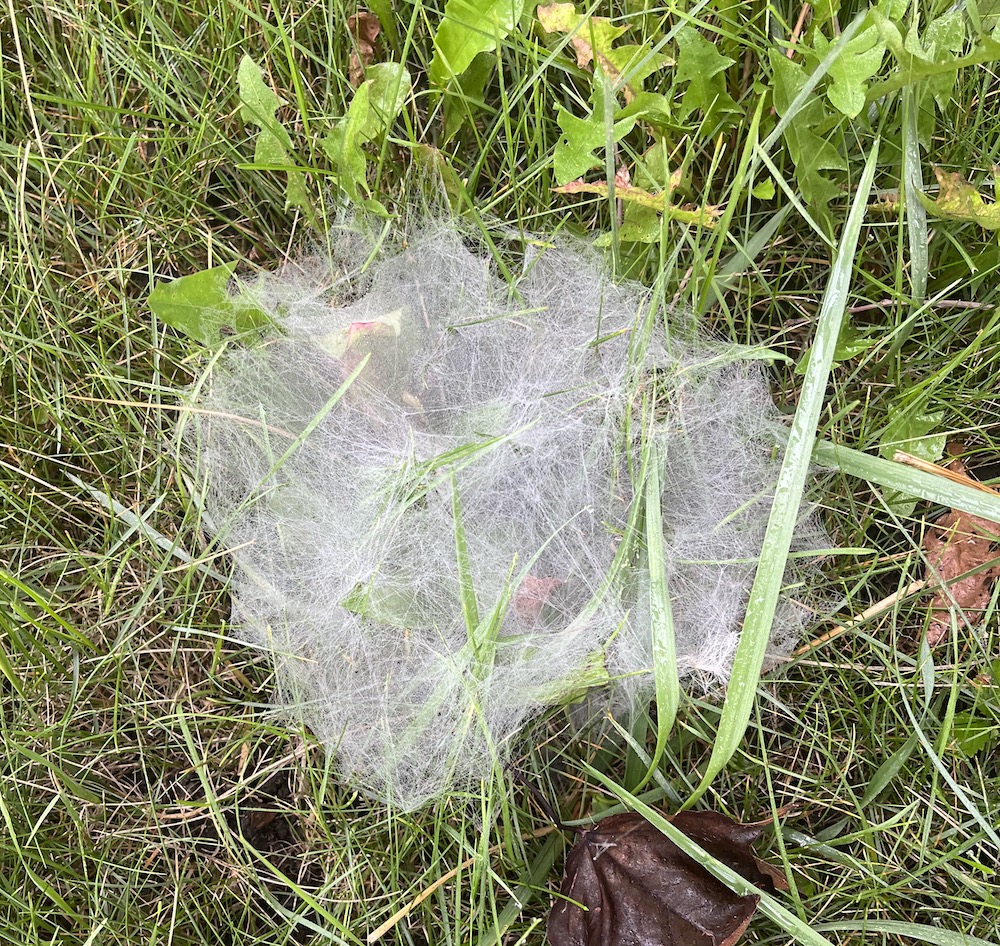
Perfect sheet webs

We’re having a little unpleasant weather — high temperatures and sky-high humidity, to the point where this morning we were socked in with a gray mist. The good thing about that, though, is that it highlights all the grass spider webs in our lawn. These are perfect and beautiful.

Yes, we have a few weeds in our lawn. It’s a yard for diverse invertebrates, so that’s OK.

Leaves? The leaves have started to fall? It’s that time, I guess.

New acquisitions

I’m home from the exotic pet fair. I acquired a Chromatopelma cyaneopubescens! And a Northern Black Widow! They’re young juveniles, now I just have to fatten them up.

Photos will follow once I have them set up.