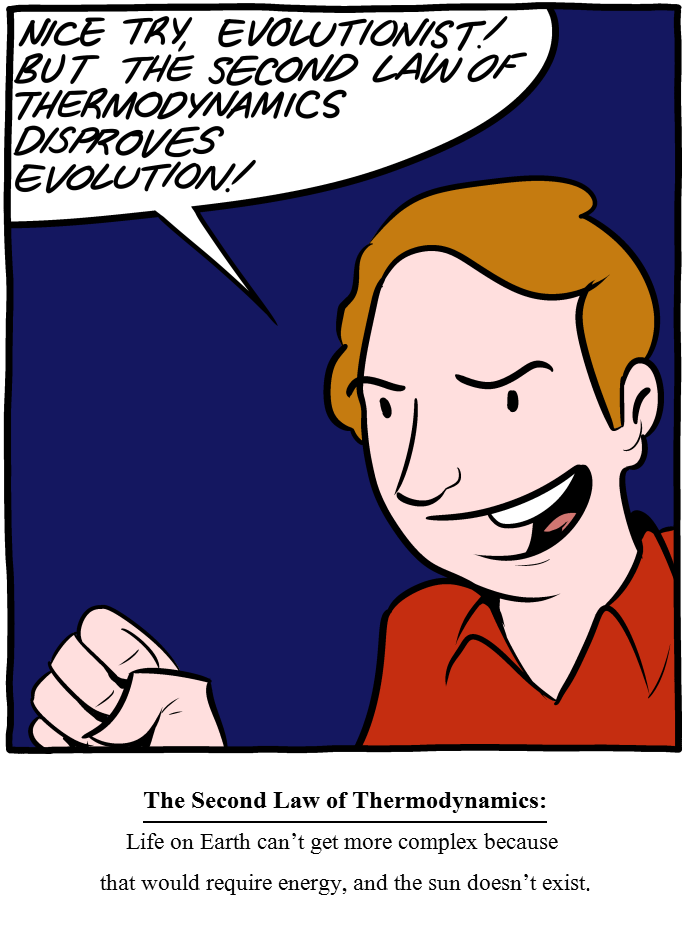
I think I’ve heard this argument a few thousand times now.
Pharyngula
Evolution, development, and random biological ejaculations from a godless liberal

I thought it was simple plagiarism, but it turned out to be so much worse. Commenter A. Noyd discovered that anti-creationist arguments posted here were being regularly parroted elsewhere, on a site called debate.org, without attribution. Jon Milne was in a debate with a creationist named Iredia, and he was getting handy rebuttals straight from me and various other regular commenters here, including Nerd of Redhead, Amphiox, a_ray_in_dilbert_space, and David Marjanović, which he’d simply copy and paste straight from here into comments there, under his name.
That’s disgraceful. I was shocked to hear of it: we often accuse creationists of this game, of simply pasting together quotes without understanding them, and here was someone acting as a debater for evolution doing the same thing. It was patent plagiarism, and ethically wrong.
But then it turned into something else altogether, something even more contemptible. From his confession, it turns out that he’d been doing something truly dishonest. He had a second account here. When a creationist gave him an argument on another site, he would copy it, word for word, come over to Pharyngula, pose as a creationist (“biasevolution”), and paste it into a comment, to trigger a response from us.
He was plagiarizing creationists.
He then used a sockpuppet account to parrot their words.
He would then plagiarize us in his replies on this other site.
He was simply shuttling arguments from one site to another, providing no creative input of his own other than to carefully remove any evidence of the origin of arguments. Why? I don’t know. Maybe he wanted to look really clever. But all I know is that his every argument on debate.org is now tainted, and he’s managed to discredit a lot of people with seriously damaging behavior that reflects poorly on the science side of these arguments.
He has been banned, along with his “biasevolution” creationist sockpuppet. And I’m really pissed off.
Aaargh. Stephanie tells me he’s been doing this for a good long while.
He’s been plagiarizing for a couple of years, too. His email address brings up a short-lived LJ account where he bragged about bringing the “epic smackdown” on a creationist.
His material? Lifted from Rational Wiki.
And the Iron Chariots Wiki.
And Rational Wiki again.
Yeah? This is my angry Viking face.


I’ve been Salon-free for a whole week, and then Blake Stacey has to link to the newest tactic in Salon’s courting of the woo demographic. I’m used to the idiot apologists; I can mock the gooey soft religion of the liberal theists; but what they’d done this time is flaunt an incompetent atheist. Yes, it’s an article by an atheist, but it’s so badly written and so waffly and so reliant on stereotypes that I want to just back away slowly and pretend he’s not there.
The author is W.R. Klemm, a neuroscientist who, every time I’ve heard of him previously, has been terribly incoherent. What does this mean?
“Many polls show that most scientists are atheists,” said Dr. W.R. Klemm, a senior professor of neuroscience at the university’s College of Veterinary Medicine & Biomedical Sciences, in explaining why he created the course. “I think that is unfortunate to say the least.”
I think it just means he’s a full-of-himself contrarian.
His article in Salon is far worse — for one thing, it meanders along forever, saying next to nothing. His premise seems to be that biologists and physicists are “two cultures” (and he cites C.P. Snow!) that don’t get along and don’t understand each other, because physicists are too mathy.
It’s hard for biologists to argue with physicists. Often physicists listen with detached bemusement because biologists can’t explain life with mathematics. Physics could not exist without math. Sometimes I think physicists get too enamored with math. I get the impression that they think that describing and predicting phenomena with equations is the same as explaining why and how such phenomena occur. Take the most famous equation of all, E = mc2. Just what does that equal sign mean? It implies that the variables on each side are the same. But is mass really identical to energy? True, mass can be converted to energy, as atom bombs prove, and energy can even be turned into mass. Still, they are not the same things. Not only are the units of measurement different, but the equation is only descriptive and predictive. It does not explain how mass converts to energy or vice versa.
I am embarrassed. Physicists, I swear, not all biologists are this stupid. Really, we aren’t.
Then, after telling us that he hates it when physicists write about biology, and muddily explaining that the mind has a material, biological basis, and sorta rejecting the silliness of The Spiritual Brain, he proceeds to explain to us that ‘spirit’ might be lurking in physics.
To me, other possibilities for discovering material attributes of “spirit” seem more likely. Modern physics, especially quantum mechanics and the theories of relativity, dark matter, and dark energy, has already shown that not even physicists understand what “material” is. I will now summarize the more likely possibilities for hidden realities of mind.
And then the neuroscientist writes about physics: quantum mechanics, relativity, dark matter, dark energy, string theory, parallel universes, etc., each with a little potted summary to explain how maybe there is a source for spirits within them. For example, bugger thermodynamics:
Also, what about the energy generated as electrons whip through protein chains in mitochondria? Only some of the energy is trapped in phosphate bonds of adenosine triphosphate. We assume that all the other energy is lost as heat. How can we be sure relativity is irrelevant to energy capture? Energy is well established as crucial for consciousness.
Oh, jebus. I am so eagerly anticipating the first creationist to come along and tell me that God is fueled by energy losses in biochemical pathways…because relativity. Or that dark energy is diddling our thoughts.
So what about dark energy? To push galaxies apart, it must impart some of its energy to the cluster of stars and planets to give them a push. What must dark energy be doing to us? Obviously, its push is not greater than the gravity that keeps us fixed to earth. But if that energy is absorbed by the galaxy, surely some of it must be absorbed in us. But what could such absorption do? Would such dark energy interact with the regular energy that we know about—like the energy in our brain? Could it act on consciousness?
Hey, and maybe the gravitational perturbations caused by the motion of the planets affects our brains, too, and astrology is true! Could it act on consciousness?
is such a cheap and meaningless question — replace “it” with anything (frying pans, neutrinos, water, fluttering butterflies in the Amazon rain forest, the color orange, cosmic clouds of sentient formaldehyde, whatever) and it’s just as empty and just as thought-provoking as that noise.
I feel like I have to apologize to all the physicists in the world right now. Please, please, please don’t think all neuroscientists are like that. Neuroscience is a field that actually does use a lot of math and biochemistry and physical chemistry and physics, and it doesn’t usually lead to crania full of drivel.

We’ve had a creationist named “biasevolution” babbling away in the comments. He’s not very bright and he’s longwinded, always a disastrous combination, and he tends to echo tedious creationist tropes that have been demolished many times before. But hey, I’m indefatigable, I can hammer at these things all day long.
He brings up irreducible complexity (IC), Behe’s ever-popular contribution to the creationism debate. Behe’s version of the idea was published in 1996, so we’ve had almost 20 years to refute it — successfully! — so it gets a little old seeing it brought up again and again.
If you really, really understood IC you WOULD NOT argue with it. You would find that it would be as silly as say arguing against variation or heredity, or the principle of flotation. The reason is this: if you must design a system towards some given function or set of function you would need critical parts. For one, you must have a source of energy for that system. Two, it must have a set of interacting parts that work towards the function you want, you can even add parts to fine-tune it to better perform that function (eg adding capacitors to fans to smoothen out voltage reduced). To then argue that an eye ain’t IC is laughable. All the accounts supposedly falsifying IC or showing how it evolved routinely assume simple IC precursors or point to other IC systems lacking a part and say IC is refuted for a system as Miller did in the blood clotting cascade (akin to arguing because some cars don’t use clutches cars ain’t IC).
I do understand IC quite well. I’ve read Behe’s books. I’ve had it thrown in my face many times, often by creationists who don’t understand it (Jerry Bergman’s claim that carbon all by itself is irreducibly complex was particularly memorable). Biasevolution’s version isn’t quite that bad, but it’s still awful.
And it’s wrong.
First, there’s the problem of begging the question: if you must design a system towards some given function
. You’re trying to argue that something is designed, and the first thing you do is demand that we accept the premise that it is designed?
The whole point of the IC concept is that if you examine a final ‘design’, and there’s no way to remove a piece of the structure without destroying its function, then it could not have evolved in a stepwise fashion, as evolution would predict. That’s really all it says: that evolution is falsified if you identify a pathway, for instance, that would not be functional if you removed a piece. It’s naively appealing — but only if you think evolutionary change must be symmetrical and reversible. But we actually evolve irreducibly complex systems all the time.
Let’s work through a simple example. Here’s a pathway, or circuit: a battery, a switch, and a light bulb (I’ve left out the one wire to complete the circuit, just to simplify it all; don’t take it too literally.) You close the switch, the bulb lights up. Simple.

Here’s a simple expansion of that circuit. I’ve merely duplicated the switch, so now there’s two of them: close either one, the bulb lights up. This might not be a trivial change to an electrician, but it is to a geneticist — genes get duplicated all the time, and typically all it would do is add a redundant element. So this is a routine variation of a kind that is frequently observed in biological systems.

Now we change one wire, shifting the output of the first switch from directly activating the effector (the bulb) to feeding into the second switch. Now to light up the bulb, you must close the second switch, but the first switch is redundant.

The biological analog to this would be if, for instance, a protein in a biochemical pathway lost its ability to bind a terminal substrate, but could still activate an intermediate protein. Again, this happens.
Now you could imagine a mutation that destroyed the first switch, and the whole system would simply revert to the initial condition, in which a single switch controls the bulb. That happens, too — we find dead genes (called pseudogenes) all over the genome.
Or, just as possible, what if you kept the first switch but lost another wire?

This is an interesting change. Now, to light up the bulb, you have to close both the first and second switch. It also fits Behe’s description of an irreducibly complex system, because removing any part, the battery, the first switch, or the second switch, produces a pathway that cannot light up the bulb. It’s a dead system. It is most definitely irreducibly complex by any reading of Behe’s hypothesis.
But does that mean it could not have evolved by the incremental addition or subtraction of parts, with every step retaining the full capability of lighting up the bulb? Of course not. I just led you through each step, and in all four of the cartoons above, you can turn the lightbulb on. The fact of ICness does not vitiate the idea of incremental evolution.
So naive creationists will look at the fact of the organization of the eye, that you cannot remove the optic nerve or the retina and still have a functional eye, and fallaciously argue that that means it could not have evolved. This is logically false. I can point to lots of biological systems that can be called irreducibly complex: I am personally irreducibly complex, for instance, because I would stop functioning if you cut out my heart or gave me a brainectomy or deleted a big chunk of my immune system — but that fact is not sufficient to demonstrate that evolution couldn’t have done it.
I’ve been pointing this out to creationists for well over a decade, and all I ever get from them is stupefied stares and the occasional splutter. I don’t expect it will sink in this time, either. But I do derive a certain rude satisfaction from the fact that creationists repeatedly exhibit that same dumb incomprehension every time, so I’ll keep puncturing them with it.

When I visited Iceland a while back, one of the sights I got to see was the dividing line between Europe and North America — one spot on the actual, physical dividing line between the tectonic plates. It was a literal rift.

Another fascinating thing about it is that it’s growing. These plates are slowly drifting apart, and we expect the Atlantic Ocean to grow larger in the coming millions of years. This is not a bad thing or a good thing, it’s just what is.
You can see a growing rift right now: just look at the atheist movement. In particular, one really good marker right now is to look at Melody Hensley. Melody has been a vigorous activist for CFI, organizing many meetings in the Washington DC area, and in particular acting as the driving force behind the impressive Women in Secularism meetings. If there are real Brave Heroes in this movement, she’s one of them. I’m on Melody’s side of the rift.
On the other side…well, a mob of shrill nobodies, who don’t seem to do anything for the movement at all, but are really good at non-stop whining and lying. They are entitled shits who get furious if you block them on twitter or ban them from your personal blogs, but mainly seem to be involved in pursuing vicious vendettas against feminism, social justice, or anyone who dares to suggest that atheists ought to be doing more than just chanting that god is dead.
I am not on their side. I’m actually wishing we had a nearby subduction zone so they’d get sucked down into a more appropriate region.
Their latest cause célèbre is to howl in rage because Melody has been diagnosed (by a professional, not some ignoramus on Twitter) with post-traumatic stress disorder, PTSD, as a consequence of years of harassment and bullying. This is a legitimate diagnosis: years of watching crime dramas on TV may have given you the impression that PTSD only affects soldiers in war zones, but real psychologists and real doctors will tell you otherwise: all kinds of prolonged stressors can produce PTSD symptoms. So if you’re one of the idiots ranting that you can’t get PTSD from bullying/stalking/harassment, you’re on the other side of the rift from me, and you’re also factually wrong. Which is amazing, considering that atheists should be putting a very high premium on following the evidence.
Then the other response is that if Melody can get PTSD from ‘mere’ online bullying, then she is demeaning the experience of soldiers who get PTSD from bombs going off near them— you know, ‘legitimate’ PTSD. This is absurd. They’re trying to rank degrees of trauma? That doesn’t discredit the fact that they’re all trauma. Someone saying they’ve got PTSD from source X is not an attack on someone getting PTSD from source Y. It’s painful to watch: it’s as if someone said they had prostate cancer, and instead of sympathy and help, they got accused of belittling breast cancer patients, because that’s a real cancer…and then someone starts tearing into those people because saying that breast cancer is a serious disease is equivalent to shitting all over pancreatic cancer patients. No, it’s not. They’re all bad. It’s a group of outsiders trying to establish a hierarchy of suffering solely so they can disparage one group. It’s dishonest and despicable.
I’m on the side of the people citing the scientific and medical evidence. I’m not on the side of people abusing the facts to further bully others.
And now, of course, their real agenda is becoming apparent: the Melody-haters who also reject the medical facts are finding common cause with misogynists and the usual incoherent ranters of the inappropriately named Men’s Rights Movement are are upset that mere rape and death threats against a woman might be wrong. It’s clear that the reason for all the bullying isn’t that Melody is weak, or lying, or oppressing people, because she isn’t — it’s because she’s a prominent, strong activist fighting for better representation of women in atheism and skepticism. That is her crime. And so those people on the other side of the rift will hound her to oppress and silence her.
Here I stand, on my side. Not only will I take pride in my choice, but if you try to tell me that I somehow have to heal this rift, I’ll ask you…”WHY?”

I don’t follow the British popular press very closely, but Josie Cunningham must have done something truly evil.
To read Cunningham’s mentions on Twitter is to explore a world of medieval morality I didn’t think still existed in the UK. The "murdering cow" needs "locking up", you see. "It’s a mental institute you need," explains one man. One woman tells her to throw herself off a cliff, while a man named Warren patiently explains that, "someone needs to throw acid on you." "I sincerely hope this woman is flattened by a lorry," prays another. Women who’ve never met her call her an "ugly no good cunt," a "rank slut," who "doesn’t deserve the ability to conceive" and needs "a good hard kick in your piss flaps." Many talk erroneously about murdering babies or children, one woman asking if she can feel the 18-week-old foetus kicking inside her.
What did she do? She chose to state on television that she was pregnant and was going to get an abortion. She had a mix of good reasons — not wanting to be tied to the father, wanting to focus on her career — and bad reasons — her chosen career is to be a TV celebrity — but that doesn’t matter. The whole point of being pro-choice is that women get to make their own decisions about their own bodies. You can also have bad reasons for wanting to have a baby, but we shouldn’t also vilify women for making that choice (it’s a double-whammy: a single career woman who chooses to have a baby can also be vilified for selfishness and not fitting the maternal stereotype sufficiently well).
I don’t know much of anything about this woman, but if she wants to have an abortion, that’s her decision, not mine. And it doesn’t really matter why she wants it.

It’s a good deal — I’m going to spend a few days with my family, and then on Thursday, 5 June, at 7:30pm, I’ll be at Town Hall to talk about An Atheist’s Insight. I’m planning on specifically addressing the conflict between science and religion, and then opening it up to a nice thorough Q&A — you’ll be able to grill me. Lots of fun!
One catch: they’re charging admission. You’ll have to cough up a whole $5 to have the privilege of pestering me.
Oh, also, the big reason for doing this: The Happy Atheist is coming out in paperback. There will be a book signing. Or if you’d prefer, a book burning (it’ll sell copies, so that’s fine with me). I’ll also be in town most of that week, so if we want to do an informal get-together, we might be able to arrange that, too.

Recently, Carl Zimmer made a criticism of the computer animations of molecular events (it’s the same criticism I made 8 years ago): they’re beautiful and they’re informative, but they leave out the critical aspect of stochastic behavior that is important in understanding the biochemistry. He’s talking specifically about kinesin, a transport protein which the animators are particularly fond of illustrating.
Every now and then, a tiny molecule loaded with fuel binds to one of the kinesin “feet.” It delivers a jolt of energy, causing that foot to leap off the molecular cable and flail wildly, pulling hard on the foot that’s still anchored. Eventually, the gyrating foot stumbles into contact again with the cable, locking on once more — and advancing the vesicle a tiny step forward. This updated movie offers a better way to picture our most intricate inner workings…. In the 2006 version, we can’t help seeing intention in the smooth movements of the molecules; it’s as if they’re trying to get from one place to another. In reality, however, the parts of our cells don’t operate with the precise movements of the springs and gears of a clock. They flail blindly in the crowd.
The illusion of directed, purposeful movement is a simplifying shortcut: as Zimmer describes, there actually is a lot of noise in the system, it’s just that the thermodynamics of the interactions promote a directionality to the motion. This is Chemistry 101. I figured that everyone with an undergraduate level of understanding of molecules would be able to grasp this.
I did not take into account willful ignorance, however. Jonathan Wells is angry that anyone dared to question the perfect “stately grace” of molecular machines, and accuses proponents of stochastic motion of Flailing Blindly: The Pseudoscience of Josh Rosenau and Carl Zimmer. He has a Ph.D. in biology, and he doesn’t understand what I just said was Chem 101? For shame.
But that’s not what the biological evidence shows. In fact, kinesin moves quickly, with precise movements, to get from one place to another. A kinesin molecule takes one 8-nanometer “step” along a microtubule for every high-energy ATP molecule it uses, and it uses about 80 ATPs per second. On the scale of a living cell, this movement is very fast. To visualize it on a macroscopic scale, imagine a microtubule as a one-lane road and the kinesin molecule as an automobile. The kinesin would be traveling over 200 miles per hour!
The speed of the reaction doesn’t say anything about the specifics of the molecular movement…and it’s especially not convincing when your trick is to multiply the actual speed in the cell by approximately 1012 to scale it up to the size of a car. The flow rate of the Mississippi river is about 1.5 miles per hour here in Minnesota — if you multiply that by 1012, oh my god, the water is moving at about 2000 times the speed of light!
But let’s set aside the stupid inflation for a minute. Wells cites a couple of papers to back up his claim of the rate of ATP consumption. It’s true. But it doesn’t show that the movement is steady and machine-like and precise at all. He must be trusting us to not bother even reading the paper.
Here’s the deal: we can actually watch single molecules of kinesin behaving. The typical trick is to use a fluorescent bead, attach that to kinesin, and then record the glowing bead’s movement as it is moving along with optical-trapping interferometry. That’s the problem with Wells’ accusation: we actually see the behavior, and it’s not linear, smooth, and graceful.
This is the data that the paper used to measure the quantum, jerky behavior of kinesin. Just look at the top graph: that’s a record of the bead’s movement over time. You should be able to see that the line holds steady at one distance for variable lengths of time, and then jerks upward. The “jerks” are distances of about 8nm, and the other graphs are power spectra to show that there is a peak periodicity of 8nm. It shows the opposite of what Wells claims; there are long pauses and sudden shifts in the directly observed track of kinesin movement. The 8nm emerges because when one “foot” of kinesin releases and wobbles forward to connect to tubulin, it has an 8nm step.
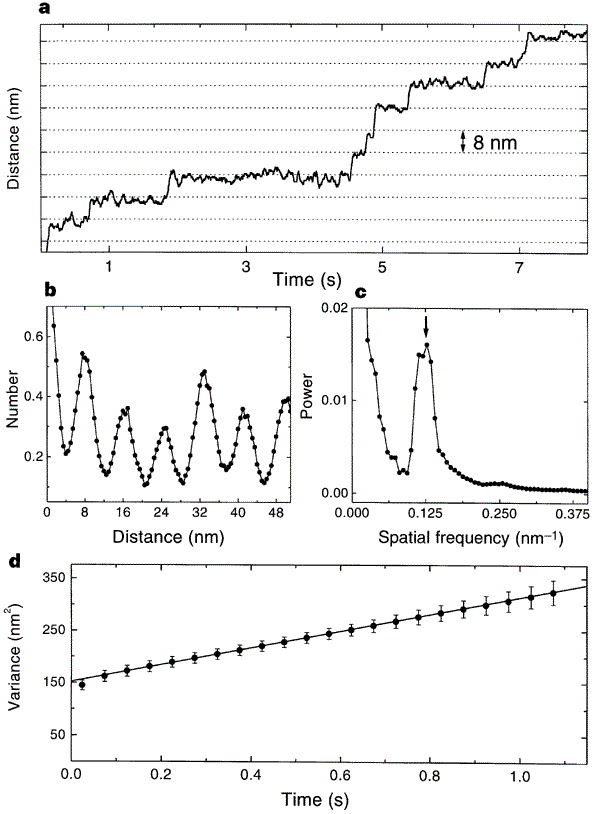
Horizontal grid lines (dotted lines) are spaced 8 nm apart. Data were median-filtered with a window width of 60 ms. b, Normalized histogram of pairwise distances between all pairs of data points in this record, showing a clear 8-nm periodicity. c, Normalized power spectrum of the data in b, displaying a single prominent peak at the reciprocal of 8 nm (arrow). d, Variance in position, averaged over 28 runs at 2 microM ATP (dots), and line fit over the interval 3.5 ms to 1.1 s. The y-intercept of the fit is determined by equipartition, left fencex2right fence = kT/alpha, where alpha is the combined stiffness of the optical trap and bead–microtubule linkage. The rapid rise in variance at short times reflects the brownian correlation time for bead position.
You can find lots of papers with direct observations of kinesin movement. Here’s data from another paper that essentially shows that the two ‘feet’ of kinesin alternate in their movement, because they made recombinant, asymmetric kinesin with slightly different step distances. Again, note the long dwell times punctuated with surges of movement.
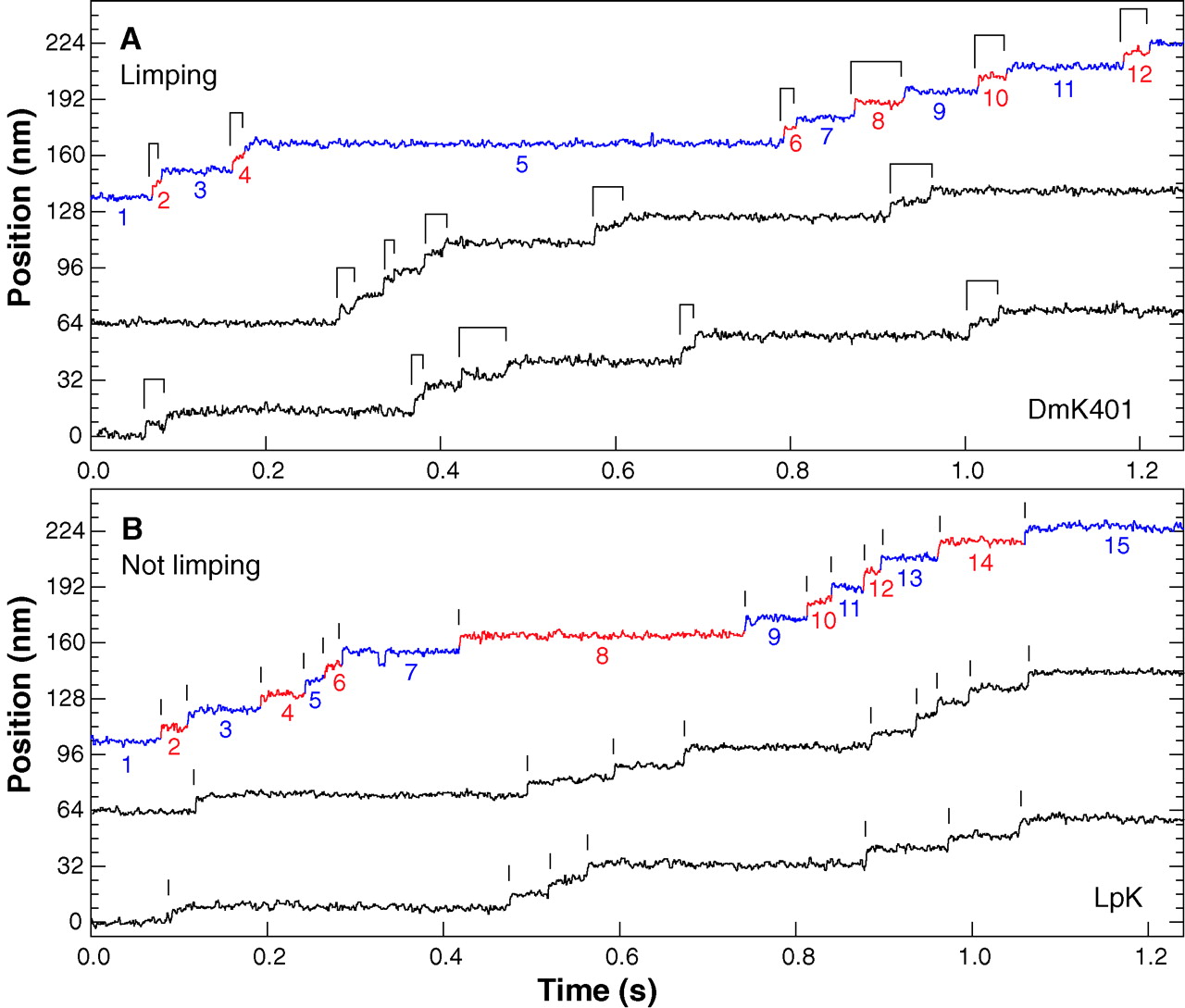
Representative high-resolution stepping records of position against time, showing the single-molecule behavior of kinesin motors under constant 4 pN rearward loads. (A) Limping motion of the recombinant kinesin construct, DmK401. The dwell intervals between successive 8-nm steps alternate between slow and fast phases, causing steps to appear in pairs, as indicated by the ligatures. (B) Nonlimping motion of native squid kinesin, LpK. No alternation of steps is apparent; vertical lines mark the stepping transitions. Slow and fast phase assignments, as described in the text, are indicated in color on the uppermost trace of each panel (blue and red, respectively), and the corresponding dwell intervals are numbered. All traces were median filtered with a 2.5-ms window.
The contrast is between “stately grace” and “jiggle and jump”. The evidence shows that it is the latter. Yet, somehow, Wells closes his weird series of non sequiturs with this question, as if he expects everyone to give him the answer he wants.
So, who are the pseudoscientists?
The answer is obvious. Wells and his cronies at the DI.
Asbury CL, Fehr AN, Block SM (2003) Kinesin moves by an asymmetric hand-over-hand mechanism. Science 302(5653):2130-4
Schnitzer MJ, Block SM (1997) Kinesin hydrolyses one ATP per 8-nm step. Nature388(6640):386-90.
By the way, I found about this because the Discovery Institute sent me email (silly season and all) proudly announcing that they were about to release evidence that would clearly rebut Zimmer’s assertion that kinesin “flails blindly” — they are making a computer animation showing that it doesn’t.
Yes, they are that stupid.

This guy wrote to me back in September, when he was regurgitating creationist rationalizations for the global flood, at the behest of wacky ol’ Walt Brown. He called me again this morning and sent me another missive. On the phone, he sounded a bit miffed that I didn’t immediately remember who the heck he was, but it’s all come back to me now, after reading this.
Dear Dr. Paul Myers,
Like I said, I read your Happy Atheist and regularly read Pharyngula.
RE: Your “Looking for a geophysicist” blog.
What are the facts and what are the beliefs?
1 FACT:
Estimations of the biggest and strongest Supercontinent and all the reservoirs of water under pressure below it Earth possibly had are altogether unheard of.
Its continental landmasses’ three-hundredfold greater concentration of heavy, radioactive elements than our found elsewhere in the Earth aren’t confirmed by observations with measurements to have been in it when the continents yet had all the former connectedness they had (however connected they may have been).
Dr. Bruce Buffett who earned a doctorate in geophysics from Harvard and is now Chairman of Geophysics at Berkeley, considered the no.1 at geophysics research in America).
http://211.144.68.84:9998/91keshi/Public/File/34/485-7398/pdf/485319a.pdf
He has answered my questions and can’t explain why geophysicists never consider that before our planet’s 52,000-mile globe-encircling Mid-Oceanic Range uplifted, fitting like a jigsaw puzzle with specific continental shelf edges, it may have had great reservoirs of water under pressure below a supercontinent, even only one supercontinent in Earth history.
I asked him, “Could not it have thereby had its greatest explosivities of outbursting water and eroded rocks, greatest magnitude earthquake, and super-intense volcanic and earthquake lightnings >1 million amperes whereby electrons shooting through them with >1 MeV produced magnetic pinch effects”?
I hope by the following it will be clear to you what is being proposed as a solution to the problem of Earth’s concentration of heavy, radioactive elements inconsistent with the nebular hypothesis.
Regarding Richard P. Feynman, Ph.D.(physics) Surely You’re Joking Mr. Feynman, (W.W. Norton: New York, NY, 1985), pp. 341, 343:
Physics Nobel Laureate Richard Feynman noted what is: “generally missing in cargo cult science. . . It’s a kind of scientific integrity, a principle of scientific thought that corresponds to a kind utter honesty—a kind of leaning over backwards. For example, if you’re doing an experiment, you should report everything that you think might make it invalid—not only what you think is right about: other causes that could possibly explain your results; and things you thought of that you’ve eliminated by some other experiment, and how they worked—to make sure the other fellow can tell they have been eliminated.
Details that could throw doubt on your interpretation must be given, if you know them. You must do the best you can—if you know anything at all wrong, or possibly wrong—to explain it. . . put down all the facts that disagree with it, as well as those that disagree with it . . .
. . . give all of the information to help others to judge the value of your contribution; not just the information that leads to judgment in one particular direction. . .
I’m talking about a specific, extra type of integrity .. bending over backwards to show how you’re maybe wrong, that you ought to have when acting as a scientist. And this is our responsibility as scientists, certainly to other scientists, and I think to laymen.”“Earth’s radioactivity was confined to the crust, a few tens of kilometers thick.”
(John D. Stacey, Physics of the Earth, 3rd edition (1992), p. 45)
“Uranium, thorium and potassium are the main elements contributing to natural terrestrial radioactivity.. All three of the radioactive elements are strongly partitioned into the continental crust.”
(J. A. Plant and A. D. Saunders, “The Radioactive Earth,” Radiation Protection Dosimetry, Vol. 68, 1996, p. 25)
“The molten rock oozing from midocean ridges lacks much of the uranium, thorium, and other trace elements that spew from some aboveground volcanoes.”
(Sid Perkins, “New Mantle Model Gets the Water Out,” Science News, Vol. 164, 13 September 2003, p. 174.
Theories of an unsupernatural ultimate origin and formation of Earth call for the agglomeration of its particles thrown together by cosmic winds. They segregated into the core, mantle, and crust by gravity and heat. However, the heaviest naturally occurring elements: uranium and thorium are not nearly as concentrated under the continents and oceanic floors as they would be if the Earth formed from an interstellar medium. . . . If uranium and thorium were among the nuclides that the universe assembled into the Earth, they would be more concentrated toward its deeper parts. At least, they would be expected to have been evenly distributed throughout it. Yet: “90% of uranium and thorium are concentrated in the continents”*;–Earth’s continents are only 0.35% of its mass.*
*Dan F. C. Pribnow, Ph.D.(geophysics), “Radiogenic Heat Production in the Upper Third of Continental Crust from KTB,” Geophysical Research Letters, Vol. 24, 1 February 1997, p. 349.
* “The Earth’s continental crust occupies 41.2% of the surface area but represents only 0.35% of the total mass of our planet.” (Hugh Richard Rollinson, Ph.D.[geochemistry], Early Earth Systems [Blackwell Publishing: Malden, MA, 2007], p. 134)
“Heat production rate is well correlated to lithology; no significant variation with depth, neither strictly linear nor exponential, is observed over the entire depths of the [two German holes].”
(Christoph Clauser, et al., “The Thermal Regime of the Crystalline Continental Crust: Implications from the KTB, Journal of Geophysical Research, Vol. 102, No. B8, 10 August 1997, p. 18,418)
Germany’s Deep Drilling Project discovered variations in heat-exuding radioactivity related to the rock types, not to depths.
Are there higher concentrations of heavy radionuclei in Earth’s continental crust beneath its fossil-bearing rock layers where the one Supercontinent in its history had comparatively greater intensities of lightnings lightening it via having been more violently quaked or comprised of stronger rock types that generated more frictional electrifications and charge condensations?
“Surface rocks show traces of radioactive materials, and while the quantities thus found are very minute, the aggregate amount is sufficient, if scattered with this density throughout the earth, to suppy, many times over, the present yearly loss of heat. In fact, so much heat could be developed in this way that it has been practically necessary to make the assumption that the radioactive materials are limited in occurence to a surface shell only a few kilometers in thickness” (Leonard R. Ingersoll, et al., Heat Conduction : With Engineering, Geological and Other Applications, revised edition [University of Wisconsin Press: Madison, WI, 1954], p. 102)
You wrote on blog saying: “There was no global flood.” I’m not altogether certain of that.
Perhaps almost all of Earth’s fossil-bearing rock layers and all their heavy, radioactive elements bound to lighter elements evidence that it had extraordinary lightnings in enormous sub-Supercontinental water and in a Supercontinent erupting it whereby the seven continents it divided into were entirely and totally overflowed with tsunamies.
Thank You, Rick Keane
Too long? Shorter Rick Keane: Why haven’t geophysicists considered that there was a giant ocean of water beneath the continent(s) that exploded outward with a lot of lightning?
I don’t know. Why haven’t geophysicists consider my theory, that the earth is a giant eukaryotic cell, that continents are rafts of cell surface molecules, and that volcanoes are examples of exocytosis? Huh? Why? They’ll all be so surprised when the planet undergoes mitosis, I tell you what.
I also have a theory that the KT event was actually a sperm fusion event. Ask me more, maybe I’ll spin out a few thousand words with lots of quotes.
It also explains why someone would write to me asking about geophysics.

Especially when they poll them on science knowledge. An AP poll on science doesn’t surprise me at all.

At least it’s good to know that finally, after 50+ years of hard lobbying and information campaigns, it has finally sunk in that smoking causes cancer. What isn’t so good are the numbers on evolution and climate change. Only 31% are confident that humans evolved, while 42% are not confident. Why? Goddamn religion.
Confidence in evolution, the Big Bang, the age of the Earth and climate change decline sharply as faith in a supreme being rises, according to the poll. Likewise, those who regularly attend religious services or are evangelical Christians express much greater doubts about scientific concepts they may see as contradictory to their faith.
Here’s the problem, though: religious apologists. When even scientists, religious scientists in particular, are making excuses for a hoary old book of myths and poetry, how can we possibly advance understanding?
But evolution, the age of the Earth and the Big Bang are all compatible with God, except to Bible literalists, said Francisco Ayala, a former priest and professor of biology, philosophy and logic at the University of California, Irvine. And Darrel Falk, a biology professor at Point Loma Nazarene University and an evangelical Christian, agreed, adding: "The story of the cosmos and the Big Bang of creation is not inconsistent with the message of Genesis 1, and there is much profound biblical scholarship to demonstrate this."
OK, Ayala, define “god”. Go ahead, I keep waiting for a concrete, clear answer, but these apologists won’t give one, or they’ll mumble platitudes (the Ground State of All Being
, they’ll say, which means fuck-all).
And hey, Darrel Falk, where in the scientific theory of cosmic origins is there a near-instantaneous creation of a garden on Earth (which didn’t even exist at the time of the Big Bang), a tree of magic fruit, and a talking snake? Sure, it’s compatible, as long as you ignore what the book actually says and pretend it’s all a big metaphor. Of course, you’re missing the One True Over-Riding Metaphor, which is “Humans are gullible saps who’ll believe anything.”