Anyone can be director of an institute of pseudoscience, I guess

So the Washington Times is disseminating quackery — nothing new about that, I guess. But this is pretty awful stuff.
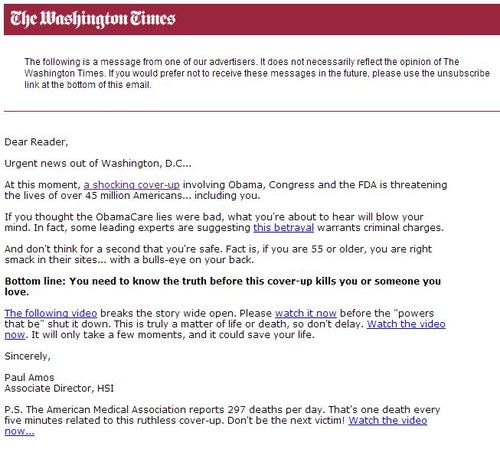
jennylies

You have to suffer to find out what she is talking about: this link takes you to a canned presentation. You’ve seen these before, I presume. They use a custom video player with all the controls stripped out, so once it gets started, you have to go through the whole thing, and you can’t skip ahead. And it goes on and on, hammering away at how evil modern medicine is and how it will kill you and stirring up fear and anger before it gets to the point: they have a cure for cancer, but Obama and the medical establishment are hiding it from you, and you can buy it from them. Wheee. So predictable.

Their miracle cure is a fermented wheat germ extract, marketed as a dietary supplement. It’s called H-86 or Avemar. Contrary to their claims that Obama and the FDA are trying to silence its existence because they want you to die a horrible painful death, it’s an object of active research. I’ve seen one clinical trial that showed a significant improvement in survival time for melanoma patients; there are a number of papers that investigate it and try to identify the mechanism (it may stimulate apoptosis in some cancer cells).

So it’s one among many. It’s got some promising preliminary results — but those are dime a dozen, I’m afraid, and many drugs that are initially interesting don’t pan out — and scientists are exploring it and publishing on it. It doesn’t magically vaporize tumors. The melanoma patients eventually died, but their average survival was prolonged. That’s the reality of cancer research.

But I was intrigued by the Health Sciences Institute. That’s a name with authority, and it sounds like a real thing. When you dig a little deeper, though, it seems to be little more than a website and Jenny Thompson, who has a bachelor’s degree in journalism and has appointed herself director of her very own sciencey institute of research and medicine.

I’ve been missing a trick. I need to declare Pharyngula to be a research think tank, start issuing dozens of e-alerts every month, and promote more FUD to draw in the massive donations so I can afford to advertise in the Washington Times, or the Daily Mail, or whatever hack rag with no standards will accept my money.

I just need a good title. “Pharyngula” is probably too obscure. Give me some ideas for convincing masks for pseudoscience, so I can get on that gravy train.


Jenny Thompson is a very naughty person. I did not sign up for anything on her website, and I didn’t even leave my email address anywhere there…but she went ahead and signed me up for her HSI e-alerts anyway. That’s OK, though, I’ve also put her HSI email address in my spam filters, so we’re even.

Todd Akin is sorry that he was sorry

Please, Republicans, welcome this man back into the fold, and make him a mouthpiece for the party. We are happy to see you drive women out of your camp. Todd Akin thinks there’s still a legitimate concern about legitimate rape.

"When a woman claims to have been raped, the police determine if the evidence supports the legal definition of ‘rape,’" Akin writes. "Is it a legitimate claim of rape or an excuse to avoid an unwanted pregnancy? Are the police warranted to take action against a crime or not?"

"In short, the word ‘legitimate’ modifies the claim and not the action. There have been women who have lied about being raped, as Norma McCorvey did before the U.S. Supreme Court. The infamous Roe v. Wade decision of 1973 was based on a lie."

"My comment about a woman’s body shutting the pregnancy down," Akin adds in the book, "was directed to the impact of stress on fertilization. This is something fertility doctors debate and discuss. Doubt me? Google ‘stress and fertilization,’ and you will find a library of research on the subject."

Yes, sometimes women are bad and ignorant and dishonest, just like men. Sometimes people lie about being robbed in order to get the insurance money, too; that doesn’t mean we have such a cynical view of humanity that we dismiss all claims of theft as fraudulent.

I found his last challenge interesting, though. But don’t go to Google — that’s wide open and leads to a lot of garbage. I did his search on PubMed. It returns about 1500 peer reviewed papers on the subject, but the problem is that ‘stress’ has a rather specific meaning in biology, and it’s not about transient terror — it’s about relatively long-term metabolic changes. It’s also a big database, so it covers everything — plants, mice, insects, etc. So I narrowed the search to just humans, which gives me 136 results. That is not very impressive.

I browsed through them all. Some looked interesting:there’s stuff on the role of follicular antioxidants, how serotonergic modulation affects the stress response in zebrafish (they mention modulators developed for human research — they’re giving Prozac to fish larvae), issues in treating Jehovah’s Witnesses with in vitro fertilization, heat stress and DNA repair in sperm production, lots of stuff about oxidative stress, and surprising numbers of papers about the effects of stress on sperm in general. I guess sperm are just easier to work with. Maybe Akin should be arguing that stressed-out rapists are firing blanks? Nah, the research doesn’t support that, either.

I found one relevant paper in my search: Stress and anxiety do not result in pregnancy wastage, by Milad, Klock, Moses, and Chatterton, published in 1998. They were looking at the effects of the psychologically stressful process of IVF on fertility clinic patients. It has a small n of 40, so it’s not entirely conclusive, but the abstract concludes:

In conclusion, there is little association between psychological scores and physiological stress hormone concentrations. Also, it does not appear that high levels of anxiety and stress result in an adverse pregnancy outcome.

Again, these are studies of long term stress — we know there are effects of overwork, worry, lack of sleep, poor diet, and fear that cause metabolic changes in the body that can reduce the likelihood of reproduction. But that’s a far cry from suggesting that a single psychologically traumatic event can instantly shut down ovaries and prevent pregnancy, like a switch.

Also, a search on PubMed on the subject of stress and pregnancy turns up many more papers. It’s easy to conflate the two issues, and it’s certainly the case that metabolic changes occur and can affect pregnancy. But it’s also easy to send people off on a wild goose chase on a complex topic to confuse them.

So far, I haven’t found any peer-reviewed papers that support the Akin Hypothesis. I probably need to dig deeper into fringe journals.

Dobbs vs. Wade

David Dobbs reviews ‘A Troublesome Inheritance’ in the NY Times. Once again, Nicholas Wade falls flat.

If Wade could point to genes that give races distinctive social behaviors, we might overlook such shortcomings. But he cannot.

He tries. He tells, for instance, of specific gene variants that reputedly create less trust and more violence in ­African-Americans and, he says, explain their resistance to modern economic institutions and practices. Alas, the scientific literature he draws on is so uneven and disputed that many geneticists dismiss it outright. Wade also cites a 2008 paper that analyzed the genomes of almost 1,000 people from 51 populations around the globe. That paper found that people from different regions do indeed tend to have distinctive genomes. But Wade errs in saying the paper supports his idea that genetic selection has created races with particular social inclinations.

To begin with, the 2008 study mentions nothing about race. It merely establishes that many of the slight differences between human genomes cluster by geography at many scales, including continents, and that genomes from any given location will most likely be similar, just as two people from a particular place will most likely speak with similar accents.

Second, and far more serious, the paper’s authors specifically state that while selection may sometimes create genetic differences between populations, they saw little evidence that selection shaped the small genetic differences they found. In fact, they say the differences can be largely explained by “random drift” — arbitrary changes in genes having little to no effect on people’s biology or behavior. All of this directly contradicts Wade’s argument. Yet he baldly claims the study as support.

And he does this sort of thing repeatedly: He constantly gathers up long shots, speculations and spurious claims, then declares they add up to substantiate his case.

You know, mangling peer-reviewed articles and throwing a prejudicial slant on science that ignores the totality of the evidence is what creationists do, but I’m sure Wade’s HBD supporters will be along shortly to accuse Dobbs of being a ‘new creationist’.


Check out Dobbs’ blog post on the article. Very first comments are tiresome cliches from the same usual bores who show up to defend racism, flinging around accusations of “New Creationism” and “Cultural Marxism”. Prediction fulfilled.

Νικασίτιμος οἶφε Τιμίονα

Just to counter the repressive BS in the last post, here’s some news that it doesn’t have to be that way: 2,500-year-old erotic graffiti has been found on an Aegean island.

"They were what I would call triumphant inscriptions," said the Princeton-trained professor who found them while introducing students to the ancient island world of the Aegean. "They claimed their own space in large letters that not only expressed sexual desire but talked about the act of sex itself," he told the Guardian. "And that is very, very rare."

Chiselled into the outcrops of dolomite limestone that dot the cape, the inscriptions have provided invaluable insight into the private lives of those who inhabited archaic and classical Greece. One, believed to have been carved in the mid-sixth century BC, proclaimed: "Nikasitimos was here mounting Timiona (Νικασίτιμος οἶφε Τιμίονα).

"We know that in ancient Greece sexual desire between men was not a taboo," added Dr Vlachopoulos, who returned to the far-flung island last week to resume work with a team of topographers, photographers, conservationists and students. "But this graffiti … is not just among the earliest ever discovered. By using the verb in the past continuous [tense], it clearly says that these two men were making love over a long period of time, emphasising the sexual act in a way that is highly unusual in erotic artwork. "

They weren’t just celebrating sex, but gay sex. All while the dour Hebrews were laying down nit-picking laws about what God allows you to do with your genitals.

I get email

Sometimes it is even informative. I was sent a data dump on official Catholic doctrine regarding sexual relations — it is rather revealing. I don’t recall requesting it, though, but sure, I’ll take it. And grimace.

I was informed of an inquiry you made some 7 months ago concerning the morality that must be preserved in the relations of the bed.

Church laws teach that spouses must fight against or quiet libidinal pleasure when they have relations or else they commit a fault for seeking to enjoy the libidinal pleasure. In Her laws and practices the Church has condemned the belief that spouses can have relations for lustful pleasure and not commit any fault or sin. The March 4, 1679 Holy Office decree on the errors of various moral subjects condemns spouses who have relations for libidinal pleasure. Canon Law 1013 teaches that the secondary motive for the marital act is mutual aid but does not mention mutual love or indulging in libidinal/lustful pleasure. Pope Pius XI’s Enyclical Casti Connubii’s teaching on the quieting of concupiscence rules out seeking to enjoy libidinal pleasure. He teaches that the purpose of marriage is the procreation and rearing of children and that the secondary purpose is companionship and friendship through the struggle of life. He also says couples should pray in order for God to help them conquer temptations. The Church Fathers are unanimous on the necessity to fight against lustful pleasure during intercourse. The Church Fathers teach that spouses sin when they have relations for lustful pleasure. And some compare it to using one another as whores and prostitutes:

Lactantius, Divine Institutes, 6:23:18: “The genital [‘generating’] part of the body, as the name itself teaches, has been received by us for no other purpose than the generation of offspring.”

St. Jerome, Against Jovinian, 1:19, A.D. 393: “But I wonder why he [the heretic Jovinianus] set Judah and Tamar before us for an example, unless perchance even harlots give him pleasure; or Onan, who was slain because he grudged his brother’s seed.Does he imagine that we approve of any sexual intercourse except for the procreation of children?”

St. Augustine, The Morals of the Manichees, 18:65, A.D. 388: “This proves that you [Manicheans] approve of having a wife, not for the procreation of children, but for the gratification of passion. In marriage, as the marriage law declares, the man and woman come together for the procreation of children. Therefore, whoever makes the procreation of children a greater sin than copulation, forbids marriage and makes the woman not a wife but a prostitute, who for some gifts presented to her is joined to the man to gratify his passion.

St. Augustine, Against Faustus, 22:30: “For thus the eternal law, that is, the will of God creator of all creatures, taking counsel for the conservation of natural order, not to serve lust, but to see to the preservation of the race, permits the delight of mortal flesh [i.e. the conjugal act] to be released from the control of reason in copulationonly to propagate progeny.”St. Augustine one of the greatest Church Fathers in Church History points to the fact that at times it does happen that a couple will climax. He points out that if this comes to pass and one did not seek it in any way: then there is no fault on the part of the couple. If for some reason the spouses or a spouse does reach the climax- which is the instant that the flesh is released from the control of reason and the flesh (body) at that moment follows commands of its own by moving involuntarily — it is not sinful when it occurs by accident. It must never be sought after and if it occurs when one does not seek after it — it is an accidental happening: and this accidental happening God permits for the sake of trying to procreate — and will not charge a person with sin who did not seek after it (i.e climax). Lustful pleasure must be hated with a perfect hatred. It does happen at times that men feel pleasure during the conjugal act. This is not sinful of itself but only when they don’t fight against it or if they seek it. If they seek pleasure and or if they don’t fight against it — they are guilty of the sin of Lust. A Manual of Moral Theology, by Rev. Thomas Slater, 1925, Chapter 2, The Capital Vices: On Lust: “Lust is an inordinate appetite for the pleasure which has its seat in the organs of generation. A wise and provident Creator has taken care that those actions which are most necessary for the individual or for society should be accompanied by great pleasure in order that they may be exercised more certainly and more readily. If there were no pleasure connected with eating and drinking, few men would trouble themselves about those necessary actions. The great pleasure felt in the act of procreation induces men to do what is necessary for the preservation of the race which otherwise would excite only shame and disgust. This, however, can only be done lawfully in wedlock. “

“And calling the multitude together with his disciples, he said to them: If any man will follow me, let him deny himself, and take up his cross, and follow me. For whosoever will save his life, shall lose it: and whosoever shall lose his life for my sake and the gospel, shall save it. For what shall it profit a man, if he gain the whole world, and suffer the loss of his soul?” (Mk. 8:34-36)

Catholic Encyclopedia, “Lust, by Joseph F. Delany, 1910: “The inordinate craving for, or indulgence of, the carnal pleasure which is experienced in the human organs of generation.The wrongfulness of lust is reducible to this: that venereal satisfaction is sought for…. at any rate, in a manner which is contrary to the laws that govern marital intercourse.(Nihil obstat: Remy Lafort, Censor. Imprimatur: + John M., Archbishop of New York.)

And within marital intercourse one must not seek for pleasure. If pleasure occurs accidentally: it is not a sin before God since it is something out of their control. The laws which govern the marital act demand that the act be consummated as quick as possible, with the lights off and the spouses fully dressed — with the only areas of their body needed for connection uncovered somewhat. In that short space of time: if the couple did not seek for pleasure then they are without fault even if they might have felt pleasure.

St. Thomas Aquinas condemns lustful kisses and touches for married and unmarried people alike as mortal sins in Summa Theologica, Second Part of the Second Part, Q. 154, Art. 4:

Objection 2: Further,fornication is stated to be a mortal sin as being prejudicial to the good of the future child’s begetting and upbringing. But these are not affected by kisses and touches or blandishments. Therefore there is no mortal sin in these.”

[St. Thomas Aquinas]Reply to Objection 2: Although kisses and touches do not by their very nature hinder the good of the human offspring,they proceed from lust, which is the source of this hindrance:and on this account they aremortally sinful.”

That is why St. Thomas even rejects in the same section (Q. 154, Art. 1) as lascivious and unlawful “acts circumstantial to the venereal act, for instancekisses, touches, and so forth“. St. Thomas Aquinas writes: “We may also reply that "lasciviousness " relates to certain acts circumstantial to the venereal act, for instance kisses, touches, and so forth.” (Summa Theologica, II-II, Q. 154, Art. 1) And so it is clear that St. Thomas taught that all non-procreative and unnecessary indecent acts are sinful and against nature.

Oral and waste-organ stimulation is intrinsically evil and against the natural law

St. Barnabas,Letter of Barnabas, section 10:8, 74 A.D.: “Moreover, he [Moses] has rightly detested the weasel [Leviticus 11:29]. For he means, ‘Thou shalt not be like to those whom we hear of as committing wickedness with the mouththrough uncleanness [oral s*x]; nor shalt thou be joined tothose impure women who commit iniquity with the mouthwith the body through uncleanness.'”

St. Augustine,The Good of Marriage, section 11-12, 401 A.D.: “But that which goes beyond this necessity no longer follows reason but lust…. they [must] not turn away from them the mercy of God….by changing the natural use into that which is against nature, which is more damnable when it is done in the case of husband or wife. Of so great power is the ordinance of the Creator, and the order of creation, that….when the man shall wish to use a body part of the wife not allowed for this purpose, the wife is more shameful, if she suffer it to take place in her own case, than if in the case of another woman.”

Very simply the mouth and the organ of the human disposal system have a purpose. Nature tells us that God made the mouth for the intake of food and drink: and the human disposal system for the disposal of waste. Moreover nature tells us that if we begin to use the mouth and the human disposal system organ in improper ways then bodily infection or disease and death may be the result.

The mouth and the human disposal system were not made to stimulate the g*nital organs. Nothing could be more evident than this fact. Catholic Tradition and the Natural Law clearly teach us that oral and human disposal system organ stimulation are sinful lustful acts and deviant s*xual behavior. Those who promote such perversions or believe them to be not sinful are guilty of the mortal sin of heresy for denying the Natural Law and as such are outside the Catholic Church.

Women must never wear jewelry, make-up, tattoos, body painting, and fingernails longer than one-eighth of an inch. Their hairstyles must never be ostentatious, they are not allowed to dye their hair, and they must wear a veil when praying or going to visit a holy place like a church or if they go to see an ecclesiastic. They must also have a veil when they hear a sermon in whatever place they might be. They are not allowed to wear transparent fabrics, laces, nets, organdy, nylon, etc and flesh colored fabrics. They are not allowed to paint their nails either. A violation of any of the aforementioned rules is mortal sin at best and heresy at worst. It is an abomination for women to wear pants. It is a heresy for which women were burned at the stake. Women must wear dresses and feminine apparel that covers them at least beginning from just below the pit of the throat to all the way half way below the knees (inclusive). As for the arms they must be covered with sleeves passing at least the half way mark after the elbows. Another issue is appropriate undergarments. In fact there are instructions for what type of knickers women are to wear and what fabrics to avoid under pain of mortal sin and possibly heresy. Since some fabrics are masculine.Also it is heresy and an abomination for women to wear pants. In fact St. Joan of Arc was burned at the stake on the mere suspicion of the heresy of wearing pants. She was falsely accused before and given a free pass twice but when the accusation happened a 3rd time she was killed (in the first accusation/trial there were some false witnesses who testified against her as well as the 2nd trial and so she already had a strike 2 strikes against her; false witnesses testified against her again for the 3rd trial). This particular heresy is called ‘the monstrous dress’ (difformitate habitus). For having 3 strikes against you would indicate to the judges of a relapse into heresy- for the accused.

Pierre Cauchon the Bishop of Beauvais was an unscrupulous and ambitious man who worked for the English and was the mover and shaker of the false accusations and trials against St. Joan who had defeated France. He and the English were determined to have her blood on some pretext. They were always sad when they failed upon the previous occasions to secure the death of St. Joan at trial. It is alleged a trap was deliberately laid by her jailers with the connivance of Cauchon (for this had happened before). Joan- either to defend her modesty from outrage or because her women's garments were taken from her or perhaps simply because she was weary of the struggle and was convinced that her enemies were determined to have her blood upon some pretext: once more put on the man's apparel (not wearing it but just covering herself with it like a bed sheet) which had been purposely left in her way.She was deliberately (illegally) put in a jail (in the Castle of Rouen) tended by male guards (profligate English soldiers) even though there was one much closer that catered to females (she bitterly complained of the indecent mistreatment she received from them before). She was also treated harshly being chained by her neck, hands, and ankles(for she had attempted to escape by desperately throwing herself from the window of the tower of Beaurevoir because of the unspeakably indecent activity of the men- the judges at her trial called this act of hers reckless). So in all there were 4 trials concerning St. Joan . The first one concerned her visions and then the last 3 concerned the accusation of her wearing men’s apparel/pants.

Sports undergarments suppress the bustline to a degree but are also unhealthy for daily wear, especially by women who are of childbearing age because they are made of elastic and suppress the delicate tissues and structures needed for nursing.

The size of the blouse is determined by the size of the bustline. That size, in turn, determines how wide to make the neckline and armholes and how far from the neckline the armholes should be. Example: If I were to wear a top one or two sizes larger than my size, the neckline would gape open in the front and not lay against my chest (unless it was a turtleneck) and the sleeve seams would hang down the upper part of my arm, giving me a baglady look and also allowing curious eyes to peer down my blouse when I bent forward or was lower than the onlooker, such as when genuflecting. Women who are amply endowed need supportive undergarments or else they suffer from back problems. These supportive undergarments must be constructed in such a way as to support the weight being held and therefore they give shape which you simply cannot avoid except by layering your clothes (a sweater draped over your top or blouse) which is impractical and dangerous to your health in a warm or hot climate and often does not solve the problem. The weight of the fabric, the style of the pattern, the size of the bustline, the style of the waistline and the undergarments all affect how a top/blouse looks upon a woman. This blouse has a nipped-in or tucked-in waist so you cannot expect it to hang straight down which would thus less emphasize the bustline. Also, if a top/blouse is tucked into the skirt (as opposed to hanging over it), the bustline is more emphasized. However, the point of drape is still the bustline.

It is a sin for women to wear pants (even those designed specifically for females) or drive cars. It is a sin for girls to wear lace underwear. The rationale is the preservation of Catholic Dignity. For Pope St. Pius X said. “There is only one human dignity: and that is Catholic dignity.”

http://www.youtube.com/watch?v=OFSQrKrrQqw&list=PLD841087C099E5B90 NFP: A Birth Control Deception 68 mins

http://onetruecatholicfaith.com/Roman-Catholic-Video.php?vid=254&vid_title=Michael+Takes+The+Bad+Man+Away&page=7

http://www.onetruecatholicfaith.com

It is amazing that the Catholic Church lasted for any length of time at all, but then I started thinking…women have always been a major proponent of religion, including Catholicism — they accepted these rules. In a world where men had total power and rape was a constant risk with little recourse for justice, and what sex there was was entirely focused on the man’s pleasure, a collection of rules that strongly discouraged sex might be seen by women as an important way to protect other aspects of their autonomy. If putting on the Armor of God means admitting that you are corrupting filth, well, that might be a small price to pay to get relief from abuse, and to have an institutionally supported way to fight back against those base, depraved men who want to touch your dirtybits.

This is what you get when the dudebros run rampant: women find repressing sex altogether more appealing and a more viable strategy than trying to find respectful partners.

I’ve got to buy a Roku now?

They seem to be nifty little devices, and now I have one more reason to get one.

American Atheists announced Wednesday that it has set Tuesday, July 29, 2014, as the official date for the launch of Atheist TV, the world’s first television channel dedicated to atheist content, on Roku. The national atheist nonprofit will host a launch party that night in Manhattan to celebrate.

“The launch of Atheist TV is history in the making,” said American Atheists President David Silverman. “There are hundreds of TV channels dedicated to religious programming, but nothing like this has ever existed before for atheists, and yet the demand is overwhelming. For the first time, atheist video content—from firebrand speeches, to stand-up comedy, to documentaries, to real science-based educational programming, and more—is now available to atheists worldwide, on the air and all in one place. Atheist TV brings consistent, quality, superstition-free programming for children and adults, on the air and on-demand, right from your regular television. This is an idea whose time has come and we’re celebrating.”

The invitation-only launch party will take place from 6-8 pm ET at the Union Square Penthouse venue in Manhattan. Well-known TV producers and personalities, atheist activists and public speakers, video content producers for the channel, and Atheist TV and American Atheists sponsors and donors will be in attendance. The celebration and launch will feature a speech by President David Silverman and a countdown to the first broadcast at 7 pm, at which time a welcome video starring several well-known atheists and science educators will air.

The channel, which provides both an on-air streaming schedule and video-on-demand, is available worldwide for free via Roku, a small device that connects to the back of a television, similar to a cable box. The on-air live streaming portion will also be viewable free on the channel’s website. See http://www.atheists.tv for more information.

Bread and circuses…well, circuses anyway, not so much bread

Michael Shermer indulges in some shabby Libertarian statistical games to wave away American economic inequality. Sure, there are inequities, he argues, but they’re not so bad — the poor are also getting slightly richer.

The rich are getting richer, as Brookings Institution economist Gary Burtless found by analyzing tax data from the Congressional Budget Office for after-tax income trends from 1979 through 2010 (including government assistance). The top-fifth income earners in the U.S. increased their share of the national income from 43 percent in 1979 to 48 percent in 2010, and the top 1 percent increased their share of the pie from 8 percent in 1979 to 13 percent in 2010. But note what has not happened: the rest have not gotten poorer. They’ve gotten richer: the income of the other quintiles increased by 49, 37, 36 and 45 percent, respectively.

I have a few problems with this. First, in an article titled “The Myth of Income Inequality”, he’s doing a bit of bait-and-switch: it doesn’t matter if the baseline is rising, the question is about the disparity. Income disparity is greater now than it was before. His own numbers show that.

This argument is basically a version of the “Well, the poor all have cell phones!” dismissal. They’ve also got refrigerators and TVs, therefore, you should just ignore the fact that the wealthiest are sucking up all our prosperity to fund luxuries and frivolities. We should just pretend that we’re all getting the benefit of a rising tide, and never mind that yacht towering above your dinghy.

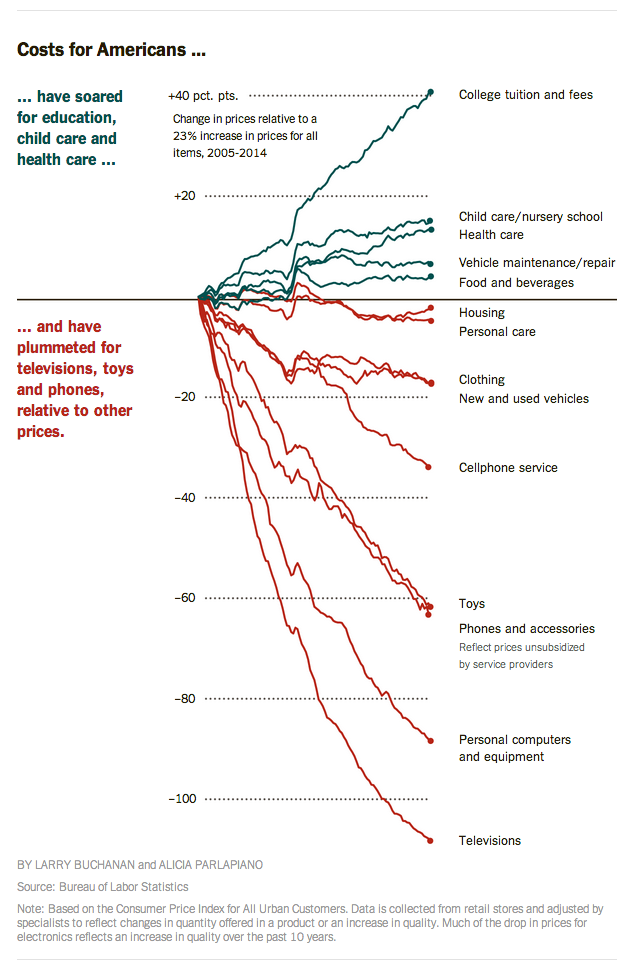
But there are other funny things going on in this economy. Look at this chart: the costs of TVs and toys and cell phones (the latter at least is essential now; but it’s a new cost for the poor, even if it is dropping) are plummeting, but the stuff that really matters for upward income mobility, like child care, health care, and education are going up. Especially education. We are saddling new graduates with overwhelming amounts of debt.

poorcosts

Another interesting game Shermer plays is to ignore the difference between income and wealth. It’s good that the poor are getting some increase in income, but if you’re using it to make ends meet or dig out from under a pile of debt, you’re not going to be accumulating any wealth — you can still get poorer. Meanwhile, the rich don’t have to worry about covering essential living expenses, and can invest and get richer. It’s useful to be able to see the distinction, so here’s a handy table of wealth and income in the US.

Income, net worth, and financial worth in the U.S. by percentile, in 2010 dollars
Wealth or income class Mean household income Mean household net worth Mean household financial (non-home) wealth
Top 1 percent $1,318,200 $16,439,400 $15,171,600
Top 20 percent $226,200 $2,061,600 $1,719,800
60th-80th percentile $72,000 $216,900 $100,700
40th-60th percentile $41,700 $61,000 $12,200
Bottom 40 percent $17,300 -$10,600 -$14,800
From Wolff (2012); only mean figures are available, not medians.  Note that income and wealth are separate measures; so, for example, the top 1% of income-earners is not exactly the same group of people as the top 1% of wealth-holders, although there is considerable overlap.

Here’s another sneaky trick. When the concern is inequality, let’s ignore the most extreme and instead focus on perceptions.

One reason for the controversy is that people overestimate differences between the rich and poor. In a 2013 study published in Psychological Science entitled “Better Off Than We Know,” St. Louis University psychologist John R. Chambers and his colleagues found that most people estimate that the richest 20 percent make 31 times more than the poorest 20 percent (it is 15.5 times), and they believe that the average annual income of the richest 20 percent of Americans is $2 million, whereas in fact it is $169,000, a perceptual difference of nearly 12 times. “Almost all of our study participants,” the authors concluded, “grossly underestimated Americans’ average household incomes and overestimated the level of income inequality.”

That’s beautiful sleight of hand. First, as previously mentioned, talk only about income, not wealth (and most of us already have poor intuition about the difference; notice also that if you look at the table above, the guesses pretty much hit the mark on wealth, rather than income). Then talk only about the top 20%, rather than the top 1%. And then make much of the fact that people’s guesses about rich people’s incomes are wrong. Har har, the proles guessed that managers make 31 times as much money as they do, when it’s really only 12 times.

Really? Try this exercise: imagine that you got paid just 10 times as much as you do now. “Just” 10 times. How much of a difference would that make in your life? I’m in a comfortable position; optimistically, I’m probably somewhere in the bottom of the 20%, so I don’t have to worry much about making ends meet, and give me an order of magnitude more money and I’d just be socking it away in a bank. But if you’re poor, if you’re struggling to cover child care and rent and keep the family fed, that’s an immense difference.

And of course the other factor is that the 20% aren’t actually working any harder than the 80% — their labor may require more training (which we’re trying hard to lock poor people out of with skyrocketing education costs), but they’re not actually working any harder than you are. My father was often working two jobs in order to keep spinning his wheels in poverty, so I’ve seen this inequality at work, and am well aware that I’m on the lucky side of the rich-poor divide.

But set aside all the squinty-eyed statistical games, and simply ask the fundamental question: Who owns the country? Where is the product of 315 million people’s labor going?

In the United States, wealth is highly concentrated in a relatively few hands. As of 2010, the top 1% of households (the upper class) owned 35.4% of all privately held wealth, and the next 19% (the managerial, professional, and small business stratum) had 53.5%, which means that just 20% of the people owned a remarkable 89%, leaving only 11% of the wealth for the bottom 80% (wage and salary workers). In terms of financial wealth (total net worth minus the value of one’s home), the top 1% of households had an even greater share: 42.1%.

That’s the inequality that we’re concerned about, that a mere 1% own well over a third of the wealth of the country, and it’s increasing — they use that wealth to manipulate media and politics to steal even greater quantities of our work. We are becoming a kleptocracy.

But never mind that. Look! Over there! There’s a poor person with an Xbox!


But wait! Even that claim that the poor have gotten richer may be dodgy: this analysis of reported incomes shows that we’ve been experiencing a decline.

Setting the bar low. Burying it, actually.

Penn Jillete defends Anthony Cumia. We’re all missing the important detail that exonerates him — sure, he went off for hours in a racist tirade, but don’t you all realize that Cumia is licensed to carry a concealed handgun?

Penn Jillette says that people are burying the lede in the alleged incident that led to SiriusXM’s decision to fire “Opie and Anthony” host Anthony Cumia. He also argued that he’s never seen any evidence that suggests Cumia is racist as many of his critics have alleged.

We are burying the lede of this story, which is that Anthony, who has a reputation for being a bit of a hot head, is carrying, comes up gets hit in the face and does not hurt the person back, Jillette said during his “Penn’s Sunday School” podcast this weekend.

That is incredible. If I am in the position where I cross somebody who is carrying a gun and who can defend themselves and hurt me, and their choice is to write angry stuff on Twitter instead of fighting me back — wonderful. Gandhi! That’s Gandhi! … That is Martin Luther King, he continued.

Seriously? He just compared a racist ranter to Gandhi and Martin Luther King because he didn’t shoot a black woman in the face?

Sure. This sounds exactly like something King or Gandhi would say.

Savage violent animal fucks prey on white people. Easy targets. This CUNT has no clue how lucky she was. She belted me 10 times. I had a gun

No,an ANIMAL BITCH used it’s instinctual violence on me. I restrained myself from putting it to sleep

It’s a jungle out in our cities after midnight. Violent savages own the streets. They all came 2 defend this pig. I had to yell like at dogs

Gosh. I’ve never shot anyone, and I’ve never even raged at minorities as animals. I guess that means I must be like Jesus!

By the way, the article strangely features a photo of Cumia’s concealed carry license…with a 2012 expiration date. I guess True Skeptics™ don’t give a damn about little details like that.

cumialicense

Godless baseball

It’s that time again — for the third year in a row, Minnesota Atheists have adopted the Mr Paul Aints for their regular conference. Come out on Friday, 11 July to watch the game, eat hot dogs, drink beer, and shake your fist at the gods, and then join us on Saturday for the conference. They’ve got Susan Jacoby! Debbie Goddard! Dan Barker! Rebecca Watson! The comedian Elizabeth Ess! Some other guy who was cheap and local! You must participate!

Closure on the Obokata/STAP affair

I’ve been following the story of stimulus-triggered acquisition of pluripotency (STAP) cells with considerable interest, and there’s a good reason for that: from the very beginning, it contradicted how I’d always thought about cell states, and if it were true, I’d have to rethink a lot of things, which was vexing. But on the other hand, empirical results always trump mental models, so if the results held up, there was no question but that I’d have to go through that uncomfortable process of reorganizing my preconceptions. It would be OK, though, because there’d be a great prize at the end.

Well, it turns out that I don’t have to reboot my brain after all, because now that all the flailing about is over, STAP is a product of sloppiness and fakery, and is dead.

So here’s the controversy, and why I found it vexatious. We want to be able to specify cell states; in particular, we’d love to be able to take any cell from the human body, tickle it with a few specific signals, and see it throw away all of its historical constraints and become a different cell type altogether. In particular, the Holy Grail is to find the right combination of switches to cause any cell to become a pluripotent stem cell — the kind of cell we can then induce to become any other cell type we might need.

We know this can’t be impossible, and is probably even fairly simple, because we know that cells can do this already (well, to some degree; your body accomplishes this task by setting aside reserve populations of stem cells. It’s also likely that some cell types are so tightly locked in by the process of differentiation that their state is not reversible). The idea is that we just need to find the right combination of signals/genes — the right kind of key — and we can unlock the cell, and make it open to additional inductions that will allow us to manipulate it.

We have some idea of the shape of the key. Yamanaka identified four genes, Oct4, Sox2, cMyc, and Klf4, that when activated, switched cells into a pluripotent state, making induced pluripotent stem cells, or iPS cells. It works. The handicap right now is that we only have a kind of brute force method of switching those genes on, and two of them are oncogenic, so it’s as if we’ve got a rather clumsy key that opens the lock, but also damages it in unfortunate ways. The resolution to that problem, though, was learning how to finesse the genes — we need to figure out how to more delicately switch on the necessary genes by a way other than bluntly transfecting cells with copies of the genes that are always on.

Then along came Haruko Obokata, an investigator in Japan who announced that she could induce stem cells with simple, generic stress, such as by exposing them to acid or physically pushing on the cells. It was like saying she didn’t need a specific key, all you needed to do was shake the lock really hard, and it would spontaneously pop open. What, really? That just seems too simple. It would be phenomenally awesome if true, but it seemed unlikely. But then, I remember this one lab I worked in where all the publicly popular drugs, like ketamine, were kept locked in a drawer to which only the PI had a key…but the countertop wasn’t secured to the bench, so if you knew about it, you could just lift the top and get easy access. It was a backdoor to the goodies that was so stupid you couldn’t believe it existed, but it did.

Could it be that cells similarly had a stupid weakness that could be so easily exploited? The short answer is no; read the whole article by David Cyranoski.

But the paper1 that set out the fundamental technique was soon shot full of holes. There was plagiarized text in the article. Figures showed signs of manipulation, and some images were identical or nearly identical to those used later in the same paper and elsewhere to represent different experiments. More damning were genetic analyses that strongly suggested the cells were not what they were purported to be. And although deriving STAP cells was advertised as simple and straightforward, no one has yet been able to repeat the experiment.

Within the space of six months, Obokata was found guilty of misconduct by her institution; well-respected scientists, including RIKEN head Ryoji Noyori, bowed their heads in apology; and both papers were retracted. In the end, the evidence for STAP cells seemed so flimsy that observers began to ask where were the extra precautions and the ‘extraordinary proof’ that had been promised post-Hwang.

It sure would have been nice to have a simple technique for generating stem cells, but I have to confess to being a bit relieved. There’s the vindication of prior thinking and the value of incrementally improving our stem cell protocols, of course, but also, I’d personally rather that it weren’t trivial to switch my cells to a de-differentiated pluripotent state — that’s a recipe for easy cancer generation, too. It is somehow reassuring to think that evolution has shaped multi-cellular organisms to be somewhat resistant to spontaneously going all stem-celly under stress.