A nice quote from Harry Harrison

Via Daz:

Stated very simply, I face reality and admit that not only isn’t there anyone at home upstairs, there isn’t even any upstairs. I have one life and I intend to make the most of it. Therefore it follows naturally that if I firmly believe this, why then I cannot deprive another person of their turn at existence. Only the very self-assured political and religious zealots kill people in order to save them.

It takes a real shallow thinker to claim that atheism has no consequences. It actually says that there is no escaping the consequences — you aren’t going to get a lollipop in heaven if you say the right words on your deathbed. You have one life and you have to live with it, and then you die, and there are no take-backs or resurrections or rewards or punishments.

Ouch, anti-feminists, you made me sad

The latest noise the MRAs have been pouring into my mailbox has actually been effective in their goals: I find it very depressing. If your intent is to fill me with despair, you win!

First, some background. Y’all have heard of Cathy Young, right? She’s one of those anti-feminists who claims to be a True Feminist™, like Christina Hoff Summers. She’s one of those people who seems to hate the idea of consent, and spends most of her time writing about evil, man-hating feminists — she’s one of the sources of mischaracterization of feminism, of the sort that misogynists love to regurgitate.

Barry Deutsch takes her to task on her weird definitions of feminism.

The Oxford English Dictionary defines an anti-feminist as “One opposed to women or to feminism.” Cathy doesn’t oppose women, but you’d have to impossibly distort her work to argue that she doesn’t oppose feminism; virtually all her writings on feminism are attacks on feminists and feminism. The OED offers a second definition: “a person (usu. a man) who is hostile to sexual equality or to the advocacy of women’s rights.” Cathy isn’t hostile to equality (and she’s not a man!), but her writing clearly is “hostile to… the advocacy of women’s rights.” She thinks women already have virtually all the rights they need, and therefore further advocacy is unnecessary.

In the introduction to her book Ceasefire!, Cathy concedes that in one area – the family/work balance – women might still have a legitimate complaint. But virtually all other concerns that justify a “case for continued feminist activism,” she dismisses as illegitimate. There’s a big difference between criticizing some feminist views, and denying that there’s a legitimate need for a women’s movement at all. How can anyone who doesn’t see a need for a movement for women’s equality, be a feminist?

Deutsch also wonders about this myth of man-hating feminism, which Young tends to favor.

But this brings up something I’ve wondered about for quite a while. When I read MRAs, as well as “conservative feminists” like Christina Hoff Sommers, a narrative history of feminism tends to emerge, which goes something like this: Once upon a time there were the suffragettes, who were libertarian or conservative and they were Good. Then came the second wave feminists in the 60s and 70s, who fought for equal pay and the like, and they were Good. But in the 1980s came the Evil “gender feminists” or “victim feminists,” who turned feminism into man-hating victimology, and feminism has been Bad ever since.

But curiously enough, when reading Sommers and others, it quickly becomes apparent that most of their examples are from 60s and 70s feminism. And so Sommers makes a big deal of the word “ovulars,” a term from the 1960s that no one but Sommers herself uses nowadays. Dworkin, Young’s example, peaked in influence and prominence in the 70s, became a hugely controversial figure within feminism in the 80s, and pretty much faded from prominence after that. Most of the feminists I see quoted as proof of how awful and man-hating feminists are (Robin Morgan, Germaine Greer , Marilyn French, etc) came into prominence in the 60s and 70s.

Are we all up to speed, then? If you’ve ever heard MRAs pontificate sagely about how they are “equity feminists” but not “gender feminists”, terms that Sommers popularized, or accuse feminists of hating men, or of being professional victims, you’ve been hearing the echoes of conservative anti-feminists like Cathy Young. Their claims are nonsense, but they resonate well with the men who like their sexism endorsed.

That’s familiar. It’s a bit sad. But here’s the article I find most discouraging, an old review of one of Cathy Young’s books…a very positive review.

"Girls are not silenced or ignored in the classroom," Young writes. "Medicine has not neglected women’s health. Abuse by men is not the leading cause of injury to American women; the courts do not treat violence toward women more leniently than violence toward men. Gender disparities in pay and job status are not merely a consequence of sex discrimination. The ’80s were not a "backlash decade’ but a time of steady progress for women and, generally, of strong support for women’s advancement."

Young spends much of the book proving these assertions in a way that makes you want to cheer aloud. Finally someone has shed light (and reality) on all those bogus and overstated women-as-victims-of-patriarchy claims.

One just has to sigh at the misrepresentations and dishonesty. But this is what really gives me little hope: that article is by Robyn A. Blumner. This Robyn Blumner.

The Richard Dawkins Foundation for Reason and Science U.S. today announced that Robyn Blumner has been named Executive Director, effective February 5, 2014. Blumner will replace the interim Director, Edwina Rogers, who also serves as the Executive Director of the Secular Coalition for America. 

Blumner is a longtime columnist and editorial writer for the Tampa Bay Times in Florida. She has an extensive background as a public advocate for church-state separation, the rights of atheists and other nontheists, a spectrum of civil liberties and civil rights causes, economic and racial justice and other progressive causes. Her nonprofit experience includes having led two statewide affiliates of the American Civil Liberties Union.

“I am delighted to have Robyn Blumner leading the Foundation in the U.S,” said Richard Dawkins. “Her published writings show her to be a strong, unapologetic atheist with the vision to pursue the imaginative aims of the Foundation, while her legal background and non-profit experience equip her to put them into practice.”

You win, MRAs, misogynists, and other pig-like beings, you win. I’m going to curl up in a corner somewhere and weep for a while. Go celebrate.

But I’ll feel better later, and get back to fighting.

They don’t understand allometry!

I think the engineers are just trying to wind me up, again. Joe Felsenstein tackles a paper published in an applied physics journal that redefines evolution and tries to claim that changes in aircraft design are a good model for evolution. It’s a terrible premise, but also, the execution is awful.

But permit me a curmudgeonly point: This paper would have been rejected in any evolutionary biology journal. Most of its central citations to biological allometry are to 1980s papers on allometry that failed to take the the phylogeny of the organisms into account. The points plotted in those old papers are thus not independently sampled, a requirement of the statistics used. (More precisely, their error residuals are correlated). Furthermore, cultural artifacts such as airplanes do not necessarily have a phylogeny, as they can borrow features from each other in massive “horizontal meme transfer”. In either case, phylogeny or genealogical network, statistical analysis requires us to understand whether the points plotted are independent.

The paper has impressive graphs that seem to show trends. But looking more closely we notice that neither axis is actually time. If I interpreted the graphs as trends, I would conclude that birds are getting bigger and bigger, and that nobody is introducing new models of small airplanes.

And they really do redefine evolution.

Evolution means a flow organization (design) that changes over time.

I’m going to redefine bridge construction as gluing together lots of matchsticks. Hire me, everyone, to help fix your infrastructure problems! I can probably underbid everyone!

But it’s just kind of amazing that they’ve defined evolution without any mention of populations or shifting allele frequencies or any of the processes (which don’t include design) that lead to changes in genotype, or even a recognition of how these processes derive from a core unity and lead to diversity. Design done did it.

My big gripe is that they got this paper published that is all about allometry with scarcely any understanding of the concept. Here’s the abstract of The evolution of airplanes.

The prevailing view is that we cannot witness biological evolution because it occurred on a time scale immensely greater than our lifetime. Here, we show that we can witness evolution in our lifetime by watching the evolution of the flying human-and-machine species: the airplane. We document this evolution, and we also predict it based on a physics principle: the constructal law. We show that the airplanes must obey theoretical allometric rules that unite them with the birds and other animals. For example, the larger airplanes are faster, more efficient as vehicles, and have greater range. The engine mass is proportional to the body size: this scaling is analogous to animal design, where the mass of the motive organs (muscle, heart, lung) is proportional to the body size. Large or small, airplanes exhibit a proportionality between wing span and fuselage length, and between fuel load and body size. The animal-design counterparts of these features are evident. The view that emerges is that the evolution phenomenon is broader than biological evolution. The evolution of technology, river basins, and animal design is one phenomenon, and it belongs in physics.

Isn’t it cute how they claim biology as a small subset of physics? Blech.

But they only address a very narrow part of allometry. There is a functional constraint on form: you won’t survive if you have a human-sized body and a mouse-sized heart; if you scale the diameter of your legs linearly with your height, you won’t be able to walk; for a given metabolic rate and mass, you need a certain amount of respiratory surface area. That’s interesting stuff to a physiologist, but it’s also purely defined by necessity.

A developmental biologist might be more interested in how the relative sizes of different body parts change over time. Again, relative growth rates of different parts of your body are not linearly related; imagine being six feet tall with the same proportions as a baby. There are regulatory constraints on development that impose different rates in different areas.

But these guys are talking about evolution and allometry…and they treat it as a simple function of physics, where you need an engine of size X to propel a plane of size Y. Then how come every animal of the same size don’t look identical? Why doesn’t every passenger plane that carries a certain number of customers look the same (well, they do kind of blur together for me, but I’m sure any aerospace aficionado can tell me about all the differences between Boeing and Airbus. But many of these differences in animals are a result of inherited patterns, and phylogeny is essential to understand them.

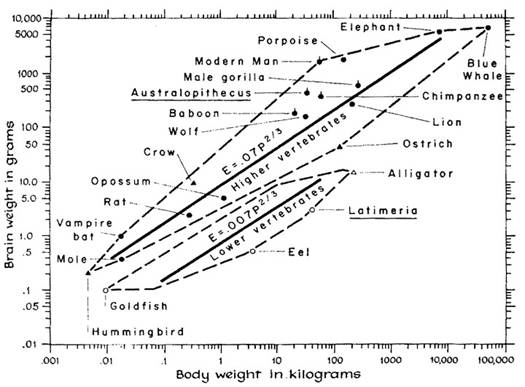
For example, here’s a plot of brain mass relative to body mass (yeah, ugh, “lower” and “higher” vertebrates; let’s call them anamniotes and amniotes instead).

eq

Notice that there are two lines drawn. Both show an upward trend, with a slope that’s proportional to the 2/3 power of the body size (that N2/3 shows up a lot in allometric growth plots). But given a fish (an anamniote, or “lower” vertebrate) and a mammal (an amniote, or “higher”) of exactly the same body mass, the mammal will have a relatively and absolutely much larger brain.

Explain that, engineer, with nothing but algebra and no concern about phylogenetic relationships. It takes more to understand evolution than physics alone, and you have to take into account history, environment, inherited properties, selection, and chance as important parameters.

Oh, well, I’ve learned that physics must be really simple. I can design a plane from the ground up if I simply postulate a spherical 747. Ha ha, all those fools getting engineering degrees when they could just bring in a clever biologist to solve all their trivial little problems.

AtheistTV, next week

I hope AtheistTV is good — they’ve announced they’ll be putting 50 years worth of their video archives on there, so I’m hoping for some interesting content. On the other hand, if it’s recycling crap from youtube as a fast way to get lots of noise online, well…it could get embarrassing. There has to be some quality control, somewhere.

I’ll check it out next Tuesday and let you know what’s on.

Big News: God was not a Klingon

Poor Ken Ham: the media has been distorting his words. They claim that he said all the space aliens are damned to hell. He did not! He plainly said:

And I do believe there can’t be other intelligent beings in outer space because of the meaning of the gospel.

See? They aren’t going to hell, because they don’t exist. He continues with a beautiful example of fundagelical creologic:

You see, the Bible makes it clear that Adam’s sin affected the whole universe. This means that any aliens would also be affected by Adam’s sin, but because they are not Adam’s descendants, they can’t have salvation. One day, the whole universe will be judged by fire, and there will be a new heavens and earth. God’s Son stepped into history to be Jesus Christ, the “Godman,” to be our relative, and to be the perfect sacrifice for sin—the Savior of mankind.

Jesus did not become the “GodKlingon” or the “GodMartian”!  Only descendants of Adam can be saved.  God’s Son remains the “Godman” as our Savior.  In fact, the Bible makes it clear that we see the Father through the Son (and we see the Son through His Word).  To suggest that aliens could respond to the gospel is just totally wrong.

An understanding of the gospel makes it clear that salvation through Christ is only for the Adamic race—human beings who are all descendants of Adam.

Now that’s impressive arrogance and delusions of grandeur. So there are 1011 galaxies and almost 1023 stars in the universe, and they’re all entirely empty of intelligent life, and they’re all going to be burned away and discarded when a Magic Jew comes reappears on Planet Earth. We know this because of an ancient book written by people who thought the earth was flat and the sky was held up on pillars.

Ooooookay.

Those sneaky forms of academic bias…

It’s Tuesday…that must mean it’s “Let’s point out flaws in the academic system!” day.

Here’s another example: some investigators did a study of the value of screening cancer patients for distress — they asked whether such screening actually contributed to patient’s feelings of well-being and willingness to follow medical recommendations, and whether it was cost-effective. Their answer was no on all counts. Kudos to the Journal of Clinical Oncology for publishing a negative result.

Raspberries to the Journal of Clinical Oncology for what they did next, though. They brought in a proponent of screening to write a dismissal of the study.

Hollingsworth and colleagues were surely disappointed to discover that their article was accompanied by a negative editorial commentary. They had not been alerted or given an opportunity to offer a rebuttal. Their manuscript had made it through peer review, only to get whomped by a major proponent of screening, Linda Carlson.

After some faint praise, Carlson tried to neutralize the negative finding

despite several strengths, major study design limitations may explain this result, temper interpretations, and inform further clinical implementation of screening for distress programs.

And if anyone tries to access Hollingworth’s  article through Google Scholar or the Journal of Clinical Oncology website, they run smack into a paywall. Yet they can get through to Carlson’s commentary without obstruction and download a PDF for free.  So, easier to access the trashing of the article than the article itself. Doubly unfair!

Why we need open access, reason #21035.

I also found it interesting that the critical opinion piece had references…but most were to the author, or lab groups that had published with the author. Signs of a circle-jerk in the citations are always a warning sign.

The opinion piece also talks at length about problems with the Hollingworth paper’s protocols. I think it’s important to point out such failings, but shouldn’t they be done by editors and reviewers before publication? And why nitpick at studies that disagree with you, while ignoring major methodological flaws in your own approach?

Try this experiment: Ignore what is said in abstracts of screening studies and instead check the results section carefully. You will see that there are actually lots of negative studies out there, but they have been spun into positive studies. This can easily be accomplished by authors ignoring results obtained for primary outcomes at pre-specified follow-up periods. They can hedge their bets and assess outcome with a full battery of measures at multiple timepoints and then choose the findings that make screening looked best. Or they can just ignore their actual results when writing abstracts and discussion sections.

Especially in their abstracts, articles report only the strongest results at the particular time point that make the study looked best. They emphasize unplanned subgroup analyses. Thus, they report that breast cancer patients did particularly well at 6 months, and ignore that was not true for 3 or 12 month follow up. Clever authors interested in getting published ignore other groups of cancer patients who did not benefit, even when their actual hypothesis had been that all patients would show an improvement and breast cancer patients had not been singled out ahead of time. With lots of opportunities to lump, split, and selectively report the data, such results can be obtained by chance, not fraud, but won’t replicate.

Oh, boy, another of my peeves: fishing with statistics, gaming with your data.

The dose makes the poison

Princeton physicist William Happer is still getting invited on television to say stupid things.

I keep hearing about the "pollutant CO2," or about "poisoning the atmosphere" with CO2, or about minimizing our "carbon footprint." This brings to mind another Orwellian pronouncement that is worth pondering: "But if thought corrupts language, language can also corrupt thought." CO2 is not a pollutant and it is not a poison and we should not corrupt the English language by depriving "pollutant" and "poison" of their original meaning….CO2 is absolutely essential for life on earth.

Did you know oxygen, while not a poison at standard concentrations, is highly reactive and will kill you at high concentration? Or that CO2 is vital for plants and is measured to regulate your breathing, but too much and you’ll suffocate?

What makes a substance poisonous is how much of it there is. Paracelsus figured this out in the 16th century. So Princeton physicists are unaware of developments and explanations that predate even Newton? That’s kind of amazing.

Maybe CNBC and other networks ought to take a lesson from the BBC on ginned up controversies and false dichotomies, and cut this bozo Happer from their invitation list.

It’s not just creationists who mangle science, some atheists do, too

I was sent this terrible statement reputed to be from the guy who calls himself “The Amazing Atheist”. There is, however, no evidence that he actually said these specific words, so the attribution was inappropriate. However, somebody still wrote this idiotic statement:

Nature already has an age of consent. That age is approximately 12-13, otherwise known as the onset of puberty. We don’t need Christian morals to set an arbitrary age on when a sexually mature human female can mate legally. We already have clear parameters on sexually maturity as established by the law of evolution, and acting within those parameters does not under any reasonable definition constitute “rape”. Moreover, because this irrational moral imperialism is almostly solely applied against males who pursue relationships with younger females, I do believe the change of age-of-consent laws should be a critical area of focus for Men’s Rights Activists.

So much wrong.

Nature does not set an age of consent. Nature doesn’t care. Nature doesn’t stop you from raping babies, and it doesn’t tell you it’s OK to rape 21 year olds, either. The age of consent is a social construct, made by people, intended to protect our children from exploitation during those difficult years when they are transitioning from childhood to adulthood.

The law of evolution (tell me, which one?) does not set clear parameters for sexual maturity. Humans have complex, prolonged development — we’re an altricial species, helpless at birth and requiring a long period of nurturing before fully independent. Ovulation is not a magic signpost that says you’re ready to be impregnated. It says your ovaries have developed, but humans live by complex social interactions and sex can be a difficult phenomenon, with obligations and responsibilities and privileges. We expect people to be able to be able to interact with each other in non-damaging social ways before they leap to bumping genitals.

The only way evolution comes into play here is in a pragmatic, rather than a moral sense. For instance, if the author were to promote the idea that since babies are plump, tender, and helpless, Nature’s Law says that we’re free, even encouraged, to eat them, it would be easy to see that any population that thought that would be quickly on their way to self-enabled extinction. Similarly, evolution doesn’t say that you can’t rape young children…it will simply and objectively pass a kind of operational judgment on your population, as the next generation grows up with fucked up, likely unstable and untenable, social structures.

The legal age of consent is arbitrary. Some people might be able to enjoy sex in a mature fashion at an earlier age, others might be best off avoiding it for a few extra years. But we don’t have a way to measure sexual maturity, so as social and legal animals, we abide by one arbitrary dividing line. But picking the moment of first menstruation is also arbitrary — it says nothing about human behavior, or the ability to be responsible for one’s actions, or readiness to cope with the burdens of a possible pregnancy.

Somehow, even worse, the author seems to think that the ability to get pregnant nullifies the concept of rape. That doesn’t follow. If a person has poor judgment because they are too immature to consider all of the consequences, that does not mean you’re allowed to freely have sex with them, as long as they say “yes” to a bowl of candy. We do not use the legal age of consent to dismiss the idea of rape — we don’t say, “she’s over 21, we can rape her now” (well, some people do, but they’re wrong.)

I’ll also condemn with equal severity older women who take advantage of boys. I know, the attitudes in our culture do trivialize sexual assault on boys and men, but that doesn’t mean we should dismiss them. Maybe that would be a good goal for MRAs, to work to defend the sexual autonomy of young men and boys.

But that would be a rational and responsible approach. That last line is revealing: rather than a responsible goal, go for personal sexual gratification. Yeah, sure, encourage MRAs to embrace pedophilia. We’ll see how effectively cultural evolution can work.

Responsible atheism

It’s the same old story: ever since I introduced the idea of dictionary atheism, I’ve been accused of trying to redefine the word.

Wrong. Although I should have noticed their twitter handle and realized that they weren’t worth talking to.

What I advocate is taking atheism seriously, owning the word and recognizing the implications and the causes behind your ideas. A flippant “I just don’t believe in god” is only the middle of the story: it’s actually “because X, I just don’t believe in god, therefore Y.” Yet so many people just make that statement, and then argue that there are no antecedents and no consequences of atheism — a revolutionary idea for which people have been executed, which is in opposition to the premises used to establish many of the powerful institutions in our culture, which directly contradicts what many people consider the basis of all morality in society, is treated as casually and cavalierly as the statement, “I don’t much care for Justin Bieber’s music”. So what we get are people who jump on the bandwagon, assert their atheism, and then continue to perpetuate the same old injustices and prejudices as before. Which is not at all unexpected in any movement, but still doesn’t sit well — I think it’s important that we remind everyone that taking on a major philosophical position isn’t the same as getting the latest shoe from Nike. There’s baggage. There are implications.

I’ll also say something that will irritate much of the readership here: you may not like some of their interpretations, but Dawkins, Harris, Dennett, and Hitchens definitely take atheism very seriously, and see it as a transforming principle for society. They’re right about that. If we do take responsibility for what atheism actually means, it has a host of consequences: it means that naturalism is the only principle we should use in making decisions, no waiting for miracles. It means that there is no afterlife, so causing death is a problem of far greater magnitude, no cop outs that they’re going to a better world. It means justice isn’t something imposed on us from above, but arises from our relationships with one another. It means we have to work together to build a better society, and clinging to old biases will not work.

Obviously, this does not mean atheism needs dogma — the disagreements we have are actually a good sign that we recognize that making a post-theist society takes work, and there certainly is no unity within the movement. But I think an important first step is to realize that some people are responsible atheists, and others are not. And for me, the first sign that I shouldn’t even bother arguing with someone is when they pull out the dictionary and declare that atheism only means that you don’t believe in any gods. Well, good for you, you’re nominally atheist, we’re all done, come back and talk to me when you’ve grown up a little.

I get email

I’m getting a swarm of these, all sounding nearly exactly alike. And what do you know, an idiot youtube atheist just issued a fatwah. Guys, I’d be more impressed with your claim to be unique individuals if you didn’t simply parrot some youtuber’s talking points.

Hello PZ myers. I just want to email you to ask you a few questions and to plead for sanity. I am fairly sure that I am just wasting my time and you will not respond but here I go anyways. What is the deal with your “free thought blog”? You censor comment and ban people for not agreeing with you, from what I have heard.

Oh, please, get down off the fucking cross already. It’s a really boring trope: I’ve got comments all over the place that start, “I know you will delete this comment because I disagree with you…” and strangely, they don’t get deleted. Look at any article with a lot of comments, and you won’t find it’s all a bunch of people agreeing with me — even regulars here routinely criticize me. What you always find in those long threads is one or more jackasses braying repeatedly and inciting prolonged rebuttals.

“From what I have heard”…right. Sleazy little wanker, you are. Where did you hear it? I bet I can guess.

You seem to start arguments in the atheist community, which largely serve to divide the community and make it harder for us to get in a position to actually do something about the harm that religion causes humanity. You have people on other websites talking bad about other atheists and scientists in your name.

In MY name? That doesn’t even make sense. I’m a guy with a blog and a teaching position, with zero power and authority. I write what I think, and many people agree, and many disagree.

And what atheist community? You act as if there is some monolithic institution with a few rebels causing trouble. Atheism is a chaotic mess, with many communities within it. It seems to annoy some people that I don’t join with the libertarian, anti-feminist herd, but they never seem to consider that it takes two sides to make a rift.

I am trying to be polite in this email but you seem to be starting a cult in your fan base. We all need to work together to make the world a better place. We won’t always agree 100% with everyone even in our little niche groups, if we do then that is a sign of something worse at work. I am not asking you to just go out and say “sorry I was a jerk” but you NEED to stop doing things to divide the community.

Oh, no, I’m dividing the community! I dare to point out that some members of this community are assholes, and you get to call me a jerk and tell me what to do. If you really want to do something to help humanity, then I’m afraid what you need to do is separate yourself from the anti-feminist ranters and join a group that sincerely cares about social justice, rather than using the term as an insult.

I grew up in the 1960s, and I remember a real divide — there were all these young people demanding an end to the draft and opposing war, and then there were all the people with the “America, love it or leave it” bumper stickers. And even when I was 9 years old I could see the deep logical flaw in the bumper sticker people. If you really loved the country, and you saw serious problems (like Nixon, or creationism, or misogyny), wouldn’t the appropriate response be to work to fix them, rather than denying their existence?

Yet here we have atheists who insist on the equivalent of “atheism, love it or leave it,” seeing no flaws at all, and demanding that anyone who disagrees should shut up in the name of holy unity.

Fuck that noise. I do not aim to conform.