Here’s a heart-warming story for Sunday morning, but it’s about a huntsman spider, so I guess it had better go below the fold.
…spiders.
There are lots of things with the “Runestone” moniker attached in my area: Runestone Telecom Association, Runestone Apartments, Runestone Mobile Home Park, etc., etc., and there’s a park called Kensington Rune Stone Park just 40 minutes away from me. I decided to take a trip out there.
That’s a rather nice building to honor a fake carved rock supposedly left by Vikings visiting Minnesota in the 14th century. It’s empty now, probably due mostly to the pandemic, but it’s not clear what they do there — it contains a big empty meeting space, perhaps for lectures about Vikings. The Olaf Ohman farmhouse is there and a big barn and some nicely maintained grassy grounds. The notorious Runestone itself is not there — it has a separate museum of its own in Alexandria, 20 minutes away. It’s all rather embarrassing.
But we didn’t care we were there for spiders. We found a few!
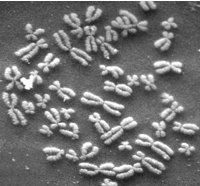
I had already known that the number of human chromosomes had been incorrectly reported as 48 (it’s actually 46), and that observers maintained that number for decades, seeing what they expected to see. I’ve used it as an example for years to tell students to clear their heads of preconceptions when making observations, trust what you see, and report your measurements as accurately as you can, because this tendency favoring confirmation bias can corrupt science surprisingly easily. It sounds like a relatively benign example: oops, early investigator makes a mistake counting chromosomes (I’ve done some chromosome work, it’s easy to do), and the initial observation gets perpetuated through the literature until superior techniques make the correct value obvious. Ha ha, don’t do that.
Now Dan Graur digs into the details of the mistake, and it turns out to be a goddamn horror story. There are more lessons here than I thought.
The guy who made the mistake was named Theophilus Painter, and he seems to have stumbled upwards throughout his career by being a terrible person.
The first horror: the specimens he used to make those initial chromosome counts were human testicles lopped off prisoners in an asylum. They were castrated for the crime of excessive masturbation. The methods discuss some grisly details I really didn’t need to know.
“The material upon which this study is based was obtained from three inmates of the Texas State Insane Asylum through the interest and cooperation of Dr. T. E. Cook, a physician at that institution. Two of these individuals were negroes and one was a young white man. In all three cases, the cause for the removal of the testes was excessive self abuse… The operation for the removal of the testes was made, in all three cases, under local anesthesia. An hour or two prior to the operation, the patients were given hypodermic injections of morphine in order to quiet them. This was followed by local injections of Novocain in the operating room. None of the patients exhibited any interest or excitement during the operation, nor did they show any signs of pain except when the vas deferens and the accompanying nerves were cut. One of the negroes went to sleep during the operation.”
Yikes. I guess mutilation of your patients was a routine practice in 1923. No big deal, Negroes don’t feel pain.
The second horror: as you might guess from the passage above, the whole affair was soaking in racism. Painter got the same erroneous chromosome count from all 3 of his victims, but always reported the count separately for his black and white subjects. There may also have been confirmation bias in Painter’s work, because more recent examination of his slides, which still exist, reveal that his methods were a cytological mess and it’s difficult to count chromosome numbers from them at all.
The third horror: Painter later got appointed to the presidency of the University of Texas because he was a reliably negligent creature who would happily turn a blind eye to blatantly discriminatory admission policies, and would allow segregation to continue.
Read Graur for all the details. I’m just dismayed that a point I’ve always used casually as an example of a simple error with long-term consequences is now going to have to be presented as a deeper point about bad science being used for evil. Oh, well, students should know how genetics can be misused for wicked purposes, and here’s yet another case.
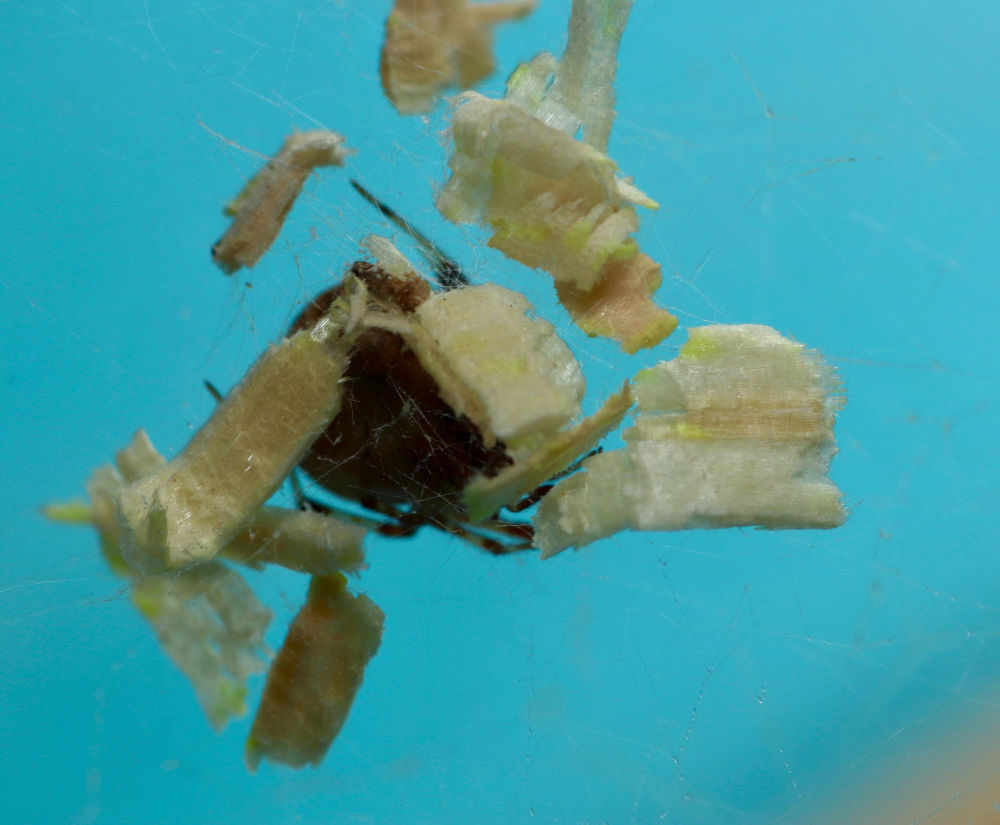
I’m still trying to work out the biology of nest building in my spiders — I’ve got some that assemble cunning little nests out of wood shavings, and some that do not. Someday I’ll have to figure out whether this is a different species from P. tepidariorum or not.
Cute, hey? I’ve been looking at spider architecture for a while, and am rather impressed with their work.
I suspect it might be P. tabulata, but I’ve got to do more experiments to be sure. I say more about it on my Patreon page.
It’s that time of year when all the spectacular orb webs are popping up all over. We found a few of their makers this morning — photos on iNaturalist and Instagram if you’d like to see them.
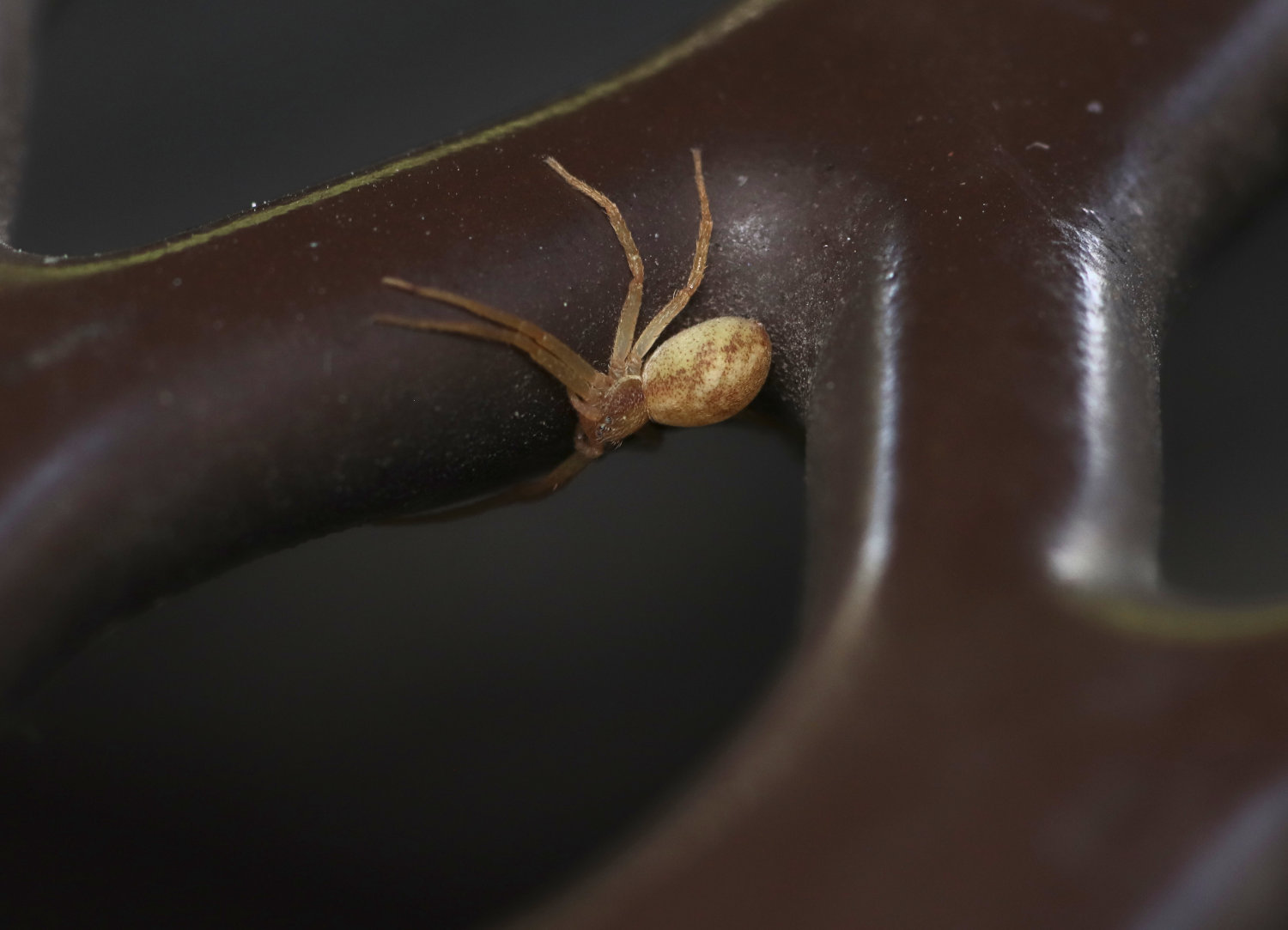
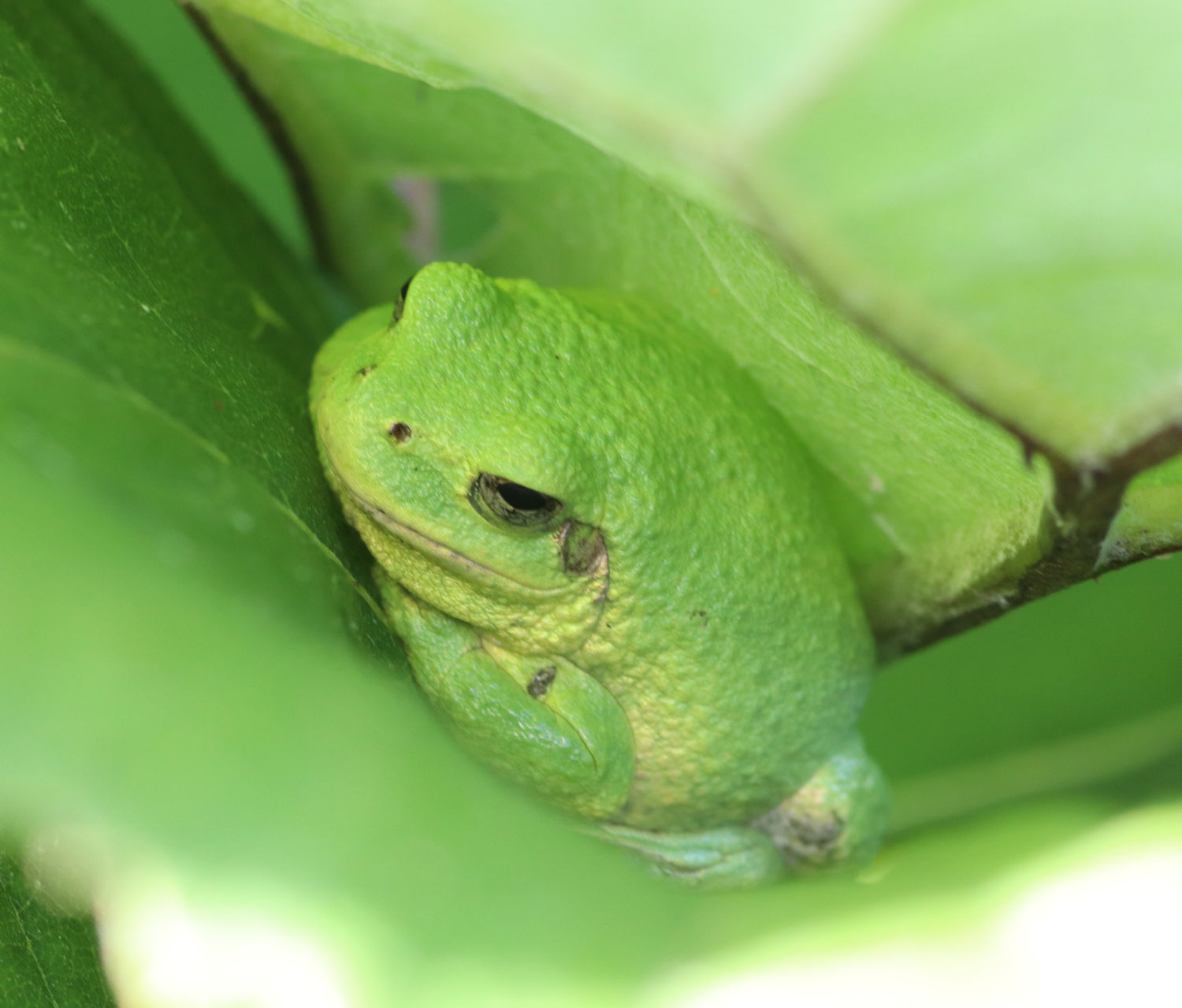
We were exploring our local horticulture garden, and found this little guy hiding between some leaves.
We also found lots of spiders, but my photos didn’t turn out very well. I threw a few onto my Patreon page anyway, but I’ve got to do better.
In the Washington Post: Coronavirus autopsies: A story of 38 brains, 87 lungs and 42 hearts, just the thing to read if you want to know how COVID-19 will kill you. To summarize it unjustly, it’s thousands of microclots in your lungs. But that’s not all! There are cardiac, brain, and kidney effects as well, only those don’t seem to be direct actions of the virus. Instead, it’s more tiny vascular damages, like hundreds of microstrokes in the brain. Good to know, when you’re lying there comatose with a respirator down your throat, that you’re being nibbled to death by lots of tiny clots destroying your organs.
Yet people now are not even taking minimal precautions, claiming a mask infringes on their liberties, as if a virus ripping up delicate membranes in their body doesn’t.
Hey, who all is gettin’ together with their buds for beer and loud music and fireworks this weekend? It may be your last chance before your lungs are perforated and your brain gets swiss-cheesed, so enjoy yourselves!
I’ve got an infrared thermometer, and I’m not afraid to use it.
Brian should be terrified.
Should we explain to him that:
So this is the quality of the opposition to basic health care measures? We’re doomed.
By the way, I have one for measuring the approximate temperature of spiders. I couldn’t find a regular thermometer tiny enough to shove up their bottoms. (Also, they’re not particularly accurate — I’m primarily measuring the approximate temperature of their environment.)
I’ve made the big leagues. I’m cited on c/net in a review of panspermia claims.
Joseph is an enigma wrapped in a riddle wrapped in a shirt unbuttoned to his stomach. He is, according to his autobiography, a well-known and acclaimed neurobiologist. He enjoys the ocean, walking along the beach and hiking. His self-published articles argue life has been found on Mars and Venus, and propagate an alternative view of life’s beginnings.
That theory is “panspermia.” It holds that life first arose in space and that planets in the solar system were “seeded” with microbes carried across the cosmos by dust, meteors and debris.
“Panspermia is one of those things where all the biologists are saying, ‘Maybe it could have happened, but we don’t have any evidence for it’,” says Paul Myers, a developmental biologist at the University of Minnesota, Morris. Myers has refuted the theory in the past, leading to clashes with Joseph and his colleagues, a group he calls “the panspermia mafia.”
Two of panspermia’s biggest proponents are famed astronomer Fred Hoyle, who died in 2001, and his protege Chandra Wickramasinghe. Hoyle helped unravel “stellar nucleosynthesis,” a process that occurs in stars to generate all the chemical elements in the cosmos and, in collaboration with Wickramasinghe, the pair discovered the organic material that makes up cosmic dust. However, in the latter parts of their careers, the two have made controversial claims with little evidence to back them up, including the idea that viruses, like the flu and coronavirus, come from space.
Myers says the academic pedigree of Hoyle and Wickramasinghe gave panspermia an air of credibility in the 1970s, helping the pair popularize it as a renegade view of the origins of life. But the theory has served as a launching pad for nonsensical, pseudoscientific theories — including Joseph’s belief that Mars is full of mushrooms, fungi and lichen.
Wickramasinghe remains the godfather of panspermia, continuing to publish on the theory in books and his own journals. Rhawn Gabriel Joseph is the heir apparent.
It’s not just me, of course. They review his claim of mushrooms sprouting on Mars.
How Joseph’s piece moved past the peer review process and was accepted for publication remains a mystery. The process usually weeds out these explicitly non-scientific claims. Other astronomers and astrobiologists who examined the research soundly rebuked its conclusions, citing poor methodology and analysis.
Michael Brown, an astronomer at Monash University in Australia, said “there’s some pretty horrible over-interpretation of blurry photos,” while Gretchen Benedix, a geophysicist at Curtin University in Australia, noted “increasing image sizes to investigate the objects of interest does not change the resolution of the image and therefore does not give better analysis of the objects of interest.”
Rocco Mancinelli, the editor in chief of the International Journal of Astrobiology, called the science and logic “completely flawed,” and said he would recommend it be rejected for publication.
A NASA spokesperson told me “the consensus of the majority of the scientific community is that current conditions on the surface of Mars are not suitable for liquid water or complex life.”
As the article points out, Rhawn Joseph and his cronies have been tainting a scientific subdiscipline for decades, relying on promotion by tabloids to generate the illusion of authority.
Over the last decade, Joseph and JOC have mostly been ignored by NASA and by the scientific community. Very few scientists take the alien fungi claims seriously, but Joseph’s work has been highlighted in UK tabloids, RT and many well-meaning science news sites since February 2019. Some have touted Joseph’s websites as “scientific journals” and even confused Joseph’s vanity website with legitimate, similarly named journals. One painted Joseph as someone trying to “defy the odds.”
And that’s where the danger lies.
Astrobiology, the search for and study of extraterrestrial life, is a serious scientific endeavor. NASA has an astrobiology program, and searching for life is a critical part of its Mars exploration program. And although the public seems resistant to fanciful claims of fungal spores on Mars or lichen on Venus, they haven’t gone away. If anything, social media seems to have made us more gullible. As crank, fringe theories start to gather steam in honest peer-reviewed journals, the public’s perception of astrobiology can quickly be muddied.
Let’s hope this is the end of Joseph and Wickramasinghe.
I doubt that it will be. They’re going to continue to dump junk science into the literature.
Nope, no way. They just keep getting in the way of finding spiders.
We took a walk out by our Horticulture Display Gardens, which recently reopened — but with sensible restrictions, like social distancing and masks and arrows designating the directions for walking. It was a little disappointing. Oh, sure, flowers and all that stuff, but our timing was off, because last night the area got pummeled by a brutal storm, there were downed trees and tree branches everywhere, and worst of all, most of the spider webs had been blown away. We found a few examples of spider survivors trying to recover from the catastrophe, like this brave little baby spider who had put together a beautifully formed orb web.
There were a few others around (posted on Instagram), but we’ll probably find more in a few days, once everything has dried out and they have a chance to do some reconstruction.