
A reader has asked me to explain Axial Twist Theory. I don’t wanna.
OK, I dug into it a little bit. It’s a crank hypothesis promoted by a tiny number of people; it reminds me of Vortex theory and Lifecode, a couple of comprehensive theories of development proposed by obsessive individuals on the basis of biased interpretations of poor or even bogus observations. Coincidentally, my criticisms of those ideas led to serious threats of lawsuits, which is another strike against them (scientific hypotheses are not defended by lawsuits), and makes me wonder if I’m going to get sued again. No worries, those were not credible threats.
So what is it? There is a web page titled “Axial Twist Theory Explained”, and a Wikipedia page. They’re both terribly written, difficult to wade through, and I suspect both were written by the same person. The theory attempts to explain a phenomenon that doesn’t exist and doesn’t need explanation.
In short, the theory claims that the face and rostral nervous system were rotated during embryonic development and evolution, which they propose to explain the existence of decussations, like the way eyes project to contralateral regions of the central nervous system.
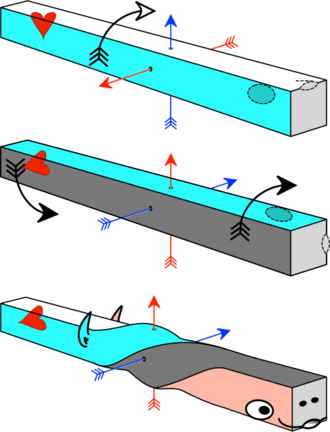
Schema of the proposed development of the axial twist. Developmental phases are (from top to bottom): (1) the embryo turns on its left side; (2) the anterior head grows in the same direction, but the rest of the body grows oppositely into a twist. So that ultimately (3) external bilateral symmetry is regained. Note that there is no evolutionary pressure for internal symmetry so the heart (and other organs) remain asymmetric.
We have no need of this hypothesis, and they have no evidence to support it. It’s that simple.
I’m pretty familiar with the concept of decussations in the nervous system. That’s what I studied in a previous life: my graduate work was on how the spinal cord gets wired up, and there are crossing fibers all up and down the cord. The lab I was in was focused on hindbrain neurons that crossed the midline to innervate contralateral motor outputs. If we needed to twist the whole axis to get them to cross, the whole nervous system would have to be twisted like the rubber band in a model airplane. It makes no sense.
As a post-doc I studied the development of commissural neurons in the grasshopper embryo. Axial Twist Theory confines itself to vertebrate development, so one might argue that grasshoppers are irrelevant, except that insects contain lots of crossing fibers that don’t require whole body twists to explain. It’s simply a functional consequence of needing to integrate both sides of the animal, and the mechanisms for generating it is straightforward molecular signaling that has existed since the last common ancestor of vertebrates and invertebrates.
But to be fair, let’s look at the research literature. Next problem: it’s negligible. Pubmed turns up one article: Opposite asymmetries of face and trunk and of kissing and hugging, as predicted by the axial twist hypothesis by Marc H.E. de Lussanet. It’s incredibly silly. For instance, bilateral symmetry is imperfect, so they interpret biases as the product of incomplete rotation of the face relative to the back of the head.
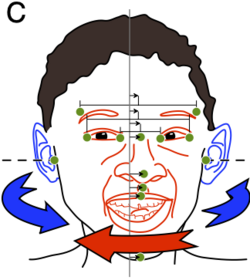
Exaggerated schema of the aurofacial asymmetry as predicted by the axial twist theory. During embryology and development, the face elements (red) are predicted to move toward the center from the left, with respect to the mid-plane between the ears.
It gets sillier. Part of the data in that paper was an analysis of photographs on the internet, and an experiment in which people were photographed hugging dolls and were observed in airports. Did I say silly? This is getting creepy.
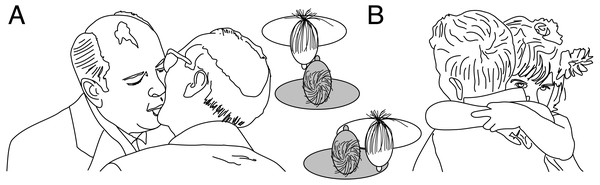
Examples of left kissing (A) and right hugging (B).
The two schemas show a top view of the opposite behavioral asymmetries.
Apparently, the asymmetry during kissing is different than the asymmetry during hugging, which suggests that there is a twist between face and body. But even that is an ambiguous mess!
The kissing results also confirm the hypothesis and reproduces the findings of airport observations, experiments with dolls, as well as with couples and questionnaires. Earlier studies have revealed clear regional cultural influences: for example in some French cities, as well as in native Palestinian and Jewish Israelis, the kissing bias is reversed, whereas in a conservative muslim country (Bangladesh) the kissing bias is as in the other studies. Also, the bias in kissing and hugging behavior is strongly reduced by emotional contexts. For example, no bias was found in a public kiss between strangers. Thirdly, the kissing bias can be influenced by a lateral head tilt. For example, when kissing a doll head that is either 5° tilted to the right or 15° to the left resulted in a bias of almost 100% to the left and right side of the face respectively. Finally, both the kissing and hugging bias seem to be reduced in left handers
How do you draw conclusions about an embryonic transition that had to have occurred in the Precambrian from a wildly variable behavior in modern humans? The author treats this noise as a solid demonstration of the Axial Twist Hypothesis.
We thus showed that humans also behave as twisted creatures, as predicted by the ATH. Asking people why they kiss or hug this way, or to try it the other way leads to responses such as “it somehow feels better, more natural like this.” We thus tend to kiss as if the ventral side of the face has not quite arrived in the centre, but is still located to the left. Correspondingly, we tend to hug as if the ventral trunk is located to the right of the sagittal plane.
The final strike for me is their gross misinterpretation of zebrafish development. They claim that there is a rotation of the two eyes that fits their model, and they show a single short timelapse.
I spent years staring in a microscope at early, developing zebrafish embryos. No, the eyes don’t rotate around the body axis. In that video, they’re showing a slightly askew perspective on the head and drawing red and blue overlays on the eyes to emphasize an asymmetry inherent in the angle.
I don’t have to explain the Axial Twist Theory because it’s an imaginary phenomenon with no good evidence for it, used to explain poor observations that don’t need a deep evolutionary/embryological foundation.
It was still a little bit entertaining to dive into some bad science.

Did they get the idea from Flounders?
Why the AF did they draw Gorbachev kissing another guy?
This looks like silliness all the way down, and it’s clearly not worth anyone’s time — at least not until RFKook finds a way to profit from it…
The first image sort of resembles the Totem from the game “Monument Valley”.
@2 Raging Bee
Why not? That’s Erich Honnecker by the way.