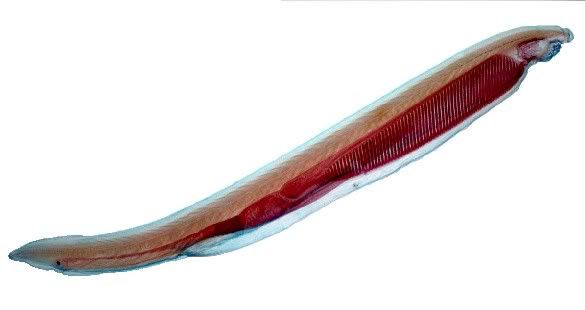
My previous contributions to the basic concepts in science collection were on gastrulation and neurulation, so let’s add the next stage, and the one I named the blog after: the pharyngula.
This afternoon, I’m traveling to the Twin Cities again. Ricardo Azevedo is giving a talk at 4:00 in 150 Ecology at UMTC on “Sex, robustness and epistasis”. The title has one of those buzzwords that always makes me perk up and pay attention. You know the one I mean. Mmmmmmm, “epistasis”.
If you’re trying to come up with names for an exotic element with amazing properties for that comic book, fantasy novel, or role-playing game you’re writing, here’s a list of apocryphal elements (there’s also a similar list with more details). These are all genuine false alarms from the world of science, guaranteed to have been generated from the twisted minds of actual chemists and physicists.
We really need elements called Ultimium and Extremium. Neokosmium isn’t bad, either.
It’s strange (but typical) how creationists will simply make up an answer to that question that trivializes the number of discovered fossils — the latest is DaveScot, who claims they “wouldn’t fill a single coffin.” Afarensis tallies them up. Would you be surprised to learn that DaveScot was making it all up?
Way back in the early 19th century, Geoffroy St. Hilaire argued for a radical idea, that vertebrates and most invertebrates were inverted copies of each other. Vertebrates have a dorsal nerve cord and ventral heart, while an insect has a ventral nerve cord and dorsal heart. Could it be that there was a common plan, and that one difference is simply that one is upside down relative to the other? It was an interesting idea, but it didn’t hold up at the time; critics could just enumerate the multitude of differences observable between arthropods and vertebrates and drown out an apparent similarity in a flood of documented differences. Picking out a few superficial similarities and proposing that something just looks like it ought to be so is not a persuasive argument in science.
Something has changed in the almost 200 years since Geoffroy made his suggestion, though: there has been a new flood of molecular data that shows that Geoffroy was right. We’re finding that all animals seem to use the same early molecular signals to define the orientation of the body axis, and that the dorsal-ventral axis is defined by a molecule in the Bmp (Bone Morphogenetic Protein) family. In vertebrates, Bmp is high in concentration along the ventral side of the embryo, opposite the developing nervous system. In arthropods, Bmp (the homolog in insects is called decapentaplegic, or dpp) is high on the dorsal side, which is still opposite the nervous system. At this point, the question of whether the dorsal-ventral axis of the vertebrate and invertebrate body plans have a common origin and whether one is inverted relative to the other has been settled, and the answer is yes.
Oh, I hate these difficult questions.
If you’re a professor and you want to change the world, what do you do? In 1993–quit and become an activist. In 2007—start a blog.
Or so it seems. PZ Myers blogging at Pharyngula is probably doing more for evolution than PZ Myers publishing papers in scientific journals. Is that true PZ?
No.
Hmmm, I guess it wasn’t so difficult after all!
I’m sure you’ve already heard about it, so I’m a little redundant to bring it up — Carl Zimmer has a spiffy article in the NY Times about duck phalluses. No, that’s not quite right; the most interesting part of the story was the bit about duck oviducts. Female ducks have been evolving increasingly convoluted oviducts to baffle the efforts of duck rapists to inseminate them, and male ducks have been evolving concomitantly long phalluses to thread the maze and deliver sperm to the ovaries.
I’d heard about these huge intromittent organs in ducks before, but this is another fascinating revelation: it took a woman scientist to suggest that maybe, just maybe, they also ought to look at what’s going on in the female ducks, and then the whole wonderful story of coevolution of these structures emerged. It’s actually a rather embarrassing instance of a scientific blind spot, where the biases of the investigators led them to overlook an important component of the story.
My little trip distracted me with the perfect timing to miss the amazing fair-use flare-up — I’m back just in time to catch the happy resolution. I guess I’ll say something anyway, but I’ll be brief.
The general question is whether blogs should be restrained from using figures and data published in scientific journals. My position is that we should use them — scientific information should be freely and widely disseminated, anything else is antithetical to the advancement of science. The only constraints I think are fair is that all material taken from a journal should be acknowledged and formally cited, and that dumping whole articles to the web should not be done. It wouldn’t be appropriate for our audiences anyway; we should be explaining and synthesizing, not blindly replicating.
I’m glad it has blown over for now, at least. Let’s hope journals continue to be sensible about letting blogs excerpt portions of published work—they have a specialized audience, we have a more general audience, and we hope that blogging about science will lead to more scientists, which will increase the market for the science journals. Everyone will be happy!
Phil Plait has the stats: it’s 1.5 earth diameters, 5 times the mass, 2¼ Gs, and probably has a surface temperature between 0°C and 40°C. It’s big, it could be wet, and it’s only 20 light years away. You know what I’m thinking? It could be the Planet of the Squid.
Somebody get cracking on that transluminal drive.
Darksyde has just announced a few details about the science panels that will be held at the YearlyKos Convention. One relevant piece of information is that I’m the guy in charge of the science caucus, and I have to organize something. If Darksyde had ever seen my office, organization is not a word that would have come to mind…