Friday Cephalopod: Our cunning plan exposed

pinksquid

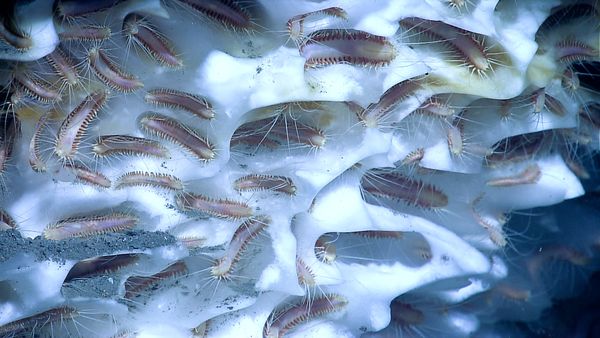
This pretty pink photo that accompanied the article has nothing at all to do with the contents; this can’t be the species involved. But that’s appropriate to the devious nature of the story.

A squid was caught in China that had swallowed a three pound bomb — a live explosive that was later detonated by the local bomb squad.

Just keep that in mind next time you order calamari. If you hear a loud boom from the kitchen, you’ll know the suicide squid have struck again.

Here I Stand; I Can Do No Other

I weigh in on Google Glass at KCET.

The gist:

Some of us come out to the desert to escape the Panopticon that life in the city already is, increasingly. In Los Angeles, Google Glass might be just one more increment of invasion in a landscape already thoroughly colonized by surveillance cameras, red light cameras, random private webcams, smart phone videographers and other such prying eyes. But there are places out here that don’t even have 4G yet. In fact — and you might want to sit down here and swallow that mouthful of coffee — there are some places out here where even the 3G coverage is spotty. We are in the back of beyond here in much of Eastern California.

And we like it that way, mostly.

So by all means, come on out and visit the desert. Bring your recording equipment, whether it’s a shoulder-mounted Steadicam or this latest bit of geek lust from Google sitting on your face. Document your hike. Record that coyote begging for sandwiches. Take video of that gorgeous desert bloom backlit by sunrise. The desert needs all the documentation it can get.

But if you’re talking to me, take that Google Glass off and put it away. If I’m speaking in public — which I do from time to time, offering lectures and poetry readings and such — and see you’re in my audience wearing Google Glass and you haven’t cleared it with me first, I will stop what I’m doing and ask you to put it away or leave. If you’re at an adjacent cafe table facing me and recording in my direction, I will write something derogatory in Sharpie on a sheet of paper and hold it up. I may escalate from there. And I’m not alone.

Read the whole thing.

[Read more…]

The argument from eyelid development

This is a new one for me. Earlier today I was summoned on Twitter to address an assertion by a creationist, @jarrydtrokis. I was slightly boggled.

He was baffled by eyelid development. It seems he thinks it requires…intelligent design!.

… Here’s one for you to ponder :) Eye lids in the womb… How are they formed? #IntelligentDesign?

Wait, what? What’s mystifying about eyelid formation?

The section of skin in the middle dies… How does it know to do that? And in a perfectly straight line???

Oh. It forms a straight line. Whoa. And he claims to have done research to get the answer.

The research I’ve done shows the scientists are at a loss for an explanation….

Gosh. I can do research, too. It’s easy to explain, with pictures even.

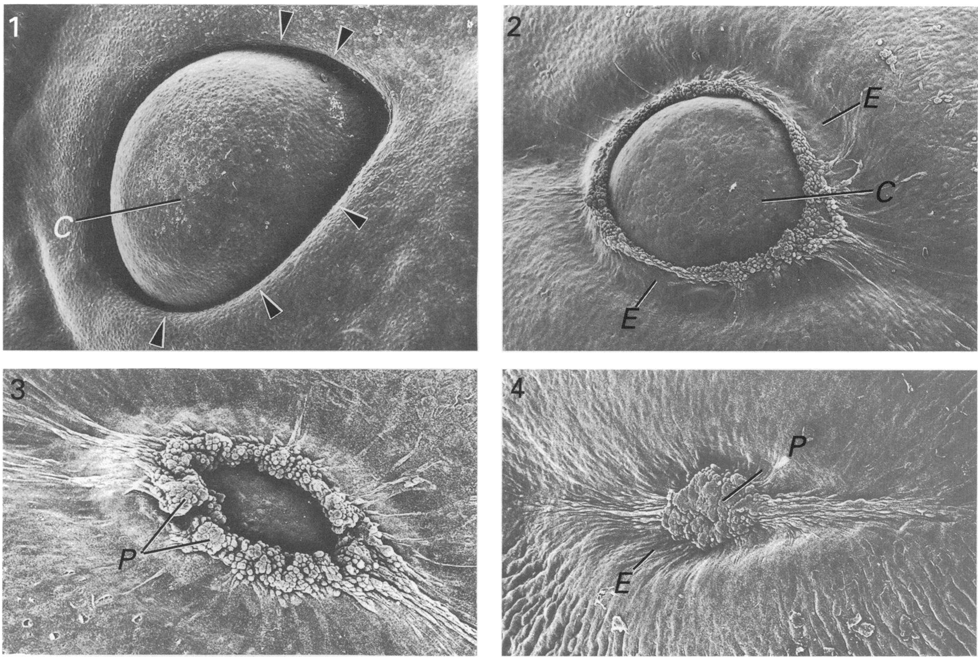
The eyelids separate in a straight seam because of how they got that way. The eyelids form by expansion of two epithelial sheets from above and below that meet in the middle. When you see how the eyelids develop, it’s easy to see how they separate in a straight line later. This is a series of images over the course of about a day in mouse development. In the first, you can see the eye sans eyelid, but ringed by epithelia. In the second, you can see that epithelium growing, expanding in a sheet over the eye. In the third, the sheet is beginning to close in a line over the middle, and in the fourth it has completely closed, but leaving a seam or scar in a straight line across it.

mouse_eyelid_sem

Wait, you say inquisitively, I’d like a closer look at that seam. Can you show me what is going on postnatally, as the eyelids separate? Sure can.

mouse_eyelid_tem

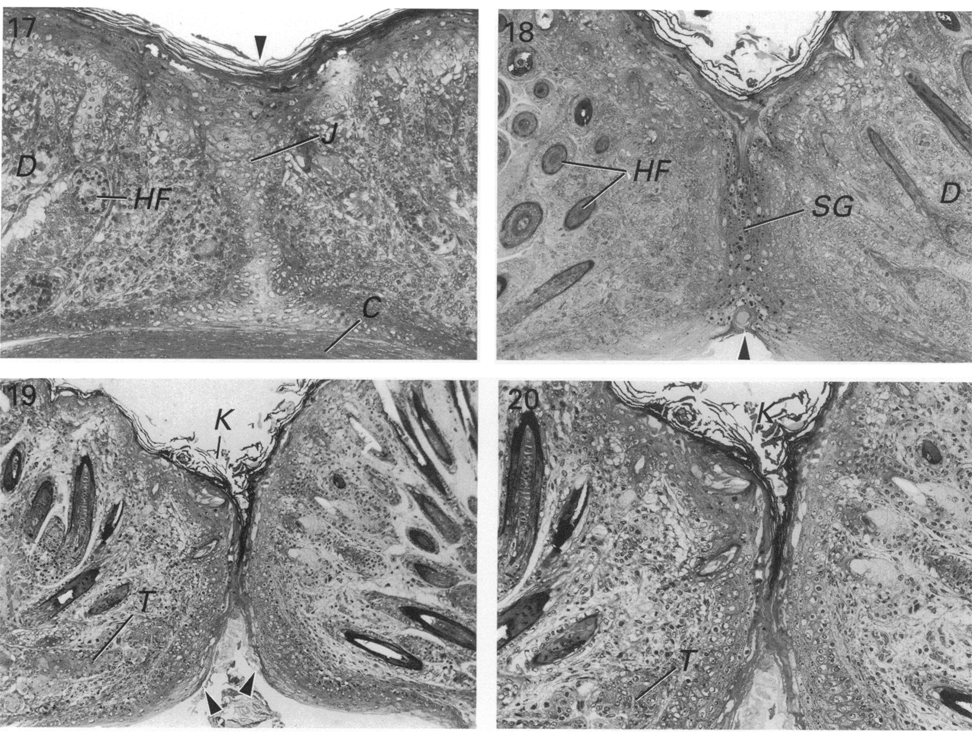
The first panel is 5 days postnatal in the mouse; the eyelids are still fused. But you can see a difference in the histology of the junctional region (J), and a depression at the arrowhead (you can also see the layers of keratin there). There’s something different in this area.

In the second panel, 10 days postnatally, the depression at the junctional region is deepening and you can see a stratum granulosum (SG) at the seam, while you can also see hair follicles (HF) forming in the adjacent portions of the lid.

The third and fourth panels are at 12 days, and now the keratin layers have extended into the depression from both the inside and outside, completing the separation of the two lids.

Now @jarrydtrokis might be tempted to say that Jesus did the separating, but that’s only true if Jesus is a polypeptide called epidermal growth factor, or EGF. EGF is a molecule that triggers growth and differentiation of keratinocytes, and it turns out that if you treat baby mice with EGF it accelerates the rate of eyelid separation.

I’m sorry, @jarrydtrokis, but your argument from ignorance wasn’t very persuasive, and your talents at ‘research’ are rather pathetic, since the paper describing all that was trivial to find. But then, isn’t this always the case with creationists? There are none so blind as those who will not see.


Findlater GS, McDougall RD, Kaufman MH (1993) Eyelid development, fusion and subsequent reopening in the mouse. J Anat. 183(1):121-9.

Gizmodo fails again

There’s a whole lot wrong with this Gizmodo piece on the proposed Palen Solar Electric Generating System. In fact, the fuckup per sentence ratio is higher than in any piece I’ve seen this month outside of Mercola.com. The Solar Energy Zone “Initiative” wasn’t “signed into law” by Obama — it was a record of decision issued by the Interior Department on an agency program as the culmination of an environmental assessment, rather than a bill passed by Congress and sent to the President’s desk. (Which means Obama didn’t sign it and it’s not a law.) Palen will very likely not start construction this year: the California Energy Commission is casting a sober eye at contractor BrightSource’s technology on its proposed Hidden Hills project, which is much closer to approval. The towers at Hidden Hills will be just as tall as those at Palen, if either plant ever gets built, and Hidden Hills will likely go up first, meaning that the Gizmodo headline is wrong.

Like I said: many, many errors. But this one’s the worst, and it’s the very first paragraph:

The US government holds vast tracts of public lands—more than a 654 million acres, in fact—for public use such as national parks as well as for military use like test ranges and proving grounds. But most of the time, much of that land is left to rot when it could be producing clean solar energy for our ever-increasing power needs.

“Left to rot.”

By way of comparison

“Left to rot.”

ashford

“Left to rot.”

marching

What is it with some of these tech writers? Any landscape that doesn’t look like fucking Trantor is useless to them, sounds like.

What I taught today: those oddball critters, the vertebrates

We’ve been talking about flies nonstop for the last month — it’s been nothing but developmental genetics and epistasis and gene regulation in weird ol’ Drosophila — so I’m changing things up a bit, starting today. We talked about vertebrates in a general way, giving an overview of major landmarks in embryology, and a little historical perspective.

We take a very bottom-up approach to studying fly development: typically, fly freaks start with genes, modifying and mutating them and then looking at phenotype. Historically, vertebrate embryology goes the other way, starting with variations in the phenotype and inferring mechanisms (this has been changing for the last decade or two; we often start with a gene, sometimes from a fly, and use that as a probe to hook into the genetic mechanisms driving developmental processes). What that means is the 19th and early 20th century literature on embryology is often comparative morphology, looking at different species or different stages and trying to extract the commonalities or differences, or it’s experimental morphology, making modifications (usually not genetic) to the embryo and asking what happens next. Genes were not hot topics of discussion until the last half of the 20th century, and even then it took a few decades for the tools to percolate into the developmental biologists’ armory.

And much of 19th century embryology went lurching down a dead end. We talked about Haeckel, the grand sidetracker of the age. There was a deep desire to integrate development and evolution, but they lacked the necessary bridge of genetics, so Haeckel borrowed one, his theory of ontogenetic recapitulation. A theory that quickly went down in flames in the scientific community (jebus, Karl Ernst von Baer had eviscerated it 50 years before Haeckel resurrected it). We actually spent a fair amount of class time going over arguments for and against, and modern interpretations of phylotypy — it isn’t recapitulation, it’s convergence on a conserved network of global spatial genes that define the rough outlines of the vertebrate body plan.

Finally, I gave them a whirlwind tour of basic developmental stages of a few common vertebrate models: frog, fish, chick, and mouse. We’re going to talk quite a bit about early axis specification events in vertebrates (next week), and gastrulation (probably the week after), so I had to introduce them to the essential terminology and events. I think they can see the fundamental morphological events now — next, β-catenin and nodal and Nieuwkoop centers and all that fun stuff!

(Today’s slides (pdf))

Science makes you good! (Sometimes.)

You’ve probably heard this explanation for the virtue of religion: that even if god doesn’t exist, belief in god (or some other monitoring authority) makes people behave more morally. There have been many experiments that have actually shown that people are nicer or more generous when exposed to religious concepts, such as this one by Norenzayan and Shariff.

In one of their own studies, they primed half the participants with a spirituality-themed word jumble (including the words divine and God) and gave the other half the same task with nonspiritual words. Then, they gave all the participants $10 each and told them that they could either keep it or share their cash reward with another (anonymous) subject. Ultimately, the spiritual-jumble group parted with more than twice as much money as the control. Norenzayan and Shariff suggest that this lopsided outcome is the result of an evolutionary imperative to care about one’s reputation. If you think about God, you believe someone is watching. This argument is bolstered by other research that they review showing that people are more generous and less likely to cheat when others are around. More surprisingly, people also behave better when exposed to posters with eyes on them.

One explanation is that simply alerting people to the possibility of surveillance makes them more careful. God is just the most popular boogeyman.

But here’s an interesting twist on the Norenzayan and Shariff study, with very similar protocols. Ma-Kellams and Blascovich also had subjects do a word scramble before sharing a money reward, and also had them make moral judgments after reading a story about date rape, and assessed their opinion on a certain controversial subject.

The twist: the word scramble contained science terms (“logical,” “hypothesis,” “laboratory,” “scientists,” “theory”), and the controversial subject was science.

I think you can guess where this is going. Thinking about science makes you more moral!

Across the four studies presented here, we demonstrated the morally normative effects of thinking about science. Priming lay notions of science leads individuals to endorse more stringent moral norms (Studies 1, 2), report greater prosocial intentions (Study 3), and exhibit more morally normative behavior (Study 4). The moralizing effects of science were observed both by using naturalistic measures of exposure to science (e.g., field of study) as well as laboratory manipulations of thought-accessibility, and emerged across a broad array of domains, including interpersonal violations (Study 1), academic dishonesty (Studies 2), prosocial behaviors (Study 3), and economic exploitation (Study 4).

It is important to note that the primes used across all studies activated broad, general, lay notions of science rather than specific scientific findings. The key words used the science primes (logical, hypothesis, laboratory, scientists, and theory) were likely associated with semantic notions of rationality, impartiality and progress–notions that are a part of the broader moral view of science as a way of building a mutually beneficial society in which rational tools are used to improve the human condition.

Another important caveat is that it’s a typical psychology study, using a small pool of undergraduates at the University of California Santa Barbara, so they’re actually tapping into very narrow cultural norms. A group of students who were familiar with the Tuskegee syphilis study, to name just one exception, might respond to priming with science words very differently, while people from a less science-dependent culture might find the exercise meaningless.

But still, I don’t think those keywords would prompt concerns about being monitored and compelling people to police their behavior more carefully — they might instead switch people into slightly different modes of thought, where, as the authors suggest, different values are emphasized more. And maybe that’s what culture is actually doing: it’s reinforcing desirable associations in people’s minds to subtly shape their behavior. Clearly, though, we don’t need religion to do that. As a vehicle for positive values, anything can work: religion, football, stamp collecting, Pokemon, comedy, technology, television, or science (similarly, I think it’s also obvious that those media can also be vehicles for destructive values).

If you’re going to make anything an agent of virtue, though, it would help if it had the advantage of being fundamentally true in the first place…which is where religion falls down hard. If one of the values we want to enhance is honesty, for instance, you can’t do it with a medium that is a tissue of lies.

I am not alone!

I guess I’m not the only one bemused by the recent weird backlash among some scientists against philosophy. Michael Krämer also defends philosophy.

So then, should we physicists listen to philosophers?

An emphatic "No!", if philosophers want to impose their preconceptions of how science should be done. I do not subscribe to Feyerabend’s provocative claim that "anything goes" in science, but I believe that many things go, and certainly many things should be tried.

But then, "Yes!", we should listen, as philosophy can provide a critical assessment of our methods, in particular if we consider physics to be more than predicting numbers and collecting data, but rather an attempt to understand and explain the world. And even if philosophy might be of no direct help to science, it may be of help to scientists through its educational role, and sharpen our awareness of conceptional problems in our research.

Unfortunately, he also sounds like he’s got the physicist’s disease of sounding like physics is the only science in the world. Every word also applies to biology, chemistry, psychology, you name it…