I know it’s only appreciated when I really hate a movie, but I liked Christopher Nolan’s The Odyssey. Sorry.
Pharyngula
Evolution, development, and random biological ejaculations from a godless liberal

I know it’s only appreciated when I really hate a movie, but I liked Christopher Nolan’s The Odyssey. Sorry.

I’m in between movie releases, so I didn’t see anything new this week. Sorry.
Although…I did have some free time, so I wandered around this old theater and found some potential spiders to track down. Next time I volunteer there I’m bringing my camera to find some spiders in the old dusty parts of the building.

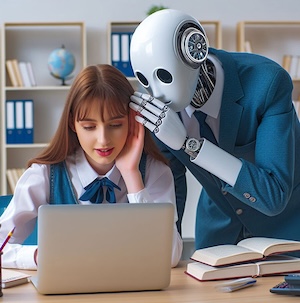
You don’t say. This is a story about a professor who discovered his students will use AI to cheat.
Serrano decided that his spring 2026 section of the quite difficult ECON 1170 would allow take-home exams for both the midterm and the final. Suddenly, the course received an influx of students. El País has the story:
The course… typically attracts few students, but very good ones. [Serrano] has never had more than 30 students enrolled at a time, and on some occasions he had only eight. This semester, probably because of the new evaluation system, 86 students signed up for the class. The results of the midterm exam, which was administered on March 5, were extraordinary, with an average score of 96 out of 100. Forty students scored a perfect 100.
This was indeed extraordinary, because as Serrano told Inside Higher Ed, “Historically the average grade in the midterm of this course has ranged between 65 and 80 [percent], and this exam was harder than the exams I wrote in the past, because… take-home is an opportunity to challenge the class a little bit more, given that you’re giving the students unlimited time.”
I figured this out back during the pandemic, when by necessity I had to offer exams online. Scores shot up! I knew immediately what was going on, but I didn’t punish the students — I couldn’t blame them for taking advantage of the system. This professor decided to test his students.
A suspicious Serrano decided that he would make the final exam in-person; he would see if students did similarly well on it. He emailed his class, telling them, “I am not declaring [the midterm] void for now. I am going to give the class a chance to prove me wrong. That is, if the distribution of the final exam is roughly similar to the distribution of the midterm, I will count the midterm. Otherwise, which is of course what I expect to happen, I will declare the midterm void and reweigh the final accordingly.”
Eighteen students suddenly dropped the course, while nine others didn’t even attend the final exam. Of those 27 students, El País noted, “22 had scored a perfect 100 in the midterm exam.”
Among those who took the test, the average score plunged—from 96 all the way down to 48.
He should have known that the scores on the final were not going to come close to the scores on the midterm. I knew in my classes that grades were going to drop when I stopped offering online exams. I wouldn’t have offered a phony deal like that to my students.
My classes were a bit different, though. It sounds like Serrano’s econ exams consisted of a lot of essay questions which could be flooded with AI slop; my exams are much more quantitative, with questions that are answered by numbers, which you’d think would be even more susceptible to AI cheating, but where I catch students who fail to grasp the process to solve the problem. You gotta know how to ask the AI how to solve the problem to get a good answer!
But still, exam scores were notably elevated during the pandemic, so once I could rely on instruction to return to normal, I made all exams to be in-class. However, I still offer weekly online quizzes. Quiz scores are significantly elevated, but constitute less than 10% of the final grade, and I don’t have a problem with that — I tell the students to cheat freely, to collaborate with their fellow students and work through the quizzes together. That’s been a benefit, because it forces students to think through the problems in a kind of practice exercise, and if they are working together they are teaching each other.
I’ve got one more year of teaching ahead of me. I plan on sticking to this same procedure in the next two semesters.

In my years of teaching, I have occasionally had students with conservative views, and that’s fine. They’re a minority, but tolerance is one of the default principles of liberal arts education, so they get to express their position, everyone else shares their ideas, we all learn.
The problem isn’t conservatism, it’s authoritarianism. We are living in a country with a rising authoritarian minority that wants to shut everyone else down, and that is a problem. And that’s why Ohio is a problem — authoritarians want to dictate the content of a college education.
Ohio universities’ new centers to combat “liberal bias” aren’t popular with students, so a Republican leader wants to require attendance.
Bringing in America’s 250th anniversary, the Republican supermajority in Ohio’s legislature wants to expand civics education at colleges and universities. That hasn’t been getting the warmest of welcomes on campuses.
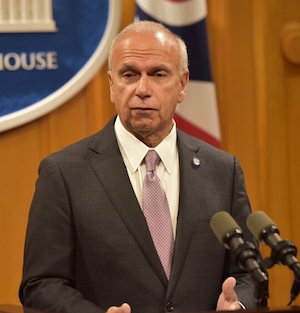
This puckered prune of a beancounter doesn’t like free speech
So this Republican, Jerry Cirino, has passed a new law.
S.B. 1 focuses on what Cirino calls “free speech,” banning public universities in Ohio from Diversity, Equity and Inclusion initiatives, having “bias” in the classroom and limiting how “controversial topics” can and can’t be taught. “Controversial” under Ohio law includes “belief policy that is the subject of political controversy, including issues such as climate policies, electoral politics, foreign policy, diversity, equity, and inclusion programs, immigration policy, marriage, or abortion.”
I appreciate how the report mentions that Cirino is a “free speech” advocate, and the next word is “banning”. It goes on to say that he opposes “controversial” ideas, in which he gets to categorize what ideas are to be policed. “Climate policies”? Climate change is real and has serious consequences (witness the heat wave we’re experiencing now), but Cirino wants to control discussion of what to do about it.
“electoral politics, foreign policy”…do Ohio universities lack political science and history departments?
I know Republicans hate DEI, but Ohio is a diverse state, and universities tend to hire from an international pool of academic candidates.
Ohioans can’t even discuss immigration policy? Are we just supposed to accept a conservative white man’s opinions without recourse to evidence, or the consequences, or the literature?
The primary consumers of college education are 18-22 year olds. Lord forbid that marriage and abortion be a topic of interest and concern among that group.
Jerry Cirino is a retired medical device company executive. Don’t assume that he therefore has experience in medicine or engineering, though — he has a BS in business and an MBA, and has completely foregone the kind of breadth of knowledge a typical liberal arts graduate gets, and instead has been narrowly focused on making money.
Yet he thinks he has the qualifications to overhaul higher education in Ohio? Jesus. This really is the age when incompetence rules.

I also made an Instagram reel as I strolled through the building.
Transcript below the fold.

Of course I had to go see the new Supergirl movie — I had to run the projector. It was OK for a superhero movie.
Don’t be fooled by my title. There was no cannibalism in this movie.
Oh look, a transcript below the fold.

Sometimes, when volunteering at the local theater, one must sometimes suffer through terrible (but popular) movies. This week was my turn to carry out my obligations. The movie: Jurassic Park. I’ve hated this movie for decades. It brings in money, though, so I sold out my principles.
That doesn’t mean I won’t complain about it, though!

I watched Backrooms. It’s very good.
I’m an official member of the Morris Theater Co-Op board. I’m going to be running the projector at the theater about once a week. Pro: I get to see a free movie, in addition to my $1 discount. Con: Our scheduled projectionist couldn’t make it tonight, so I’ve volunteered to take it on at the last minute. This will be my first solo! I’m worried that I might forget to flip some essential switch and a horde of movie-goers will lynch me.


Today marks the 10th anniversary of Prince’s death. I love that guy’s music, and I’m going to be playing his music nonstop today.
This one tells me he really was a Minnesotan.
My favorite, though, is Raspberry Beret. That one takes me back to being 19 and taking my girl on drives through farm country — not in Minnesota, but the music is universal. I was a fan before I moved to this state!
Lately, I’ve been setting summertime goals for myself. I know I’m probably going to be laid up with knee surgery for a while (I hope I can get these wobbly aching knees fixed!), and I’m going to get through it with some dreams. One is to get up to the Boundary Waters before the Republicans destroy them, and go spidering in the woods. Another is to visit Paisley Park. I’ve driven by it many times, this summer I’m going to get off the damn freeway and take the tour.

Governor Josh Shapiro of Pennsylvania has decided what kids in his state need to learn. It’s cursive handwriting.
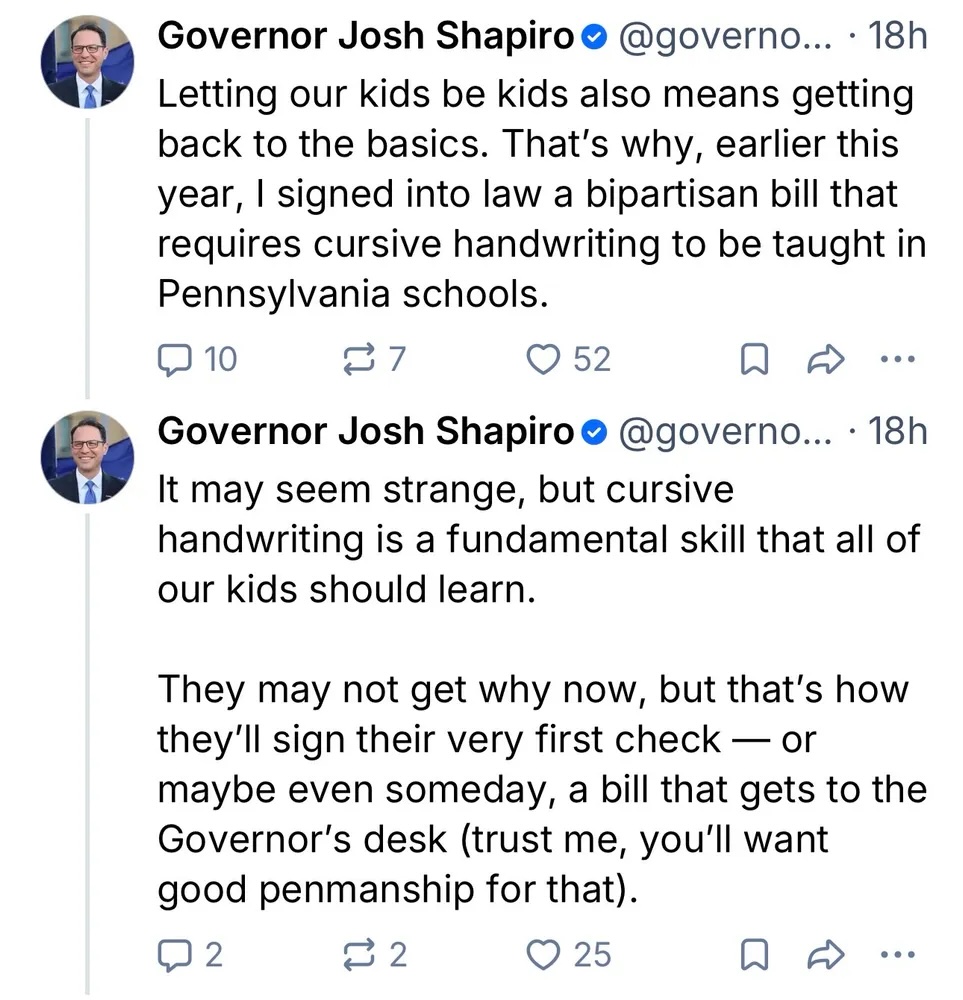
Letting our kids be kids also means getting back to the basics. That’s why, earlier this year, | signed into law a bipartisan bill that requires cursive handwriting to be taught in Pennsylvania schools.
It may seem strange, but cursive handwriting is a fundamental skill that all of our kids should learn. They may not get why now, but that’s how they’ll sign their very first check — or maybe even someday, a bill that gets to the Governor’s desk (trust me, you’ll want good penmanship for that).
Nope. It’s not an essential skill anymore. You can sign a check with a barely legible scrawl…it’s still accepted. The President of the US can sign bills with a peculiar string of pointy squiggles that is completely illegible…it still works, unfortunately. When I have to sign a series of papers, it starts out OK, but I use a kind of sloppy block printing, and by the time I’m done the “yers” in my last name has eroded down into a kind of uneven flood plain. That’s a really stupid reason to force kids to write in cursive.
Also, Shapiro has a law degree, not an education degree. He is not qualified to tell people what educational initiatives are “fundamental”. Leave that to educators.
It reminds me of my early disaffection with Bill Gates. He was doing all this philanthropy, and one of his pet projects was reforming US education…by taking it out of the hands of teachers and promoting charter schools. Like Bill Gates, Shapiro is meddling in subjects in which he has no authority and is going to end up doing more harm to education.
