
Governor Josh Shapiro of Pennsylvania has decided what kids in his state need to learn. It’s cursive handwriting.
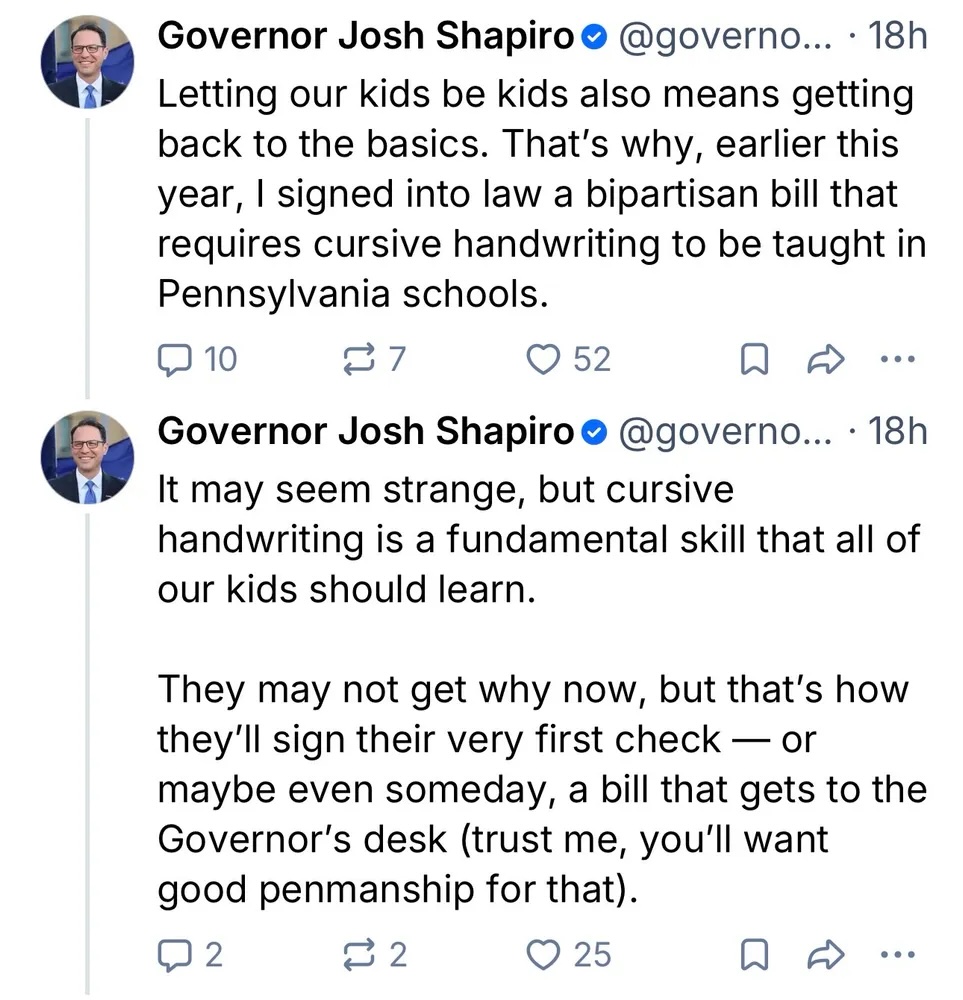
Letting our kids be kids also means getting back to the basics. That’s why, earlier this year, | signed into law a bipartisan bill that requires cursive handwriting to be taught in Pennsylvania schools.
It may seem strange, but cursive handwriting is a fundamental skill that all of our kids should learn. They may not get why now, but that’s how they’ll sign their very first check — or maybe even someday, a bill that gets to the Governor’s desk (trust me, you’ll want good penmanship for that).
Nope. It’s not an essential skill anymore. You can sign a check with a barely legible scrawl…it’s still accepted. The President of the US can sign bills with a peculiar string of pointy squiggles that is completely illegible…it still works, unfortunately. When I have to sign a series of papers, it starts out OK, but I use a kind of sloppy block printing, and by the time I’m done the “yers” in my last name has eroded down into a kind of uneven flood plain. That’s a really stupid reason to force kids to write in cursive.
Also, Shapiro has a law degree, not an education degree. He is not qualified to tell people what educational initiatives are “fundamental”. Leave that to educators.
It reminds me of my early disaffection with Bill Gates. He was doing all this philanthropy, and one of his pet projects was reforming US education…by taking it out of the hands of teachers and promoting charter schools. Like Bill Gates, Shapiro is meddling in subjects in which he has no authority and is going to end up doing more harm to education.

Cursive is cool. So is calligraphy. Both should be electives. Weird part is everyone’s block printing is unique. Add to that its legibility and block printing should be the standard for legal documents.
My father was a obsessive small case journalist who wrote in cursive. He created thousands of pages in his version of cursive thus rendering illegible decades of family history.
One of my most haunting memories from my childhood is about being relentlessly bullied and mocked by my teachers for my awful handwriting. Neither dysgraphia nor autism was widely known back then, and they thought that an otherwise brilliant student like me was just lazy.
In the Uni, I stopped writing in cursive completely. I developed my own block-letter script and used that. It is still difficult to read unless I concentrate, but it is more readable than my attempts at cursive.
I “sign” all kinds of official, legal documents by clicking a button which inserts my name in a vaguely cursive font. Better than anything I could do with my actual hand. I guess Shapiro is a MASA Republican…Make America Stupid Again or Make Americans Silly Asses…take your pick.
Cursive handwriting – Everyone should know how to wright damn, fuck, and hell.
What is it about politicians that make them feel they have to meddle in the details of anyone’s profession? Do they go home at the end of the day feeling unsatisfied if they haven’t told surgeons how long to wash their hands for? Do think it’s an opportunity missed if they haven’t told delivery drivers not to park on the sidewalk? What will tomorrow bring? “Detectives, you must always check for fingerprints.” “Nurses, change the sheets every day.” Gah.
We weren’t learning cursive because it was useful in and of itself 30 years ago, when I learned it. The point, as I understand it, is to foster the development of fine motor skills and have a somewhat objective standard to measure against. Kids are still baking, and measuring the degree of fine motor control they have in 1st and 2nd grade gives you a really good model of how that baking is going. There may be better options these days, I’m not an educator, but it’s not on-its-face a stupid thing to teach in elementary school.
A front runner for the next Dem nominee for President. I continue to be unimpressed. Don’t know if he is better or worse than Newsome.
We will have better options, right?
Hey grampa, what’s this “check” he’s babbling about?
Cursive writing was easily the most worthless thing I learned in school, and I’m including all the lies I learned about the “greatness” of the US in history classes. It’s considerably slower than printing, especially when trying to make it at least semi-legible, and it’s significantly harder to read. There are no advantages, except to the minority of people who are able to make it pretty. Frankly, flattering the egos of a small number of students at the expense of the well-being of the rest is a terrible reason to require a subject in schools.
I tried for years to get it right, endured constant abuse from teachers to whom it came easily, but I never got past marginal proficiency in it. My cursive was never, ever good enough for anyone, and we were required to use it for years. One of the happiest days of my schooling life was when I heard the magical words “you may print if you prefer.”
I’ve got no problem with teaching it as an option in art classes, like calligraphy, but as far as I’m concerned, requiring every student to sit through that crap is tantamount to child abuse. Some children, because of the ways their brains and bodies work, will NEVER have “good penmanship” no matter how many hours they work at it. And, a decade of being told that your best is never anywhere near good enough? That shit’s corrosive.
Rich Woods @ #7 — Well, you could chalk it up to the fact that most of them are lawyers, but that’s just a prejudice of mine.
Shapiro is of course wrong: cursive writing isn’t a fundamental skills at all. In fact, writing isn’t a fundamental skill. Per what I read, cursive hasn’t been particularly “useful” since the invention of metal nibbed pens. There is some cognitive advantage for children to focus on handwriting, but I doubt that the particular style…cursive…really matters as much as just the eye-hand coordination.
I don’t really have a signature, I just start with something that could resemble the first letters and end with some squiggles. Nobody cares. When I have to sign for something like a parcel I draw whatever comes into mind, I think I once wrote MOOOOOOO! without any objecting.
Reading and writing is just a stopgap measure until we get our brain chip interfaces working.
Way to say you’re a dinosaur without saying you’re a dinosaur. Sign a what now? It’s been more than fifteen years since I last wrote a check (a cheque, actually), and at least ten years since I received and cashed one. Shops in the UK stopped accepting checks about twenty years ago (and even before that, you had to have a credit card or a “cheque guarantee card”, which, for most current accounts, was your debit card…).
The other thing is equally “fundamental”. Just make a zigzag with a Sharpie and post a photo with the damn thing on Twitter.
Also, cursive is torture if you have dyspraxia, and it’s objectively less legible.
vucodlak:
“Cursive writing was easily the most worthless thing I learned in school, and I’m including all the lies I learned about the “greatness” of the US in history classes. It’s considerably slower than printing, especially when trying to make it at least semi-legible, and it’s significantly harder to read.”
You must be thinking copperplate or Palmer or the like.
I’m thinking ‘not printing’, but still legible.
Printing is far slower for me; nothing to do with ‘pretty’, but for example, when I used to take minutes, I’d write as fast as possible, and that meant no printing (not calligraphy or total continuity, either).
So you can’t universalise from your specific problem.
cvoinescu @13,
Like you, I much prefer using my bank card, but I’m in the minority where I live. Our small, “beachy” towns are full of small businesses that prefer cash or checks. Often, at local restaurants, the bill is presented with a request for cash, and my husband has to request a credit card form to sign. We don’t like to carry cash.
I write a check to my gardener when he works at my house, so I have to keep a supply of checks.
Writing is tough for me. I have a severe intention tremor in my dominant hand. My cursive writing was never great, but now it is ridiculous!
The real educational scourge Shapiro should be worried about is AI. Maybe it’s a reflexive solution to a problem by focusing on something symbolic of that problem. Like a Luddite—old, good; new, bad.
remyporter@6– if the point of learning cursive is fine motor control, then why not teach a useful fine motor skill? Electives in art, music, drafting, crafting, woodwork, metalwork, and yes, cursive/calligraphy for those who want it.
I’m amazed that checks are even still a thing in the US. They were phased out about 20+ years ago in (most of?) Europe.
While I agree that cursive is not as important as it was many decades ago (how old is this governor?) could this be a plea for better literacy?
Pennsylvania falls in the middle third of all states for literacy. After all, the governor can’t even spell “cheque”.
@ ^ WhiteHatLurker : “how old is this governor?”
He’s 52 years old.BornJune 20, 1973. According to wikipedia see :
https://en.wikipedia.org/wiki/Josh_Shapiro
Which isn’t that old really..
The only D I ever got on my permanent record in 18 years of school (1rst-MSEE) was for handwriting in 3rd or 4th grade. Seems I couldn’t stay within the lines or have the correct angle for the letters. Of course, it didn’t help that I’m left-handed and everything was taught from the perspective of righties. No, I’m not bitter.
chrislawson @ # 17: Electives in art, music, drafting, …
AKA Canva, BandLab, AutoCAD …
No doubt our fearless entrepreneurs will have an array of apps for FineMotorControl™ as soon as schools try to teach that – and kids will probably prefer same to, say, games of jacks or darts.
I think it is a good idea to learn good cursive handwriting. I have always found that writing out material helped greatly in learning it, compared to just reading or typing. Typing it out really didn’t help compared to just reading it. And there are quite a few published studies to support that personal experience. Whether that is true of printing versus cursive handwriting I don’t know though.
By the time I started university teaching most students could only print and printing is definitely slower.
It is also worthwhile to learn to write clearly. I lost count of the number of times I had students who had recorded observations in the lab only to be unable to read their own writing/printing when it came to analyze and write up the results.
For speed in handwritten note-taking, I’ve always thought that it would be good to learn a form of cursive: shorthand.
Never learned it though. It’s on my “to be learned” list, right after Morse Code, which I hear is faster for texting.
Seeing a lot about dexterity, which I lack being undiagnosed with autism during school.
Honestly, after reading documents in (very bad) cursive from the 1870’s for a job, I’m convinced cursive encourages laziness: Big letter followed by squiggles, like how I sign my name.
If it’s to measure kids’ dexterity, there has to be other ways than bullying them over being bad at obsolete penmanship skills.
Last few times I had to write my signature it was to receive a package, using just my index finger on a handheld terminal which looked much worse than my illegible but slightly elegant pen signature.
I think that an actually useful skill might be not kids learning how to write cursive, but kids learning how to read it.
A whole lot of the world’s historical and other important documents and all that (from not so long ago, either) are written in cursive, so perhaps just familiarity with how the letters look written in cursive, so that they can read older documents.
@ 9 remyporter
I learned to write cursive before ballpoint pens were common.
A good reason to write cursive was you did not get the messes from block printing with a cheap. fountain pen.
My handwriting was bad enough that the school inspector reassured my teacher that if I got a job where people needed to understand what I was writing I’d have a secretary to handle it.
As @malleefowl says there seems te be better understanding and retention of materials when written rather than typed but I have not seen a comparison between cursive and print.
I wonder though if this is an age thing and teenagers who always type may do as well as they are more familiar with the method.
I have a t-shirt saying “Those who can teach teach. Those who can,t, pass laws about teaching.”
I’m left handed, so, fuck cursive. It can be mastered, but no (right handed) teacher will ever appreciate the work put in. Case in point, and to prove a point, I learnt to write cursive from right to left, just to spite my year 5-6 teacher. She was not impressed. But I’ve always been a bit of a contrary jerk like that, especially about my left handedness.
And with that I’d leave you with a left handedness emoji, but guess what???? I can’t. There isn’t one.
I don’t normally complain about the handedness stuff, but if you’re gonna force a writing style designed to be harder for 1/10 the population, you force my hand – MY LEFT HAND!
Cursive ceased to be a useful skill when typewriters became widespread.
I do agree that some sort of handwriting is a necessary skill for kids to learn. When I was in grade-school, I was taught what was called “round-hand” then, which I guess means cursive. I eventually found it faster and easier than block-printing, though others’ mileage may vary here.
But passing a state-level bill to mandate it? That sounds fishy. Why is that necessary? Is there a significant pushback against cursive? What are kids currently taught?
I’m left handed, so, fuck cursive.
I’ve never heard of that being a problem in handwriting. My teachers just showed me what the letters should look like, and none of them even seemed to notice which hand anyone was writing with.
Cursive ceased to be a useful skill when typewriters became widespread.
There are still situations where one needs to write legibly, without a typewriter available. That doesn’t necessarily mean cursive, of course.
One of the most useful classes I took in junior high in the late 70s was typing. I only took it because it was the only elective that was left that fit in between the other classes in my schedule. But by the mid 1980s knowing my way around a keyboard turned out to be pretty useful. As has knowing how to format paragraphs, different types of letters, addresses, and so on.
I agree that touch typing is a far more useful skill than cursive handwriting, though in my own case I went about it abnormally. Word processors came in after I left college, and I learned to be passable on a QWERTY keyboard while looking at the keys. Eventually I decided I needed to learn to type while looking at the screen (or source text), so after a number of failed attempts, in my 50s I got reasonably proficient using Dvorak layout. Dvorak had the advantage of not following the letters on the keys, so I was never tempted to cheat by looking at my hands. W00t.
I almost never use cursive except for illegible signatures. If they want to teach fine motor skills, teach knitting or needlefelt or calligraphy or something. Those at least produce a fun final product.
I learned cursive in the 1960’s. Other than limited class requirements and from then on my signature, I never used it for class notes or any other pen-and-ink writings. My penmanship has never been very legible to others, unless I concentrate on a seemingly glacial pace. These days, a signature usually requires a one-finger scrawl on a touch pad- hardly fit for elegant script from a retiree.
As far as fine-motor-skills development goes, cursive (and, for that matter, printing) are terrible. Better for the kids to all take music lessons, when they’ll be both learning to read music and the skills and integrating the two together. Then we can really do The 5,000 Fingers of Dr. T… at each grade level (or maybe two together) at the average public elementary school.
Then there’s the lefies-in-a-right-handed-world problem, but nobody ever remembers that only 10% of the population is in its right mind. Right brain. Whatever. (Ever seen an average left-handed kid taught to write with the right hand? It still happens…)
Personally, I find the distinction between “cursive” and “handwriting” a bit odd, but I’m not sure if that’s an age thing or a culture thing… It does seem to be mostly an American thing though, like that weird thing you do with your cutlery.
From a practical perspective, I’d say the most useful skill I’ve picked up is touch typing (well, almost)… I can definitely see an argument for teaching that.
However, all of this assumes something much more important and fundamental, which is also under threat: literacy. And I don’t just mean basic literacy, I mean the real thing – the ability to engage properly with extended, complex texts. How about we mandate that kids spend a significant amount of lesson time reading actual proper books?
Who even signs cheques anymore? They went out of fashion once all the banks were offering debit cards accepted by the major payment processors, because retailers insisted on a cheque guarantee card anyway to pay with a cheque, and the same piece of plastic served both purposes; so why even bother with the cheque?
I prefer pound notes, because you know exactly how much you’ve got at all times, but everywhere has a chip and PIN machine these days. The hazard of such payment methods is that inserting your card and typing your PIN on a keypad, or tapping a card against a reader, doesn’t feel like spending money (and the younger generations who have grown up without the instant feedback of a purse getting lighter probably are not going to have this problem).
On the other hand, booking a cab with a phone app, paying in advance by debit card and getting out at the other end without handing over any cash to the driver still makes me feel like a film star …..
What cursive? As far as I can tell the way I was taught to write a T in cursive as a grade school kid in the early ’70s was different than how it was taught elsewhere. Some people would look at it and think it was a J if I still used it.
I’m left handed, so, fuck cursive.
@33 Raging Bee
Try it out yourself. Notice that you have to rotate your hand 90 degrees into a form that causes increased strain when you’re writing the letters. Notice also that your LTR script leads your left hand, which drags along the page and smears ink all over the place.
For people asking, until not so long ago I used checks to pay my dentist, and possibly another medical practitioner or two. But no more. Sending checks in the mail isn’t a safe practice anymore.
The good thing about Newsom is, he wants to expand the Supreme Court.
But he is a typical status quo Democrat when it comes to taxing the rich.
A friend of mine has adopted a Chinese character as his signature. I don’t remember what it means. It is quite legal. Any mark made with the proper intent is binding (at least according to a Google AI summary).
#32 @ Raging Bee
In California they were taught to print, only. Recently cursive was added back to the curriculum, like 6 months ago. It was politically popular.
I do remember niece and nephew being resistant to learning printing, and they are nearing their forties now. Perhaps they don’t need to anymore or got decent at it if they needed? I doubt they can write cursive.
The students today can’t print. (Most of them can’t read either, so TikTok as an information source is perfectly logical that way) They can’t read my cursive writing, nor can most people younger than 45. My writing is very pretty, so much so that people think it is a wedding invitation. Nevertheless it is a secret code.
Checks have legal protections that other money transfer systems do not in the United States. The scams currently happening with them are because banks are not doing their due diligence. They’re all monopsonies now due to bank collapses so what do they care?
My agreement with Wells Fargo literally says (in legal terms I looked them all up and did not sign) fuck you you moron for using Zelle we won’t help you if you get scammed, nor will we help you if the error is clearly our fault, and Zelle is not-us. Zelle is the system that they themselves created.
I’ve seen a few pop-sci articles about the developmental benefits of teaching handwriting, not just for fine motor skills, but also cognitive benefits, especially for literacy. But I admit I haven’t dug into the actual original research, nor am I aware of whether cursive in particular offers any particular benefits over printing.
My own middle school had universal touch typing classes starting in middle school, which has been extremely useful to me in my own life. All things considered, middle school seems like appropriate timing for such a class, too.
OTOH, the whole discussion over curriculum should be up to educators, not micromanaged by the legislature and governor.
#46 @ seachange
I know it’s anecdotal, and based on a disadvantaged group of kids, to boot. But my (adult) daughter spent some time talking to another woman running a youth program, who made a comment about how all the kids in the program made voice calls to their parents rather than send texts, because they weren’t functionally literate. I think in their case, it was probably a combination of their specific school and the lost years from COVID, but it’s still troubling that there’s any population of kids in the modern day that would have such literacy problems.
beholder: I HAVE been trying it out myself, all my life. Others’ mileage my vary, of course, but I don’t remember feeling any sort of “strain” from writing anything left-handed; except of course for when I was writing a lot of text for a long(ish) time. Also, that tendency of my left hand to smear what I’d just written was something I had to deal with whether it was round-hand, block-printing, or italic.
For a different historical perspective on typing, my teachers forbade typing of assignments. The argument was that they wanted to see our own work rather than that of our ‘fathers’ secretaries’ (note gender assumptions). People who wanted to learned to type on their own. The first time in my life that typing was preferred or required was in graduate school. Oh, and when I arrived there, in 1990, computers had just become accessible enough that each student could type their own thesis rather than have the departmental secretaries do it – suddenly there was a glut of secretaries who ended up spending much of their time playing solitaire until enough of them retired or were let go.
OTOH, the whole discussion over curriculum should be up to educators, not micromanaged by the legislature and governor.
I agree, and this bill, dealing with nothing but cursive writing, seems like a wasted opportunity. If you’re going to sign a state-level bill mandating what’s taught in schools, you should sign one that covers the whole picture, not just one item. Like maybe update what’s taught in sex-ed, evolution, ConLaw, US history, religion, overall literacy and comprehension, etc. Signing a bill that covers nothing but handwriting just seems meek and spineless. And calling it “back to basics” sounds like they’re caving to simpleminded Republican curriculum rollbacks. Is handwriting really the only education issue that PA schools have to deal with?
I write cursive left-handed and I don’t smear because my hand is below the text. I see right-handers writing with their hand above the line on all the already-written text; it looks uncomfortable to me, but it seems to work for them.
And I write a cheque less than once a year.
I could only write well in cursive when I wrote so slowly that I’d lose my train of thought. I like doing calligraphy but it’s a different thought process for me . Like a previous poster my handwriting was constantly being criticized in elementary school . In my case it was just annoying because we weren’t really graded on it.