Pharyngula
Evolution, development, and random biological ejaculations from a godless liberal


He hates Tiktaalik. He hates it so much he even has a hard time spelling its name correctly.
Tikaalik is again being popularized through the new PBS series "Your Inner Fish.” it’s really a desperate con job on the part of evolutionists who can’t defend their evolutionary fictional story.
He actually surprises me a little bit: one of his arguments that it can’t possibly be a transitional form is that it is only a fossil. That’s one I hadn’t heard before. So extinct species can’t be evidence for evolution anymore, because only living species count?
Because it belongs to the group of lobe finned fishes (like Coelacanth /lung fish), and is only found as a fossil, the secularists force their evolutionary worldview onto this fossil in their desperate need to try to convince the world they have found a transitional form (when in reality such transitional forms should be abundant both fossilized and living).
I have heard creationists tell me, though, that extant forms can’t be ancestral (obviously), therefore living examples of intermediate forms can’t be used as evidence for evolution, either. That leads to perfect, irrefutable arguments for creationists.
Evilutionist: “The shared expression of Sonic Hedgehog and it’s homologous role in limb development in the limbs of different forms is evidence of common desc…”
Creationist: Doesn’t count. It’s alive. Are you trying to pretend that modern limbs are ancestral forms? God clearly created it that way.
Evilutionist: “OK, here’s Tiktaalik with limbs that exhibit a bony core of homologous…”
Creationist: Doesn’t count. It’s dead. Transitional forms have to be living creatures.
Evilutionist: <stunned into silence by the stupidity>
Seriously, reading anything by Ken Ham is discombobulating.
They claim that Tiktaalik is the link between fish and “terrestrial tetrapods”—four legged animals that walk on land. Tiktaalik’s discoverer Neil Shubin even calls his big fish a “fishapod” to emphasize his belief that it is a transitional form. (Most people hearing about Tiktaalik even think it had limbs, but it didn’t—it just had fins, like fish do. Having a special kind of fins with bones in them—as lobe-finned fish do—did not mean they were legs or limbs.)
Having a special kind of fins with bones in them
…but, but, but — that’s what makes them transitional. They have a combination of characteristics of the fins of fish and the limbs of tetrapods, being neither quite one of the other. Once again, we enter the realm of Catch-22.
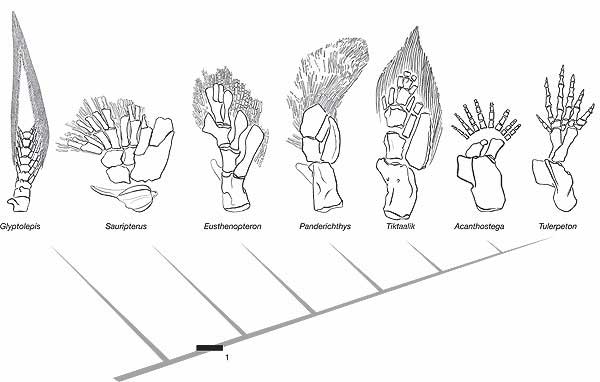
Evilutionist: “Here’s the Tiktaalik limb. It’s got these internal bones, unlike a fish fin, that are similar in organization to our limb bones…”
Creationist: Then it’s a land animal. Case closed.
Evilutionist: “But it wasn’t strong enough or anatomically capable of actually walking on land, and it’s got traces of membranous fins…”
Creationist: Then it’s a fish. Case closed. It’s got to be one or the other, because transitional forms don’t exist, therefore I say it’s all fish.
Evilutionist: <wondering why she is wasting time with this idiot>
It wouldn’t be a Ken Ham rationalization if it didn’t drag out his usual claim that both the evilutionist and the creationist are using the same data, and only differ in the worldview they use to interpret it.
All this talk about Tiktaalik is also a reminder that the battle is not ultimately about evidence–Liz Mitchell and the evolutionists are looking at the same fossil. It’s not the fossil that’s different–it’s the worldview one has (and the starting point it is built from–God’s Word or man’s word) the determines how one interprets this fossil in regard to the past. But looking at the fossil, one can see it won’t directly fit into an evolutionary worldview–but it does fit directly into a worldview based on the Bible, as it is a particular type of fish for which we have similar types of living examples (e.g. Coelacanth ).
But we aren’t using the same data. The scientist is using the totality of the data, looking at both similarities and differences, to try and account for its place in history and biology. The creationist, as Ham has just clearly demonstrated, handwaves away all the unique characters of the fossil to claim it’s just like a coelacanth or a lungfish — he is explicitly ignoring any datum that contradicts his presupposition that it must be just another fish.
And then to take it that extra step further, and argue that his naive vision of what Tiktaalik was, stripped of all of its significant and unique characters, is somehow evidence for creationism that contradicts its clear evolutionary niche…
Evilutionist: “Holy crap…you’re an idiot, Creationist. Go away.”

Virginia Hughes tells us about techniques to look inside the zebrafish brain. The gang at HHMI are using two photon imaging and clever image analysis to get very clear, sharp images of fluorescent neurons.
Oy, that’s pretty. This old codger did some of that stuff, many years ago, but you know what we had to do? Point injections of tracer dyes, followed by serial sectioning and reconstruction. Early on we use injections of horseradish peroxidase into, for instance, the muscle, so that neurons in transit through the lesion site would pick up the enzyme…and then we’d have to fix and process the animals with a series of reagents to visualize the stuff. Then you’d have to section the animal — I think I spent most of my graduate years hunched over either a vibratome or an ultramicrotome. This technique was hit-or-miss, so you’d only get a subset of neurons labeled, and you’d have to do it over and over hundreds or thousands of times to get a good sampling. Later we started using lineage tracer dyes like rhodamine dextran, and later still lipophilic dyes like Di-I, to get fluorescent images that allowed us to skip the tedium of sectioning, but it was still haphazard labeling. If you tried to label everything, you got a glowing blob with no ability to sort out the fibers and cells.
And even then, we used early generation intensified cameras to pick it up! Imagine those grainy images from the night-vision cameras CNN would use during the Gulf War, all stored on VHS tapes. That’s what we had. None of these lasers and all digital storage at high resolution, and computers that automatically optically scan through to produce a 3D image.
It’s like seeing a few years of your work reproduced in an afternoon by some cocky young whippersnapper with a fancy machine, all a bit John Henry.
Being really close to the work sometimes helps, though. Hughes recites a number, that there are 300,000 neurons in the zebrafish brain. I did some of that work, too — I did counts of cells in the spinal cord, which involved doing many sections and counting and measuring cells in each, to get an estimate of average cell volume, and then measuring the dimensions of the organ in question, so you could calculate the number of cells present. I did the spinal cord measurements: there were about 100,000 cells in there. That number is an overestimate of the number of neurons, though, because I know that many of the cells I was counting were neuroblasts and glia and other oddments, and we didn’t have a robust way of distinguishing neuronal elements from others.
Give me a two-photon scope, a big computer, and a collection of molecular probes for various cell types, though, and I’d be happy to re-analyze that data. It would probably take a few days. OK, and a few months of learning how to use the complicated new toys.


That photo is from a lovely new documentary, with this trailer.
However, I have to call attention to one troubling fact.
“All these lemurs have one thing in common – from the little one to the very largest one – they all have female dominance. The females are the leaders. The females are the ones that make the choices of where they go and what foods they eat and where they’re going to sit,” says Dr. Wright.
We must immediately call for an MRA boycott.

This new documentary on Showtime is pretty good (despite the appearance of Thomas Friedman), and this is the premiere episode.
One of the most interesting aspects of the show is that it emphasizes economic issues. The standard tactic of the climate change denialists is to argue that it’s happening, we can’t do anything about it, and it would hurt our economy to take measures to reduce emissions; but this show focuses strongly on the fact that climate change is doing us economic harm right now.
The denialists are, of course, squinking furiously against it already, but they lie. They lie hard.
By the way, Harrison Ford, one of the sponsors/narrator of the show, has also done an IAmA on Reddit lately — he seems to be a cool and admirable dude.

Stephan Lewandowsky, the author of the article that made climate change denialists cry and that was later retracted under pressure from denialists, is doing a Reddit AMA right now. Get in early! Before the kooks flood the questions!
(via Greg Laden)

You all remember Lex Luthor’s scheme in the original Richard Donner Superman movie, right? Of course you do, you’re all nerds. But we nerds are all pedantic and love to start monologuing, so I’ll tell you what it was anyway.
Luthor was going to set off a nuclear bomb in the San Andreas fault and cause a giant earthquake so that California would slide into the sea, creating new, valuable ocean front real estate that he would buy up, making himself fabulously rich.
Grand plans to cause devastating earthquakes are staples of cheesy comic book villainy; they’re also a regular part of the diet of conspiracy theorists. Did you know the High-frequency Active Auroral Research Program (HAARP) is actually a scheme by the Illuminati/Men in Black/New World Order to take over the world by inducing earthquakes? It’s true. Bad guys cause earthquakes.
So what should we make of the recent disclosure that fracking causes earthquakes?
Before January 2011, Youngstown, Ohio, had never had an earthquake since observations began in 1776. In December 2010, the Northstar 1 injection well came online, built to pump wastewater produced by hydraulic fracturing projects in Pennsylvania into storage deep underground. In the year that followed, seismometers in and around Youngstown recorded 109 earthquakes—the strongest of the set being a magnitude 3.9 earthquake on December 31, 2011.
In a new study analyzing the Youngstown earthquakes, Kim finds that the earthquakes’ onset, cessation, and even temporary dips in activity were all tied to the activity at the Northstar 1 well. The first earthquake recorded in the city occurred 13 days after pumping began, and the tremors ceased shortly after the Ohio Department of Natural Resources shut down the well in December 2011. Also, the author finds that dips in earthquake activity correlated with Memorial Day, the Fourth of July, Labor Day, and Thanksgiving, as well as other periods when the injection at the well was temporarily stopped.
Further, the author finds that the earthquakes were centered in an ancient fault near the Northstar 1 well. The author suggests that the increase in pressure from the deep wastewater injection caused the existing fault to slip. Throughout the year, the earthquakes crept from east to west down the length of the fault away from the well—indicative of the earthquakes being caused by a traveling pressure front.
Comic book supervillains aren’t real. We’ve got the oil companies instead.

Probably not. But the New York Times reports:
A review of studies has found that the health benefits of infant male circumcision vastly outweigh the risks involved in the procedure.
Actually, it doesn’t. Not at all. The paper is all about the frequency of circumcision in the US; this is the only real data in the paper, and notice that a good chunk of it is speculation.
![Prevalence of adult circumcision in the United States during the past 6 decades (1948-2010). The solid line represents documented prevalence among adults; dashed line, [Morris's] predictions.](https://proxy.freethought.online/pharyngula/files/2014/04/circumcision.jpg)
Prevalence of adult circumcision in the United States during the past 6 decades (1948-2010). The solid line represents documented prevalence among adults; dashed line, [Morris’s] predictions.
It does toss in a table purporting to show the tremendous risks of not circumcising baby boys, but this is not new — these are the same sloppy data that the author has been peddling for over a decade. With some trepidation, I give you a sample from his 2007 paper: don’t trust these numbers!

The author is Brian Morris, better known as the Man Who Hates Foreskins. He’s a real crusader, who touts foreskin removal as just as important as vaccination — that leaving it intact imperils the child to a 1 in 3 chance of a serious condition requiring medical attention. You might immediately question how he arrives at this conclusion — by multiplying a series of dubious assertions together — and the likelihood of it being true, given that circumcision is a culturally variable practice, and that countries where it’s rare (for instance, in Scandinavia, where the frequency of circumcisions is around 2%) don’t typically have emergency rooms crowded with young boys whose penises are in painful, infected, states, raddled with disease.
I suppose it could be because glorious Scandinavian penises are perfect and universally wholesome — that’s what I’ve been told, anyway — but that would be baseless speculation and unwarranted extrapolation of anecdotes into unsupportable evidence, of the sort that Brian Morris does.
Take that first condition, the likelihood of urinary tract infections. That’s taken from a sample of 36 children, half of whom had an unknown circumcision status, and the difference was not found to be statistically significant. Yet here he just presents it as established fact, that uncircumcised children have a ten-fold greater rate of urinary tract infections.
Or look at his claim of much greater rates of HIV infection. There actually is some interesting mechanistic reasoning behind that: the foreskin represents an enlarged area of delicate membrane which could be an avenue of entry for some viruses. But the real test would be an epidemiological study: there are lots of circumcised men around, and lots of uncircumcised men, when we look at the rates of infection, is there a significant difference? It hasn’t been done very often, but when it is, the hypothesis often fails to be supported. Here’s one example of a scientist who thought heightened sensitivity to STIs was a reasonable hypothesis (his “hunch”), but found it didn’t pan out at all when examined.
Armed with this hunch, rather than set up a website I chose to do some research. Australia is a good place to do such research because there is a roughly even population split for the intervention (circumcision) and in most cases it is not a maker of ethnicity, wealth, education or religion. Unexpectedly, our research findings were uniformly negative. Circumcision did not protect against STDs in our clinic population, though we did not look at HIV because it is rare in heterosexual men in Sydney.
Then there are some of Morris’s very peculiar ideas. This is the abstract from a paper advocating more circumcision; note that one of his arguments is basically that women find uncircumcised penises ugly. As usual, no evidence for that is presented.
Circumcision of males represents a surgical “vaccine” against a wide variety of infections, adverse medical conditions and potentially fatal diseases over their lifetime, and also protects their sexual partners. In experienced hands, this common, inexpensive procedure is very safe, can be pain-free and can be performed at any age. The benefits vastly outweigh risks. The enormous public health benefits include protection from urinary tract infections, sexually transmitted HIV, HPV, syphilis and chancroid, penile and prostate cancer, phimosis, thrush, and inflammatory dermatoses. In women circumcision of the male partner provides substantial protection from cervical cancer and chlamydia. Circumcision has socio-sexual benefits and reduces sexual problems with age. It has no adverse effect on penile sensitivity, function, or sensation during sexual arousal. Most women prefer the circumcised penis for appearance, hygiene and sex. Given the convincing epidemiological evidence and biological support, routine circumcision should be highly recommended by all health professionals.
I suspect that women’s preferences are going to be shaped by culture, by familiarity, rather than some objective hideousness of the foreskin, and what the heck is appearance doing in a paper that is supposed to be summarizing medical evidence, anyway?
It’s also an argument that can cut both ways. When presented with evidence that one phenomenon, dyspareunia (painful intercourse) was found to be more common in partners of circumcised men than uncircumcised men, Morris waved it away by arguing that women in countries with lower rates of circumcision might be disturbed by the sight of a cut penis.
Morris et al. should be commended for their creative attempt to dismiss the higher prevalence of frequent dyspareunia in women with circumcised (12%) than uncircumcised (4%) spouses (ORs between 4.17 and 9.00). They suggest that Danish women with circumcised spouses may be so psychologically troubled by the shape of their spouse’s penis that it might result in painful intercourse. A more plausible explanation would be that reduced penile sensitivity may raise the need among some circumcised men for more vigorous and, to some women, painful stimulation during intercourse in their pursuit of orgasm.
But then, that’s Brian Morris all over the place. He actively tries to suppress work that doesn’t support his conclusions, he inflates any evidence that suggests circumcision might have a few benefits (there are some!), and dismisses any evidence to the contrary…or worse, twists it around to claim it supports the opposite of the author’s interpretations. All this in defiance of worldwide statements from pediatric organizations that say the evidence for health benefits from circumcision are weak, and that routine circumcision is not recommended.
One other weird thing: why are circumcision advocates so obsessed with this procedure? It’s certainly not that the benefits are as solidly established as they are for vaccination; reading the literature, the most striking observation is the murkiness and insignificance of the evidence. If you’ve got lots of studies, and they vary up and down in their conclusions, and are constantly skirting the margins of likelihood, what’s the best explanation: that there is a strong effect that can only be detected by true believers, or that we’re dealing with no effect at all and people are cherry-picking peaks and troughs from statistical noise? I lean towards the latter. The former is also the excuse used by psychics, UFOlogists, and Bigfoot hunters.
It also doesn’t help that Morris has been affiliated with the Gilgal Society a pro-circumcision organization that also published a book of ‘erotic’ circumcision stories.
Yes, you read that right. Circumcision child porn. Short excerpt below, in rot13.
Ur unq abg ernpurq choregl ohg fbba jbhyq: n srj unvef jrer fgnegvat gb tebj ng gur onfr bs uvf cravf. Arvy jnf gura nfxrq gb yvr ba gur pbhpu sbe gur cravf gb or cubgbtencurq. …gur qbpgbe grfgrq gur svg bs gjb fvmrf bs Tbzpb Pynzc oryy. Qhevat guvf cebprqher Arvy rerpgrq, ohg jnf abg rzoneenffrq ol vg naq znqr ab nggrzcg gb uvqr vg.
Znex pnzr va arkg naq ntnva qebccrq uvf gebhfref ernqvyl. Ur unq ernpurq choregl naq jnf dhvgr jryy qrirybcrq. … Vgf yvxr na ryrcunagf gehax jnf gur qbpgbef pbzzrag, gb juvpu Znex urnegvyl nterrq. … Cubgbtencuf bs uvf cravf jrer gnxra…
Ur unq ernyvfrq nsgre frk rqhpngvba yrffbaf ng fpubby gung ur unq n ceboyrz.
…gur oblf jrer tvira cyragl bs jvar gb erynk gurz. …gur qvfphffvba jnf nobhg gur frk yvirf bs gur oblf naq gurve fpubby sevraqf. Gur qbpgbe nfxrq ubj bsgra gur oblf jnaxrq. … Gur qbpgbe fubjrq gur oblf uvf zvpebfpbcr naq nfxrq vs gurl unq rire frra fcrez haqre bar. … Ur fhttrfgrq gb Znex gung vs ur jnagrq gb, ur pbhyq unir n dhvrg jnax juvyfg Arvy jnf orvat pvephzpvfrq… Guvf jnf rntreyl npprcgrq. … Ur ynl onpx jvgu uvf rlrf pybfrq naq whfg yrg gur qbpgbe trg ba.
Morris has been trying very hard to dissociate himself from Gilgal, at least, but still…eww.
“Gilgal”, by the way, is apparently Hebrew for “hill of foreskins”. Really? They needed a word for that? Double eww.
Frisch M (2012) Author’s Response to: Does sexual function survey in Denmark offer any support for male circumcision having an adverse effect? Int. J. Epidemiol 41 (1): 312-314.
Morris BJ (2007) Why circumcision is a biomedical imperative for the 21st century. Bioessays 29(11):1147-58.
Morris BJ, Bailis SA, Wiswell TE (2014) Circumcision Rates in the United States: Rising or Falling? What Effect Might the New Affirmative Pediatric Policy Statement Have? Mayo Clin Proc doi: 10.1016/j.mayocp.2014.01.001. [Epub ahead of print]


That plastic grocery bag you got at the store is something more than just an eyesore and a source of nasty chemicals, it’s also a magnet for accumulating more pollutants.
The ingredients that make up more than 50% of plastics are already deemed chemical hazards by the UN Globally Harmonized System. But as floating bits of trash, plastics pick up additional pollutants like pesticides, flame retardants and combusted oil. “We don’t know yet how long it takes plastic to fully break down, but it’s somewhere on the order of tens to thousands of years,” says Rochman. This means that plastic debris accumulates a multitude of toxic chemicals over potentially many, many years. This type of marine plastic is ending up as lunch for birds, fish and other animals.
The article goes on to detail specific effects of PAHs, PCBs, and PBDEs on medaka. It’s ugly. Now I just have to figure out a way to reduce plastic consumption at home — it’s painful how much of our food and other essentials are packaged up in plastic.