Endocrine disruptors — you’re soaking in them

A human embryo at the 4th week of development is just a tiny bean with a length measured in millimeters, but at this time all kinds of remarkable features are starting to develop. This week in class I talked about urogenital development, which involves forming an array of incredibly delicate, thin tubes from a structure called the urogenital ridge, a thickening of an embryonic membrane which will eventually form a succession of kidneys, the pronephros, mesonephros, and metanephros, only the last persisting into adulthood. The key feature for the story I was telling, though, is that they formed something called the mesonephric duct, and then the paramesonephric duct which parallels it. Another name for the mesonephric duct is the Wolffian duct, and the paramesonephric duct is called the Müllerian duct (personally, I don’t care for the self-serving names given to critical bits of the developing embryo by 19th century men, but it’s what still persists in the embryo. So it goes.)

Both of these ducts are associated with the bipotential or indifferent gonad. There are no sexual differences in embryos this young.

The sex differences emerge later, in response to differential signals. The Müllerian ducts degenerate in males, while the Wolffian ducts persist. In females, the Müllerian ducts persist, while the Wolffian ducts fade away. The bipotential gonad associates with the remaining duct and differentiates into testes or ovaries.

I’ll refrain from delving deeper into the details. My point is that these minuscule ducts and tissues form very early, and are going to expand to form critical, elaborate structures necessary for human fertility. They’re fragile. You really don’t want to perturb the signals and processes going on in a one month old embryo, especially since you may not see the consequences for 15 or 20 years.

In 1941, pharmaceutical companies started to market a synthetic drug with properties similar to estrogen, called diethylstilbesterol, or DES. It wasn’t patented, so anyone could make and sell it, and they pushed it hard to pregnant women. There was weak evidence that it could help sustain pregnancies in women with low progesterone levels, so sure, let’s market it as “routine prophylaxis in ALL pregnancies.” About 4 million pregnant women took this stuff at the suggestion of their doctors, between 1941 and 1971, when it was finally banned.

Think about that. This was an endocrine disruptor, term that wasn’t invented until the 1990s, but everyone knew then that it would have some kind of effect, since it was a functional analog of estrogen. So they gave it to pregnant women, and by that means delivered a potent hormonal signal to their embryos at a time when they were carefully assembling those delicate little tubes. Worse, they knew that high doses given to mice and hamsters caused mammary, cervical, vaginal, and uterine cancers in adult females, and that adult males developed lung cancers, which ought to have set off all kinds of alarm bells. Any tissue that was sensitive to estrogen could be provoked to turn cancerous with DES.

Just for dessert, it was determined in 1953 that DES did nothing to maintain at risk pregnancies. They continued to prescribe the stuff. Just in case, you know.

For additional profit, they also marketed it as a growth hormone for livestock. That continued until it was eventually banned for that purpose in 1979.

Here’s the structure of this potent little molecule.

A is DES; B is estrogen; C is BPA, the common, heavily used plasticizer that we now know is an endocrine disruptor.

You might be wondering what happened to those 4 million women who took the drug. They were fine! Humans and other primates seem to be more resistant to the carcinogenic effects of DES, and they were taking much lower doses than those poor rodents in testing labs who were given massive doses of the drug.

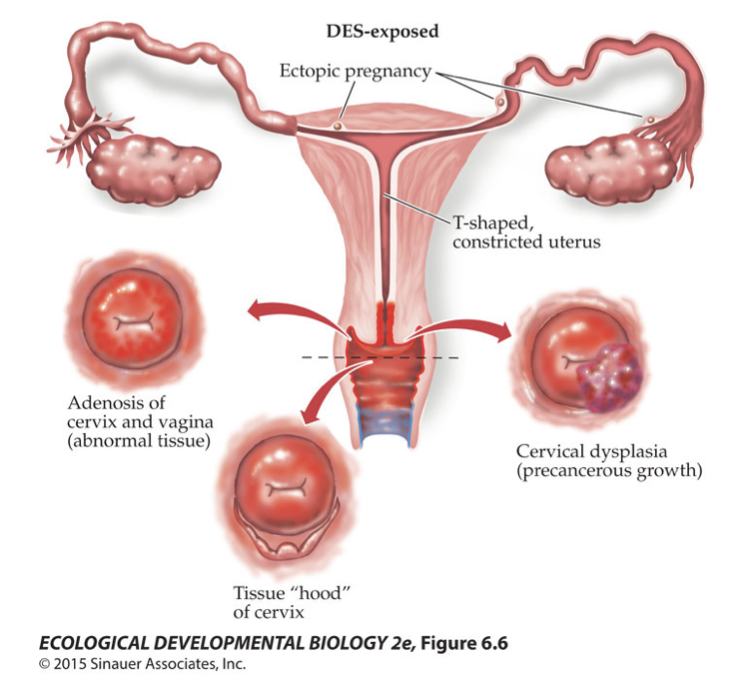
And what about the millions of boomer babies who were doped with it in utero? Again, mostly fine — this is the thing about endocrine disruptors, they tend not to have the gross teratogenic effects we associate with chemicals that cause significant birth defects, like thalidomide. They’re more subtle. They perturb the balance of internal organ systems, and in this case, cause problems in the physiology of reproductive organs, which may lead to fertility issues or some kinds of cancers. I emphasize may because I know DES-exposed people who have had children and are cancer-free; it’s more a matter of letting their gynecologists know to keep an eye on potential warning signs.

But it can go very wrong.

DES is still used in experimental studies because it’s such an interesting molecule. Regular readers probably know about the importance of Hox genes; these are genes expressed along the body axis in pretty much all animals that defined anterior-posterior structures. The same genes also get re-expressed to define the proximal-distal axis of the tetrapod limb. They seem to be a handy-dandy molecular tool for establishing tissue identities along a line.

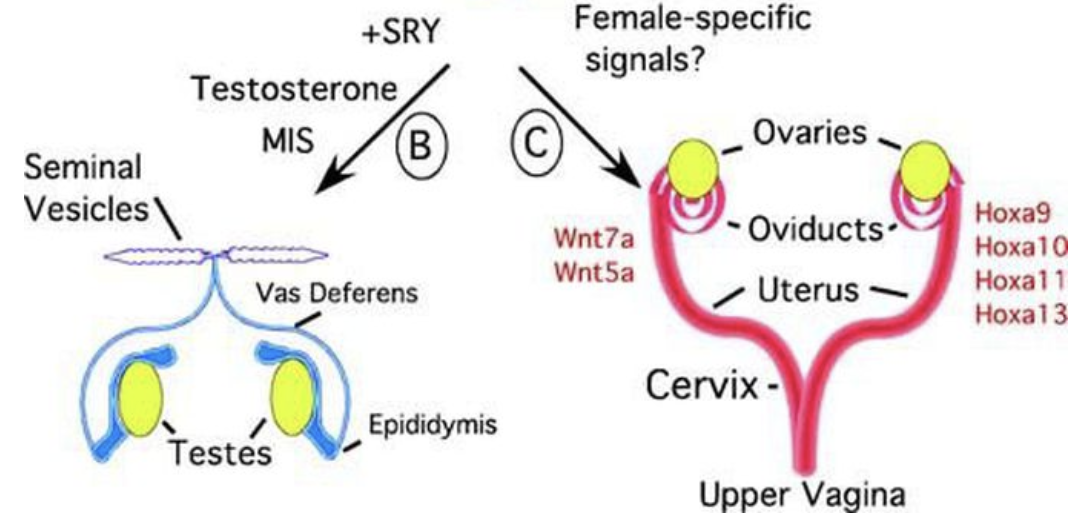
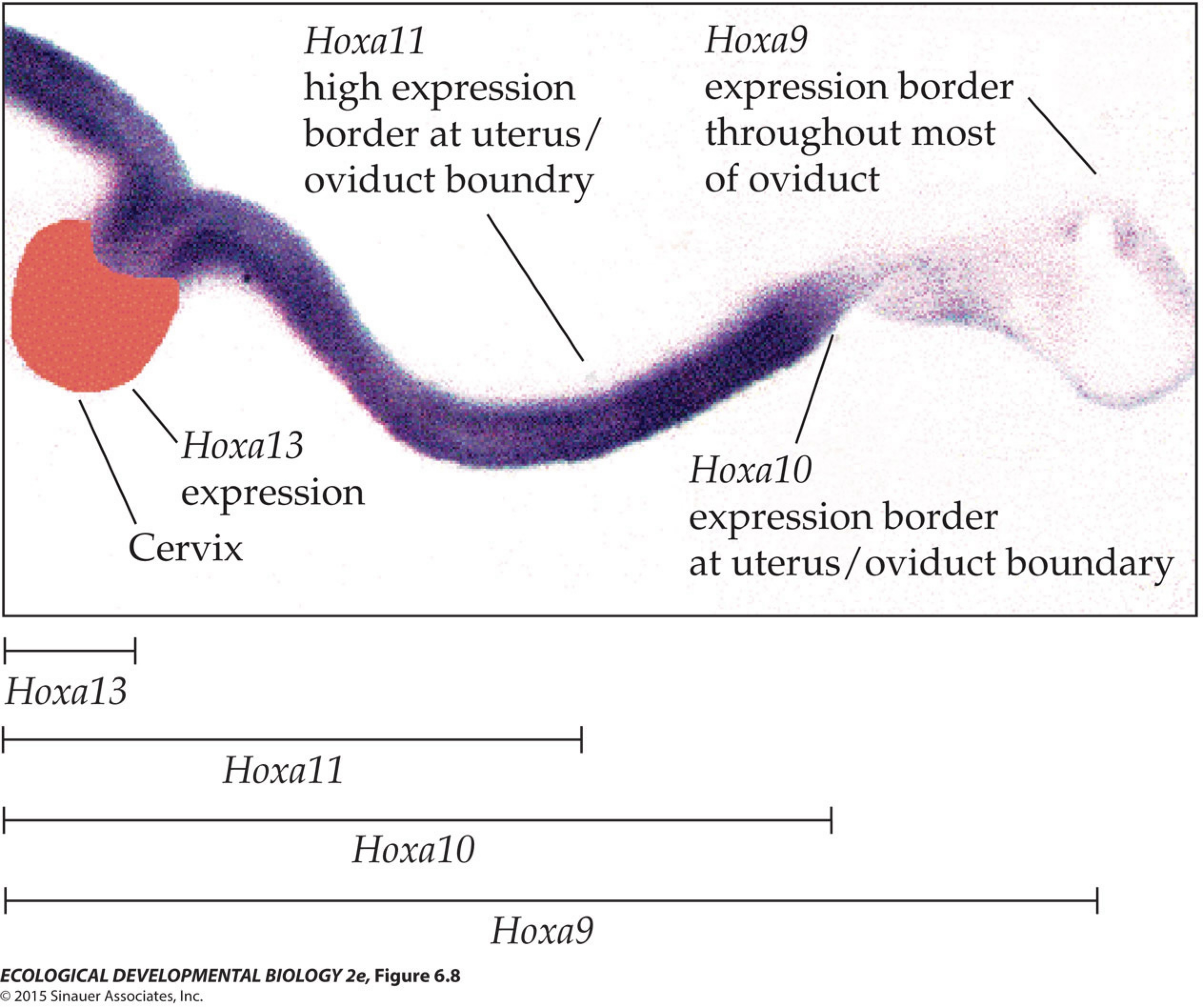
Here’s another instance of Hox genes defining position on an organ: they’re re-expressed in the Müllerian ducts, which become the fallopian tubes of adult women.

Hoxa9 is expressed throughout the oviduct, Hoxa13 in only the cervix, and Hoxa11 and Hoxa10 in between, forming a kind of positional coding system. This is really neat! I like finding examples of molecular recycling in the evolution of developing systems.

What isn’t so neat is that DES downregulates Hoxa10 by inhibiting an important signaling molecule, Wnt7a, creating coding ambiguities in the structure of that delicate little tube. That leads to poor cell specification and disorganized tissue, erasing what should be clear, sharp boundaries in the organ, which may then be expressed in dysplasias, increasing the odds of cancer.

As if that weren’t enough, we don’t really know what perturbing these signaling pathways does to other developing organs, like the brain. Also, DES affects methylation/demethylation of the genome, so it may have transgenerational effects — pregnant women who took DES may have messed up their children, but there is some evidence (weak, I think) that it also affects their grandchildren.

But wait! It’s banned, so we shouldn’t have to worry about it anymore! That’s partly true, but look at the diagram of the molecules above. Estrogen and DES share similarities to another molecule, bisphenol A, a ubiquitous plasticizer used to make plastic materials less brittle. BPA is found in your food packaging. It lines the interior of aluminum cans. Any plastic you have that is at all flexible has been treated with plasticizers, like BPA or phthalates. It’s leaching into your food and your general environment, and it does not go away. The US has banned its use in baby bottles and baby formula packaging, but not from all your snack food packages and your phones.

If you’re of a certain age, you might recall those commercials for a dishwashing detergent that announced, “you’re soaking in it!“, as if that meant the stuff must be safe. We ought to be aware that capitalist industries have us all soaking in a gentle bath of toxic chemicals right now, and it’s not safe.

You know, alcohol is not good for children and other growing things

A few weeks ago, I had an absolutely delicious stout at a brew pub in Alexandria. I’m going to have to remember it, because it may have been the last time I let alcohol pass these lips. Why? Because I’m slowly turning into one of those snooty teetotalers who tut-tut over every tiny sin. It started with vegetarianism, now it’s giving up alcohol, where will it end? Refusing caffeine, turning down the enticements of naked women, refusing to dance? The bluenose in me is emerging as I get older. I shall become a withered, juiceless old Puritan with no joy left in me.

It didn’t help that last week I was lecturing on alcohol teratogenesis in my eco devo course, and it was reminding me of what a pernicious, sneaky molecule it is. I’ve known a lot of this stuff for years, but there’s a kind of blindness brought on by familiarity that led me to dismiss many of the problems. You know the phenomenon: “it won’t affect me, I only drink in moderation” and other excuses. Yeah, no. There are known mechanisms for how alcohol affects you, besides the obvious ones of inebriation.

  1. It induces cell death.
  2. It affects neural crest cell migration.
  3. It downregulates sonic hedgehog, essential for midline differentiation.
  4. It downregulates Sox5 and Ngn1, genes responsible for neuron growth and maturation.
  5. It weakens L1-modulated cell adhesion.

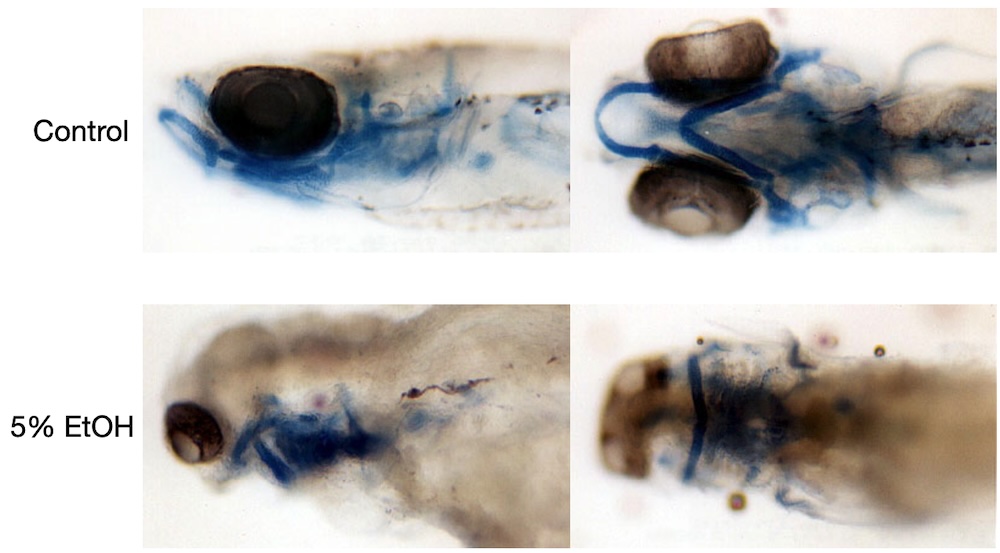
I already knew all about those first four — I’ve done experiments in zebrafish like these done in mice.

Take a normal, healthy embryo like the one in A, expose it to alcohol, and stain the brain for cell death with any of a number of indicator dyes, like Nile Blue sulfate in this example B (I’ve used acridine orange, it works the same way). That brain is speckled with dead cells, killed by alcohol. If you do it just right, you can also see selective cell death in neural crest cell populations, so you’re specifically killing cells involved in the formation of the face and the neurons that innervate it. In C, you can see the rescuing effects of superoxide dismutase, a free radical scavenger, and that tells you that one of the mechanisms behind the cell death is the cell-killing consequences of free radicals. I could get a similar reduction in the effects with megadoses of vitamin C, but that doesn’t mean a big glass of orange juice will save you from your whisky bender.

I was routinely generating one-eyed jawless fish, a consequence of the double-whammy of knocking out sonic hedgehog and cell death in the cells that make branchial arches.

You can wave away these results by pointing out those huge concentrations of alcohol we use to get those observable effects, but we only do that because we don’t have the proper sensitivity to detect subtle variations in the faces of mice or fish. So we crank up the dosage to get a big, undeniable effect.

I only just learned about the L1 effects, and that’s a case where we have a sensitive assay for alcohol’s effects. L1 is a cell surface adhesion molecule — it helps appropriate populations of cells stick together in the nervous system. It also facilitates neurite growth. It’s good for happy growing brains.

It also makes for a relatively easy and quantitative assay. Put neuronal progenitors that express L1 in a dish, and they clump together, as they should in normal development. Add a little alcohol to the medium, and they become less sticky, and the clumps disperse.

What’s troubling about this is the dosage. Adhesion is significantly reduced at concentration of 7mM, which is what the human blood alcohol level reaches after a single drink. The fetal brain may not be forming as robustly when Mom does a little social drinking that doesn’t leave her impaired at all, not even a slight buzz.

Maybe you console yourself by telling yourself a little bit does no harm, your liver soaks up most of the damage (and livers are self-repairing!), that it’s only binge drinkers who have to worry about fetal alcohol syndrome, etc., etc., etc. We have lots of excuses handy. Humans are actually surprisingly sensitive to environmental insults, we have mechanisms to compensate, but there’s no denying that we’re modifying our biochemistry and physiology in subtle ways by exposure to simple molecules.

Now maybe you also tell yourself that you’re a grown-up, I’m talking about fetal tissues, and you also don’t intend to get pregnant in the near future or ever. I’m also a great big fully adult person who is definitely not ever going to get pregnant, but development is a life-long process, and we’re all fragile creatures who nonetheless soak up all kinds of interesting and dangerous chemicals during our existence. We know alcohol will kill adult brain cells, but what else does it do? Do you want to be a guinea pig? I think that, as I age, I am becoming increasingly aware of all the bad stuff I did to myself in my heedless youth, and am starting to think that maybe I need to be a little more careful, belatedly.

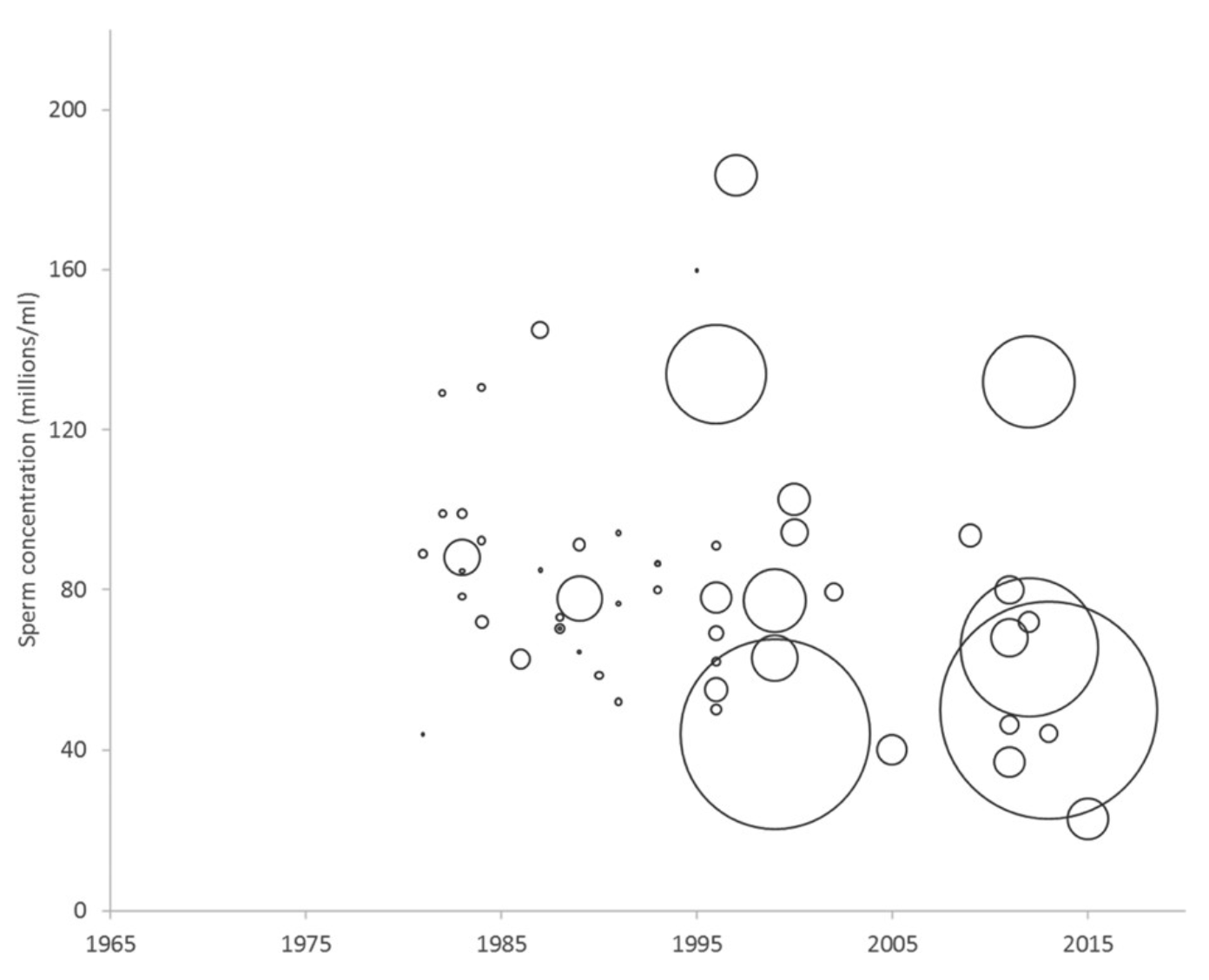
Oh, you want some reassuring information? Next week we’re discussing endocrine disruptors in my class — DDT, DES, BPA, PCB, etc. — all these wonderful products of plastics and petrochemical technology. You’re soaking in them right now. They never go away. How’s your sperm count looking? Any weird glandular dysplasias? Ethanol looks pretty good compared to chlorinated and brominated biphenyls.

Am I creepy? Kooky? Altogether ooky?

There may be something wrong with me. I just spent a happy hour and twenty minutes watching a video about brown recluse spiders, and my only regret was that we don’t have any Loxosceles living anywhere near me. We don’t have any medically significant venomous spiders in this region — it’s one of my only regrets about living in west central Minnesota.

See? Fascinating. Good bit on horizontal gene transfer of the sphingomyelin toxin, lots of practical advice on brown recluse bites, and the spiders are all gentle and generally kind. It tickles my brain in all the right spots. Is that weird?

And then, the best essay I’ve read this week is all about bats and white-nose syndrome. You too can grieve for all the beautiful animals, and you should find them beautiful, that are succumbing to this terrible epidemic.

If you know where and when to look, you can find bats all over the midwest. We’ve got a bunch nesting over our garage, and we put up a bat house near our deck — we’d be thrilled to have even more.

Bats and spiders, and more generally any invertebrate that has a freaky number of legs or eyes — I’m beginning to wonder if maybe I’ve got some kind of exotic disease…a Halloween infection, or Addams syndrome, or something similarly diagnosable.

Of course, one of they symptoms of this syndrome is that I don’t want to be cured. Give me more.

(By the way, I’m teaching a course in science essay writing in the Fall, and am collecting samples. That bat article is going right into the folder. I might be planning to infect impressionable young students with my disease.)

Today is climate change day in the classroom

As I’ve mentioned before, one of the things I’m doing in my Eco Devo class is to throw more of the burden of learning on the students. It would be too easy for me to just get up and lecture, telling them what they should know, and it is often hard for me to just shut up and let the students talk. I’ve split up the course so that Monday is when I start talking and dominate the classroom, Wednesday I ask the students to answer questions about Monday’s lecture and the book chapter, and on Fridays they’re given a paper to analyze.

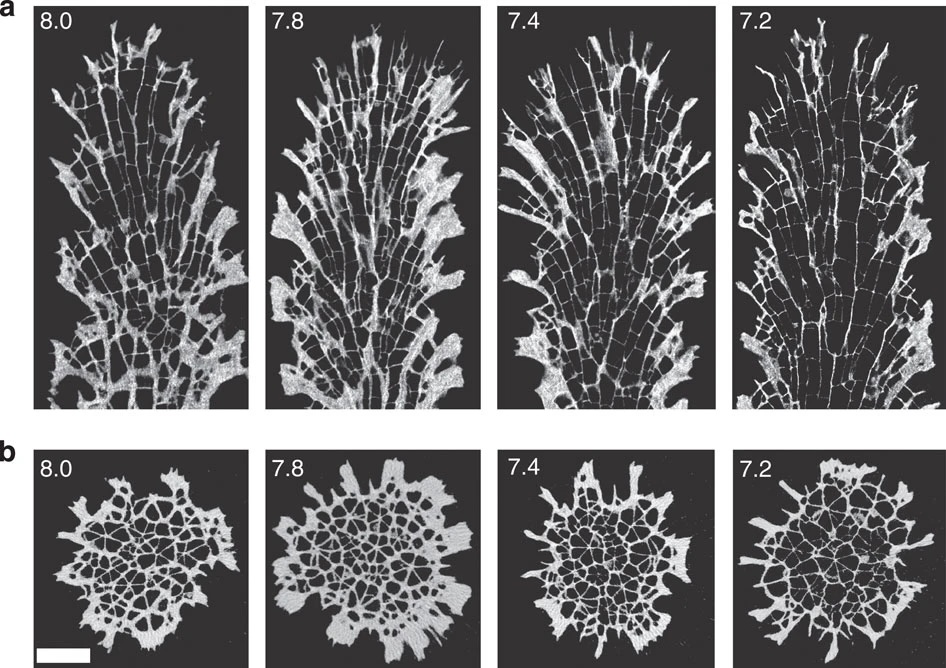
This week’s paper is Morphological plasticity of the coral skeleton under CO2-driven seawater acidification by Tambutté and others. The context is that we’ve been talking about cellular physiology and development, and responses to environmental stresses, so I figured a primary research article about the effect of rising CO2 levels would be appropriate.

(Answer: more CO2 is not good for corals. Decreasing pH leads to a cnidarian version of osteoporosis.)

(a) Representative longitudinal sections; (b) transverse sections. pH treatment is indicated in the top left corner of each image. Scale bar, 1 mm.

It’s symbiosis week!

Yesterday’s lecture began with a dilemma. The topic this week is all about symbiosis, so of course I had to talk about Lynn Margulis, a very complicated person. I have a lot of respect for her contributions to the field, but also had to mention some of her wrong ideas, like that 9/11 was a false flag operation, and that AIDS was caused by a spirochete. It was also a dilemma back in 2007, when Margulis was a guest on this blog and also on our IRC channel. Whew, that was awkward. There might be a few old timers here who remember that.

Also awkward: most of the students had never heard of Margulis until now (they also had no idea what IRC was). At least I got to expose them to a little significant scientific history, which is my job, even when Margulis expressed the opinion that “I believe at all zoologists are intrinsically poorly educated in biology and that medical people are misinformed.” Ouch. There’s a grain of truth there, but mainly my students got to learn that some famous scientists can be colossal dicks. I did tell my students that if she were alive today she’d be a popular guest on Joe Rogan’s awful show.

Anyway, duty done, I lectured on mycorrhizae and gut microbiomes and a lot on Wolbachia. The paper of the week that the students will be telling me all about on Friday is “Eco-Evo-Devo: developmental symbiosis and developmental plasticity as evolutionary agents” by Gilbert, Bosch, and Ledón-Rettig, which you can read if you want to catch up on the course.

So that’s how things work at Frontiers journals, eh?

That ghastly article with the AI-generated rat testicles has been fully and completely retracted.

Following publication, concerns were raised regarding the nature of its AI-generated figures. The article does not meet the standards of editorial and scientific rigor for Frontiers in Cell and Development Biology; therefore, the article has been retracted.

This retraction was approved by the Chief Executive Editor of Frontiers. Frontiers would like to thank the concerned readers who contacted us regarding the published article.

I would like to know where those “standards of editorial and scientific rigor” were when the article was reviewed and accepted by the editors, because that paper was so blatantly, glaringly, obviously bad that it’s clear that no one actually read the damned thing before stamping it with an “approved” label. I think we’ve just gotten a peek at the process at Frontiers in Cell and Development Biology, and it’s cheap and lazy.

Notice also that no responsibility was taken.

How love can last a lifetime

In today’s eco-devo class, we’re going to be talking about a general phenomenon: the physical reality of your feelings, as witnessed by changes in gene expression. Seems appropriate for Valentine’s Day, right? On Monday I lectured on a few principles of gene regulation, and how environmental factors are transduced into patterns of epigenetic activity. Today, the students are going to answer questions and give explanations on the mechanics of all that, and then on Friday, they’ll discuss this paper: “Maternal care as a model for experience-dependent chromatin plasticity?” by Meaney and Szyf. Here’s part of true love:

The students are going to explain it all to me later this week, so I don’t want to spill all the beans, but in short, these are the results of studies in mice. Happy baby mice are licked and groomed by their mothers, while less happy mice are neglected and stressed. Being groomed increased serotonin levels, which activates adenylate cyclase, which increases cytoplasmic cyclic AMP levels, which activates a serine-threonine kinase called PKA, which activates a DNA binding protein that demethylates specific DNA sequences. Some of these sequences regulate stress responses in the hypothalamic-pituitary-adrenal axis, so those loving mommy-snuggles are changing how baby mice respond to stressful situations, and those responses persist long into adulthood.

So maternal care, or lack of care, is drilling right down to the structure of DNA and making lifelong modifications to your feelings. At least, if you’re a mouse, and humans almost certainly have the same biochemical arrangement. And a scientist can rip out some of your DNA and find a different pattern of epigenetic marks in individuals who had a loving relationship with Mom versus those who were neglected. It’s written in your semi-permanent epigenetic record.

Of course, this is just one pathway, and there are multiple regulatory pathways modulating stress responses, so all is not lost if you have one bad mother. These individual effects are sort of permanent, though, and would require alternative compensatory mechanisms to be overcome. Also, keep in mind that bad mothers could be a product of bad grandmothers, and that these epigenetic modifications can ripple across multiple generations.

Indeed, maternal effects could result in the transmission of adaptive responses across generations. In humans, such effects might contribute to the familial transmission of risk and resilience. Finally, it is interesting to consider the possibility that epigenetic changes could be an intermediate process that imprints dynamic environmental experiences on the fixed genome, resulting in stable alterations in phenotype – a process of environment-dependent chromatin plasticity.

I hope you all have an opportunity to stimulate some environment-dependent chromatin plasticity today. If you don’t have a date, you can at least call your mom, or be kind to a child. Modify someone’s DNA with a hug!

A conversation about orthodontia today

It’s Friday, and that means that today I make all the students in my eco-devo class do all the work, while I sit back and observe. It’s too bad I can’t do this every day of the week, but I guess I have to do something now and then to earn my gigantic paycheck. Anyway, on Fridays I pick a paper relevant to the subject of the course, throw it to two student volunteers, and tell them to lead a discussion.

This week the paper is The Jaw Epidemic: Recognition, Origins, Cures, and Prevention by Sandra Kahn, Paul Ehrlich, Marcus Feldman, Robert Sapolsky, and Simon Wong. It’s about the fact that our jaws have been shrinking rapidly in some cultures, and speculating about why. The answer the paper gives is that it’s an epigenetic response to environmental factors, specifically diet but also respiratory phenomena. You might be able to see why this is of interest in an eco-devo class.

Some scholars, although they accept all or some of our narrative, still assert that part of the problem must be genetic or hereditary. They apparently do not realize that, because every attribute of all living organisms must to some degree be traceable to their DNA (or RNA), the statement is nonsensical. Nonetheless, some scientists continue to push partial blame for the epidemic toward genetic evolution while ignoring the etiology of jaw shrinkage and distortion. The success of some clinical techniques to normalize jaw growth in young children and abundant evidence that jaw shrinkage is a factor in both obstructive sleep apnea and the advancement of maxilla and mandible are key treatments, in addition to other surgical techniques. This further makes clear the largely environmental cause of the epidemic.

This confusion over etiology is a possible result of the genetic determinism that is characteristic of much of popular science. For instance, recent genome-wide association studies (GWAS) studies aimed at orofacial issues have been focused on possible genetic factors involved in the variation in the eruption of third molars (wisdom teeth). But they in no way suggest that selection and widespread genomic evolution explain the rarity of impacted third molars in hunter-gatherers compared with their common occurrence in settled or industrialized human populations). Similar problems occur when “racial” differences in the occurrence of jaw-related disease are discussed. For instance, Weinstock and colleagues (2014) found that African-American children were about 20% more susceptible to pediatric obstructive sleep apnea than children of other ethnic groups. But, unhappily, possible key environmental variables such as allergen concentrations at home or the length of nursing were ignored, as were different head shapes in different human groups that could make some more susceptible to the impacts of environmental change. In short, despite the great attention paid to a possible genetic evolutionary cause of the jaw epidemic, precious little evidence of genomic change being a significant factor has been uncovered.

I hope this sparks some good conversation. It’s a bit over-the-top to call it an “epidemic” of jaw shrinkage, but the hyperbole might trigger some arguments.

P.S. Their instructor is no gigachad. I grew up with a horribly crowded mouth with crooked teeth every which way that was treated crudely, by just yanking out a half dozen teeth to make room — we couldn’t afford braces or any finesse. Also, I had painfully impacted wisdom teeth that required an oral surgeon to take a hammer and chisel to my face.