Please, people on my side, don’t make arguments this bad

Uh-oh. Nick Matzke doesn’t like that recent paper by Jerry Coyne on the causes of creationism. It is telling, though, that Matzke’s reasons are terribad. He lists four.

  1. Theodosius Dobzhansky was a Christian and a scientist, therefore he was an accommodationist, therefore…I don’t know, what? How does that refute anything Coyne wrote? No one is claiming that it is impossible for people with screwy personal beliefs to be significant contributors to science.

  2. Darwin was an agnostic, and he would be called an accommodationist today, therefore…again, this is a meaningless argument. Neither Dobzhansky nor Darwin were infallible. Matzke seems to be trying to salvage accommodationism by arguing that people who were significant contributors to science in key domains could not possibly be wrong in others.

  3. Coyne relies, Matzke claims, on claiming that religious people aren’t allowed to endorse natural mechanisms as a method of God’s action. That argument is false and incoherent. Of course religious people can endorse natural mechanisms: every good scientist, of which Matzke has mentioned two, endorses natural mechanisms. Where his argument falls apart is in this bizarre notion that you can simultaneously claim that a mechanism is natural and that it is driven by a supernatural entity. OK, show me such a thing. Show me evidence that mutation, for instance, is the result of a god diddling DNA.

  4. Matzke just doesn’t like that word “accommodationist”. At the same time, though, he claims that accommodating religious beliefs to science is a good thing, so presumably the word isn’t so bad, then. What he doesn’t recognize is that accommodating religion to science means jettisoning supernatural explanations, which we flaming atheists would also say is a most excellent thing; the problem, though, is that accommodationists instead make excuses to modify science to fit their religion…for instance, claiming that quantum indeterminacy is god’s way of tinkering with life.

Then he wraps it all up by questioning whether atheist interpretations of evolutionary biology ought to be allowed to be published in good journals of evolutionary biology, because it isn’t “serious”. That’s ironic. Apparently, it is serious to promote liberal Christianity as an ally of evolution, as the NCSE does.

Those are all pathetically weak “arguments”. Matzke ought to be embarrassed to have made them.

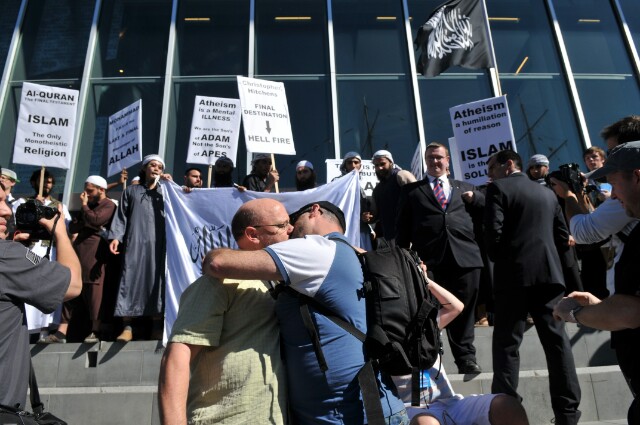
Our world in a photo

This picture is all over the place, so I don’t have the original source to credit, but it’s still wonderful. At the Global Atheist Convention 2012, we were picketed briefly by an angry mob of Muslims who wanted us all to go to Hell, the sooner the better. So in response, two gay men…

Love vs. Hate, Tolerance vs. Intolerance. That’s what it’s all about. I’m glad I’m on the right side.

(Whoever took that photo, let me know and I’ll update this. I met the two subjects of the picture too — very nice guys, but I didn’t get your names. Fill me in!)


Got the info: that’s Gregory Storer and Michael Barnett.

Why I am an atheist – Ville Orelma

I am an atheist quite simply for the same reasons most people are theists. I’m not talking about the theists who think about these things or wonder how we got here.

I’m talking the majority of theists. Like them, I’m an atheists because I was raised as an atheist. I was never baptized, I was never forced to join or go to church and (unlike most here in Finland) never attended religious education in school.

Religion was a subject that was always treated neutrally in my family. Thor and Mars were always seen as equals to Moses or Jesus and both nothing more than myths and legends (tho I always thought Thor was much more badass than Jesus).

I can’t remember ever asking my mother why I attended ethics class while all the other kids on my age group had religion. I just kind of accepted it. In any case it wasn’t anything that picked me out from the other kids.

There are a few times I can recall thinking (with my then first or second grader mind) if there was a supernatural being watching over everyone and even a few times talking aloud to said being on the off chance someone was there, but it always seemed just a little too silly even back then.

Perhaps the question overwhelmed me back then, but in any case, I’ve never really believed in gods and I’ve never had, what some people call, “a religious experience”, I don’t even know that that means to be honest.

Today the reasons for my atheism haven’t changed. What has changed is my understanding of why other people are theists.

Ville Orelma
Finland

Why I am an atheist – Sid Schwab

Here’s a confession: I find myself resisting describing myself as an atheist, and I wonder why that is. Since I can’t claim certainty, I suppose I could use the rubbery rubric of agnosticism. But right or wrong, I can’t believe there are gods (and there have been times when I’d have liked to). So why the reticence? Maybe it’s fear of reprisal; it is, after all, an untidy time for people like me, whose offense is only looking at the world with clear eyes, neither willing nor able to go beyond reality and the observable; the constitutional inability to make a leap of faith, even as our country seems unstoppably heading toward theocracy. But I think it’s something different.

As I’ve thought about it, it seems that atheism ought to be the default assumption, for anyone. Certain things ought to go without saying. One should not have to describe oneself, for example, as a mathist. Or a gravitist. (Yes, I realize the analogy is sort of a semantic contradiction, but you get the picture.) I believe the grass grows; I believe in chlorophyll. I (sort of) understand radioactive decay, and I understand (to a degree) its relation to measuring the age of the earth. I know (mostly) why planes fly and I don’t need to claim an angel holds them up; I don’t think the earth rides on the back of a turtle, and it seems reasonable that anyone would assume that about me. Nor does the fact that I don’t know everything lead me to fill in the blanks with imaginary answers. I can wait. Belief in the demonstrable ought to be the default baseline for anyone, and it shouldn’t need a particular label.

Okay, maybe “realist.”

Or “normal.”

It’s when you begin to come up with magical explanations (ones, I must point out, that other believers in other magic will decry ferociously and consider false magic, capital blasphemy, compared to their version of it, with no sense of irony whatever), that it seems labels should be applied. I think of those judges who sentence people to wearing a sign after they stole something. People who didn’t steal anything don’t need a sign saying so. Not believing in gods oughtn’t need particularizing any more than breathing does. I do breathe; I admit it. But it’d be strange to identify me as a breather, wouldn’t it?

A world-view ought to start with reality. Reality is enough. Reality is, for one thing, real. Realists shouldn’t need to explain it, or to have (loaded) labels applied. Nor, for that matter, should they feel the need to brag about it, or get in the faces of others. Why should the world need a movement that announces its commitment to reality?

Except for the fact that any realist can’t help being shocked, worried, and appalled at the direction we’re headed in the US, as magical thinking has become the basis for a major political party; as intelligence, the quest for knowledge, are considered elitist and abhorrent, actively and proudly mocked and scorned. In that party, belief in god seems to have become synonymous with rejection of science, with denialism, with economic amnesia. It needn’t be thus; it wasn’t always so. But those who wonder why there are suddenly a few highly outspoken and, as some have called them, “militant” atheists out there need only look at today’s Republican party, its teabaggers, its “values voters” for the answer. Scary, hateful, regressive, aggressively ill-informed people.

There’s where labels belong, seems to me.

Sid Schwab
United States

Speaking truth to apologists

If you’re looking for an explanation for why creationism is rife in America, don’t ask religious scientists. Their answers tend to be evasive and weird and unbelievable.

For example, Ken Miller claims it is due to the American virtues of rebelliousness and disrespect, and has nothing at all to do with religion. No, not one thing. All the blame for creationism lies on…those awful New Atheists. Then there’s the paleontologist Robert Bakker, who similarly misplaces the blame.

We dino-scientists have a great responsibility: our subject matter attracts kids better than any other, except rocket-science. What’s the greatest enemy of science education in the U.S.?

Militant Creationism?

No way. It’s the loud, strident, elitist anti-creationists. The likes of Richard Dawkins and his colleagues.

Bizarre, isn’t it? Yet this is more or less the position taken by the NCSE, NAS, the AAAS, and most museums, which seem to bend over backwards to avoid offending religious sensibilities of any kind.

At last, though, somebody speaks the plain truth: Jerry Coyne has published a paper in Evolution, “Science, religion, and society: the problem of evolution in America“, that correctly answers the question about why Americans hate evolution.

The answer seems pretty clear: religion (I define it as “those systems of belief that accept and worship the existence of supernatural beings whose actions affect the universe”). Religion is an answer that many people don’t want to hear, but there is much evidence that America’s resistance to evolution is truly a byproduct of America’s extreme religiosity (I use “religiosity” in the first sense given by the Oxford English Dictionary, as “religiousness; religious feeling or belief”). Evolution, of course, contravenes many common religious beliefs—not just those involving Biblical literalism, but those involved with morality, meaning, and human significance.

To argue any other way is madness. Creationism is an entirely religious concept that denies science, and to throw it on the shoulders of atheism is absurd to an incredible degree. I’ve been asked to write a paper for a different journal that discusses the fallacious reasoning of scientists who argue for the compatibility of science and religion — we’re going to have a fun time in the scientific community finally paying attention to the obvious on this issue.

Prideful buffoons

Oh, dear. The Way of the Master is after “PZ Meyers and his limited vocabulary”. They caught me at the Reason Rally, and I dismissed Sye Ten Bruggencate with a laugh and called him a “slimy motherfucker”. The segment of interest begins at about 9:30.

What they don’t tell you is that I’d been strolling about the rally all morning, and this was the fourth time Sye Ten Bruggencate or Eric Hovind had come up to me with their inane presuppositionalist argument…the same dim argument that they always make (you may notice that at one point, I say “…like I said…” — I was referring to previous encounters with these jerks). And what was that argument?

Well, you may recall that there was a zombie invasion a while back, in which a mob of Hovind acolytes suddenly showed up en masse and started babbling repetitively. You can find the totality of their reasoning on that thread.

I can summarize their argument very briefly:

  • Your ability to reason comes from god.

  • Therefore, if you use reason, you prove the existence of god.

  • If you use reason to disprove god, you actually prove god.

  • If you claim any of their arguments are logically fallacious, you are using reason, which comes from god, therefore you prove them correct.

  • Demanding evidence for a claim presupposes that you should support claims with evidence; they make no such requirements, therefore they are exempt from providing evidence for their god.

  • This god just happens to be the god of the talking snake and the guy who was nailed to a big stick.

  • They know this for certain because god told them he was god.

That’s the totality of their argument. It just goes around and around and around; it’s like getting trapped on a merry-go-round with a ranting, defective, and very limited Eliza program…one written in an old and very slow BASIC interpreter, by a very lazy programmer who only coded it with about ten phrases that are cued semi-randomly.

Ray Comfort thinks Sye Ten Bruggencate is brilliant. Enough said.

Why I am an atheist – Kassiane

I am an atheist because there is no god.

I was raised in an increasingly religious environment–the parents I grew up with took us to church every week (Catholic & eastern Orthodox), and they sent us to Catholic schools. I listened, I tried to believe, I memorized everything they told us in Religion class & tried to understand how people believed it.

But I could not believe.

After my parents split up, my mother became gradually more religious. Here’s the fun part: I am autistic & have temporal lobe epilepsy. My mother went from a bit off to absolutely convinced that I was possessed by demons. Eastern Orthodox don’t even really do the exorcism thing-certainly not the way evangelicals do-but I had not one, not two, but three exorcisms. Being waterboarded with holy water is still being waterboarded. Could any really loving god allow this, or my mother’s increasing use of church and marathon prayer sessions as punishment? I’m thinkin’ not.

So I survived years of abuse because “god told me to do it”. No god I knew or was told about would do that, but I kept trying to believe. I got straight As in religion class. We had to pass a religion test to graduate high school; I scored high enough to get “advanced scholar of catechatical knowledge” on my diploma.

Yet still I had doubts.

That summer I went to an Eastern Orthodox church camp to coach Special Olympics for a week. Being teenagers, all of the volunteer coaches snuck out of our cabins and stayed out way too late. I was surrounded by kids with whom I should have a lot in common, except they seemed to have no doubts at all, while I saw all the ritual as a routine, but nothing that meant anything to anyone but the people doing it.

It hit me that I am an atheist that summer. We were laying in the outdoor volleyball court looking for shooting stars. It was beautiful-I had never seen so many stars, and had certainly never seen so many shooting stars. We were all very quiet except for the occasional muttering about the beauty of God’s creation–and at that moment I knew, absolutely KNEW, that there was no god who put all those stars there. There was no god who made us and the plants and the stars and the things so far out we did not know about them. It was so vast and beautiful that saying some guy in the sky (but not really the sky-some kind of other dimension or something) put them there just for us was far too conceited and just didn’t make sense. There’s so much out there humanity may never experience, and no one put it there, and that was far more awe inspiring to 17 year old me than “goddidit”.

I was born an atheist, I couldn’t learn not to be, and reality is so much cooler anyway.

Kassiane

Why I am an atheist – Wayne K

My parents were Catholic, as was their parents, and their parents, etc. as far back as anyone in the family can remember. When I was about 4 or 5, it didn’t understand mass or any of the other rituals and ceremonies that make up Catholicism. I know that I hated going to church, catechism, confession, communion, and all that stuff. But I was sometimes terrified that I might die in my sleep and go to Hell because I wasn’t in a “state of grace.” When I was about 5, my mother told me that Catholics had to suffer in life and that only Catholics went to Heaven. Wow, what a horrible thing to tell a 5 year old! I went to church and catechism every Sunday, and I mean EVERY Sunday. There was no “go or else”, there wasn’t any “or else”. At about 12, I began to doubt all the teachings of the church, but didn’t really know if I believed or not in a god. When I left home, I also quit going to church and told my parents I didn’t believe in any of “that stuff”. My parents practically disowned me for a time. Thereafter, for most of my adult life, religion wasn’t a part of my life and didn’t think about it. I didn’t know or associate with anyone that went to church. I probably did know people who went to church, but they didn’t talk about it. I went to my father’s funeral mass only to please my mother and swore I would never go to a mass again and I haven’t.

When I was 44, I married a woman who was about as Catholic as the Pope. Probably more Catholic because she really believes on all that bullshit. I doubt the Pope does. He’s just another ambitious politician who used religion to gain power and status. My wife and I argue religion all the time, but this hasn’t had a really bad effect on our relationship. At least she finally stopped nagging be to go to church.

But then we moved to northwest Arkansas, part of the Backward, Baptist, Bible, Belt. Here, there’s church on every block, people talk about their church, their religion, their Bible, their Bible study class, their choir practice, etc. etc. constantly. I got so tired of being told in person and on the TV, that the Bible says this and that, that I read the Bible, the ENTIRE Bible, to see what it said. Makes me sick. The best source I know of for turning a believer into a non-believer, is the Bible. The people who are always quoting the Bible and how it is the basis for morality, obviously haven’t read the Bible. If I were god and someone said that I wrote it, I would be insulted. I also read much of the Koran. By the way, Arkansas is one of seven states that has an unconstitutional state law requiring a belief in god to serve in a public office or on a jury. I know this is the law and from personal experience. I was excused from jury duty for refusing to take a religious oath. Arkansas doesn’t say which god you have to believe in, but then you’re given a Christian Bible to swear an oath. Doesn’t matter if you’re Jewish, Muslim, Hindu, a non-believer, or whatever.

After reading the Bible, I started reading about other religions and also I read Dawkins, Hitchens, Harris , Dennet, plus the writings of religious people. I tried reading a book titled, “I Don’t Have Enough Faith to Be an Atheist.” I read about half of it and couldn’t read any more it. Total bullshit, circular arguments and nonsense. For example, “God exists because the universe exits.” “All religions claim to be the true religion”, (true). But in the next paragraph, “of course, Christianity is the true religion.”

I don’t know why people are called Agnostic.

In reality, everyone is an Agnostic. Agnostic means, no knowledge. That is what we have about Heaven, Hell, and an afterlife. Of course religious people “know” there is. Religion enables people to know things that are impossible to know.

In summary, if one studies religion, which of course the clergy forbids, one can only come to the conclusion that it’s all a lie.

Wayne K

Why I am an atheist – Sandra Goodick

I am an atheist because I am a feminist. I think that statement is self-explanatory but others have been stumped by it so let me elaborate.

When I was young, my parents sent us (my siblings and I) to Catholic school. We weren’t a terribly devout family, but the Catholic school was very close by and, technically, we were Catholic so off we went.

Given our age, my classmates and I were on the cusp of modernization. The Church was moving towards a softer, gentler Catholicism. But, our priests were old and we still got the old lessons. So, when I was 8 yrs old and preparing for 1st Confession, Father Tim informed the girls (in a special lesson that we were seperated from the boys to receive) about the punishments of Eve. Not only were we responsible for the Fall of Man from His Perfect StateTM but we (as in “all women for all time”) would have to pay for it also. In particular, we would have to pay for it by submitting to the authority of our fathers, brothers and, someday, husbands and sons. The feminist in me revolted and in a moment of clarity where I may have actually exclaimed: “Eureka!” (It’s hard to tell since all I could hear was the blood rushing in my ears, maybe I yelled “Bullshit”) I knew that he was lying.

I told him so as well. There are few things in this world that an 8 yr old is certain of but I was certain of these things. First, I knew that I was smarter than my brother and the likelihood that I would ever submit to his will was right up there with pigs producing beef (experience has held up my childhood hypothesis). Also, I knew that sons damn well submitted to the will of their mothers, if they knew what was good for them. Plus, lots of women don’t get married and even those who do marry don’t universally submit to their spouses, so that rules out husbands. And, as for the will of our fathers… Well, every child (male or female) submitted to the will of its father, there was nothing special about girls in that case.

I was promptly sent to the hallway by my teacher to consider my insubordination for the remainder of Christian Living. This was a bad move on the teacher’s part as it gave me time to think and my moment of clarity blossomed. If Father Tim was lying about Eve, what else was he lying about (other than the fact that he was sexually assaulting altar boys regularly – a fact that didn’t come out until I was in my 20s)?

Once I asked that question and started to examine the claims of the Church, it was only a matter of time before I was a full-out atheist. Although I rejected Catholicism at first (because I didn’t know enough about other religions to accept/deny them) ultimately I realized it was the existence of god that I was rejecting. I didn’t really give religion any thought in high school (in Canada in the 1980s, religion was only discussed as a strange phenomena of a by-gone age) and it wasn’t until I took a university course in Philosophy in Religion that I seriously thought about faith and the existence of a supernatural world. That’s when I realized the interconnections between the Abrahamic faiths and how equally spurious their claims were.

So, by the time I was 20 yrs old, I had considered the question and decided that I was an atheist. But ultimately, what sent me down that road was my feminism. And I’m still a feminist now – and an atheist, trade unionist and social justice activist.

Sandra Goodick