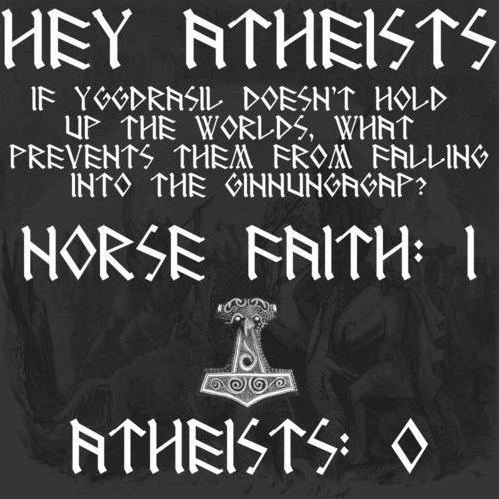
The answer to that is not particularly interesting: Gods are impossible by definition. Any being constrained by natural laws can’t rightly be called a god, and any being unconstrained by natural laws can’t exist. Q.E.D. However, I would like to share the story of how I became an atheist.
I was baptized as a Catholic before I was two weeks old. I was sprinkled with water blessed by an ordained priest and was anointed with oil on my forehead, thus giving me a shield against Satan’s evil. I grew up a very trusting and very shy little boy, entranced by the power and authority of the priests who spoke so definitively. God was all-powerful. When I became sick, I wondered what I had done to deserve influenza or an ear infection, and prayed my apologies every night as I fell asleep. I knew that piety and devotion were the way to be good, and I only wanted to be good.
When I was a little older, I heard a priest speaking his homily in my grandmother’s impressive church in Hacienda Heights. He said that we were all called to be saints, and this seemed conclusive and sensible. There was no reason to strive for anything less. God abhorred sin of all kinds, and He only ever gave us good things. To sin at all was an unwarranted failing, and He noted all of them in His perfection. To be Christian meant to be like Christ, and the Prince of Peace was a sinless human being.
You may here divine my coming troubles.
I began to leave all my allowance in the collection plate every Sunday, and I examined my conscience studiously. When I learned how to give a proper confession, I sought out priests to unburden my soul, and left every time with a light heart. But that light heart never lasted. I couldn’t seem to refrain from spite, from jealousy, and as I aged, especially from lust. I began to change, to see the world beyond my family, school, and church, and I was pained by what I saw. The world was full of greed, poverty, and hatred, and I myself couldn’t stop desiring the bodies of the women and girls I saw. That dream of piety began to fade with my awakening, and I became desperate to reclaim it. I prayed the Act of Contrition with all the focus I could summon, even as I witnessed the words “I will sin no more” become shamefully fake. I cashed all my birthday checks and bought cans of vegetables for an Easter food drive. I kept a Rosary in my pocket and prayed while riding to school and while waiting for friends. When I was sixteen, I cut down a fifty-pound cottonwood log and carried it across my shoulders while I performed the Stations of the Cross, a series of fifteen prayers commemorating Jesus’ march to Cavalry and His Resurrection, in an attempt to understand the Sacrifice which redeemed the world.
But I was still a sinner.
I believed absolutely, but I knew that I would never be able to joyfully proclaim that I was following the true Will of God. I could be forgiven, but I could never master my sinfulness. I would always choose to stain the perfection of God’s Kingdom. There was only one conclusion: there was something wrong with me. I was too weak to follow or too stupid to understand and I was always too undisciplined. I begged for wisdom, strength, and courage every night. I confessed my shame to middle-aged priests at my high school, stumbling over the words “sexual sins” every single time. Masturbation was never followed by a simple contented sigh, but by anger and humiliation. At certain times afterward I was so furious and ashamed I took all the strength I had and cracked myself in the jaw with a closed fist, desperate for a bolt of pain sharp enough to sever my need for sexual release. I literally tried to beat myself into compliance with the dogma of Holy Mother Church.
It never worked.
Around this time, my appetite for books led me to the Kurt Vonnegut works in my high school library. In the middle of that despicable Catholic institution, a few cheap paperbacks were my first step on the way out. In one of his major novels, he described a tenet of morality: do what is good because it is good, not because you desire reward or fear punishment. There was something attractive about that sentiment. I came to understand that
it was self-contained. This was a method of being good which did not rely on a complicated world of obscurely interdependent prophesies and fulfillments. I liked it.
As I contemplated this idea, my Catholic faith continued to wear me down. The golden land of my youth had become a twisted carnival of guilt. Every week, I sat before a man who continually bled to death in an unappreciated attempt to save people who hated Him. I hated Him, and He died because of me. I could do nothing in His churches but apologize. His hands began to look like pointing fingers. I was looking for a way out and this was my weakness trying to please Him. I was miserable. I don’t know when, but some day I said “I refuse to be ashamed”.
This repeated in my head, almost unbidden. “I refuse to be ashamed.” I was tired. I was exhausted. I had tried with all the strength I had for my entire life and I never won. How do you have a relationship with a Savior who is perfect? You can do nothing for Him but fail to meet the goals He sets. I was tired of missing a bar which He in His fucking perfect Arrogance had set too God-damned high. I went to Mass less and less. One day, I never went back. I don’t even remember the last time.
I still had a confused ball of spiritual beliefs inside me. I believed in love, in the unity of people, in a God who could be found through the discipline of any and all religions. I divested myself of the shameful parts of my Catholicism, but still sought God. As I worked through this, a dear friend of mine who had been raised in Protestant churches explained to me that she no longer believed in any god. I respected her viewpoint but couldn’t abandon the idea of a being who was central to all of existence. Then one day she emailed me a copy of The God Delusion and insisted that I read it. I was bored at work, so I did. Then I read it a second time. Later that week, I told her these words: “There’s probably no god”. She was right.
There is still so much anger inside me. I hurt, and wept, and injured myself while I was a child. I contorted myself into an alien shape to please a master who never existed, because I believed. Do you
understand? I believed what they told me. That was all I ever did. I tried so hard to be the person they wanted me to be and never blamed anyone else for my own shameful failing. I only blamed myself.
The Church taught me to hate myself.
I have no professional training in this area, but I believe there
are strong commonalities with the experiences of people who were abused emotionally as children. I cling to the rational arguments of Dawkins and Sagan and P.Z. himself like life preservers when I feel overwhelmed. I worry if I am obsessing over my church experiences too much. Sometimes I think it was all my fault for taking the church teachings too seriously; if I had only lightened the fuck up maybe I wouldn’t have been such a little bitch for so long. I still can’t talk about my worst experiences without crying, and I bring them up way too often when I’m drunk. I worry that my friends would feel contempt for me if they knew how I can’t seem to heal.
When I hear people say religion does no harm, I want to punch them in the fucking mouth.
Loren Lemos
United States