At 9am Central, I’ll be live on AM950 for Atheist Talk radio.Tune in!
You missed it? You can find it on the Minnesota Atheists site in a day or two. Also, my interviewer, Maddy Love, has a podcast. Check it out!

At 9am Central, I’ll be live on AM950 for Atheist Talk radio.Tune in!
You missed it? You can find it on the Minnesota Atheists site in a day or two. Also, my interviewer, Maddy Love, has a podcast. Check it out!

Anjuli makes a good point, one that resonates with what I’ve been saying for years. Atheism is not a loss of something; it’s not about simple disbelief. It is about acquiring a more thorough and accurate and liberating understanding of the nature of the universe.
My atheism is not a loss of any kind and even when I embraced it (at the age of twenty-two), it was most certainly a gain. I conceived of it as gaining control over my own mind, and gaining the freedom to use it as I thought best. I also saw it as an escape from a particularly damaging form of social control. It was significant to me, as a twenty-two year old still settling into my identity, that I no longer had my life parameters set by people I regarded as cruel, stupid and ignorant (though I’ve mellowed somewhat on that front).
I have heard these sentiments so many times from so many people over the years, that accepting atheism was like crawling out of a straitjacket to finally be free, and to see the world with new eyes. And then there are others who shrug and just say that it was nothing, they just stopped believing in a god…and the whole damn culture that propagates god-belief and reality-ignorance at its core? An absence of oppression is not simply something that is, it’s something you have to struggle for. And free thought is more than just the absence of something, it’s a positive in its own right.

James Croft is looking for assistance to cope with his own life choices.
He chose to be a humanist.
He chose to speak out loudly about that.
He chose to join a protest against police brutality in St Louis.
He chose to try and record an instance of police beating a protester.
He chose to get arrested…oh, wait, no. He didn’t choose. The police chose to arrest him for daring to document their actions.
And now he’s e-begging to get money to cover his court costs and support his criminal lifestyle. Do you want to encourage that sort of thing? Then yes, you should give him cold hard cash and make yourself a co-conspirator, an accomplice, no less.

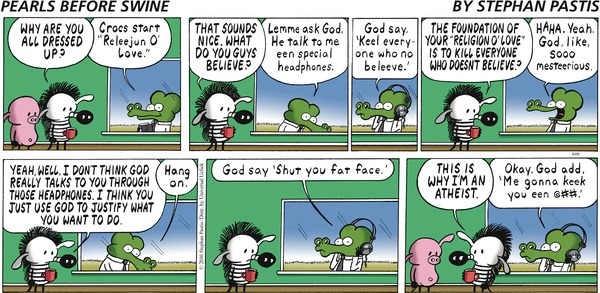
Someone in the Bible belt is going to open up their Sunday paper to read Peanuts or Blondie or BC or one of those other bland, dull, tired, dead strips, and they’re going to get a shock:
That’s pretty much a standard atheist understanding of how religion works, and one of the characters is able to plainly say that he is an atheist. Progress in the mainstreaming of godlessness!

If you’re at all interested in the latest kerfuffle in the atheosphere, you might want to tune in to Atheist Talk radio tomorrow morning at 9am Central. Callie Wright and Ari Stillman will be the guests.
Then, next week, they’ll have somebody else to talk about the same thing with a wildly, radically different perspective to share — I’ve heard rumors. Maybe it’ll be Milo Yiannopoulous. Maybe it’ll be Rush Limbaugh or Ann Coulter. Who knows? Or maybe it’ll be somebody who pretty much agrees with them. You’ll have to listen to find out.

Trav Mamone listened to that debate with David Smalley, and thinks we both made good points. Of course we did! I agree with Smalley on a lot of things, even a majority of things.
Now maybe I’m being too nicey-nice, but I think both Smalley and Myers made valid points. I used to be all “If you disagree with me, I want nothing to do with you,” but the more involved get with the atheist movement, the more I realize we’re a pretty complex group of people. We all have our blind spots, so it’s not unusual for two skeptics to look at the same piece of empirical data and come up with two completely different interpretations. For example, Smalley once said he thought Black Lives Matter protesters blocking the road was “going too far,” but Alix Jules explained to him why that wasn’t the case. At least they had that conversation so that Smalley could understand where Jules was coming from.
He’s quite right that there’s a lot of bickering and misunderstanding going on within atheism. He’s also right that a lot of it can be smoothed over with calm, rational discussion between the two who are in disagreement. I have no problem with any of that. But there are a number of things where I do disagree strongly, and I’m not going to paper those over to be popular and friendly. Here’s where I still think Smalley is dead wrong.
Petty disagreements are not killing atheism. This is the human condition. We squabble over everything. Gather a small group of people together to discuss anything, from how to share out chores in the apartment to running the country, and you’ll find arguments and jockeying for advantage and people getting snubbed and others storming out in a huff. It’s routine and to be expected. If you aren’t prepared to focus on the larger goal, and get distracted by the small stuff, you won’t be effective.
I won’t deny that people get pissed off and do horrible things like “unfriend” each other on Facebook, but to make that the big crisis in atheism when it is only the common small drama of social networking is a mistake, especially not when there are huge, substantial problems that are generating deep divides.
What is petty to you might loom large in the mind of someone else. There is a kind of arrogance to seeing two other people fight on social media and deciding that their disagreements are trivial and you, the wise social arbiter, will explain to them that they agree on 98% of everything else, so their dispute is unimportant. We all have ideas that we regard as central to our identity, and no one else gets to deny that. The fact that all human beings breathe the same air 24 hours a day, and that we all have this common requirement, does not negate the fact that I might like peas and broccoli, while you don’t, and doesn’t give me the right to declare that your preferences are unimportant and you had better just set aside your distaste and clear your plate. We share a love of oxygen, how can you not share all of my tastes with me?
Making it personal rather than public buries the disagreement. I’ve been around this rodeo too many times, and have heard this as a panacea far too often. “Don’t argue publicly, pick up the phone and call them!” No. There is a small number of people I might enjoy having a phone conversation with on a disagreement, but not many. I would especially not appreciate a phone call with the intent to forestall public expression of disagreement.
It’s also an overt attempt to convert disagreement over an idea into a personal disagreement with a person. Telling me I can resolve a disagreement by just having a quiet conversation with one person ignores the fact that maybe my concern isn’t with who said it, but that I find the whole expressed concept repugnant.
No one does what Smalley suggests! This really irritates the pragmatist in me. I am the target of a lot of hate — in fact, the comments on Smalley’s podcast are largely expressions of frustration and irritation with me — and would you be surprised to learn that none of them have called me up or even emailed me to ask what I was thinking, or to chat one-on-one about our shared humanity? Not one! They just go ahead and publicly express their disagreement without consulting me!
This is a good thing. I’m trying to imagine the nightmare world that would occur if every Youtube commenter felt a moral obligation to ring me up and have a heartfelt conversation with me before they posted their declaration that I was a cuck fag.
Sometimes, reconciliation is not a desirable goal. I do not really want to sit down over a beer with a racist or a homophobe. Nope, sometimes you just have to say “Your values are opposed to my values, and I do not want to associate with you.” I am also uninterested in accomplishing minor concessions. I’ve gone ’round and ’round with creationists, for instance, and you can sometimes get them to admit one argument is bad. Here for instance, is Creationist Ministries International’s page on creationist arguments that creationists should not use. Don’t use the “Darwin recanted on his deathbed” claim, for example; even Answers in Genesis says to avoid the “why are there still monkeys?” argument. These are tactical retreats, nothing more. They have not changed their core values at all, but are merely conceding that these few arguments are not effective in advancing their position.
So when Smalley triumphantly points out that he got a homophobe to admit that one piece of “evidence” was incorrect, I am unimpressed. Maybe if you could get one person to do that a thousand times, it would lead them to question their underlying assumptions, but I’ve yet to see it happen. I have many times gotten creationists to grudgingly give up on specific lies, but still insist that the Earth is only 6,000 years old.
One weird minor issue: a lot of the comments focus on just one thing. Myers said that that photo of Ellen riding Usain Bolt was racist! How dare he?
This is also something I’ve seen way too much of. We white people are really good at getting indignant over being called racist, but racism itself? Meh, not as important a problem. Get over it, people! We’re all racist, we all profit from racist policies and our racist history, so the least you can do is be a tiny bit conscious of the implicit (and often overt) racism we’re swimming in.
Here’s the deal. If you’re going to talk about what’s killing atheism, you better be prepared to give substantial reasons, and not fall back on a lot of decade-old debunked nonsense (the only thing he was missing is “you’re doing it for the clicks!”), and the core of your argument better not be something as superficial as “we’re not polite enough to each other”, a claim that could be made for every movement and organization in the history of humankind.
I myself have argued that atheism has serious structural problems. It’s even a highlighted quote on Conservapædia!
The atheist PZ Myers declared on September 27, 2014, “I will make a prediction, right here and now…. The number of people identifying as atheists will stagnate or even shrink…“[
So gord knows, it’s not as if I’m upset that someone has pointed out a problem in the movement. What bugs me is that the concern is so irrelevant and displaces activism to correct the real problems.
If you’re wondering about the context of that quote on Conservapædia, here’s the original full post. What I find interesting is that it’s another example of the Strategic Ellipsis, that habit of creationists of snipping out the bits of a quote that directly oppose their views.
I will make a prediction, right here and now. The number of people identifying as “nones” will grow in this country in coming years, because we’re on the right side of history, and because organized religion is happily in the process of destroying itself with regressive social attitudes, scandals, and their bizarre focus on other-worldly issues that don’t help people. The number of people identifying as atheists will stagnate or even shrink, because organized atheism is happily in the process of destroying itself with regressive social attitudes, scandals, and their bizarre focus on irrelevant metaphysical differences that don’t help people.
I can’t say that’s a bad thing. The name of atheism has been burdened with unfair and inaccurate stigma for a great many years, and we’re now drifting into an era in which atheism will be burdened with a totally fair and accurate stigma.
But don’t worry! David Smalley will make sure we’re polite and sociable about our problems, as we sink into irrelevancy.

Or is it that he agrees with me?
Anyway, David Smalley and I did a grueling two hour recording for Dogma Debate tonight. The argument always goes on!
The debate is already available for listening — at least, the first hour of it.

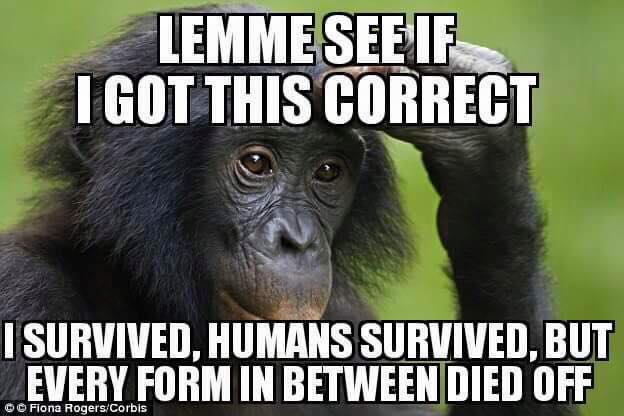
This is apparently intended to be a criticism of evolution posted by a Jehovah’s Witness. I don’t quite get it.
Yes. Everything died. Every individual between the current extant cohort and the last common ancestor died. It’s what organisms do. Is this so hard to understand? But that does not imply that every possible intermediate form existed and died. They may also be confusing individuals with populations, but I find it very difficult to read the minds of creationists.
Here’s a tree branch.

There is a twig at A (call it humans), and there is a twig at B (chimps), and there is an ancestral branch point 6 million years ago. A population of cells at the “ancestor” point divided multiple times and split into two extending meristems that produced the branch leading to A and the branch leading to B. I think our creationist is assuming that there had to have been a solid sheet of wood filling the space between A and B, that the space of all possible positions for twigs had to be filled, and that it was somehow pruned back selectively to create just the two twigs.
But that would make no sense, wouldn’t fit our understanding of how branches form, and would be really stupid. They can’t possibly think that, can they?

Maybe I’m just stuck in a time-loop, because the old familiar arguments keep popping up. Back in 2010, I had to explain to skeptics that Skepticon was a conference of skeptics — they just included religion among the valid topics for criticism. And today, what do I see but that Lauren Lane has to explain that Skepticon is skeptical.
Okay, so we give our skeptical side-eye to a lot of things that other skeptics groups consider to be outside the traditions of the skeptical movement. But skepticism is an approach to finding the truth by valuing evidence and reason, recognizing human biases and limitations, and working to overcome them. Skepticon promotes skeptical thought on a wide range of topics, from bigfoot to bigotry, psychics to society, reflexology to religion. So many ideas can benefit from a skeptical look.
It’s annoying to have to repeatedly explain these basics, but unfortunately one of the traditional activities of many old-school skeptical organizations has been to build fences around certain topics and tell us that we’re not allowed to be skeptical of some sacred cows.
I’m glad Skepticon isn’t afraid to brush past the gate-keepers.
P.S. I’m supposed to remind you to donate to Skepticon.

I’m sure glad David Smalley and I are friends and fellow atheists, because he begins a post titled What’s Killing the Atheist Movement? by saying this:
Remember when our friends could be wrong?
I do. Lots of my friends were idiots growing up. Hell, I was that idiot a few times.
But we stuck by each other, we worked through our issues, and we grew together.
So he won’t mind at all when I say that the post is a string of obnoxious atheist cliches and that he’s dead wrong about everything. It’s all the same bullshit I heard over 5 years ago when assholes started harassing my friends, and random women and minorities, off the internet.
We’re supposed to keep our disagreements private.
Also, I have standards in my friends. I don’t mindlessly stick with them; there are things they can do that I would absolutely kick them to the curb over, that are not negotiable. This is as it should be. “Friends” is not a contract that requires me to abide the abominable.
Yes, we had fights. And that’s ok. But our fights were private, and were about the issues. Not public horrific Trump-like attacks because of a simple disagreement in method or opinion.
Not once, in my entire history of blogging (over a decade), or my entire history of internet interactions (going on 25 years or more) has anyone politely called me up to have a “private fight” about something. I can’t even imagine it happening. I’d probably look at my phone in disbelief and say, “Dude. Take it to the internet. We can take our time and write stuff with substance and put it on record, instead of babbling on ephemeral media.” But I’ve heard this suggested many times, publicly, on the internet, and usually by someone who fears they’ll get publicly eviscerated. And then it’s usually a prelude to the poor person who wants to make it “private” using the opportunity to publicly denounce the other person for being a poor sport, rude, and unwilling to settle a disagreement with a friendly game of tiddlywinks.
Then there’s the “our disagreement is so petty that you should back down for the good of the movement” approach.
When our “friends” on Facebook or Twitter make a comment that we find offensive or absurd, we are so quick to disown them and “take a public stand” immediately, that we’re fracturing our movement into a thousand tiny micro groups that will be useless against the larger powers we’re collectively fighting.
Who are these larger powers that justify silencing dissent?
There are two parts to this issue that I find difficult to handle.
One is that I hear this from the same atheists who like to tell me that the only thing atheists can unite and agree on is the trivial issue of whether god exists (He doesn’t. There, done with that!) So there is a substantial segment of the atheist community (which doesn’t exist, according to them) that wants you to shut up about anything other than the existence of a god…and the operative phrase is shut up. The nonexistence of deities is not a very useful or practical cause; I’m far more interested in the implications of an absence of a divine authority, specifically in how science and reason explain the nature of the universe, and how any moral action should be based in humanism. So right away we have a problem: merely fighting against a vague and unspecified faith isn’t useful, and many atheists refuse to discuss in any concrete way what they want to fight for.
The second part is that the things I think important are disparaged by these same atheists: feminism, equality, social justice. So when I encounter some dudebro atheist jerkoff spitting on feminism, you’re not going to persuade me to go easy on him in the name of unity over our shared agreement that god doesn’t exist. When someone declares their indifference to the murder of a transgender woman, I’m not going to resist the temptation to unfriend them on facebook because, gosh, we both laughed at an irreligious George Carlin routine.
I’m also not going to sit back and let someone else tell me what’s important to me, and trivialize the causes I consider essential, asking me to silence myself about misogyny or racism because darn it, this year we’re going to get “In God We Trust” off of our pennies.
I’m not saying to excuse all ridiculous behavior.
This is another example of trivializing: now the problems many of us see in the movement are merely “ridiculous behavior”. We are fractured because there are deep disagreements about how to address serious social issues. Worse, because some people won’t even accept the dehumanization of fellow human beings as something more substantial than ridiculousness.
But where’s our Humanism? Where are the private and personal phone calls to work things out?
What is it with the phone calls? I give my phone number to friends and family. The last thing I want is The Amazing Atheist to give me a ring so we can work out our differences, as if a phone call would fix anything. Where does this fantasy that differences in philosophy are best resolved over the devil’s instrument, the telephone, with a strategy, talking, that can be as godawfully bad as Twitter for engaging in depth.
The “phone call” ploy is just another silencing tactic. Don’t express your disagreement and your ideas where other people can see them, please put it on a private channel where I can ignore them.
When someone is being absurd on Facebook, and we dog pile that person, make fun of that person, and create little secret groups to demean that person, that sounds more like church than it does a bunch of skeptics.
“Absurd”. Someone can say something dehumanizing, violent, racist, anti-woman, and we’ll just tuck that into the category of the “absurd”, and then dismiss the protestations against it. We’re not talking about deep rifts in atheism over whether we favor Skittles over M&Ms. Pay attention to what the people leaving atheism are complaining about. They’re serious. This isn’t over jokes or trivia.
Also, what sounds to me more like church is demanding quiet deferral to authority and a conspiracy of silence, in the name of the sacred cause, to protect the powerful and popular.
This is all just the tired old “civility” debate rehashed again. Not interested. I’m also not interested in discussing nothing but the existence of gods with atheists, where that issue is already settled, especially when it’s used as an excuse to avoid grappling with substantial human concerns. Fuck civility when we’ve got atheists who think the humanity of women or transgender individuals or non-white males in general is something we need to debate.
Oh, excuse me, not debate — to phone people up and have a private conversation about.