Go away, Alain de Botton

Oh, no, another interview with the insipid de Botton. I can’t stand it.

Sean Illing: You’ve said the most boring question we can ask of any religion is whether or not it’s true. Why is that?

Alain de Botton: For me, and I think for many other people as well, the issue of religion actually goes way beyond belief in the supernatural, and yet a lot of the debate around religion started by people like Christopher Hitchens and Richard Dawkins…

Stop right there. I’m already bored. Christopher Hitchens is dead, and Richard Dawkins is one guy. Why does everyone who is asked to pontificate on modern atheism immediately try to turn it into a cult of personality? There are some atheists who certainly seem to have replaced religion with the worship of their personal favorite godless prophet, but that sure isn’t the central concern of most of us.

But then, de Botton wouldn’t know how to handle an issue that wasn’t reduced to its most simplistic state, and I think he identifies strongly with the whole cult of personality thing himself.

…reduces to familiar questions: Does God exist or not? Do angels exist or not? Is it stupid to believe in angels?

Those are important questions, but only because people still insist on believing in the existence of gods and angels. Most atheists I know are thoroughly satisfied with the answer that no, they don’t exist, and only continue to address them because believers insist on it. I’ve been in debates before; it’s always the other guy who pops up and thinks “Does god exist?” is a respectable debate topic, and I’m the one who says “No, pick something more specific”.

While I understand the kind of emotional resonance around that, I think the real issue is why did people get drawn to religion? Why did we invent religions? What need did they serve? And also what are the aspects around religious life that may be disconnected from belief that nevertheless have great validity and resonance for people outside of faith today?

You know, de Botton, those are the same questions your bugaboos, Hitchens and Dawkins, asked in their books. That they asked in their lectures. That people discuss at atheist conferences now. I know you want to think you’re something special, but you’re not.

Religions are not just a set of claims about the supernatural; they are also machines for living. They aim to guide you from birth to death and to teach you a whole range of things: to create a community, to create codes of behavior, to generate aesthetic experiences. And all of this seems to me incredibly important and, frankly, much more interesting than the question of whether Jesus was or wasn’t the son of God.

Drop in to most of the churches in the United States and stand up and suggest to everyone that this Jesus stuff is irrelevant. See how well that flies. You might be able to get away with it at a UU church, or a Church of Christ, or the liberal branch of a church on a university campus, but elsewhere…whoa. Have your escape route planned ahead of time.

There’s also this absurdly pollyannaish view of religion.

The underlying ambition of religions is impressive to me. They are trying to locate the tenets of a good life, of a wise life, of a kind life. They are interrogating the greatest themes, and so I’m attracted to the aspects of religion that know that human life is quite difficult and that we are going to need a lot of assistance, a lot of guidance. And what religious life is trying to do is to provide us with tools for how to keep being the best version of ourselves.

No, most are not about a good life. They are about servility. They’re about sacrificing part of your life to serve an institution that makes false promises; it’s often about earning a good afterlife, which does not exist.

My experiences with most religions has been that they are about giving you the tools to be the worse version of yourself: intolerant, self-righteous, meddling, and ignorant. There are small religious groups that do try to be the opposite of that, but if you aren’t ready to recognize the difference between Southern Baptists and your own idealized vision of a benevolent religion, you aren’t ready to discuss how to develop a philosophy for living that doesn’t plummet into dogma and solipsism and tribalism.

It’s to distinguish it from the modern incarnation of atheism, which was promulgated by people like Richard Dawkins and Christopher Hitchens

Shut up, Alain de Botton.

that really made the central aspect of atheism the question of whether one did or didn’t believe. And I suppose I’m interested in the kind of atheism that starts with the assumption that of course God doesn’t exist, we made him up, that’s fine.

While I’m more interested in the kind of atheism that starts with the assumption that the natural world is central and important, and that pursuit of the truth is absolutely essential to understanding that world. Do not let a lie linger unquestioned.

I want to look at the way religions go about things as an inspiring starting point for thinking about what secular culture is lacking and still needs. Because let’s remember that when religion started to decline in the 19th century, in Western Europe…

This is false. The 19th century was not a non-religious era. WWII was driven by religious justifications — “Kinder, Kuche, Kirche“, and the idea that the religious and ethnic other must be cleansed — and the Cold War sent the United States into a self-destructive spiral of conservative religious doctrine that still lingers with us.

But then, de Botton does not consider truth to be an important issue. It’s how you feel about it that matters.

…there was a lot of thinking that was done. People asked how would we fill the gap, the God-shaped hole. And there were lots of theories, and the leading answer, I suppose, was culture.

And that’s religious dogma once again. There is no “God-shaped hole”. When culture was dragooned into believing that culture was in service to a non-existent deity and a self-serving religious institution, it was culture itself that was needed, not the parasitical religious apparatus that was leeching off of it. Kill the parasite, the culture still thrives.

It’s just that the parasite wants you to believe that it is responsible for art and science and music and architecture and poetry, and that if you destroy it you will lose all that beauty. It’s another self-serving lie that de Botton gladly parrots.


Election fraud!

Oh, look here: the Christian Times has exposed a massive conspiracy, tens of thousands of pre-cast ballots for Hillary Clinton stored in an Ohio warehouse, ready to be released and cheat Trump out of his rightful victory.

According to sources, Randall Prince, a Columbus-area electrical worker, was doing a routine check of his companies wiring and electrical systems when he stumbled across approximately one dozen black, sealed ballot boxes filled with thousands of Franklin County votes for Hillary Clinton and other Democrat candidates.

“No one really goes in this building. It’s mainly used for short-term storage by a commercial plumber,” Prince said.

So when Prince, who is a Trump supporter, saw several black boxes in an otherwise empty room, he went to investigate. What he found could allegedly be evidence of a massive operation designed to deliver Clinton the crucial swing state.

Prince, shown here, poses with his find, as election officials investigate.

Prince, shown here, poses with his find, as election officials investigate.

The article then goes on to state that they don’t actually have any photos of the contents of those ballot boxes, but they have a picture of a sample ballot filled out for the Democrats.

You might be predisposed to be suspicious — wouldn’t this be big news? Why don’t they have any samples of the ballots? You might also look at that photo and be thinking…wait a minute, the words “BALLOT BOX” are just clumsily Photoshopped on, without even an attempt to tweak them into the appropriate perspective.

I bet you wouldn’t even be surprised if I told you that that isn’t Randall Prince. Or that the photo isn’t taken in Ohio. Or that while those actually are ballot boxes, they’re empty.

We know this because the origins of that photo have been tracked down. It’s a stock photo that has been poorly edited of empty ballot boxes being transported in Sheldon Heath, Birmingham, England.

Boy, the residents of Birmingham are sure going to be surprised to learn that they voted to elect Hillary Clinton to the US presidency.

When homeschooling sucks…

I was sent a link to the science curriculum for the Easy Peasy All-In-One Homeschool program. I managed to get through Day 1 of the program, in which a speech is delivered.

I want to teach you something about science. Science is a collection of observations about the world. When something has been observed enough, it becomes scientific law. [That is not true. This person doesn’t understand even basic concepts of science.] That means that scientists say that what they have observed will always be true. [My cat pestered me to feed her this morning. I’ve seen that many times. Therefore, it is a scientific law that my cat is always hungry.] It is stated as fact. But even these “laws” have been broken at times when all of a sudden, something different is observed. [Scientists will actually tell you that all knowledge is provisional and subject to revision in the light of new evidence. I wonder who regards their knowledge as absolute and unchanging?] It was believed that the atom was the smallest thing in the universe. It was called fact. Then someone figured out how to split an atom. [Nope. No one just “figured out” that. It was a huge research program involving many scientists who worked hard to challenge the claim that it couldn’t be done] The point is that science only really tells us what has been observed. [This is a version of science that is purely descriptive — glorified stamp-collecting. It is not how any scientists work.] It doesn’t prove truth. [First week of my introductory biology course, I explain that there are two words you should never use in science: “proof” and “truth”.] It just states what is observed and measured in the world around us. [So science is like a list? Why is this person teaching this crap?] Why am I making sure you understand this? Because who was there to observe the creation of the universe? God alone. [Oh, that’s why. She’s been steeped in the pseudoscience promoted by Answers in Genesis, that the only true things are the things that you can see with your own two eyes] Science can’t prove anything about the creation of the world because it can make no observations about it. [Actually, we do observe many things about the beginning of the universe: cosmic background radiation, the distribution of stars and galaxies, their current movement, etc. If the cat’s food bowl is empty, can I not infer that she ate the food?] It takes what it observes in the world today and makes hypotheses, guesses, about the creation of the world. Until pretty recently most Western scientists were Christians. [Irrelevant. In the past, you were unemployable if you were non-Christian, and in some cases, were condemned to death. The intolerance of Christianity is not an argument for its positive role in science. ] Never let anyone make you feel stupid for believing God created the world. Many scientists that you read about in history believed in a Creator, some of the smartest people that have lived. [This is true. Also irrelevant. Some of the smartest people in the 1970s wore polyester bell bottoms, it doesn’t make fashion true] The Bible contains all truth. [Wait. Didn’t you just condemn science for having a false belief in possessing absolute truth?] You never have to be afraid to believe the truth in the Bible. There may seem to be things that couldn’t possibly be true. Say, we measure stars at being billions of light years away. That means, in order for us to see its light, that light would have had to be traveling for billions of years to reach us. Well, a Christian mathematician and scientist has shown how it could appear that way and still only be less than ten thousand years away. [Who? How?] No one has yet been able to dispute the math he used to show it. [What math?] Here’s an article about it that your parents might be interested in. [You will not be surprised to learn that it is an article on Christian Answers that has no math in it, is not written by a scientist, and that it argues that light was created in transit to earth, giving an appearance of age.] One method science uses to try and observe something’s age is carbon dating. There are some that say carbon dating shows that there are bones that are millions of years old. [Only creationists say that, who know nothing about it. Carbon dating is a technique that has an upper bound of about 50,000 years.] Here are two articles that talk about how carbon dating isn’t accurate. [Again, articles on two creationist sites by non-scientists that argue backwards from a desired conclusion] These are articles for adults. You don’t have to read them. [Both articles are foolish instances of twisted illogic that only an ignorant adult would find interesting. I’ve known children who would see right through them.] The first is much easier to read than the second, but if you or your parents are interested, please go ahead and read them. I just want to show you that there are scientists that believe the earth is young. [Irrelevant. Being a scientist does not confer infallibility. ] I personally know a scientist, a physicist with a PhD, who has studied the topic and believes the earth to be less than 10,000 years old. [Yeah, so? I know some ‘scientists’ like that, too. They’re idiots.] It’s not silly to believe it. It is silly to let someone change your mind with “facts” that aren’t proven true. [Hold that thought.] Remember this: Scientists don’t agree on things! Anytime you hear someone say, “All scientists say that…” It isn’t true. [We actually think that disagreement and testing conflicting hypotheses is a good thing] It’s propaganda to try and get you to believe something. Don’t be afraid to believe the Bible. It will always prove to be true in the end. [It is silly to let someone change your mind with “facts” that aren’t proven true.] God is Truth and cannot lie! You can trust His Word. [How do you know that? The evidence suggests that the Bible is scientifically unreliable.]

This curriculum consists of 180 superficial, brief, day-by-day descriptions of what to do — it focuses almost entirely on descriptions of anatomy, and on “plants”. Any child subjected to it is going to learn absolutely nothing about science. They don’t get to do any. The ‘teacher’ has cut off any synthesis of ideas by denying that you are allowed to integrate knowledge and test explanations because All Truth Is Biblical. It’s exhaustingly depressing.

Spooky evolved powers!

The Alien Disclosure group has discovered an alien starchild living in China with amazing powers. They have proof. It’s on video.

Ooh, spooky. His eyes aren’t brown! I bet you didn’t know that blue eyes give you the power to see in the dark, did you?

The description of this kid is pretty silly, too.

In the Chinese city Dahua lives child of a new human race. Little Nong Yousui has blue eyes with a deep neon glow in the dark just like the cat’s eye effect.

NONG YOUSUI CAN SEE IN THE DARK AS MUCH AS WE CAN SEE IN THE LIGHT

Such eyes are a familiar sight even for the inhabitants of the Nordic lands. The boy can see in the dark as we can see in the light.

Yes. We Nordics are familiar with the neon glow of our eyes. We have to wear blindfolds to bed so that the glare doesn’t keep are partners awake. We also have a tapetum, just like a cat.

Let’s bring the Science to bear.

After his teacher shared these unusual abilities on the internet, suspicious reporters from Beijing decided to check out the information with specialists. They concluded from a variety of tests and experiments including DNA analysis and chromosonal defragmentation, none of which hurt the boy, that indeed he had ‘evolved’ genes. Little Nong is the first living man that can see in the dark.

According to some specialists, it is not a random change. Namely, this change isn’t a mutation consequence but more of an evolution consequence.

How do you tell a mutated gene from an evolved one?

I’d also like to try defragmenting my chromosomes, especially since they say it doesn’t hurt.

Catholicism is really weird and ghoulish

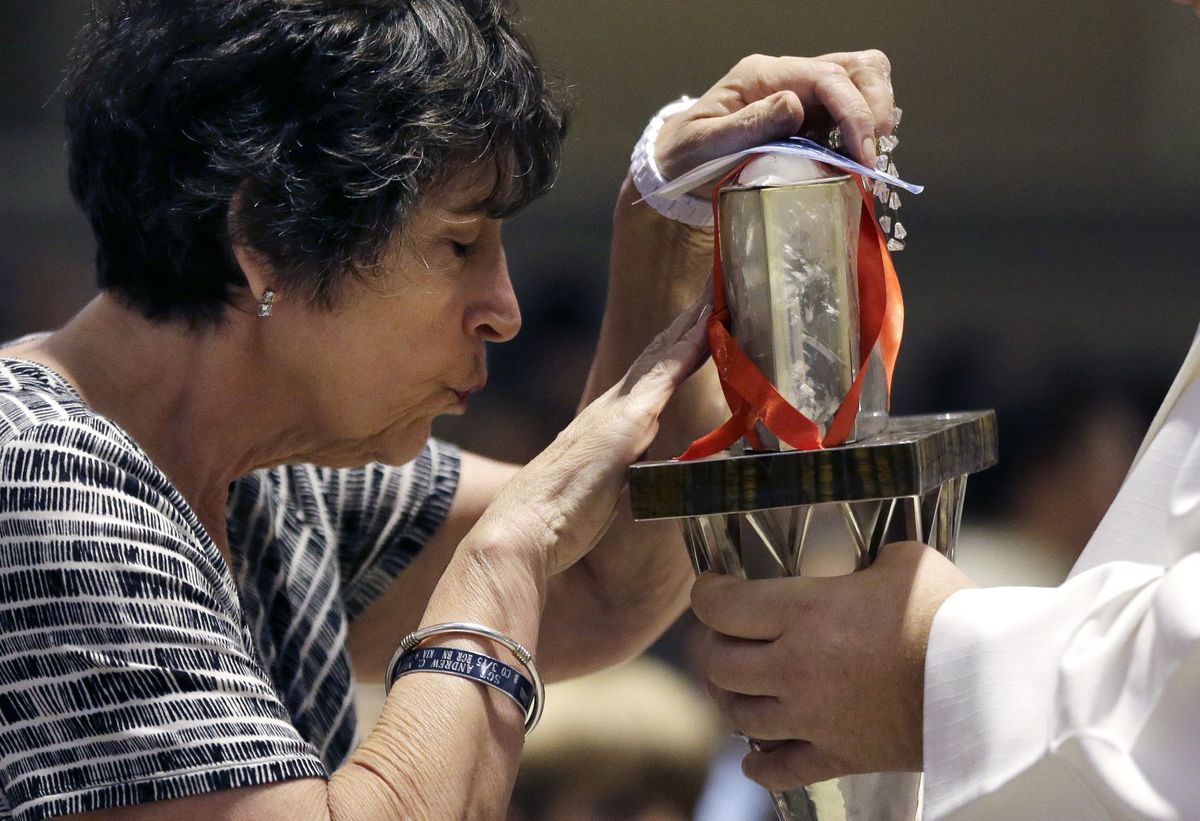
The Catholic church is proudly taking the excised heart of a dead monk on a grand tour of the US. Literally. They gouged the heart out of the corpse of Padre Pio and are exhibiting it across the country.

padrepioheart

Don’t worry. It may be incorruptible, but spectators won’t be touching it or even getting a good look at it because it is sealed for their protection within a plastic box. But, like gamma rays, apparently saint rays can pass freely through thin sheets of plastic.

Australia’s leading erotic poet disproves mathematics

Please, crackpots, I am not your sympathetic ear. Stop sending me stuff.

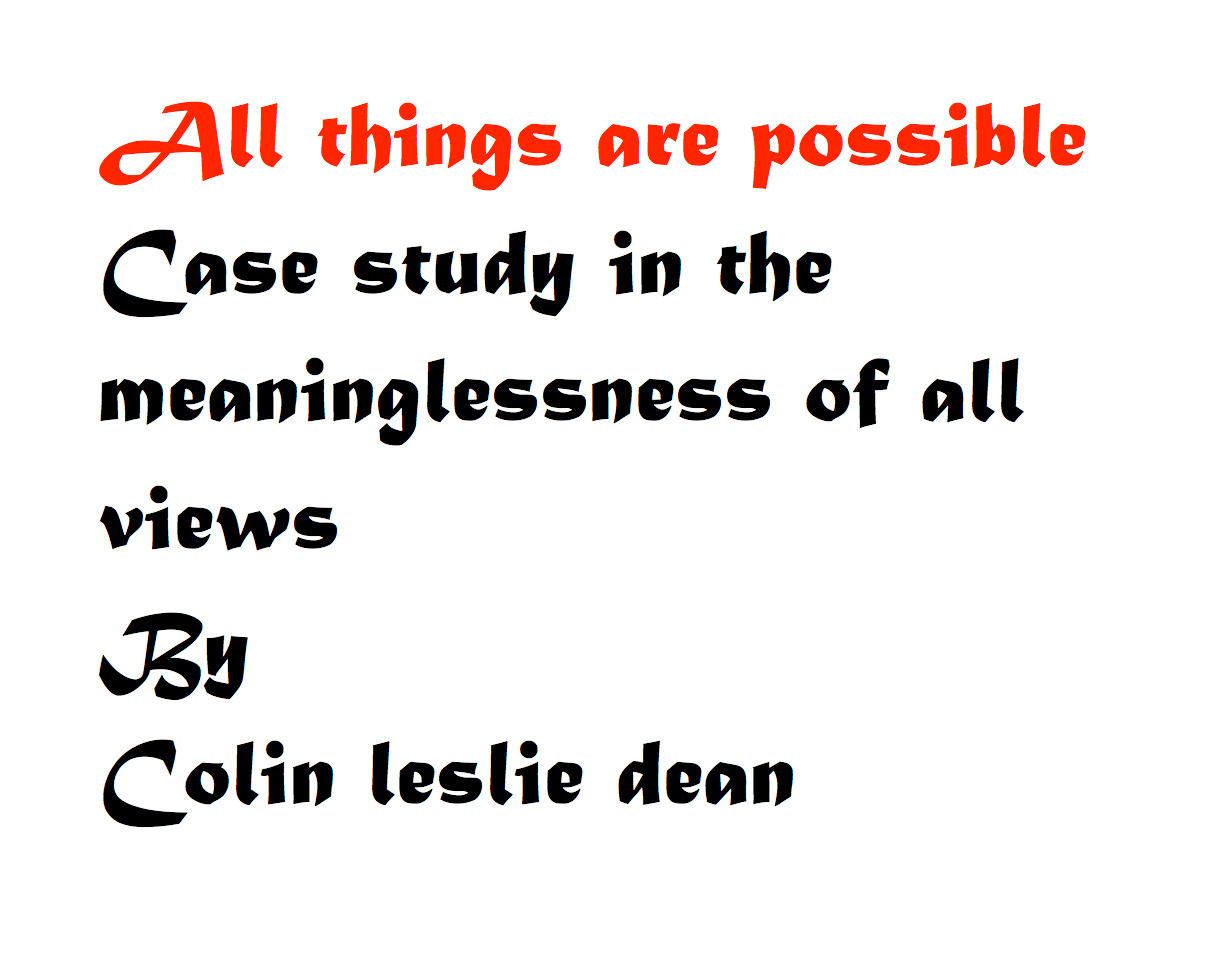
The latest entry in the pile of bogus crapola is a “book”, if you can say that of a 14 page long pdf file that uses a very large and ugly font — this is the tech equivalent of sending someone a long letter written in crayon. Here, you can read it for yourself: All things are possible: Case study in the meaninglessness of all views By Colin leslie dean. It has more impact in the original Gibberish.

allthingspossible

Professional typesetting sets the tone, doesn’t it?

But once you get past the eye hemorrhages from trying to read it, the content…is worse. For instance, he disproves mathematics.

Again
1+1=2
And its negation
1+1=1
It be said that 1+1=2 be a
certain truth
Blah
1 number + 1 number = 1
number
1 number (2) +1 number (2)
=1 number (4)
So 1 +1=2
And
1 + 1 = 1
Thus a contradiction in
mathematics

I love the “blah” in the middle.

Another bonus in his book: he claims to be Australia’s leading erotic poet. I don’t believe it. I looked at one of his erotic books, and sheep aren’t mentioned even once. (Oh, that was mean of me, and I’m sure you Australians are tired of that joke.)

Yeah, you can read it for yourself. 100 Views of Mons Venus by Hiroshige Basho by c dean. I find myself hoplessly confused by just the title. I’ve heard of Utagawa Hiroshige, the ukiyo-e artist, and I’ve heard of Matsuo Basho, the poet, but not the chimera, Hioshige Basho. And who wrote the book? Hiroshige Basho or Dean? But hey, maybe you’ve got a thing about very short poems that combine “lips” and “petals” with lots of adjectives, and will enjoy the work.

Michael Egnor is business as usual for creationism

ignorant

The other day, I wrote about how New Atheists are the same as the Old Atheists, and in particular, how all kinds of atheists are responding to the failure of all religion to answer basic questions about our existence. I could argue that religion is a font of bad ethics, bad philosophy, bad charity, etc., but because I’m a science guy I wrote about how badly it addresses questions of our origin and nature, and how the major premises of all religions are false.

This has roused the indignant jellyfish of the Discovery Institute, Michael Egnor, who has declared that atheism is a catastrophe for science. The most remarkable thing about his complaint is that I asked a number of questions about key premises of faith, like about the existence of a deity, an afterlife, and why we should believe your particular dogma over another, and he doesn’t answer any of them. He doesn’t even try. This isn’t even an argument.

I ask, “Why should I believe one religion over another?”

He harumphs back, Because Christianity is obviously true.

I could ask, “How do you know?”

Because it just is.

This is not a productive direction the discussion could take, but it’s what I expect from a Discovery Institute flunky. The details are not much different from my broad outline. So I bring up this basic question in my post:

Why should I believe in any god? We don’t need an intelligent authority to explain the universe…

His answer:

Of course we need an intelligent authority to explain the universe. The universe is shot through with intelligibility. Nature is governed by astonishingly complex and elegant physical laws, and the laws themselves are written in the language of abstract mathematics. In fact, theoretical physicists must often explore utterly new mathematical theories in order to explain the behavior of inanimate matter.

That’s not an answer. Nothing in that addresses the issue, and when he continues on to babble about the religious beliefs of scientists, claiming that many of them have believed in gods, he is mistaking personal quirks that are irrelevant to question for the facts that support his contention. I could argue that many scientists have been good musicians, but it would not imply that therefore my theory that the universe began with a note on a violin is true; an even more universal truth, that all scientists have possessed nostrils, is not support for my theory that the Big Bang was actually the Big Sneeze. And doesn’t Sandwalk’s list of atheist scientists immediately refute the idea that religiosity is a precondition for good science?

Egnor is simply making a fallacious assertion, and is begging the question. I will reply with a quote from Percy Shelley, published in 1814, which the Intelligent Design creationists will ignore, as they’ve been doing for two centuries.

Design must be proved before a designer can be inferred. The matter in controversy is the existence of design in the Universe, and it is not permitted to assume the contested premises and thence infer the matter in dispute. Insidiously to employ the words contrivance, design, and adaptation before these circumstances are made apparent in the Universe, thence justly inferring a contriver, is a popular sophism against which it behoves us to be watchful.

11?

Uri Geller is using his psychic powers to make an amazing prediction.

To all my dear friends,
Whether you like him or dislike him I have got news for you!
Donald Trump will become the 45th president of United States of America!

What is the basis for this prediction?

11 is a very powerful mystical number.
Barack Obama : 11 letters
George W. Bush: 11 letters
Bill Clinton: 11 letters
Jimmy Carter: 11 letters
John Kennedy: 11 letters
Donald Trump…. 11 letters!!

Barack Hussein Obama: 18 letters
George Walker Bush: 17 letters
William Jefferson Clinton: 23 letters
James Earl Carter: 15 letters
John Fitzgerald Kennedy: 21 letters
Donald John Trump: 15 letters

I think he was rigging the numbers to fit.

If you’re not convinced on the importance of 11, please see this page on my website: http://www.urigeller.com/are-your-eyes-attracted-to-11-11/
More significant people with eleven letters in their name:

Sorry, I didn’t bother.

Jesus Christ
Antony Blair
Nostradamus
Pope Francis
Colin Powell

“Jesus Christ” wasn’t his name. “Christ” was a title.

He had to leave a letter out of Tony Blair’s first name to make it fit! Besides, it’s Anthony Charles Lynton Blair.

That’s the latinized version. His name was Michel de Nostredame.

His first name is not “Pope”.

Again, Colin Luther Powell. He seems to have some funny rules for what names he’ll use.

There are so many other historically significant people, places and events that also include 11, or 11.11, read the article, it will blow your mind!
Please let me know your thoughts, and if you are unhappy – or happy at the thought of Donald Trump becoming President, please let me know why, it interests me to hear your perspective.
By the way, do you know of any other people or important events or places that are not on my page about 11.11, please comment to let me know.
Don’t forget to share!

I’ve shared. You’re an idiot, Uri.