Virginia Heffernan makes an interesting admission about the book publicist John Brockman and his salon for famous science popularizers, Edge. This was well-known group among certain people. Yeah, certain people. It wasn’t very inclusive.
Brockman, my former agent for tech writing, told me Edge was an intellectual salon. Edge.org is indeed intriguingly sprawling, jammed with scholarly idols whose bios have “Booker” and “Nobel” in them. Members of Edge participated in conferences and symposia, and promoted each other’s work. Who was I to say no? Among Edge’s prodigious ranks were Ian McEwan, Yuval Noah Harari, Steve Wozniak, Richard Dawkins, Nassim Nicholas Taleb and Daniel Kahneman.
But if I’d read the member list more closely, I might have hesitated. Edge was overwhelmingly male, for one. It was said to be an intellectual salon, but in the club photos were tech bro billionaires, including Edge members Elon Musk, Bill Gates and Larry Page. And too many members were men now largely renowned for misconduct, professional or personal: Marc D Hauser, Jonah Lehrer, Lawrence Krauss, and Marvin Minsky.
Once upon a time, I was edging into Edge. Brockman was also my former agent. I’d been introduced to Brockman by Dawkins and Adam Bly, I was on his mailing list, I was invited to contribute essays to his series of books. It didn’t last. Partly it was because I was getting weird vibes from the whole group, but also my criticisms of various precious ideas that were current among them, like soft-pedaling eugenics and demeaning women, got me abruptly and finally dropped from the mailing list.
There was also the matter of Jeffrey Epstein’s poisonous influence. I never met him, and pretty much knew nothing about him, it was only later that I discovered what a factor he was in the New York science publishing scene, and was a significant factor in founding Seed, which I wrote for.
I flashed back to the Edge crew’s relentless criticism of the humanities in the 1990s. In The Diversity Myth, Thiel and Sacks bitterly complained about “diversity” as jargon that concealed a nefarious political agenda. Well, now we have metaheuristical eugenics, and the jargon’s on the other foot.
With the Epstein files, we’re confronted with exactly what all the Edge men – from Pinker to Dawkins to Musk to Gates – did with the intellectual territory they seized. With their Ivy League posts, their billions, and their blue-ribbon DNA, the would-be intellectuals in Epstein’s circle converged on nothing less than the ideology of Mein Kampf. The Edge dinners have ceased and the site is now dormant, but generations of young men trained at Harvard, LSE and Oxford absorbed the lesson — and generations of young women learned that their place in intellectual history is sidelined, exploited, or prone.
I’d say I was lucky to have dodged that bullet, except that I was never a particularly good target for them. Although…those who were in the club, with exceptions, seem to have thrived. Has anyone paid the consequences for their association with Epstein? One of the most prominent ghouls who profited off their connections to Epstein, and Brockman, is Steve Pinker, whose unsavoury history gets exposed by Cathryn Townsend. Epstein was cultivating a group of scientists who shared his views on society, and Pinker was a prize catch.
Steven Pinker’s Panglossian worldview of inexorable progress, for example, is likely most appealing to those who have a vested interest in the hierarchical status quo.
There was a deeper ideology than that.
An exploration of Epstein’s connections suggests that eugenics and scientific racism played a role but that there was more to it than that. Investigations of Epstein’s relationships with academic scientists illustrate Epstein’s extraction of four gift types from them: 1) objectification of women, 2) legitimization of eugenics and scientific racism, 3) intellectual cosplay, and 4) cover for depraved and sometimes illegal behavior. The latter ranged from the reputation laundering service that was performed by all the academics who continued to associate with Epstein after his 2008 conviction for sex crimes, to conspiring to help Epstein avoid the legal repercussions of his crimes against children. Each academic in Epstein’s orbit likely offered a unique set of gifts to him but these four types seem to be recurring.
What the select group of academics got from the equation was money or expensive gifts, publicity, and the perceived glamour of being part of the Epstein class. Edge salons came with private flights, Michelin-starred meals, mink throws, and “beautiful young assistants”, after all. Who cared if it was, in Evgeny Marazov’s words “an odd intellectual club located on the dubious continuum between the seminar room and a sex-trafficking ring”?
Darn. I missed out on all those perks, probably because I didn’t provide gifts 1-4. Just think, I could have been at this party, if I’d played my cards right.
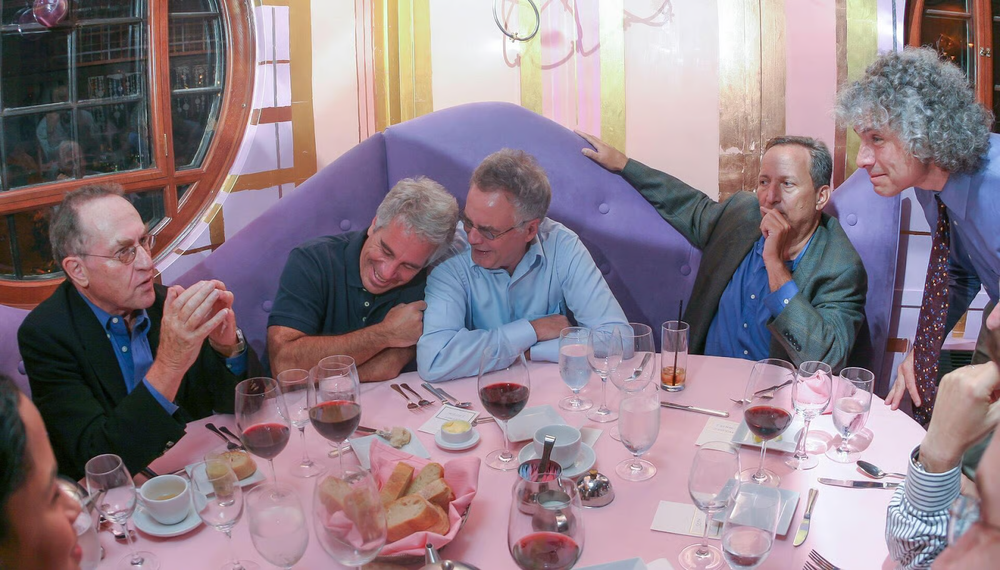
Now that’s disreputable group. The only one with a vestige of credibility remaining is Pinker, but the lies are starting to unravel even for him.
Harvard linguist Steven Pinker has claimed that he unknowingly contributed to Jeffrey Epstein’s legal defense back in 2007, when Epstein was fighting charges involving the sexual exploitation and trafficking of minors. His claim is contradicted by newly surfaced evidence from the cache of documents released by the U.S. Department of Justice.
An allegation that Pinker received $10,000 for a three-page letter appears in a 2008 memo titled “wrongdoing by attorneys in the Epstein criminal matter”. The memo was apparently authored by Darren Indyke, Epstein’s longstanding personal attorney. It states that “Alan had us give Steven Pinker $10,000 for a letter”. When questioned, Pinker has previously claimed that he was not paid for his expert opinion letter and that he didn’t know who he was providing the letter for. The “Alan” that the author refers to in the 2008 memo is Alan Dershowitz, a high-profile lawyer and former Harvard academic, who represented Epstein in his fight against charges related to the sexual exploitation and trafficking of minor girls.
I have written many recommendation letters over the course of my career, but I have never been paid a penny for any of them, let alone $10,000. If I were even offered $10K for a letter, I’d be instantly suspicious and the only thing I’d write is a damning letter reporting them to whoever they were trying to cultivate a relationship with. Pinker was lying. Pinker was unethical.
Pinker’s involvement in Epstein’s legal defense was first reported in 2019 by BuzzFeed. At the time, he told BuzzFeed that “I don’t recall [Dershowitz] telling me that the question pertained to the Epstein defense … I was not aware of the charges against Epstein at the time. And no, I was not paid for the letter—it’s something that Alan and I do regularly, as colleagues.”
Nothing he says is believable. He was just getting more devious in avoiding exposure.
Pinker claims that he couldn’t stand Epstein, never took funding from him, and tried to keep him at a distance, also describing him as a “kibitzer and a dilettante”. Perhaps, but for all that, he was willing to rub shoulders with him and accept gifts from him, for example traveling on Epstein’s private plane in 2002. Most of Pinker’s meetings with Epstein were through the Epstein-funded boy’s club known as the Edge. After Epstein’s conviction for sexually abusing a 14-year-old, Pinker continued rubbing shoulders with him, but Epstein’s presence within the circle of elite academics was carefully hidden from publicity. In the Epstein files, Pinker’s name appears repeatedly in emails related to Edge events, emails which included Epstein in the list of recipients, or which were forwarded to him, and which often pertained to exclusive salons for the Edge inner circle.
And he was hanging out with the worst people on the planet — billionaires. Yuck.
Pinker was a featured speaker at an Edge salon, billed as a master class on the science of human nature, that was held at a boutique vineyard in St Helena, Napa, CA in July 2011. According to emails between Epstein and Edge director John Brockman the salon was planned to be ‘confidential’ and limited to 20-25 invited guests. Epstein forwarded the email invitation, including the list of recipients, to a redacted email address asking “will you be in la. then”. The list of recipients included Elon Musk, Bill Gates, and Mark Zuckerberg.
And not just billionaires — Pinker keeps willfully entangling himself with racists and racist organizations. Right, he just “accidentally” finds himself sharing a stage with Jared Taylor, just like he “accidentally” cashes $10,000 checks from Dershowitz and Epstein, and then forgets about them.
Pinker’s interest in legitimizing scientific racism doesn’t seem to have died along with Epstein. Recently, he has appeared on a podcast outlet that is infamous for promoting scientific racism and eugenics. The media outlet concerned has produced an interview with Jared Taylor, a white supremacist who was apparently banned from the Schengen Area of Europe, and a blog post arguing that in order to achieve economic growth in Africa, eugenics should be used to engineer more intelligent Africans. An undercover investigation by Hope Not Hate exposed the neo-Nazi connections of the outlet’s holding organization. In the Hope Not Hate investigation, one of the directors of the holding organization explained to the undercover investigator (who was posing as a potential donor) that well-known commentators like Noam Chomsky were being used as part of a deliberate ploy to attract “high-value” subscribers: “We’re using these people to get legitimacy by association,” similar to Epstein’s strategy. Incidentally, Chomsky is another academic Epstein managed to add to his trophy shelf. To be charitable to Chomsky, he did at least reject Epstein’s racist ideas.
Separately, at a recent festival of cringe that Epstein would have loved, Pinker delivered a speech tritely titled ‘A Positive Vision for Scholarship and Society’ alongside titles such as ‘Parasitic Ideas and Suicidal Empathy Are Killing the West’; ‘Is Islamophobia Real? Finding Empirical Answers to Questions We’re Not Supposed to Ask’; and the showstopping ‘Truth, What it is, How to Find it, Why it Still Matters’. Papers by authors who attended this conference are being prepared for a special issue in a social science journal that has recently had a new editorial leadership imposed by the publisher, Springer. It now includes Pinker on the editorial board alongside an editor from a conservative think tank that has previously sponsored research by The Bell Curve author Charles Murray.
That Edge gang was one fucking creepy gang of creeps. Don’t forget it, let’s not let these losers escape their well-earned reputation.
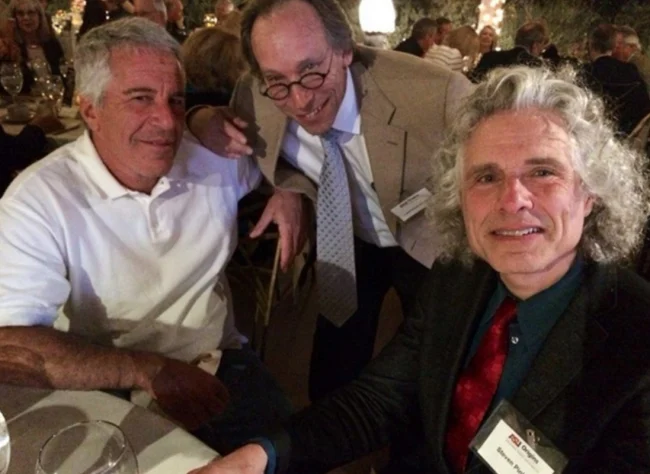
Epstein, Krauss, Pinker