
The goomba fallacy is when some people say A, and some people say B. And then you say, isn’t it ridiculous that people believe A and B at the same time? But it isn’t necessarily true that anyone believes both at the same time.
Never heard of the goomba fallacy? That’s because it’s new. It was coined in 2024. It’s widely circulated in certain parts of the internet, and if you’re not in those parts of the internet then good for you, you’re not missing much.
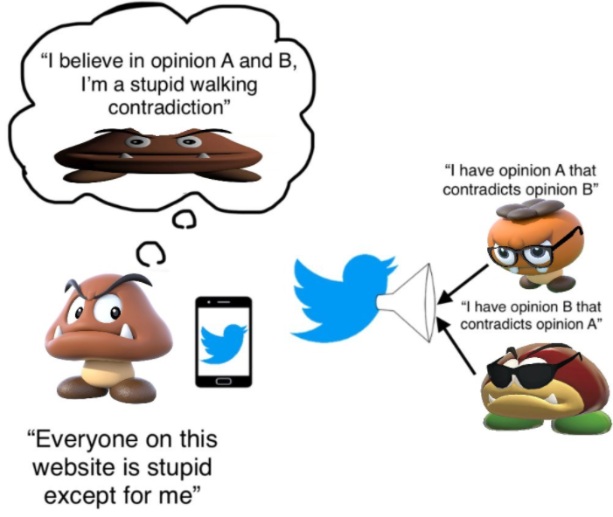
The goomba fallacy doesn’t have anything to do with goombas. It’s just that the meme image that popularized the fallacy contains goombas. Source

My instinct when learning about a fallacy has always been to pick it apart. What exactly makes the fallacy wrong? Are there contexts where the fallacy isn’t wrong? What is the goal when people commit the fallacy, or point out the fallacy? So here is my overanalysis of the goomba fallacy.
Surface analysis
The goomba fallacy is a special case of the composition fallacy. The composition fallacy is when you assume that what is true for individual parts is also true of the whole. If you look at individual people, you may find people who believe A, and who believe B. But these are properties of individuals and not properties of the crowd as a whole. Therefore you cannot assume that everyone in the crowd believes A and B simultaneously.
Under this analysis, the goomba fallacy is always straightforwardly wrong.
Next step back a little, and consider why people commit the goomba fallacy. The purpose of the fallacy is to accuse people of hypocrisy. It’s to show that people have beliefs that conflict with one another.
And when people point out the goomba fallacy, the purpose is to defend against the accusation of hypocrisy. There isn’t necessarily any hypocrisy occurring. Yes, there may be different beliefs that conflict with one another, but those beliefs are not necessarily held by the same individuals. So rather than talking about hypocrisy, what we’re seeing instead looks like ordinary disagreement between different people.
In defense of hypocrisy
Let me ask the question: Why is hypocrisy bad? Why is ordinary disagreement less bad?
Both hypocrisy and disagreement imply the existence of conflicting beliefs. If two beliefs conflict, at least one of them must be false. So if all we care about is the presence of false beliefs, then both hypocrisy and disagreement are equally problematic.
Think about it from this angle. “Individual people” are not in fact indivisible units. Individual people change over time, may be thought of as many distinct people from one moment to the next. Brains are material objects with spatially separated components. We think of individuals as cohesive wholes as a matter of practical reality, but we understand that not all parts of the individual are necessarily aligned, thus the sin of misalignment, i.e. hypocrisy.
But couldn’t we also apply the same reasoning to communities? We understand that communities are made of many component parts, yet we may conceive of them as cohesive wholes. Just as we speak of the sin of misalignment within the individual, we can reasonably speak about the sin of misalignment within a community. Why can’t people within the community talk to each other and get their story straight? Why is the community presenting a unified front while ignoring substantial disagreements within their own ranks?
Disanalogies
I drew an analogy between hypocrisy and disagreement, but the reader should remain unconvinced. There are some major disanalogies.
In particular, it is relatively easy to resolve a conflict between one’s own beliefs. It is much harder to resolve disagreements between distinct people.
Hypocrisy is the greater sin, because it suggests you’re not even trying! You could just stop believing one of the things, but for some reason you chose not to. Is this epistemological neglect? Or worse, you may be deliberately advancing contradictions with malicious intent.
On the other hand, if people disagree, that doesn’t reflect neglect, it reflects the fact that people do not have infinite resources to argue until they come to a consensus. It’s widely understood that communities, even communities with a shared political goal, are essentially alliances. Disagreements, even on important matters, must be accepted if you want to get things done.
Blurring the line
We’ve shown that disagreements within a community are often accepted as a matter of practicality. Are there any analogous situations for individuals?
One example comes from lawyers. Lawyers have a practice of “arguing in the alternative”–making multiple parallel arguments on behalf of their client, ignoring that some of those arguments conflict with one another. I think this contributes to the image of lawyers as dishonest, but it serves a practical purpose. The lawyer is professionally obligated to pursue all arguments that may help their client, and they only need the judge/jury to accept one of their arguments. It does not matter which argument gets accepted, and the lawyer’s own belief on the matter is irrelevant.
And then there’s the classic example of hypocrisy: Rules for thee, not for me. Technically this is logically consistent, but violates a common ethical principle: rules should apply fairly or not at all. This form of hypocrisy is clearly self-serving, and should be rejected.
Is there an analogous situation in the community context? Suppose some people in a community believe “rules for thee”, and other people in the community believe “not for me”. When it comes to enforcing the rules on other people, the community is insistent. But when it comes to applying rules on themselves, the community remains silent. Is this not a form of community hypocrisy? The community is being epistemologically negligent for a self-serving purpose.
Generally speaking, it’s worse for a single person to hold conflicting beliefs than it is for the conflicting beliefs to be spread across multiple people. People commit the goomba fallacy because it gives them the upper hand in an argument if they can show that their opponents are being hypocritical. But my intention has been the blur the line just a bit. Sometimes, hypocrisy does not require that contradictory beliefs are held within a single individual; hypocrisy may occur on a community level too.
Your premises are problematic.
I think otherwise.
Hypocrisy is the act of pretending to hold beliefs, virtues, or feelings that one does not actually possess and engaging in behaviors that contradict one’s own stated standards.
That is, pretend beliefs, not false beliefs.
There’s a distinction there: performative claims vs. cognitive commitments.
@John Morales,
You could say the same of communities though.
I do think there is a distinction between pretend beliefs and false beliefs, but it’s a distinction I don’t emphasize, because you can pretty much run the same arguments either way. Sometimes hypocrisy is sincerely held (but self-servingly wrong) beliefs, sometimes hypocrisy is insincerely claimed (and self-servingly wrong) beliefs. Either way, it’s an error of alignment. Either way, we commonly think it’s worse when the conflict is held within a single person rather than a community. Either way, there are some circumstances that a community is guilty of the same.
occasionally i’ve expressed distaste for hypocrisy. imagine two hypothetical nazis, one a hypocrite and one not. neither is better or worse than the other, but i still respect the hypocrite less. just a distaste for people who either have such poor reasoning they can’t notice their internal contradictions, or worse, people who lack the courage of their convictions. either way, how justified am i? not very.
communities glossing over their disagreements excessively also sits uncomfortably with me. maybe that’s because i’m a leftist and we’re drawn to counterproductive standards of purity, where right wingers have, in modern times, formed an extremely capacious big tent – for now. on a personal level, i’ve been in the room with muslims and christians having a nicey nice interfaith conversation which was not inclusive of atheists, of course.
it is funny to argue the discontinuities within an individual can be regarded as equivalent to those between separate people. i’m reminded of “system” identity and its discourse. or that disney movie about the personality parts, whatever that was called. i don’t know if you remember this about me but i do have serious misgivings about the idea of the self, so this should please me. does it? man i’m tired tonight.
i’ve seen arguing in the alternative happen but never heard the phrase for it. i hope i remember that; it’s interesting. and the post as a whole, thanks.
–
Sure. Thanks for the clarification, and for introducing me to the term.
(Also, there is doublethink. Everything is complicated)
@Bebe Melange,
My initial motivation for thinking about this is my own skepticism of the self. It’s fascinating to me that a logical fallacy should in some way appear to rely on the notion of the coherent self. What if we lived in an alternate universe, where we had an exotic psychology that lacked a notion of the self? Logic is logic, it shouldn’t become valid or invalid based on the specifics of human psychology!
Still, the goomba fallacy is compelling and I don’t think it’s wrong. Why is that? That question was my starting point.
I am not on those parts of the internet, but I was wondering if people might also be claiming there is hypocrisy when there may actually be a matter of context. So maybe my comment here contributes to the conversation or maybe I am totally off the mark. But here is my attempt at a contribution:
I am a soccer referee and so my example comes from trying to enforce the rules (which are called “laws” in soccer, but I’ll use “rules” for this comment). We have a rule that “kicking or attempting to kick an opponent” is a foul that results in a direct free kick. But have you ever seen 9-year-old children play soccer? Players of average skill will tend to bunch up and kick wildly at the ball. Since they lack good coordination, they will often miss the ball and kick an opponent. So do I as a referee blow my whistle and call that foul every time an opponent is kicked? No, I do not. That is because I may not want to be stopping the game every time an opponent gets kicked as I may then be making many such calls in a game and games like that are not fun for children. Oh, I should probably note referees are directed, more so for children’s soccer, to make games “safe, fun, and fair.” That’s not in the rule book, nor is the guidance national governing bodies typically give out to avoid calling “trifling” fouls. So referees are not supposed to be calling every instance of a player “kicking or kicking at an opponent” as a foul. We’re supposed to be considering the context as well. Primarily, how forceful was the kick? “Where was the opponent kicked?” should also be a consideration. Were they kicked in the side or back of the leg (or even above the leg?!?) where they do not have a shin guard to provide protection?
The whole point here is I may have a “rule,” but I am not strictly enforcing the rule. I may allow minor offenses slide, but I will do my best to catch the egregious ones and call those out. That could look like hypocrisy and I definitely have games where kids think I am inconsistently applying the rules. I had one such game on Monday (and it is almost always the losing team that thinks the rules are being applied inconsistently). I’m not trying to; it’s more an issue that there is subjectivity in my decision making as to whether or not a rule violation actually needs to be enforced or not.
@Leo Buzalsky,
Here’s an example of the goomba fallacy that I see on gaming subreddits. “People complain the game is too hard, but also complain that there needs to be more of a challenge. Can’t they make up their mind?”
Usually these are just two distinct groups of players. But there’s also room to say it’s context dependent! Someone could believe the game needs to be harder while also believing certain challenges are unfun.
Insurance is based on the difference between individuals and groups. If an individual suffers a major loss, they are diminished. End of story. If someone in an insured group suffers a major loss, the insurance company absorbs the loss and reallocates it over the whole group, and the insurance company and the whole group both continue on as before.
The goomba fallacy is different from other fallacies in that it’s not trying to actually argue for a specific opinion, but just to point out “people in [whatever group] are ridiculous and illogical because they believe opinion A and also opinion B.” I think most of the time, if people in [whatever group] hear someone making this claim, they would think “where are you getting this idea? I don’t hold opinion A *and* opinion B” or “yeah I hold opinion A and I too am annoyed by people in my group who hold opinion B.”
Also hypocrisy is usually not just “someone had beliefs A and B which contradict each other because they are just illogical” but more like, there’s a secret background reason that’s their actual motivation/belief, rather than whatever they’re saying. Sometimes it can be good to discover what the background reason is because that gives insight into the whole overall ideology.