Review: I Want to Be a Wall

I write a bunch of book reviews, and review-ish writings on my Pillowfort.  Maybe I should port some of these over?  I picked out a review I wrote in 2024, and applied light editing.  If readers engage with it, then I might do it more often.


I Want to Be a Wall, by Honami Shirono

Yuriko is an aro ace fujoshi.*  Gakurouta is a gay man in love with his straight childhood best friend.  They just got married.  Bam! Premise established in 2 pages.  What follows is a dramedy where they deal with Japanese-style amatonormativity.  They think they’re fake-married because they’re not in love with each other.  But the manga wishes to show that the marriage is real despite their own belief otherwise.  They really are close partners who love and support each other, bringing each other happiness–just not in the specific way demanded by society.

*”Fujoshi” is the Japanese term for fans of boys love (BL) manga, especially female fans.
[Read more…]

Annoyances with AI Wars

I’ve been spending some time on Reddit, mostly following stuff about puzzle video games and game dev. I also see stuff from a couple subreddits that argue about AI art, namely r/aiwars and r/defendingaiart. I have found these subreddits just barely tolerable that I haven’t blocked them (yet). But they contain a lot of viewpoints that annoy me, so I’m going to talk about them.

Sorry, I’m not going to cite examples, because the purpose isn’t to litigate these particular subreddits. I know the typical reader doesn’t really care about them, and indeed should not care about them. This is just my way to discuss a scattering of AI-related issues that I think people commonly get wrong.

[Read more…]

Red vs blue button

The internet has been talking about this red vs blue button problem. Since I’ve been talking about game theory lately, why not talk about this one too? You know, as a treat?

Here’s the problem. Everyone in the world is presented with a choice between a red button and a blue button. If the majority of people press the blue button, then everyone lives. If the majority of people press the red button, then only people who pressed red live, while all the people who pressed the blue button die. Which do you press?

As always, I find it funny that these questions posit life or death stakes. What if instead of dying, people were just mildly inconvenienced? Like, if they were forced to do nothing for five minutes, would that change how we approach the problem? I guess if it were framed that way, then it would be obvious that it’s not worth arguing about for more than five minutes. But anyways…

[Read more…]

Link Roundup: May 2026

Sawatsky: Sexual pain in Christian Women | The Asexual Agenda – Okay, so this is for my journal club, and I wrote up the discussion notes.  But I have a few things more to say here.  The paper is exploring possible causes for the high prevalence of sexual pain among Christian women (primarily Evangelicals).  But the authors of the paper are evangelicals, and they frame it like religious belief is generally great for sexual outcomes.  To them, sexual pain is this one mysterious exception where religious women are doing worse.  Color me skeptical.

I recalled that a long time ago, there was a study that circulated among atheist blogs, seemingly claiming the opposite, that people who leave religion have better sex lives.  The study was called “Sex and Secularism” by Darrel Ray in 2011, and it was based on a survey that recruited a lot of participants through Pharyngula.  You can find news articles talking about it, but the article itself is totally gone. I’m skeptical of that study too, and the ephemeral circumstances of its publication certainly don’t help.

The thing is, “better sex life” is a normative judgment, and perhaps it’s not very surprising that any given value system results in better sex lives, as measured by researchers who share that value system.  Obviously my values would overlap more with Darrel Ray’s than with the evangelical authors.  But I’m also ace, which tends to come with its own sexual values.  Like whenever “better sexual outcomes” means higher frequency of sex, I’m just going to roll my eyes.  But sexual pain, that’s uncontroversially a bad thing, even when ace people have it.

Why was I invited to Beast Studios | Folding Ideas (video, 1:30 hours) – MrBeast is the most subscribed youtube channel of all time, valued at $5 billion dollars.  But they’re losing money, viewers, and their film production is at once lavishly expensive, yet made of paperclips and glue.  Dan makes few attacks on Mr. Beast’s character, yet exposes the organizational rot at the heart of his media empire.  They prioritize viewing metrics above all else, and seem uninterested in hiring any real expertise.

[Read more…]

The Goomba Fallacy

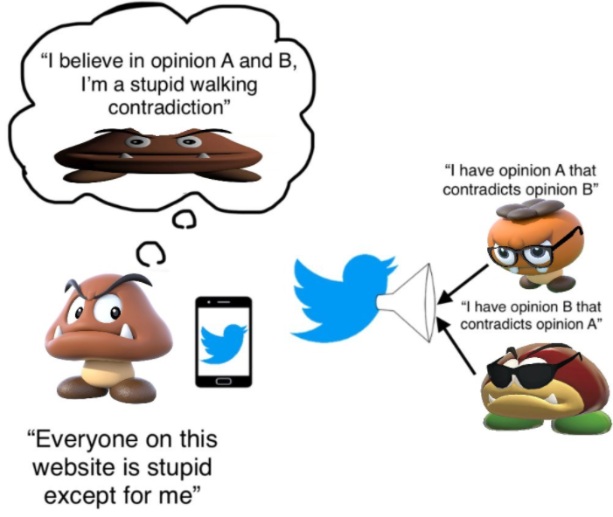
The goomba fallacy is when some people say A, and some people say B. And then you say, isn’t it ridiculous that people believe A and B at the same time? But it isn’t necessarily true that anyone believes both at the same time.

Never heard of the goomba fallacy? That’s because it’s new. It was coined in 2024. It’s widely circulated in certain parts of the internet, and if you’re not in those parts of the internet then good for you, you’re not missing much.

goomba fallacy original image

The goomba fallacy doesn’t have anything to do with goombas. It’s just that the meme image that popularized the fallacy contains goombas. Source

My instinct when learning about a fallacy has always been to pick it apart. What exactly makes the fallacy wrong? Are there contexts where the fallacy isn’t wrong? What is the goal when people commit the fallacy, or point out the fallacy? So here is my overanalysis of the goomba fallacy.

[Read more…]

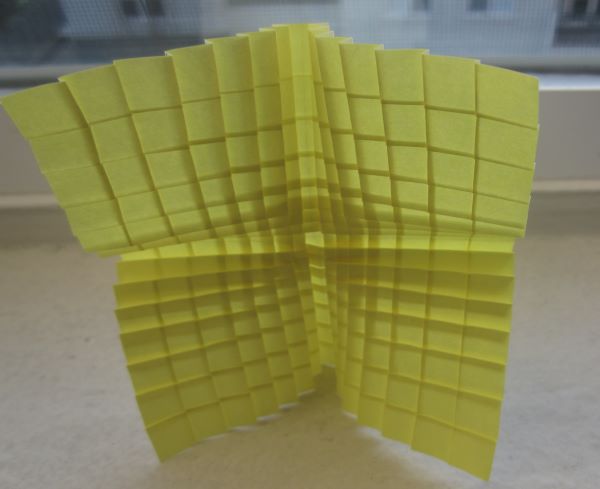
Origami: Polyrhythmic flower

Polyrhythmic flower

Polyrhythmic flower, designed by me

This is a pleat-based design, similar to other designs I’ve posted before.  They’re fairly simple to fold on the spot and improvise.  This probably took me like 20 minutes to fold, but I like the idea.

So what’s the idea behind this one?  I fold the paper into 16 divisions… and also 15 divisions.  So the outermost pleat is 1/16 – 1/15 = 1/240.  The next pleat is 2/16 – 2/15 = 2/240, and so on.  So the pleats are very small towards the edge of the paper, and very large towards the center.  Ever since I demonstrated this idea to myself, I’ve been wondering how I can apply it to make more complex designs.

How do I fold 15 divisions, you ask?  I have some diagrams here, but I’ve been thinking for a while I ought to make some clearer diagrams.