Origami: Sferica

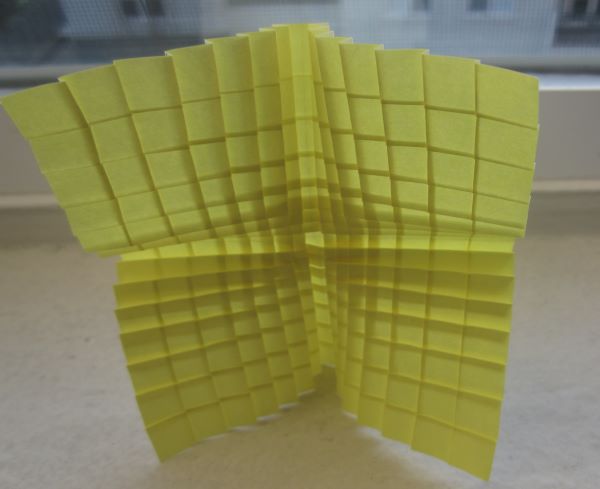
Sferica

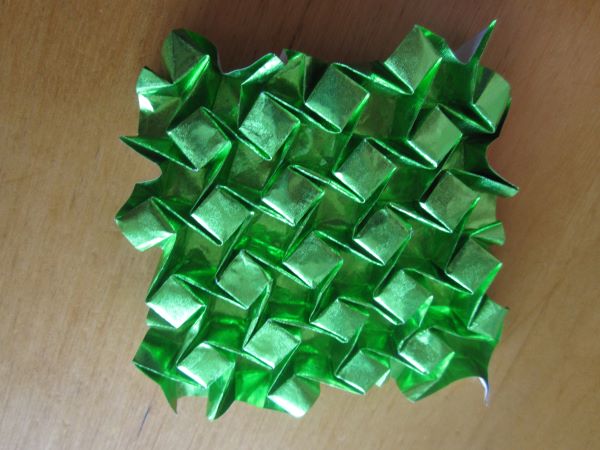
Sferica, designed by Riccardo Colletto

I’m out travelling, but I brought some origami paper to fold.  I got this model from the 5th Geometric Origami Convention, and folded it on the train.  It’s essentially a variant of the herringbone tessellation, but slightly shifted so that it makes a shape like a sea urchin.

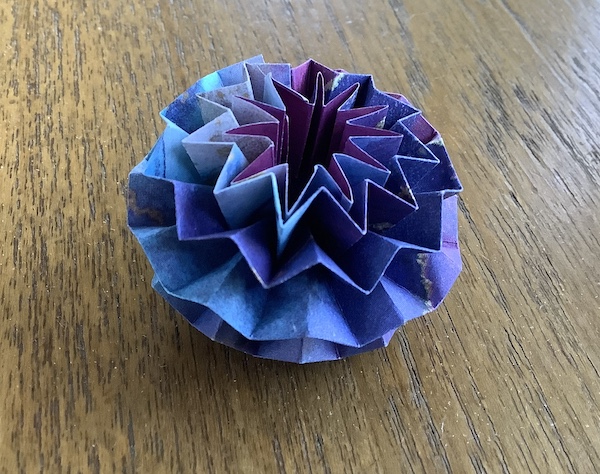
Origami: Polyrhythmic flower

Polyrhythmic flower

Polyrhythmic flower, designed by me

This is a pleat-based design, similar to other designs I’ve posted before.  They’re fairly simple to fold on the spot and improvise.  This probably took me like 20 minutes to fold, but I like the idea.

So what’s the idea behind this one?  I fold the paper into 16 divisions… and also 15 divisions.  So the outermost pleat is 1/16 – 1/15 = 1/240.  The next pleat is 2/16 – 2/15 = 2/240, and so on.  So the pleats are very small towards the edge of the paper, and very large towards the center.  Ever since I demonstrated this idea to myself, I’ve been wondering how I can apply it to make more complex designs.

How do I fold 15 divisions, you ask?  I have some diagrams here, but I’ve been thinking for a while I ought to make some clearer diagrams.

Origami: Drawer box

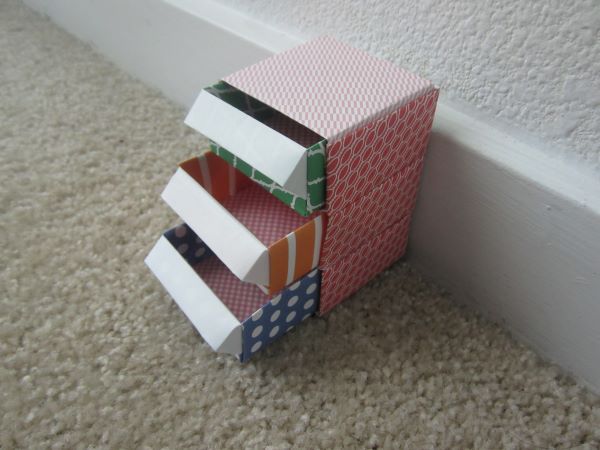
Drawer box

Drawer Box, designed by Akiko Yamanashi

I got this drawer box from something called the Practical Origami Convention.  I didn’t actually attend the convention, but happened to access the models later, and picked this one out to fold.  I have to imagine that there are a bunch of origamists making “practical” designs like tiny chairs to sit on, and tiny tables to hold tiny flowers.  (I’m joking, I know that practical origami has a lot of emphasis on boxes and envelopes.)

I can’t remember how many sheets this needed, but it was over 10.  Each drawer is a separate sheet, with another sheet to be used as lining.  The cabinet box (I had to look up what this part of the drawer is called) is made of 4 pieces, or maybe more?

Now obviously there’s a lot of origami that stretches what you would think is possible with a single sheet.  But other designs are more sheet-maximalist, with multiple distinct units working together.  There’s some complexity in that; you need to make the sizes match, accounting for the thickness of the paper, and some units need to be firmly attached to each other.

Origami: Horses

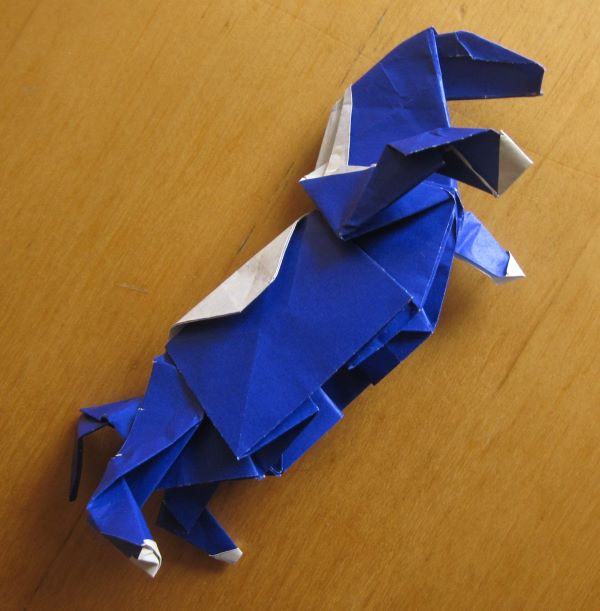
Persian Horse

Persian Horse, designed by Peter Engel

Here’s a horse I folded at a conference many years ago.  It’s meant to stand on its hind legs, although you’d really need to attach it to a stand.

[Read more…]

Origami: Practical Bookmark

Practical Bookmark

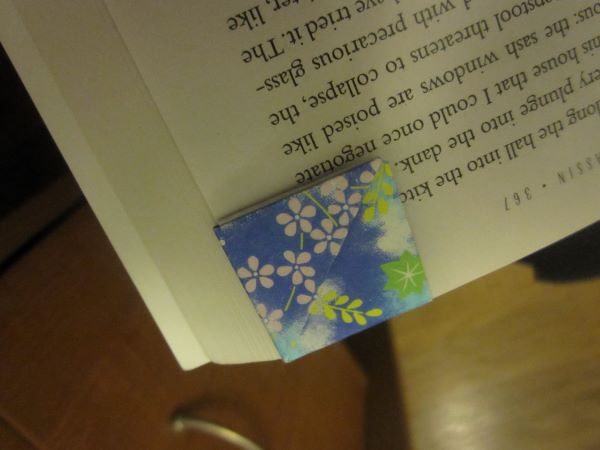
Practical Bookmark, designed by me

Here’s a really old design of mine, back in 2013.  I wanted a simple origami bookmark–no frills, just mark my page please.  Some origami bookmarks stick out of the book, and that’s obviously not practical if I’m throwing the book in my bag or something.

[Read more…]

Origami: Free pleating

Free pleating

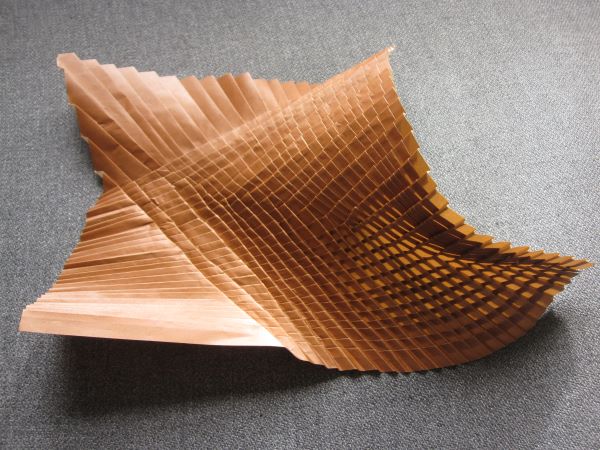
A free pleating model, made in a workshop with Goran Konjevod

I made this a couple months ago in an origami workshop with Goran Konjevod.  The subject of the workshop was how to pleat paper without pre-creasing.  It’s an improvisational technique where you don’t worry about making folds equally spaced or parallel.  You just approximate, and watch how it distorts the paper.  And since you’re approximating, you can do stuff like making the lines slightly non-parallel.

My style generally involves more careful planning and precreasing, but I like this technique too!  I imagine if you do it enough, you gain some ability to predict how it will turn out.

Origami: early works

Early origami models

From top to bottom, left to right:
1. Dimpled Model with Curls by Meenakshi Mukerji.
2. Sonobe Cube, by Mitsunobu Sonobe.
3. Cube with Windows, by Bennett Arnstein, simplified from Lewis Simon’s Decoration Box.
4. Equilateral Triangle Edge Module, by Lewis Simon and Bennett Arnstein, modified by me to make a square pyramid.
5. Same as #4, making a tetrahedron.
6. Simple Chain-of-4-Equilateral-Triangles From a Square, by Lewis Simon.

I mentioned that I messed up my photo organization, so I was trying to figure out what I hadn’t posted already.  I think I’ve posted a few of these, but let’s just knock them all out from my list.  These are the very first models I folded when I started doing modular origami in 2012.

Most of these are from Beginner’s Book of Modular Origami Polyhedra: The Platonic Solids by Rona Gurkewitz and Bennett Arnstein, and I do recommend that for beginners.  The Dimpled Model with Curls is from Meenakshi Mukerji’s Exquisite Modular Origami.

[Read more…]