
Some plants are taking off and looking promising.

© Charly, all rights reserved. Click for full size.
Alfalfa is almost knee-high, and even the bald patches have some plants here and there. The yellow peas (on the far end of the photo) also look healthy, albeit they still have not started to bloom.

© Charly, all rights reserved. Click for full size.
The first patch of green peas is full of pods now, and they are beginning to swell. I hope to get several kg of canned/frozen green peas from this. And I still have three 0,25 kg packets of green peas to sow during the summer if something else fails and I have spare space. Which I shall have because…

© Charly, all rights reserved. Click for full size.
The soy beans failed spectacularly. There might be a soybean plant somewhere in this picture, but I cannot find it. I can find several plants in the field, but they are very small and sickly. The reasons are several.
- The seeds themselves had only about a 60% germination rate when tested separately. And even some of those that sprouted looked weird; the roots had no proper tip for burrowing into the soil and curled in on themselves like a pig’s tail.
- Some seeds sprouted, grew several cm long, and suddenly the whole seedling emerged above the ground, lay flat, and died due to exposure. I am completely dumbfounded by this; I have never seen anything like that, ever.
- Many seedlings were damaged by slugs, because their emergence from the ground coincided with cold and wet weather.
- This bout of cold weather was really cold, below 10°C at night in June, which is weird and not really good for the garden.
There are some soybean plants here and there, but overall, I will be lucky if I get a handful of unripe soybeans at the end of the year. Great disappointment. If I get some viable ripe seeds, I will be really surprised. Lesson learned – I might be able to grow a few soybean plants if I pre-grow them in pots as seedlings and put them outdoors when they are tall-ish. Or to grow them in the greenhouse. But my location does not allow for large-ish scale growing.

© Charly, all rights reserved. Click for full size.
The white and brown bush beans do not look much better; the seeds mostly rotted away (0% germination when tested separately indoors!), but at least enough emerged so it does look like I might get enough plants to get my own quality seeds for subsequent years. To sow them directly into the soil for large-ish-scale growing, I will probably have to do so in the first week of June at the earliest. Thus, I need to find some variants with a short vegetation period, and that might take some time. On that front, we get to the title of today’s post.
I mentioned to my nephew the poor germination rate of bean seeds these last two years, and he told me about a webshop with a money-back guarantee for seeds that do not germinate. They also purposely sell variants that allow saving one’s own seeds for the future, heirloom varieties, and genetically diverse mixes that allow for one’s own selective breeding. The seeds are expensive, but I bought 48 seeds of an old bush bean variety that should have a short vegetation span. I planted them in pots to get them started quicker in the greenhouse, and I hope to have some plants to grow outside once the cold spell subsides and the summer begins in earnest.

© Charly, all rights reserved. Click for full size.
And to plant them, I had to make a new vegetable patch. Luckily enough, I was making hot compost again, and it burned this ca 3×3 square in my lawn. The burned parts were really easy to till with a garden fork, because the composting not only killed all the grass, it completely dissolved its roots. The hardest work was around the edges, where there was still live, tough grass. I wish I could make huge compost heaps to kill grass on large areas.
However, 3×3 m is a small patch for my garden, but it is a bit much for a handful of beans. But I did not buy only beans; I also bought several other seeds for the next year, and I am especially excited about these:

© Charly, all rights reserved. Click for full size.
I wanted to try this crop for years; I knew it existed, but I did not know the exact name of the variety, so I could not find seeds. And coincidentally, this supplier had them, and they were not prohibitively expensive. So I bought 300 seeds, and I sowed 60 of them today to test them.
It is the variety “Painted Mountain,” and it should be exactly what I need at my elevation – hardy and with short vegetation. Ideally, it should have been sown last month, but it still might fully ripen if the fall is frost-free until the middle of October. Which is not a guarantee, but it might happen. And whilst it will not be as sweet as a modern sweet corn variety, it still should be perfectly edible and tasty for an early harvest. In any case, I soaked the seeds in water overnight to expedite germination by a few days.
So now I have a 3×3 square sown with corn, and around the edges I will plant the bush beans. A two-sister patch, if you like.
I already have another corn variety sown in the garden, as does my neighbor, so there might be some cross-pollination, but probably not much, and it should not affect the quality for an early harvest (and I won’t need to save my own seeds this year). And for next year, I have already discussed the issue with my neighbors, and we will both grow only this variety.
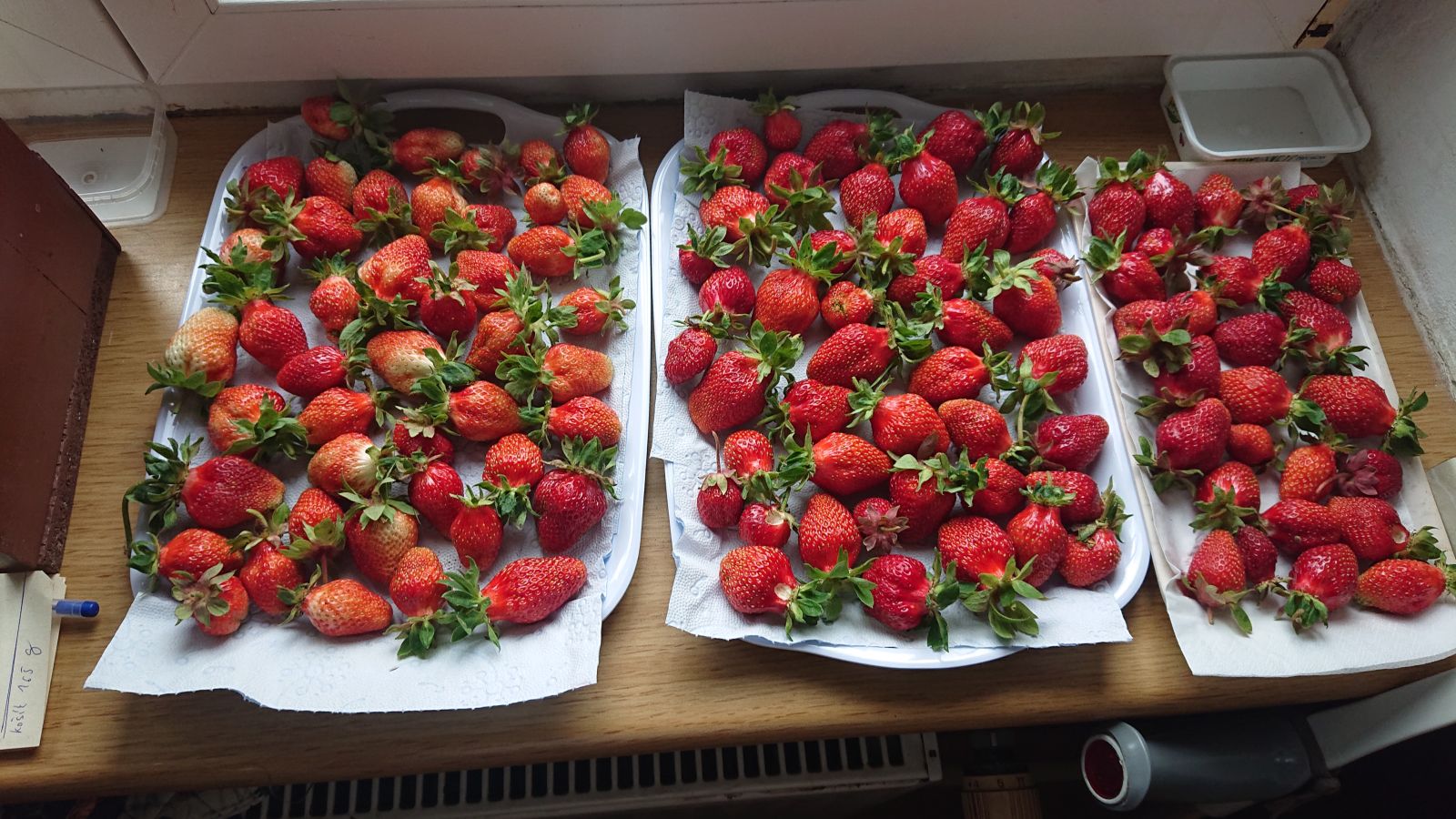
And to finish today, I harvested the first significant amount of strawberries this year, 1850 g. There were nearly no slugs on them, which surprised me, though I am definitely not complaining. If the weather gets warm and sunny now, I might look forward to a substantial harvest this year. I hope I get one; we already ate all the marmalade and dehydrated strawberries from two years ago, and we need to refresh our stock.
Oh those strawberries do look good! I hope they go on cropping fruitfully.
The alfalfa and the peas look promising as you say, but various beans are honestly rather pathetic :-( I hope you get better results from the new supplier, it is definitely worth shopping around when you come across problems like such appalling germination rates.
I’m really sad about the soybeans. I had wished you better luck.
I don’t think you should try to transplant beans, I tried it once and they all just laid down and died.
They didn’t even try.
@chigau, I was pre-growing beans in old yoghurt cups for years, bush beans as well as pole beans and runner beans. I had a 100% survival rate so far (except when they froze a few days later due to wacky weather). Imagine my surprise when, this year, I read on the internet that it is not advisable to attempt it; you are not the only one saying this.
I do not know whether I was lucky, or whether I am doing something right that others do wrong, but I really never had an issue with transplanting beans. I will write about what and how I do it when the time comes, even if the beans do not survive this time.
I hope you get an a-maize-ing harvest. They look so colourful! Also great yummy strawberries!
The whole bean situation is sad to see, good luck with the next set of seeds. I also transplanted beans in the past with no problems.
I’ve not come across the no transplanting advice for beans and we’ve not had problems doing it either. We do try to put them in deeper pots because the roots get going quickly, but it’s been standard practice in the UK for decades, to give the beans an early enough start to make it to fruiting.
Hello. Looks like the recent comments to Never-Ending Thread are not visible in “Recent comments”. Not that there’s much anything to see there.