The Greater Gardening of 2026 – Part 18 – Potato Potential

Things are growing. Some well, some badly.

© Charly, all rights reserved. Click for full size.

The indeterminate potatoes “Agrie” look promising. They are now tall enough to be hilled up, which I will do this weekend.

© Charly, all rights reserved. Click for full size.

The same goes for “Dali”, although those might need a few more days to reach sufficient height. These two varieties look really promising, they even were not damaged by late frost.

© Charly, all rights reserved. Click for full size.

The very early variety “Bellarosa” was damaged by late frost, despite being covered with white cloth. But the damage was not very severe and it appears that the plants are recovering now.

© Charly, all rights reserved. Click for full size.

The early variety “Camel” is a headscratcher. They still did not all emerge from the ground, and those that did are still tiny. Some were also probably destroyed by voles who had nests under the PVC mats. But that only explains the empty spots, not the stunted plants. Maybe they will take off later.

© Charly, all rights reserved. Click for full size.

The garlic “Dukát” looks promising, albeit the leaves are a bit yellow near the tips, so I added nitrogen today (very dilute KNO3 solution). Mulch from old leaves works very well at suppressing weeds.

Onions and carrots, on the other hand, look downright pitiful. The seedsnails for the onions did not work well – using the landscaping cloth was a mistake, plastic wrap would work better. On top of that, they really suffered in the cold May weather.

For some reason, the trick with egg trays did not work for the carrots either; only about a third emerged from the ground. I think I made a mistake and buried them too deeply. I tried to sow some seeds directly into the soil now, it should still result in reasonably sized carrots, if they manage to survive the heat

© Charly, all rights reserved. Click for full size.

Spinach from seeds sown directly into the ground failed again; spinach from seedlings fared a bit better, though still nothing to write home about. It just seems I do not have the soil or climate, or both, for it. I will harvest it this weekend, and I will plant summer squash in its stead. That was the plan all along, only I was hoping to harvest more Spinach than I realistically will.

The Greater Gardening of 2026 – Part 17 – Towering Trellises

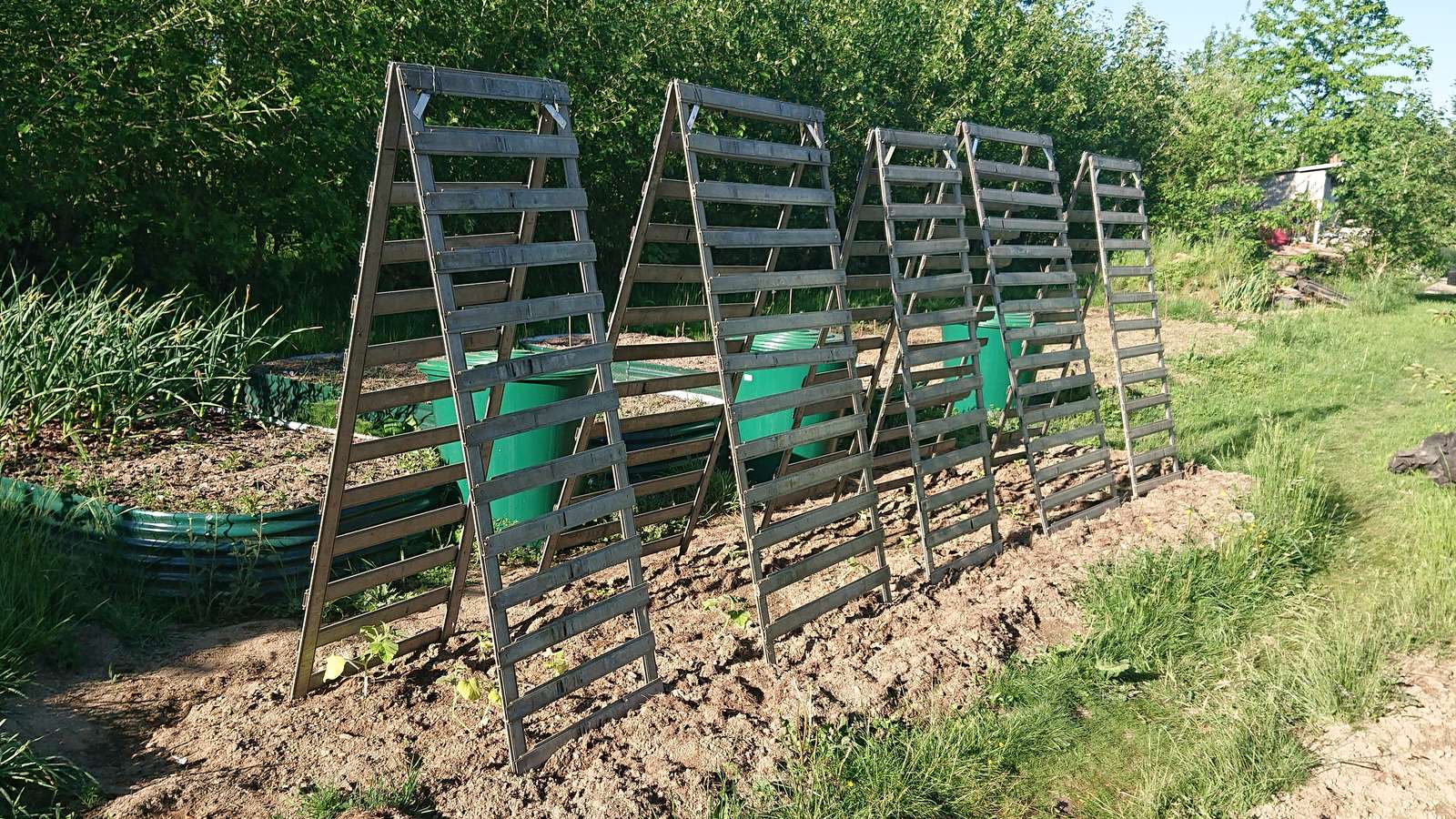
I concentrated on increasing my ability to grow things vertically in several ways this year. I already mentioned some in passing, but let’s write specifically about just that.

© Charly, all rights reserved. Click for full size.

I completely reworked the supports for runner beans near the south wall of my house. Instead of running the clothesline in a zig-zag fashion between the rain gutter and the poles at the bottom, I run it in such a way that each pole has only one clothesline running to it from a wire support on the gutter. The wire supports also serve a secondary role of strengthening the gutter laterally (it got bent out of shape by heavy ice and snow). I also increased the number of plants that can be planted there, so hopefully, I will get bigger harvests and a better coverage of the wall against the hot summer sun.

© Charly, all rights reserved. Click for full size.

I repaired more of the old aluminium fencing that my father used to keep poultry in check. I used it last year as a trellis for butternut squash, and I am trying to do the same this year. Growing butternut squash vertically allows for denser planting of the plants and thus better use of space.

© Charly, all rights reserved. Click for full size.

Unfortunately, all my butternut and hokkaido plants are rather pathetic. I was away from home for three days, and I did not want to burden my nephew with having to drag them indoors every evening, so I left them in the greenhouse. And as bad luck would have it, it was exactly those three days when the weather was so cold that even in the greenhouse the temperatures fell below 10°C. As a result, all my winter squash plants are yellowish and sickly looking. But I got them outdoors a month earlier than last year, and most of them are starting to grow healthy green leaves again, so they might not be lost yet.

© Charly, all rights reserved. Click for full size.

I also had several aluminium frames approximately 180×90 cm in size. I repaired them, and to convert them into portable trellises for beans, tomatoes, and pumpkins, I covered them with PVC-coated welded wire fencing mesh.

© Charly, all rights reserved. Click for full size.

I made 12 of these portable trellises, and I hope they last me for years. This year, I intend to use them mainly for an improvised shelter and support for tomatoes, because I have more tomato plants than fit into my greenhouse, and I do not want to throw them all simply away.

© Charly, all rights reserved. Click for full size.

To finish the post, have a look at some very nice Aquilegia blossoms.

The Greater Gardening of 2026 – Part 16 – Bad Beans

I am not a happy camper right now. Of all the soy beans that I have sown, none emerged. I dug up a part of one row, and I found a few badly damaged and dead seeds; the rest has completely rotted away already. Either the seed batch was bad, or the weather was too cold. I am inclined to suspect the latter, because we had abnormally odd weather – it was sunny, dry, and very cold until about three days ago, when it suddenly became very hot. We had a change in temperatures 12°C within a week.

© Charly, all rights reserved. Click for full size.

I removed the rubber and PVC mats that I put on my lawn in order to kill it. They fulfilled that role perfectly, and although it was very compacted clay, with the roots being dead and partly decomposed, it was comparatively easy to till it with a garden fork and flatten it with an electric hoe. Whilst doing so, I dug out two vole nests, with stashed-away potatoes and grass. I was expecting the voles – they would do the same thing under thick snow cover, only it would be more difficult to see in living grass.

© Charly, all rights reserved. Click for full size.

I sown it with white bush beans. And I put aside five beans to check the germination rate. Two sprouted, three rotted away. I am really pissed. I hope that at least enough of them sprout out of the ground and ripen in order for me to get my own seeds for the future. I do not know what it is with leguminous seeds these last two years. If you remember, I had the same problem last year with pole beans. Speaking of which…

© Charly, all rights reserved. Click for full size.

Last year, I had barely enough white runner beans to put aside fifty seeds for sowing. Luckily enough, they had 100% germination rate.

© Charly, all rights reserved. Click for full size.

I changed the trelis behind the house to 26 poles spaced circa 40 cm. To each, I planted two plants. There is a 27th place too (not in the picture). That is occupied with a frost-hardy seedless grape that I bought this year. I was worried that it died, but it started to grow this week and looks healthy (albeit tiny).

© Charly, all rights reserved. Click for full size.

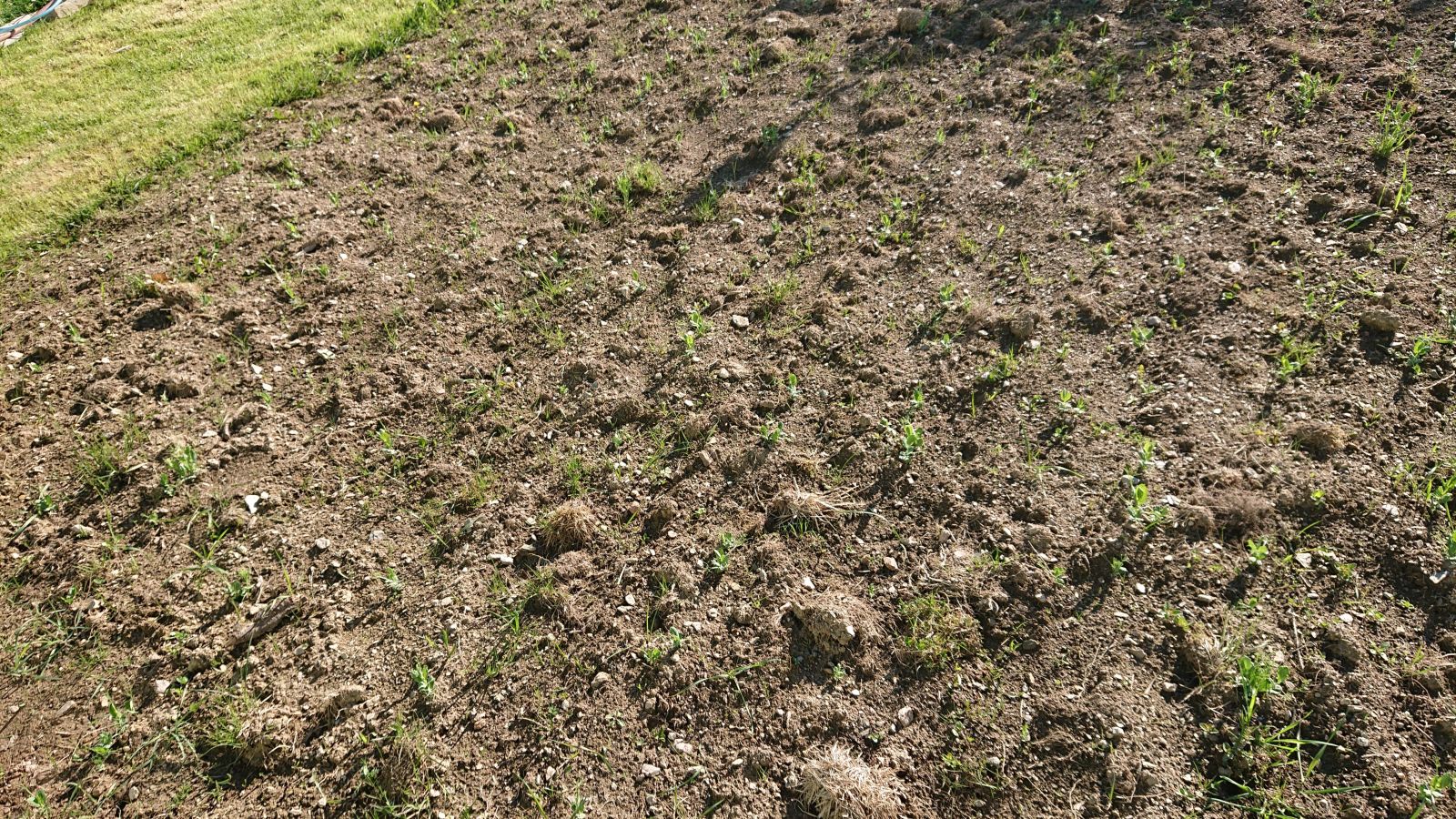
The green peas on the large leguminous patch are growing well, and they had a nearly 100% germination rate, too. Today, they even started to bloom.

© Charly, all rights reserved. Click for full size.

Alfalfa is still tiny, and for some reason, it is spotty – there are areas where it did not germinate at all, and there are areas where a lot of the seeds germinated.

© Charly, all rights reserved. Click for full size.

Yellow peas should be the most advanced by this time, yet due to the abnormally cold weather, they barely emerged from the ground, and the germination rate is also nothing to write home about. At least the germination rate was hopefully good enough for the crop to improve the soil, even if not to harvest enough peas for food.  I do wonder what the hell is going on with legumes.

I ordered some more white bush beans and a new batch of soybeans. Unfortunately, the soybeans very probably won’t manage to ripen when I sow them this late, but I will try it anyway. Maybe I will get lucky, and frost does not come before late October – it can happen.

© Charly, all rights reserved. Click for full size.

The oats look promising so far. It is lush, dark green, and almost knee-high. I do hope this continues.

© Charly, all rights reserved. Click for full size.

The bamboo survived the replanting in December. Most of the stalks above ground died off, but there are new shoots emerging from the ground, and they are pencil-thick. That is a good sign that I might finally get some bamboo growth – the soil is now not compacted, and I added a significant amount of eggshells to elevate the pH a bit.

© Charly, all rights reserved. Click for full size.

I did a lot more other work too, but this post is long already, so I will finish with a picture of my new compost thermometer. I decided to buy one, because I almost forgot and lost my digital thermometer in the pile, not to mention that it was too short and hard to read. I spent two days mowing 2 thirds of my garden. I mixed the grass with old brown grass and leaves at approximately a 1:1 ratio, and the next day, the pile was almost hot enough to cook an egg. I still have not found the time to mow the last third of my garden, and in the meantime, the first two-thirds are getting covered with new growth already. There is enough time in the day to manage all the work that needs to be done, but alas, there is not enough strength in Charly. Currently, I am doing my best to keep on top of the work without injuring myself or getting completely exhausted.


Of Boomers and dogs

Before you “not all men” me: of course, not all boomers…

A small tricolour dog is trying to steal a colourful sheet from the couch

©Giliell, all rights reserved
Putting fresh sheets on the couch actually requires zero dogs….

Boomers largely grew up with dogs. They were something you just had, much the same way you had kids and they were treated much alike: they were supposed to be quiet, well behaved and functioning, and the means to achieve that was violence. Becoming adults, many of them stopped having dogs but not children, but the children were still raised much the same. Maybe the belt was replaced by the bare hand, but violence was still very much the preferred method of “teaching” kids. Gen X and Millenials mostly put a stop to this, making grandparents catch up with the 21st century or cutting them off and protecting their children.

While not every popular trend in current child rearing is actually good, today’s parents are much more consciously thinking about how they want to raise their children. Many read books or go to parenting classes. While they may not always achieve it, they do want to raise their children without violence and trauma. And actually, much the same is happening with dog training. We don’t just expect dogs to function. We see them as creatures with both needs and also somelevel of understanding. We actively learn how to interpret their body language correctly. A wagging tail does not mean a happy dog. A wagging tail means an excited dog, but not whether he’s positively excited or actually upset. (With Socks you can tell a genuinly happy wag by the fact that he’ll also wag his entire butt. Which is extremely cute.)

If the boomers didn’t choose to keep dogs, there was no such pressure on them to catch up with the time. Or as my dad said: “We didn’t have doggy school back then and we didn’t need it. You kids these days.” Enter my father in law, who is like the poster boy for a certain kind of old white man. Not the virulently capital letters Racist or Misogynist, just the ordinary type. A guy who got through life by simply ignoring things he didn’t like, who got his family to not contradict him or have fights with him by being loud. A guy who never had his beliefs challenged. Back to the topic: a guy who thinks he knows how to handle dogs, even though he hasn’t kept dogs in 60 years.

Socks is still learning many things and one of them is to tolerate people in “his” space. He’s a rescue who has finally found his safe place, a rescue who, like almost all rescues, has an issue with big loud men, and a kokoni, who was bred over two millenia to protect the home. This means that when people enter our home who have not been added to his expanding list of trustworthy humans, he is often insecure. That means barking and keeping his distance, but it also means giving warning signs. Growling, showing teeth, snapping at the air. Which my father in law all takes to mean “please keep getting closer, especially reaching over me with your big hands and try to touch me, preferrably on my head”. And no matter what you say, he’ll keep doing it. The father in law, not the dog. The dog is much more teachable. This is the way biting happens, but of course it’s the dog who gets blamed then.

Self-Sustainability Tangent – Part 18 – Medicine

In our hypothetical scenario, despite the carbohydrate-heavy diet, caloric excess and a lack of exercise would not be things that happen, ever.  But a healthy lifestyle does not guarantee health. And it is not possible to be self-sustainable with regard to medicine. With that being stated, medicinal herbs do exist, and they do work. And since I am writing this series from my point of view, I would like to mention three that I consider essential and extremely helpful. For all three, I did look up studies on PubMed in the past, and although there are not a lot of them, to my amateur eye, it looks like they are proven to work to some extent. I am including quickly found links today, too, although I need to stress that I am not a physician and this article is not meant as medical advice.

So what health problems could arise that need to be addressed frequently-ish, but do not necessarily need professional medical attention?

First thing would be minor scratches, cuts, splinters, and suchlike. I have a lot of scratches and cuts on my hands and legs. Most heal without me even noticing them, but a lot of the work involves soil, and thus some get inflamed (which is why I am up to date on my tetanus shot). And for minor inflammations, there is nothing like hot chamomile tea, IMO (-click-). In my experience, soaking an inflamed area in chamomile tea as hot as is bearable cuts the healing time by several days, and reduces the pain to almost nothing within minutes. I also occasionally get sniffles bad enough that my stomach gets upset. In that case, drinking a chamomile tea also helps to clean the tubes and restore lost appetite.

The second thing happening probably on a regular basis would be a sore throat, sniffles, and suchlike, from exertion in cold weather. Most would resolve without a problem, some could become a mild strep infection or viral infection if the conjunction of pathogen presence and bad weather is just right (bad). And some of those can become bad enough to need antibiotics, which only a medical doctor can prescribe. I know I have a bad case of sore throat coming when I get a craving for elderberry tea, made from black elderberry juice (Sambucus nigra). I absolutely loathe the taste of elderberry juice, hot or cold, but when I get sick, I get a craving for it that I never get for anything else. It helps (-click-), sometimes to the point that I do not need to go to the doctor after all. However, once I heal, I go back to hating elderberries again. I haven’t drunk elderberry tea for over two years now, but I do keep a stock in my cellar just in case.

And the third often appearing problem would be bruises, sprained ligaments, slightly banged-up-but-not-yet-broken bones, as well as stress fractures, and, of course, back pain. In this regard, comfrey root is your friend (-click-). I am either using store-bought creams or an alcohol-based infusion that I made a few years ago, and I apply them directly to the affected area.

All these could be easily grown in our self-sustainability scenario. An elderberry bush could be part of the fruit shrubbery. Cammomile, once introduced, would probably thrive quite well as a weed that would need more to be managed than harvested. And comfrey could be grown anywhere near the compost heap, in half-shade and with plenty of water. In addition to the medicinal use of its roots, comfrey leaves are also a great nitrogen source for composts.

The Greater Gardening of 2026 – Part 15 – Sowing Soybeans

I did other work too since the last post, but today I have sown the soybeans. Which, as you might remember, is the first time I am trying out this crop at all. Theoretically, I am a tiny bit too far north and a tiny bit too high up for it to prosper here, so there is a huge question mark over this endeavor. I tried to read up on it, and allegedly, tiny seedlings should be frost-resistant for a while. The current weather projection for the last frost of the spring is 8 May, so sowing it today should not be too early. It is the variety “Liska” that, according to the interwebs, grows in Canada. We shall see- even if the seeds do not completely ripen and dry on the stalk, I should still get unripe but edible green seeds similar to green peas.

© Charly, all rights reserved. Click for full size.

First, I had to use a string and a hoe to mark the rows on the plot where potatoes were grown last year. I got eight rows, a nice number. Whilst doing that, I collected nearly a full bucket of stones.

© Charly, all rights reserved. Click for full size.

The stone hoard behind my shed keeps growing. Shame it is worthless and, mostly, useless.  I do not think I will need this much gravel anytime soon. I have done all the concrete and paving works that needed to be done. Now, I just keep pouring buckets of stones on the growing pile.

© Charly, all rights reserved. Click for full size.

After I was done sowing, I watered it thoroughly with water from my sewage cleaning facility. The weather is way too dry this year so far, and I am hoarding rainwater like Scrooge McDuck coins.

© Charly, all rights reserved. Click for full size.

Since I expanded my growing operations significantly (by at least a factor of three over two years ago), it is no longer possible for me to water everything with watering cans. I had to use a pump and a hose last year already, but I had to stand there like a scarecrow for the whole time. Which was boring and also a huge waste of time.

So this year, I bought a cheap adjustable lawn sprinkler. To be able to water taller crops too, and slightly increase its scope, I rigged it on a ca 1 m tall pole that I can stick in the ground. In 20 minutes, it covers an area of circa 4×4 m with an equivalent of 10 mm rainfall and can be moved to the next piece of land. It is a significant labor saving, albeit at the cost of some electricity. At least I can put it in place, set a timer on my phone, and go do something else while it is doing its thing, thus using my time more efficiently.

Tomorrow I will sow some leftover peas and soybeans, and I will plant gladiolus bulbs. After that, I will be done with sowing and planting until the last frost day, after which I will do the rest.