
The internet has been talking about this red vs blue button problem. Since I’ve been talking about game theory lately, why not talk about this one too? You know, as a treat?
Here’s the problem. Everyone in the world is presented with a choice between a red button and a blue button. If the majority of people press the blue button, then everyone lives. If the majority of people press the red button, then only people who pressed red live, while all the people who pressed the blue button die. Which do you press?
As always, I find it funny that these questions posit life or death stakes. What if instead of dying, people were just mildly inconvenienced? Like, if they were forced to do nothing for five minutes, would that change how we approach the problem? I guess if it were framed that way, then it would be obvious that it’s not worth arguing about for more than five minutes. But anyways…
As a prisoner’s dilemma
I’m going to compare to a few other games commonly discussed in game theory. The first is the Prisoner’s Dilemma. The red button is defecting in a prisoner’s dilemma, because it leads to a selfishly beneficial outcome (you guarantee your own survival). But when most people defect, it leads to a worse overall outcome (some people die).
But it’s not purely a prisoner’s dilemma. If we’re above 50% red, then picking red doesn’t just lead to the most selfishly beneficial outcome (you survive), it also leads to the best overall outcome (one fewer death). And if everyone picks red, that’s just as good as everyone picking blue. The outcome follows this curve:
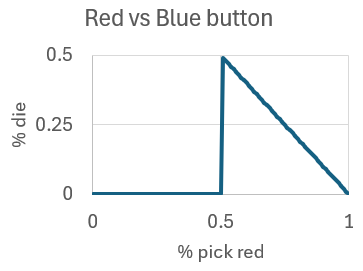
X axis: Percentage of people that pick the red button. Y axis: Percentage of people that die.
But if you squint at the curve, then yes the red button does have overall worse outcomes. We can formalize “squinting” by introducing some noise into the outcome. (In game theory terminology, we introduce a “trembling hand”.) Noise could come from many places. For instance, there might be some people who just randomly push buttons. The noise could also be epistemological in nature–however many people you think will pick red, your prediction will be somewhat off from reality. The effect of noise is to smear the curve, like so:
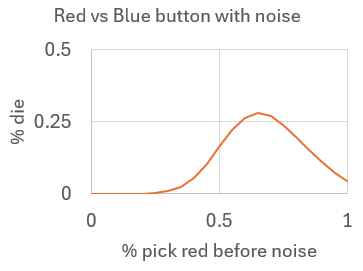
X axis: Percentage of people that pick the red button before adding noise. The noise is a random error in the final percentage that pick red. Y axis: Percentage of people who die, averaged over the probability distribution of the noise.
Once we have a smeared curve, it becomes clear that trying to make everyone pick red is overall worse than trying to make everyone pick blue. It’s because you just can’t control or predict what everyone will do.
As a coordination game
Suppose we play a game where we each pick a side of the road–either the left, or right. If we both pick the same side, then we safely drive past each other, hooray. If we pick opposite sides then we crash. Which side do you choose? It’s not much of a deep ethical question, because obviously the answer is to choose whatever everyone else is choosing.
So when I look at the outcome curve for the red/blue button, the most important aspect of the curve is that bump in the middle. That bump represents a lot of deaths. More than anything, you want to avoid that bump, which means getting everyone on the same side. So, just like when you choose which side of the road to drive, the correct answer is to choose the same thing as everyone else.
That’s right. Hot take! People who say red button are wrong. People who say blue button are wrong. The answer is neither. Just pick whatever everyone else is picking. Unless you have influence over a lot of other people, you should just take other people’s choices as a immutable fact, and work around it.
On the other hand, if we have time to prepare and communicate with each other, here’s a different strategy. Create a single authoritative poll, and tell everyone to commit to whatever the poll says most people will do. And then in the poll, vote blue.
The presence or absence of communication can make a difference in coordination games. Consider the following problem. There are a hundred quarters on a table, and one penny. We each silently pick a coin, and if we both pick the same coin then we win that coin. Without communication, we have little chance of landing on the same quarter. So the correct strategy is to pick the penny, because that’s easier to coordinate even though the payoff is much smaller than a quarter. On the other hand, if we could communicate, then the correct strategy is to arbitrarily agree on one of the quarters.
So, an open question. Could it be the case that if we can communicate, the correct choice is blue, but if we can’t communicate, then the correct choice is red?
As a battle of the sexes
The battle of the sexes is a special kind of coordination game. In the battle of the sexes, a married couple can’t decide where to go out for the night. One of them wants to go to the wrestling match. His husband wants to go to the opera. Both of them want their own way, but above all they prefer to go together.
A good strategy in the battle of the sexes is to somehow convince the other player that you are committed to your own choice, much more committed than they are to their own choice. For example, buy some non-refundable tickets to the wrestling match. But suppose that commitment isn’t possible–all tickets are fully refundable.
So the strategy is to act like you are irrationally committed to your choice. Declare that you will go to the wrestling match with or without your husband, even though in reality you would hate to go alone. But you could just be pretending to be irrational, and your husband knows it is in your interest to pretend. So you got to pretend even harder, and your husband has to ignore your pretense even harder. On and on in an ever-increasing arms race. Basically it’s an unhealthy marriage, and you should just divorce your game theorist husband already.
The red vs blue button problem is basically a battle of the sexes. Some people have a philosophical preference for red, and some have a philosophical preference for blue. Each group prefers their own answer, but above all they need to reach a consensus. What’s the correct strategy? I suppose you should make a big deal about how irrationally committed you are to your own answer. And the rest of us should ignore you because we all know it’s in your interest to pretend. Then you should pretend harder, and we should ignore you harder, in an ever-increasing arms race.
In other words, game theory says the correct strategy is to argue loudly and meaninglessly on the internet. I think most people don’t know that much about game theory, but in this one case they’re nailing it!
Well done! I think you cracked it.
Answering your open question, by adding a bit to it.
Most people presented with this problem don’t assume that the participants are rational, honest characters. They assume they’re people, and on that basis assume that a disappointingly high percentage of them are either venal, disgusting narcissists or knuckle-dragging borderline morons you couldn’t train to operate an elastic band. The world presents with them with evidence such as the US presidential election result, and it’s pointless arguing with it. We can communicate – but we live in a world where that communication proves that other participants are not to be trusted.
My favourite formulation of the red button/blue button problem reformats it as a trolley problem.
You’re walking along, and you come upon a set of trolley tracks and some rope. Blue rope, if you like. A sign nearby presents you with two options:
Option 1: tie yourself to the tracks. If you tie yourself to the tracks, but nobody else does, the trolley comes, and you die. But… if ENOUGH people who come along ALSO tie themselves to the tracks, the row of people tied to the tracks will be visible from far enough away that the driver will see you all, and stop. Great!
Option 2: keep walking. The footpath is red, if you like.
Put like that, the blue option sounds insane. As does the idea of pressing the blue button. I’ve yet to see an argument that can persuade me that pressing the blue button is NOT completely insane.
If you press the blue button, you don’t care if you die, but you do care if other people die. Whereas if you press the red button, you want to live yourself but don’t care if or not other people die.
Those two positions are not equivalent. I already live in a world where there are people who want to kill me. I would not enjoy living in a world populated only by red button pressers.
I can’t help thinking all these “thought experiments” are just an effort to persuade people to push the red button and see the killing of a bunch of strangers as a necessary cost.
@sonofrojbalke,
Well you don’t need to trust people 100%! Only 50%.
I still think that the best option is to not push either button, and convince people to not push either button. That would add a third dimension to the curve, I guess. And I suspect that game theorists would frown at that complication.
#NeitherButton
Put like that, sure it sounds insane.
So let’s put it another way:
You are in a tunnel along with everyone else. Everyone will slowly but certainly eventually be pushed to another tunnel, with a train, and a track. You can get on the train, with guaranteed safety, or get on the track (not tied down). If most people get on the track, nothing happens. If most people get on the train, it will start moving inexorably forward, faster and faster, with spinning blades below and above and to the sides (so no-one can hide), mowing down the people on the track.
You can color the track blue and the murdertrain red, if you wish.
You might say that it just makes sense to get on the train, if safety is guaranteed to everyone on it, but maybe there’s some people who are claustrophobic, or otherwise who don’t like being cooped up, or people who mistakenly think they can follow the tracks far enough to get away from the train (the tunnel goes in a big loop, so that can’t work) , or just don’t like the idea of starting the murdertrain when they see that there are already people on the track. You see the people on the track when you get to choose. Which way do you go? Are you sure you want to help start the murdertrain?
The original red button- blue button question as posed by Tim Urban states that everyone has to take a private vote by pressing a red or a blue button, the outcomes of either choice are well explained above – there is no mention of the luxury of time for campaigns for either choice just that it is a private vote. Within this original framing I’ve yet to hear an argument that, while knowing that there will be a subset of {EVERYONE} pressing blue who don’t understand the question or will in fact choose blue for other reasons and don’t actually deserve to die because of that choice (and the majority of {EVERYONE} surely knows that they know this to be the case), makes pressing red a sane choice.
Maybe thats why the original question achieved a 57.9% majority blue vote. Another poll on this question of “nationally representative Americans” has in fact revealed a 2/3 overall blue-button majority, with a 74% blue majority among Biden-Harris voters and even 55% of Trump voters choosing blue! See https://theconversation.com/red-button-or-blue-button-what-a-viral-question-tells-us-about-game-theory-and-the-state-of-the-world-281993
@bluerizlagirl, 3:
This is certainly one way of formulating it, albeit one seemingly designed to upset yourself.
How about:
If you press the blue button, you volunteer to die in the hope that you’ll save the lives of other people, every single one of whom have also volunteered to die, for the same reason. Whereas if you press the red button, the only people who die are the ones who volunteered to do so, and you’re fine.
As usual, the game theoretic ideal requires that everyone participating fully understands the rules and acts rationally based on their beliefs, whereas the typical non-mathematician will take the question at face value (because why wouldn’t they?) and consider how many people they know who:
1. would recognise red as the rational answer and press blue just to be contrary
2. would recognise red as the rational answer and press blue just to be dramatic
3. would recognise red as the rational answer and press blue just to signal clearly to everyone how very compassionate and progressive they are
4. would recognise red as the rational answer and press blue because they’re the kind of person who breaks something in their kitchen at least once a month
5. would recognise red as the rational answer and press blue because hey, blue is a nicer colour, right?
6. don’t understand the concept of a rational answer
7. would press blue in the hope that red wins because they don’t want to live in world with the people who would press red.
And having made that consideration, they’d question whether they (or the world) would be worse off without those people.
The payoff matrix looks like this:
Press red and most people press red: I live.
Press red and most people press blue: I live.
Press blue, and most people press blue: I live.
Press blue and most people press red: I die.
Again – it seems completely insane to pick an option where I might *die* – or even be mildly inconvenienced, if you like – if the alternative means that there’s NO chance of that happening.
>Again – it seems completely insane to pick an option where I might *die*
You WILL die, as will we all. You don’t have an option to not die.
If you approach the question of ‘red-button-majority=blue-button-pressers-die’ or ‘blue-button-majority=everyone-lives’ with only game-theory in mind I think you miss the point – this question is also about what it means to be a member of a society made up of humans, the majority of whom are in fact not schooled in game-theory and won’t necessarily consider the two options mathematically.
So please don’t preface the choice of those not schooled in game theory with they “would recognize red as the rational answer …..” followed by them being contrary, dramatic, virtue-signalling, clumsy, distracted by the shiny-shiny blue button, or of being suicidal. The majority of people that I know who would choose to press blue would not do so for any of your given reasons. Don’t forget that the “everyone lives” bit includes those that press the red-button.
Knowing that in fact there will be some who choose blue, for whatever reason they might want to dream up, and acting to not condemn them to death is actually an informed and therefore rational choice. If you still choose to press the red button while knowing that there WILL be people pressing blue, it is my belief that it is you that is being irrational by not considering all of the obvious facts.
The buttons are a work of fiction. The important thing is what you learn from it, not the stance you take. Or if you learn nothing, then nothing about it is important.