Meandering about spiders

I went for my morning stroll this morning, checking out spider haunts. My garage is still destitute, with nothing but dead husks and cobwebs. I walked over to the science building, and checked a few places that I knew were crannies where cobwebs and insect parts and spider poop could usually be found — nothing! They were shiny clean! I guess our magnificent custodial staff had been scrubbing unusually thoroughly for commencement. I’ve still got my lab spiders looking sleek and plump, but they’re all female, and I’m desperate for male spider juice right now.

I consoled myself by making my final travel details to the American Arachnological Society meeting next month. I’ll get my spider fix one way or another.
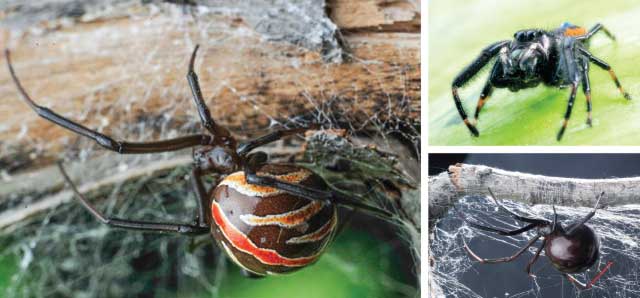
I like the label “charismatic minifauna”

Then I was reading a This American Life episode about spinelessness. It’s about the vertebrate bias in research publications and funding. Malcolm Rosenthal is deploring the fact that invertebrates are relatively neglected.

Our findings can be summarized in two major points:

First: The warm-blooded vertebrate skew was intense. Almost 85 percent of described species are arthropods, but more than 70 percent of publications were on vertebrates. Birds and mammals alone accounted for well over 50 percent of publications, despite representing less than 2 percent of all animal species.

Second: In a world where citations are used to measure impact, publishing on understudied systems comes at a cost to the researcher. Publications on vertebrates received more citations on average than arthropod papers. They were also far more likely to be “blockbuster” publications with more than 100 citations.

He’s right. You can’t deny that there is a strong bias at work. Back in the early days of zebrafish work, we often made the argument that these are honorary invertebrates when we were talking to other developmental biologists, because they do have a lot of the advantages of model systems in that group, but in our grant proposals we turned around and emphasized that these were true vertebrates, and that they had the virtues of relevance to research in human health and disease. We did our best to straddle that line.

And while Rosenthal’s evidence is true, I think he’s missing the real distinction. This bias is a consequence of a fundamental difference between basic and applied research. Basic research is all the stuff he and I love, where we just care about how the world in all of its richness works. Applied research has a focus on science that helps us, the human species, and because we’re such selfish assholes, that’s where the lion’s share of the moolah goes. Look at the names of the big funding agencies: the National Institutes of Health, the National Cancer Institute. That’s where you apply if you want to make a case for research that contributes to our understanding of human health and disease. You can apply for research grants to study, for instance, zebrafish, or even insects, but you’re going to have to link it with some relevance to Homo sapiens.

You want to study some other organism, because it is interesting in and of itself, and might tell you something fundamental about biology? You apply to the National Science Foundation.

The budget for NIH is $37 billion. The budget for NSF is $7.8 billion. Enough said. Even if you convince the agency to fund your research on some fascinating, little known organism, some jerk in the legislature is going to proxmire you and whine about wasting money on bugs. If you avoid the spotlight, you’re still going to that family reunion this summer where Uncle Dork is going to sneer at you and wonder what the hell you do for a living.

I agree that there should be more support for more diversity in topics in science, and I really want to see more support for basic science, but that’s going to require a huge shift in science priorities. I’m all for a National Spider Institute that is well-funded by congress, though.

There are more spider videos where this one comes from, I guarantee it

I have noticed that my spider videos get about a fifth of the traffic of my other videos, which means I must make more, many more, in order to train my audience. You don’t think people just naturally gravitated to cat videos, do you? It took years of exposure to overcome ailurophobia and accustom people to seeing lithe hairy predators (note: description applies to both spiders and cats) on their computer screens. So you just need more. You WILL watch the spiders. You WILL learn to love them.

This is Iðunn, my first specimen of Parasteatoda tepidariorum caught in the spring of 2019. I discovered that she had molted either last night or this morning, so here she is with her leftover cuticle.

WATCH IT. WATCH IT NOOOOOOOOWWWWWW.

Now my beauties. Something with poison in it I think. With poison in it!

I’ve spent all winter doing the book-learnin’. I’ve got so much unfocused spider lore stuffed into my head that I expect it to hatch and little spiderlings to start creeping out of my nostrils. I really need to start applying this information and working with real animals, so every day I prowl around looking for eight-legged beasties to study, and every day I shake my fist at the weather which hasn’t gotten around to any sustained warmth yet. It’s getting a little frustrating. I also have a group of students I’d like to deploy, but it’s all empty cobwebs right now.

They’re out there, I know it. I see an occasional salticid or pholcid indoors, I’m starting to see flies and other prey buzzing around, I’m expecting an explosion of spiders any day now.

Springtime for Spiders

I have been so impatient for the spiders to flourish once again, and have been keeping an eye on what looks like a hotspot for Parasteatoda egg sacs and spiderlings. Nothing there yet, but at least I get to show you the spider paradise and where I expect to see more spiders soon.

Then my wife discovered the first Theridiidae of the spring scampering across some cardboard! I caught her (I’m pretty sure it’s a her, but she’s small and juvenile), and brought her into the lab.

The new spider is named Iðunn. May she be fertile and fruitful.

Whales just want to say hello

Who wants to go swimming with sperm whales? Their sonar is so intense that they can kill animals with a focused click, but here are some free divers playing with them.

(The video overstates some of its inferences — you can’t predict higher brain functions from the presence of spindle cells, or simply from the size of the brain — but it’s still powerful stuff.)

That’s some adaptation they’ve got, and still we killed them to scoop out the oil in their heads.

5,000 year old crime

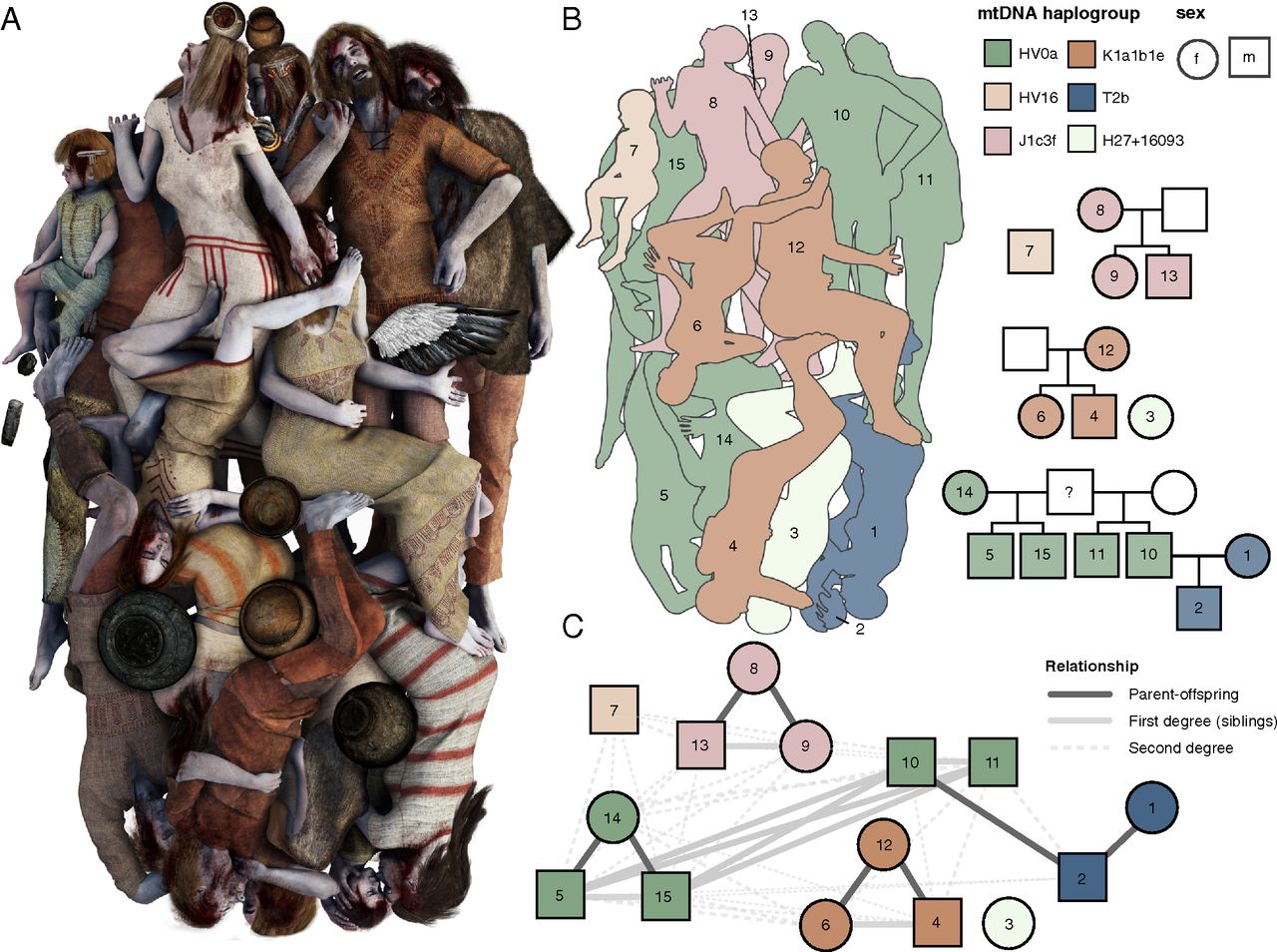
Well, this is a dreadful image. It’s a reconstruction of a mass burial in Poland from 5,000 years ago. It’s mostly women and children who were murdered.

The interesting thing about it, illustrated above, is that they did DNA analyses of all the bones and figured out the family relationships.

Evidently, these individuals were buried by people who knew them well and who carefully placed them in the grave according to familial relationships,” they note.

Based on their research, the authors gained a startling glimpse into the families’ relationships. For example, they discovered that four of the individuals were brothers, but did not all share the same mother – though the similarities in the two women’s DNA suggest that their mothers may have been related.

One of the mysteries in the grave is the absence of older males in the grave, except for one father. This has led the authors to suggest that they were the ones who buried the people in the grave, who are mostly women and children.

Based on the nature of their injuries, the authors suggest that the people in the grave were captured and executed, rather than killed during fighting. This would fit the broader context of violence between competing groups at the time, in which women and children were often taken as captives.

The forensic analysis of the nature of the crime is fascinating, but the picture of Neolithic family structure more so, and this was a terrible tragedy that struck these people.

Now we just need to track down the individuals responsible for this horrific act and bring them to justice.