Teenagers are acquiring bone abnormalities from cell phone use! It’s the perfect story, combining contempt for social media and technology and young people with an apparent appropriate comeuppance for those sins.
Mobile technology has transformed the way we live — how we read, work, communicate, shop and date.
But we already know this.
What we have not yet grasped is the way the tiny machines in front of us are remolding our skeletons, possibly altering not just the behaviors we exhibit but the bodies we inhabit.
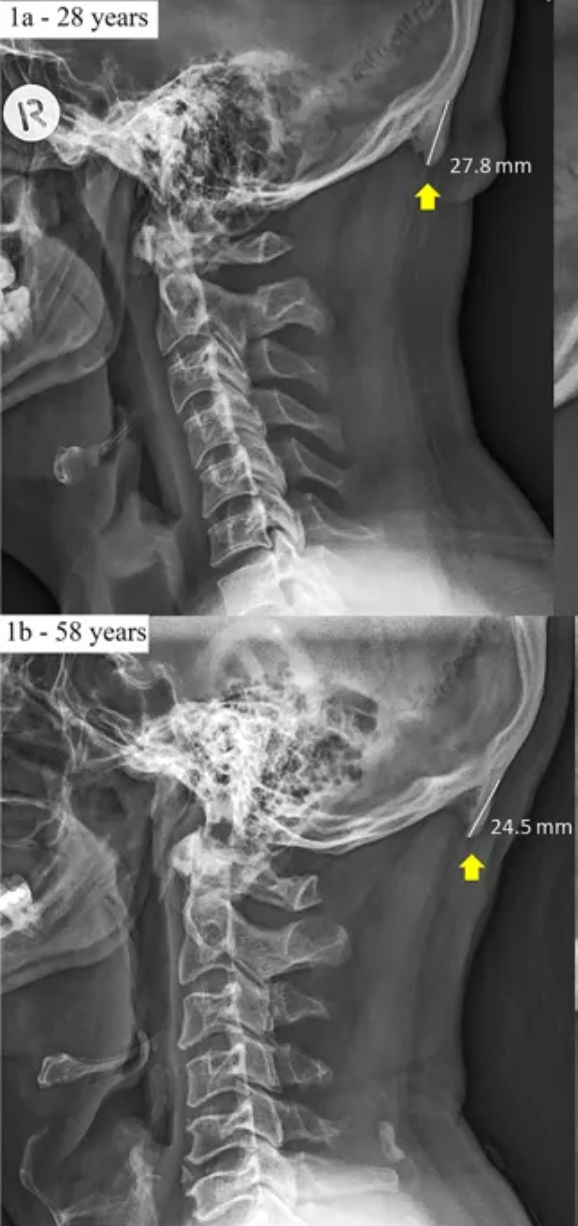
New research in biomechanics suggests that young people are developing hornlike spikes at the back of their skulls — bone spurs caused by the forward tilt of the head, which shifts weight from the spine to the muscles at the back of the head, causing bone growth in the connecting tendons and ligaments. The weight transfer that causes the buildup can be compared to the way the skin thickens into a callus as a response to pressure or abrasion.
The phenomenon is called an EEOP, or enlarged external occipital protuberance, and in a study of 1200 people, they found that about a third have this feature…and that it is more common in men and younger people. They assume from the differences in frequency at different ages that this is an emerging, recent change, which may be reasonable, but I’d like to see a better analysis of the causes.
The authors also assume that this is an undesirable change, with loaded language and an attempt to imply this feature causes serious problems.
Alarmingly, a survey of university staff and students revealed that participants spend an average of 4.65 hours/day using a hand held mobile device, and that 68% of the participating students reported neck pain.
Why is mobile device use alarming? Also note: they do not show a correlation between the presence of EEOPs and neck pain. We’re simply supposed to assume there’s a causal relationship, I guess, between exostoses and this vaguely defined term, “neck pain”. They have not shown that these bony bumps are a problem, but they are ready to raise the alarm.
Clearly, our findings should raise concern as morbidity and disability due to musculoskeletal disorders impose increasing physical, social and financial burdens on individuals and societies. Accordingly, the mitigation of poor postural habit through prevention intervention may be prudent.
Again, they have not demonstrated morbidity or disability. They’ve found that lots of people have these “bumps” that are easily detectable in x-rays, and maybe it’s because people are peering at their cell phones or playing the video games, so there must be a problem. They’ve only shown that the phenomenon exists!
To which I would point out the example used in the Washington Post article: hard work causes a healthy plastic response by your tissues, building up calluses. Are we alarmed by the growth of calluses in working people? Or do we recognize that this is a normal protective response by our bodies to environmental stresses? If you adopt an unusual posture in your work, your bones, cartilages, and tendons also mold themselves to fit.
They also show that 40% of college-age people are exhibiting this “problem”. I’d say that if it’s that common, while these same people seem to be functioning well and are actively and voluntarily engaging in the activity that putatively causes it, it probably isn’t a problem. It may also become the new normal. When over half the population expresses it, will doctors change their diagnoses and note of the new minority, “Oh, you’re missing your occipital exostosis. I’m going to recommend some physical therapy to build it up”?
Finally, one peculiarity here is that they’re jumping all over this possibly entirely benign phenomenon. Rather than focusing on college students using cell phones, I wonder what musculo-skeletal distortions are affecting people who are doing stoop labor, or other repetitive tasks in their work. Perhaps someone can put together an alarmist paper showing the plastic responses in the bones of menial laborers, expressing concern for the unfortunate spinal problems of those people. After all, if you’re horrified that students spend 5 hours a day looking at their phones, you should be experiencing raging apoplexy about farm workers spending 8-10 hours a day bent over, picking crops.
Nah, those people don’t matter.