NEE NED ZB 6TNN DEIBEDH SIEFI EBEEE SSIEI ESEE SEEE!!

Wired tries to defend SETI and UFOlogy. They argue that there are 3 branches of inquiry — exobiology, the search for extraterrestrial intelligence, and the study of UFOs — and each has their place in our battery of methods.

Aliens—hypothetical beings from outer space—fall into roughly three categories. They could be far-away microbes or other creatures that don’t use technology humans can detect; they could be far-away creatures that use technology earthlings can identify; or they could be creatures that have used technology to come to Earth.

Each of these categories has a different branch of research dedicated to it, and each one is probably less likely than the last to actually find something: Astrobiologists use telescopes to seek biochemical evidence of microbes on other planets. SETI scientists, on the other hand, use telescopes to look for hints of intelligent beings’ technological signatures as they beam through the cosmos. Investigating the idea that aliens have traveled here and have skimmed the air with spaceships, meanwhile, is the province of pseudoscientists. Or so the narrative goes.

The issue, the article argues, is that the boundaries of legitimate research have shifted over time and are culturally determined, not objective at all. There’s a continuum of legitimacy, and it’s entirely arbitrary that we place UFOs in pseudoscience, and don’t fund SETI, and think exobiology is valid and interesting. That is a good point, except that I think there is a solid criterion that is rooted in how we do science.

Here’s the deal: early in our training, we’re taught to keep an open mind — you use hypotheses to guide a line of research, but we must be prepared to find unexpected results and alternative explanations. We’re adapted to thinking, “My experiment to test my hypothesis should find X, but if it finds Y we’ll have to modify the hypothesis, and if the answer is Z, well, back to the drawing board, but gosh, that would be exciting.” Experiments are designed that give interesting results, and whether the results are compatible with our hypothesis or reject it are equally useful.

Exobiology fits the paradigm. We’re looking at other worlds with they hypothesis that life produces chemical signatures we can detect, and even if we don’t see them, we learn something about that alien planet. We gather data looking for biology, and if we don’t see it, we still have data on extraterrestrial chemistry. That’s the safe bet funding agencies look for, that we’ll learn something even if our preliminary hypothesis fails.

SETI doesn’t work that way. SETI is looking for specific patterns in extraterrestrial signals; they have a pre-set goal, rather than an open inquiry. Not finding a signal they are looking for is a literal failure that tells us nothing. That star isn’t transmitting anything useful? Abandon it, move on, look somewhere else. Over and over again. It also doesn’t help that all their hypotheses look like ad hoc dreck contrived to convince people that there might be someone out there, with infinitely bendable variables.

UFOlogy, on the other hand, is an extreme example of that latter phenomenon. We don’t see what we’re looking for — no little green men, no crashed spaceships — so they invent elaborate and often contradictory rationalizations. The evidence isn’t there, but they are determined to pretend that it is. It’s a kind of anti-empiricism where the accumulated data is irrelevant to the conclusion.

It’s as simple as asking, “What will we learn from doing the observation/experiment?” SETI’s answer is nothing, unless we find a one in a trillion possibility, then it’s the jackpot. UFOlogy’s answer is that they already know little green men exist, so we just have to photograph thrown pie plates until we’ve persuaded the establishment. Neither is good science.

Both SETI and UFOlogy are strongly susceptible to apophenia as well. They are trying to fit complex data to a prior expectation, so there’s a tendency to impose patterns on noise. Here’s a classic example: NASA has observed complex sand dune formations on Mars.
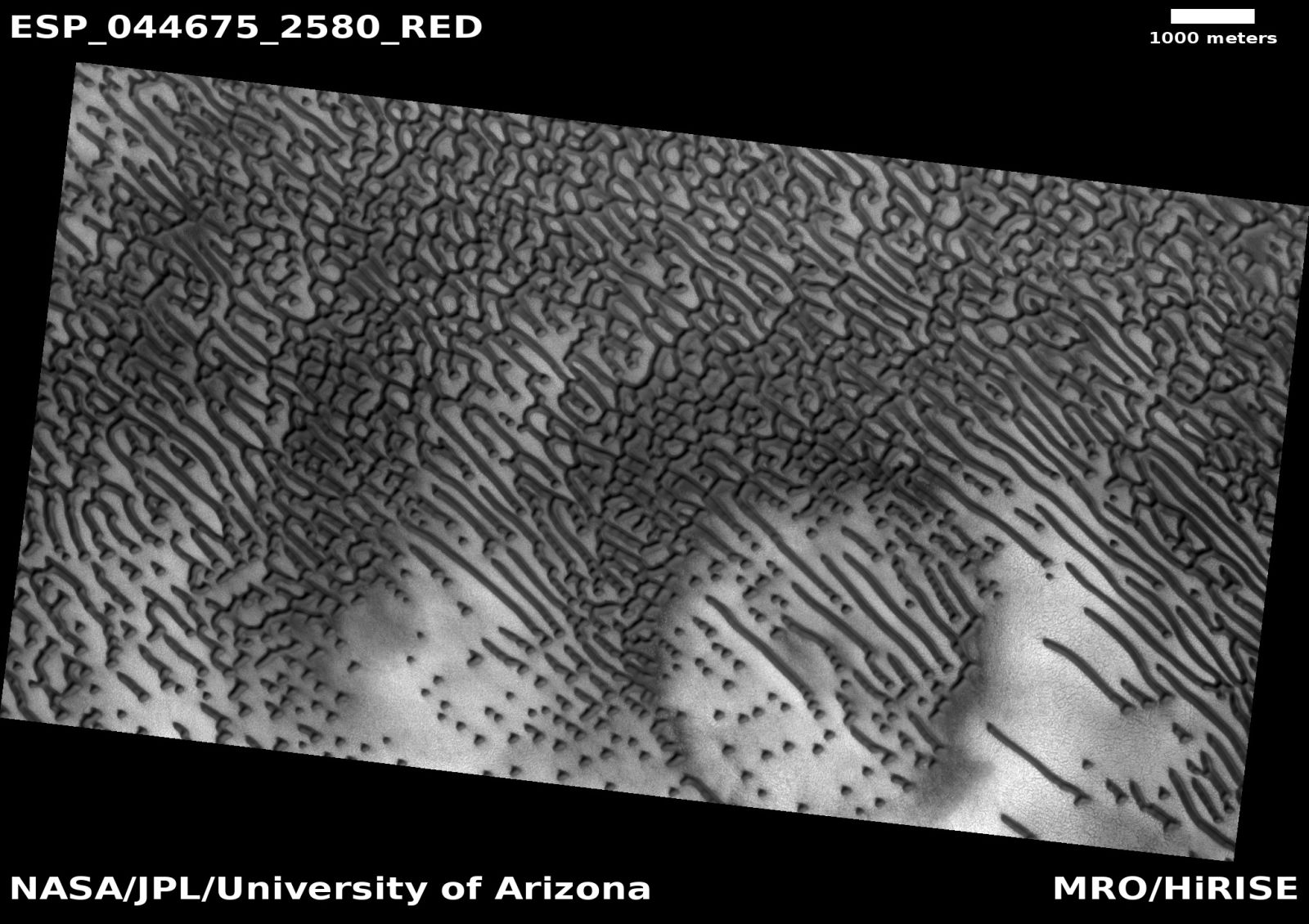
Cool. What causes it? These are windblown rills shaped by topography and prevailing, but changeable, winds that formed under more or less chaotic pressures, producing lines and bumps and branches.

But, if you’re looking for it, it could be a signal. Perhaps, if we ignore the physical mechanisms that made them, these dunes could be Martian handwriting. Or better yet, a Martian code.

Right. So someone, probably as a bit of lark, tried to interpret them as dots and dashes, and then translated them into Morse code (why ancient Martians would have used a code devised by a 19th century American is left as an exercise for the reader). The Martian dunes therefore announce to the universe these immortal words:

NEE NED ZB 6TNN DEIBEDH SIEFI EBEEE SSIEI ESEE SEEE !!

I’m sure that means something profound in the original Martian. Either that, or it’s a compressed recipe for cored cow rectums.

That’s the problem with SETI, though. The universe produces patterns all the time, and human brains strain to impose interpretable derivations on them — SETI will milk that for all the news and attention they can get, even if it is ultimately meaningless.

Meanwhile, UFOlogists already know that the aliens are living on Mars, and have trained Bigfoots raking the dunes to send secret messages to the fleet hovering invisibly in our atmosphere, and you ignore it at your peril, you fools.

I’m not panicking over the coronavirus

It has the potential to be a serious pandemic, but with a strong medical infrastructure, robust public health response, and a sensible, informed public, we can minimize…wait. What the heck…PANIC! Not over the virus, but over the ongoing dismantling of those very things vital to keep the citizenry as safe as possible.

Trump is making massive cuts in biomedical research.

Multiple organizations expressed shock and disappointment at Trump’s budget proposal, which adds $54 billion in defense spending but would slash nearly $6 billion from the National Institutes of Health, which funds most basic medical research in the country, as well as eliminate entirely dozens of other agencies and programs.

It would cut the overall Health and Human Services department budget by 18 percent, including the 20 percent budget reduction at NIH, and reassign money from the Centers for Disease Control and Prevention to states.

In response to concerns that we might not have enough doctors if a crisis arises, he has said that we’d just hire more doctors in that case. Doctors are not fungible. They require years of training, and their expertise requires constant maintenance.

Trump seems to think creating a task force and appointing a “czar” is a smart response. We already have experts in infectious disease at the NIH and CDC…you know, those agencies he is defunding. Appointing an ignoramus like Mike Pence, who has no qualification and has a history of botched public health management does not inspire confidence. Nor does having Ken Cuccinelli, Steven Mnuchin, and Larry Kudlow on the task force.

Also, this:

As for our informed public, Corona, the Mexican beer, has taken a substantial hit to their revenues because people are associating it with the virus.

Please note that the beer and the virus have nothing to do with each other.

We’re gonna die.

Working data from a museum, all yours

It is good news that the Smithsonian is making its archives of millions of images freely available — this is information ought to be in the public domain. Before you start drooling at the prospect of piles of free scientific art that you can use, the implementation is a bit rough. Sure, you can search for images of “spider” in the Smithsonian collection, but you’ll get back is a hodge-podge of imagery, most of which isn’t exactly polished, and the searches are difficult to refine. I mostly got photos of spider wasps, and black and white snapshots of broken, fixed specimens from the museum archives. General terms like “skull” give you a flood of miscellaneous imagery, some of which is neat or historically interesting; try to narrow it down to, for instance, “Neanderthal skull” and you get…nothing.It’s a work in progress, I guess.

It’s an excellent start, though. Just be warned that there isn’t much in the way of curation behind it and a lot of the images look like quick photos to go into a catalog of things that are buried deep in cabinets in the bowels of the museum.

Dr Mona coming to UMM

Hey, gang! Thursday evening at 7pm we have a guest speaker, Dr Mona Hanna-Attisha talking in Edson Auditorium about her work. She’s one of the first people to discover how the water in Flint, Michigan was poisoned with lead (which, by the way, it still is), and she’s going to grace our little college with knowledge that evening. You should come. Why aren’t you coming? Don’t give me that old excuse that it’s far away — you have Google Maps, you can find us.

Ignore this if you’re not an arachnophile

I put more spider photos on Patreon and Instagram. Today’s subjects are members of the tribe of Pholcus phalangioides who are dwelling in my basement. They seem to have undergone a population crash recently, though, probably because, while it’s warm enough in our house, they’re probably getting hungry at the lack of invertebrates to eat here in the depths of winter.

The spiders are hiding on Freethoughtblogs, but they’re still around

I said I’d stop flashing spider photos at you all, so really, it’s safe to come back here if you’re arachnophobic. I still occasionally indulge on the Patreon site, and I just added a few this morning (I’ll put them on Instagram shortly). My model was the lovely Danu, a Parasteatoda tepidariorum I caught at Skepticon in Missouri last August. My lighting setup was far short of ideal, though, so I’m going to have to work on that.

Yes, I still have those St Louis spiders in my lab, they’re doing fine, but in the absence of St Louis males, are not producing babies for me. I guess I’ll just have to go to Skepticon again this year and find some mates for them. Maybe if you go to Skepticon, I can draft you to help!

Who’s been chalking our sidewalks?

When I walked into work this morning, I noticed something odd: all the sidewalk tiles were outlined with ragged, chalky lines. It sure was a lot of work to go to to get such a minimal, if striking effect.

The explanation was obvious (look at the top right tiles), and was clearer a little later when I came home. Melting snow and ice filled the cracks first, and then there’s a race between slow diffusion of meltwater and evaporation due to the sun, leaving precipitated salts at the leading edge of the front.

It looked cool, anyway.

If you thought eugenics was only an abstract notion…

You might want to look up Geoffrey Miller, evolutionary psychologist and general bigot, who wrote a piece for John Brockman’s Edge site on Chinese eugenics in which he’s practically drooling at the prospect of manipulating the human germ plasm. No, really, the West is doomed if we allow the Chinese to race ahead of us in practical eugenics!

Chinese eugenics will quickly become even more effective, given its massive investment in genomic research on human mental and physical traits. BGI-Shenzhen employs more than 4,000 researchers. It has far more “next-generation” DNA sequencers that anywhere else in the world, and is sequencing more than 50,000 genomes per year. It recently acquired the California firm Complete Genomics to become a major rival to Illumina.

The BGI Cognitive Genomics Project is currently doing whole-genome sequencing of 1,000 very-high-IQ people around the world, hunting for sets of sets of IQ-predicting alleles. I know because I recently contributed my DNA to the project, not fully understanding the implications. These IQ gene-sets will be found eventually—but will probably be used mostly in China, for China. Potentially, the results would allow all Chinese couples to maximize the intelligence of their offspring by selecting among their own fertilized eggs for the one or two that include the highest likelihood of the highest intelligence. Given the Mendelian genetic lottery, the kids produced by any one couple typically differ by 5 to 15 IQ points. So this method of “preimplantation embryo selection” might allow IQ within every Chinese family to increase by 5 to 15 IQ points per generation. After a couple of generations, it would be game over for Western global competitiveness.

There is unusually close cooperation in China between government, academia, medicine, education, media, parents, and consumerism in promoting a utopian Han ethno-state. Given what I understand of evolutionary behavior genetics, I expect—and hope—that they will succeed. The welfare and happiness of the world’s most populous country depends upon it.

Oh god. The high-decoupling.

First, sequencing DNA is not eugenics. Telling me how many genomes they sequence per year is not the same as telling me they have a eugenics program in operation. The Chinese government’s crackdown on He Jiankui suggests that they are a bit more hesitant than Miller imagines.

Second, the whole idea that they can get a 5-15 IQ point per generation increase is ludicrous. He’s postulating that a) the observed variation is entirely genetic, and b) that a ruthless pattern of selection is desirable and would have no unforeseen consequences. You can get equal, more equitable, and less disruptive effects by investing in better education. Note that IQ scores have been going upwards for the last century without the state choosing to cull the undesirables.

Third, the idea that IQ scores are a proxy for “competitiveness”, rather than the ability to do well on IQ tests, is a fallacious leap.

Fourth, why would you think eugenics would increase welfare and happiness? It would do the opposite for the majority of the population that lacks the arbitrary genetic markers they use for selection.

Fifth, he is an evolutionary psychologist, which means his understanding of “evolutionary behavior genetics” is feeble at best.

But he does imagine a country that tightly regulates its families on the basis of poorly understood DNA sequences is a “utopian ethno-state” that will increase the welfare and happiness of its citizens, which makes him a kind of third-rate villain in a dystopian SF novel.

If DNA data were as powerful as he imagines it is, though, don’t worry about the Chinese supermen overwhelming us. Comrade Geoffrey has done his part to sabotage the program by donating his DNA, corrupting the database with his genome rich mainly in ignorance and arrogance.

The fall of the mayfly empire?

I’m only a 21st century Minnesotan, by which I mean I grew up on the West coast, lived on the East coast, and only made the trek to the Midwest when I was in my 40s, in the summer of 2000. One feature of the trip across Ohio and Illinois, up through Wisconsin along Lake Michigan, and across to Minnesota and the Mississippi that grossed out my kids was the bugs — the windshield splatter, and worst of all, the black cake of insect carcasses matting the grille of our truck at the end. In the years after we arrived, there were many times our car imitated a filter feeder on summer drives, sucking in a pathetic mass of dead mosquitos and mayflies, requiring a thorough hosing out to be presentable once again. We’d also see the weather radar on the TV, showing vast clouds of insect hatches rising from the rivers and lakes.

In recent years, though, almost imperceptibly, the population of insects has declined to the point where it’s unusual and noticeable when we splatter a few bugs on a drive across the state. Apparently, we also missed the genuinely remarkable swarms that sporadically blanketed the Midwest in the 1950s.

Through the middle of the 20th century, enormous summertime swarms of Hexagenia mayflies were a common sight across many of North America’s largest waterways. The immense scale of mayfly emergences made them a natural spectacle, and reports of the aquatic insects blanketing waterfront cities regularly filled newspaper headlines. Deep drifts of mayflies rendered streets impassable until snowplows could clear and grit roadways, and the dense swarms reduced visibility and inhibited water navigation, temporarily halting river transportation.

I regret not ever seeing that spectacle, although the locals don’t seem to — while I’ve heard many stories of fierce blizzards and massive snowfalls in the “old days”, no one has regaled me with tales of deep deposits of mayfly corpses. It’s a shame, I’d like to hear about it.

These stories do at least make an anecdotal impression that there has been a steep decline in the aquatic insect population. From a time when insect swarms could shut down travel in the mid-century, to my personal experience of running into major bug densities when I first arrived in Minnesota, to now only rarely hearing about scattered clouds of mayflies rising off the lakes, it’s hard to avoid the conclusion that we have a problem here. The problem is…us.

…by 1970, these mass emergences had largely disappeared. The combination of increasing eutrophication from agricultural runoff, chronic hypoxia, hydrologic engineering, and environmental toxicity resulted in the disappearance of Hexagenia from many prominent midwestern waterways, with complete extirpation from the Western Lake Erie Basin and large segments of the Illinois, Ohio, and Mississippi Rivers. After two decades of absence, targeted efforts in conservation and environmental protection led to the eventual recovery of Hexagenia populations and recolonization of major habitats in the early 1990s.

So there was a window of time where the numbers were even lower, and what I saw in 2000 was a resurgence? I’d say, from my subjective observations, that they’re in decline again, and what we need is more hard data on insect numbers over time. That’s what we’re getting from Stepanian and others, who recently published quantitative data on the emergence of mayflies across Lake Erie and the Upper Mississippi river, making calibrated measurements using weather radar. For instance, here’s a single emergence event smothering the entire western end of Lake Erie in a single night in June of 2018.

Macroscale phenomenology of a mayfly emergence over Lake Erie on the night of June 27, 2018 as observed by weather surveillance radar. (A) Radar snapshot at 01:56 Coordinated Universal Time (UTC) depicting the initial ascent of mayflies from the lake surface surrounding the shorelines of Point Pelee, Pelee Island, and Kelleys Island. At this time, a total of 2.1 million mayflies are detected in the airspace. (B) Radar snapshot at 02:50 UTC showing the continuing ascent and downwind drift of mayflies across the lake to the southeast. Additional emerging mayfly plumes develop surrounding North, Middle, and South Bass Islands. Mayflies reaching the southern lakeshore rapidly descend out of the airspace. At this time, a total of 394 million mayflies are detected in the airspace. (C) Radar snapshot at 03:32 UTC. Emergence and ascent have largely terminated as mayflies continue to fly downwind toward the southern lakeshore. At this time, the aerial abundance reaches a maximum, with a total of 2.0 billion mayflies detected in the airspace. (D) Radar snapshot at 04:32 UTC. Most mayflies have already descended from the airspace as the trailing edge of the mayfly plume approaches the southern lakeshore. At this time, a total of 81 million mayflies are detected in the airspace. (Lower) The time series of aerial mayfly abundance during the emergence event. The mayfly numbers given in A–D are annotated as well as the time of local sunset.

Over two billion insects surging out of the water over the span of a few hours! That isn’t even the most impressive event: they report that a single event in Lake Erie can spawn 88 billion mayflies with a mass of over 3,000 tons; the upper reaches of the Mississippi might produce 3.25 billion insects weighing a total of 114 tons. These events represent a huge transfer of organic matter from the bottoms of lakes and streams to terrestrial environments. That’s a significant transfer of nutrients like phosphorus and sulfur to the land, and is clearly an important food source for many animals. The authors do an entertaining calculation of how many calories are in flux here.

Starting with the 104.49 calories contained in a single Hexagenia limbata, we multiply by the Lake Erie emergence (115 billion individuals) to get annual caloric content (12.016 trillion calories). We took the tree swallow (Tachycineta bicolor) as a model aerial insectivore that has been shown to rely on aquatic insect emergence for feeding fledglings during the nesting season. Dividing the total annual caloric content of the emergence (12.016 billion kcal) by the required 224 kcal to raise a nestling over the 15-d development period, we arrive at the total number of nestlings that can be supported by this food resource (53.6 million birds).

That matters! While I vaguely had the impression that mayfly numbers have declined in the 20 years I’ve lived here, that kind of loss has effects that ripple upwards through the populations of animals that live here. It’s too easy to obliviously trundle along, relieved that I’m not having to go to the car wash as often, and then at some point we notice that we’re not hearing as many songbirds, and the bats seem to be dying off, and the fishing isn’t quite as good anymore, and we finally wonder what’s going on…and it’s too late, because we didn’t stop to think that maybe life in the Midwest has been missing the tons of flying biomass that had been periodically deluging the environment with manna.

That’s one of the messages of this paper — that we have lost about half the mayfly biomass in recent decades, lost to poor management of fertilizers and excessive toxic chemicals in our most productive agricultural lands and just general neglect of wetlands. They’re measuring the disappearance of billions of insects.

Ongoing declines in Hexagenia mayfly abundance (individuals ×109) and biomass (tons ×103) on the Upper Mississippi River. Surveys of Hexagenia abundance over the Upper Mississippi River (black) as well as contributions from the northern (La Crosse, WI; red) and southern (Davenport, IA; blue) subdomains as measured by benthic sampling (crosses) and radar surveillance (circles).

It’s a slow, quiet catastrophe. We’re in the depths of winter right now, no mayflies in sight, but just yesterday I was out by our local river, the Pomme de Terre, where this is a typical view. It’s frozen over, with a foot or two of ice frosted with snow, but beneath all that is a busy ecosystem, with fish feeding on the aquatic insect larvae, and billions of mayfly larvae consuming algae and detritus, growing strong for the spring thaw and the summer breeding season, when they should leap into the air in eager swarms, filling the air with life.

But will they?

The Pomme de Terre river, near Morris, Minnesota, on 15 February 2020. There are mayflies there, you just can’t see them…yet.

Stepanian PM, Entrekin SA, Wainwright CE, Mirkovic D, Tank JL, Kelly JF (2020) Declines in an abundant aquatic insect, the burrowing mayfly, across major North American waterways. Proc Natl Acad Sci U S A. 2020 Feb 11;117(6):2987-2992. doi: 10.1073/pnas.1913598117.