Can I quarantine myself in Queensland?

They’ve got spectacular spiders there. The Queensland Museum is closed to visitors now, but they’ve started this program called #couchcurators where the people make videos about what they’re doing. This one features Caitlin Henderson and her spider expertise.

I am so jealous. It’s not quite hammock weather here in Minnesota yet, but it is gradually warming up. We also have almost no spiders yet, except for the pholcid swarm that is scheming down in the basement. I am planning to do a spider walk around the house and yard today, though, not that I expect to find much, too cold. It’s even in my daily to-do list: “12:00 — search for spiders.”

By the way, that’s my new thing, getting up and making a list for the day. Everything has become so structureless that I’ve decided to create my own structure, so I get up in the morning and make a schedule for the day, and then I stick to it. Sadly, today my list is mostly repetitive.

1:00 grade
2:00 grade
3:00 grade
4:00 grade

You get the idea. There is a 5:00 student seminar to attend online, and mealtimes (I lay out the menus ahead of time and do not deviate — it’s all too easy to sit here eating all day long), and my 9:50 class, and most importantly, that noon hour dedicated to spiders.

Spirals. It’s always spirals.

Whoa. This is a siphonophore colony, 15 meters in diameter, just floating in the ocean with tentacles dangling down to catch prey.

I read the whole thread and didn’t see an answer to the question that immediately popped into my head. This is a colonial aggregate of multiple siphonophore bodies linked together into a long string, but it has an overall form of a spiral. How? Is there local signaling going on to regulate the distance between the strands so that it spontaneously forms that structure, or is it an accident of currents? I’m going to guess the former, which would be most interesting, because it implies the existence of factors that lead to large scale form and is therefore the kind of process that would lead to more elaborate patterns of development.

Also, it’s so planar. Is this something the animal regulates, or is it just layers in the ocean maintaining it?

Can haz spider time?

I’ve been doing class stuff all morning. I haven’t left the house in several day. I haven’t fed the spiders in five days. Am I permitted to go into the lab for an hour or so today? I promise to avoid touching anything, to wash my hands thoroughly, and feed the girls with lots of tasty flies. And I’ll buckle down to more grading as soon as I get back.

They miss me. Or at least they miss dinner.

Visit a museum!

That’s bad advice, since in my experience museums tend to be full of excited, eager disease-carriers — I mean, children — and a lot of museums are currently closing their doors and laying off staff. There are still museums with an online presence, though. Here’s a spider expert answering questions at the Burke Museum, and the Bell Museum has video tours of their exhibits. Tell your little disease-carriers kids to sit down and pretend they’re visiting a museum!

Hey, also, when this is all over, and when your finances have recovered…become a member of your nearest museum. They’re all hurting right now, too, and we should appreciate and support our local resources.

Rooting for Australian arthropods in amber

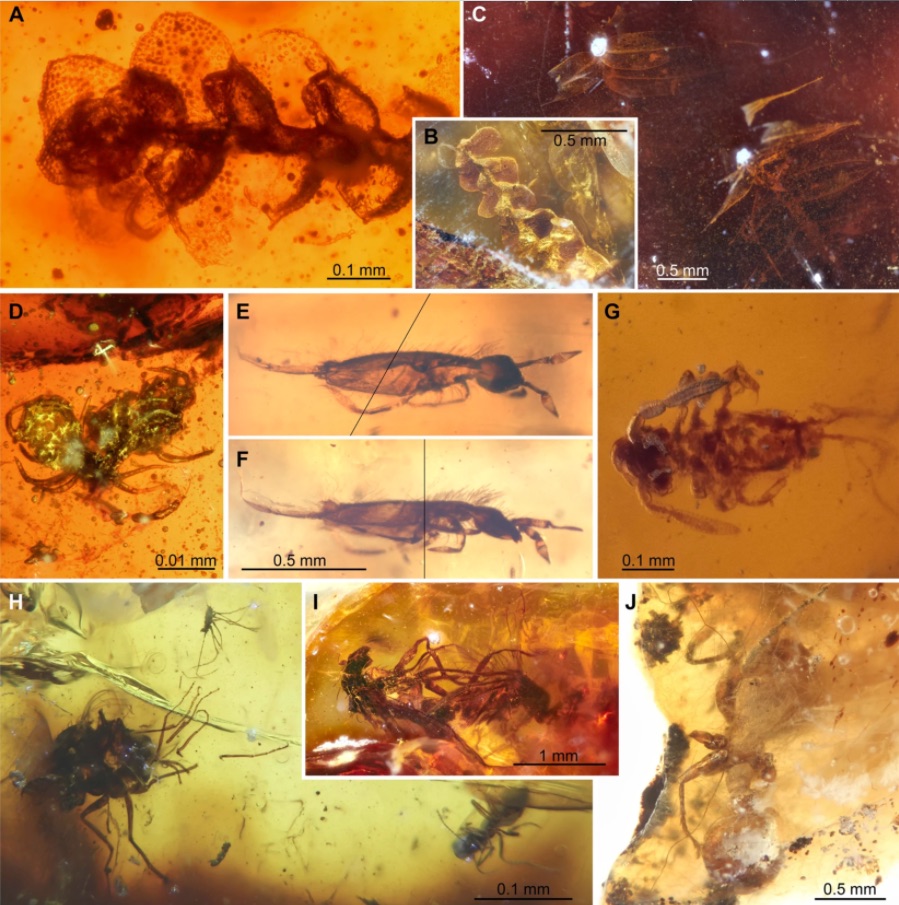
I think the title is a double entendre in Australian, but it’s not a language I am fluent in. Anyway, a paper in Nature describes an assortment of organisms found in amber from Australia and New Zealand, ranging in age from 230 million years to 40 million years. It’s lovely stuff.

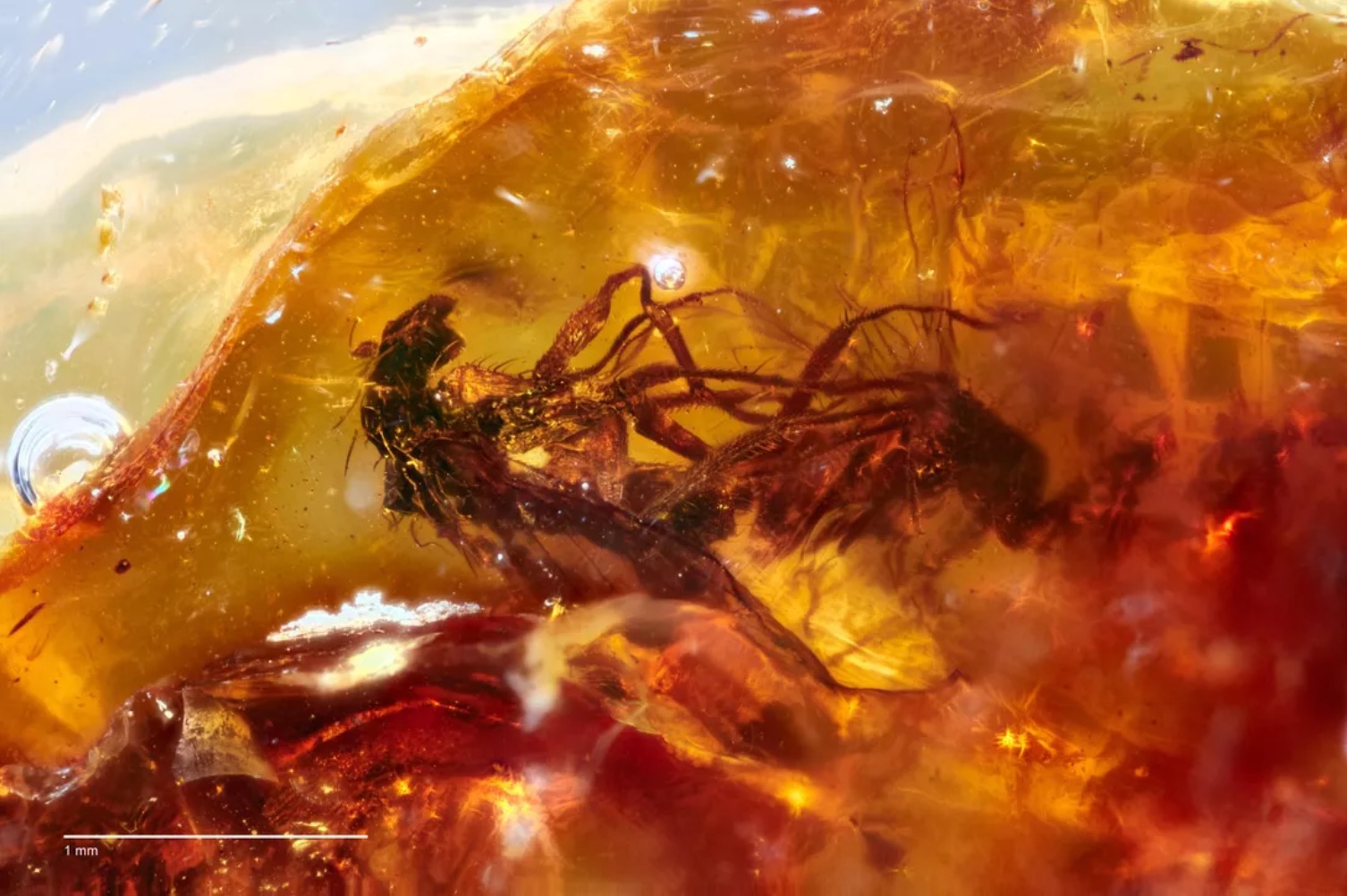
Significant bioinclusions of plants and animals in Southern Gondwana late middle Eocene amber of Anglesea, Victoria. (A to B) Liverworts of the genus Radula (Marchantiophyta: Radulaceae). (C) Two stems with perfectly preserved phyllids or leaf-like structures of mosses of the genus Racopilum (Bryophyta: Racopilaceae). (D) Juvenile individuals of spiders. (E to F) Springtail of the living genus Coecobrya (Entomobryomorpha: Entomobryidae) in two views. (G) A Symphypleona springtail. (H) Light photograph of large piece of yellow amber with two dipterans, Dolichopodidae at left and Ceratopogonidae at right, and at top of image a mite of the living genus Leptus (Arachnida: Acari: Trombidiformes: Erythraeidae). (I) Dipterans of the family Dolichopodidae (long-legged flies) in copula. (J) Worker ant of the living genus Monomorium or a “Monomorium-like” lineage (Hymenoptera: Formicoidea: Formicidae).

I don’t know about you, but I was most interested in D, the two juvenile spiders.

Wait, I do know about you — you’re most interested in I, the two flies caught in the act. So here’s a closeup.

Count yourself lucky. Now if you want to take a pornographic selfie, you just whip out your phone, capture the moment, and go on with your life. Forty million years ago, you had to say “Freeze! Look sexy!” and wait for a drop of sap to ooze over you, and then you had to hold the pose for tens of millions of years.

There are laws about this kind of congregatin’

The snow is back. Not much of it, but it was mixed with freezing rain and now everything is covered with a thin glaze of extraordinarily slippery ice, so I guess Nature is enforcing the stay-at-home order.

These scofflaw birds don’t care at all, though. My yard was covered with sparrows for a while, and the birdfeeder in my front yard has become the most popular meeting spot in the area. KEEP YOUR DISTANCE. STAY INDOORS. Stupid birds.

Michael Egnor agrees with me, I’m having a panic attack

Uh-oh. Michael Egnor is writing about me over on the Discovery Institute site. He’s commenting on that summary of the origin of SARS-CoV-2 virus I wrote the other day, which is fine. What isn’t fine is that he agrees with it.

I threw up in my mouth a little bit.

Reading further, though, he agrees with it for all the wrong reasons, so I feel a little better.

Myers, like the Nature Medicine scientists, uses the scientific inference to intelligent design to search for (and discount) human intelligent agency. Design science is at the forefront of research on the emergence of coronavirus. Based on the available evidence and using the inference to design as a scientific hypothesis, intelligent design of the COVID-19 virus seems unlikely.

That is incorrect. “Design science” is not at the forefront of the research. The authors of that paper came to their conclusion by extensive comparisons of the viral sequence with viruses in other organisms, and by a functional analysis of the structure of the receptor binding domain. Conspiracy theorists and creationists have been poisoning the global conversation with nonsense about the virus being “designed”, so they addressed and dismissed that idea. The primary interest was in the original source, and what properties of the virus make it dangerous to us.

They also pointed out two major adaptations of the virus spike protein: changes to the receptor binding to allow it to bind effectively (but not optimally) to the human ACE2 protein, and an insertion that adds a polybasic cleavage site which also allows the linkage of glycans to the protein that assist in immunoevasion. Two mutations at once! Doesn’t his pal Michael Behe have something to say about the improbability of multiple mutations?

But there is another lesson about design and evolution to be learned from scientific research on this virus. Natural selection, if understood as undirected variation and differential reproductive success, is a destructive process. Natural selection destroys biological functional complexity — it produces diseases, cancer, and pandemics. It weakens and kills. Natural selection does to living organisms what rust does to a machine. Natural selection corrodes and destroys life, and plays no role in creating it.

Not for the virus, it wasn’t a destructive process. What was undergoing natural selection here was the virus, not us, and it has acquired attributes that make it wildly successful — it is now colonizing vast fields of billions of human beings, producing uncountable numbers of progeny, infecting more people at an accelerating rate. The virus is stronger and thriving thanks to those features, and doing very well thank you very much.

Humans are now possibly undergoing a round of natural selection in response. I don’t know if there’s a pool of heritable resistance to the virus in the population, so it’s possible we’re experiencing a field of bullets scenario, where nothing heritable is being selected for, but if there is a genotype that has an advantage here, natural selection would increase their frequency over time. Natural selection could make us more resistant as a species to SARS-CoV-2, and definitely wouldn’t be a destructive process.

Also, one of the features of the virus is the addition of short sequences, so SARS-CoV-2 may have had a slight increase in complexity over its predecessors.

Egnor is basically wrong about everything. Balance is restored to the universe.

Another perk for my Patreon patrons

For patrons only, I’m going to post the YouTube videos I’m doing for my courses during this period of isolation. Note that these are rough, I’m not doing any fancy editing at all, and abbreviated. I’m aiming too keep them under 15 minutes, and then they are supplemented by discussion sessions on Zoom…and by the textbook, of course.

I have to whip out a couple of these every week so when I say rough, I mean rough — they’re just recordings of Keynote presentations. Normally I’d hope to be interacting with students and handling questions and throwing out problems to solve, and these 10-15 minute summaries would expand out to an hour, but we gotta do what we gotta do during this pandemic.

Lawyers and self-importance go together like a slime & maggot sandwich

This New Yorker interview with “legal scholar Richard Epstein” is one of the most amazing exhibitions of arrogance I’ve read lately…and I’m living in the age of Donald Trump. Epstein earlier wrote an essay for his home base, the right-wing think tank the Hoover Institution, in which he predicted that the coronavirus pandemic was over-exaggerated, that it would peak with about 500 deaths and then fade away. His work was widely cited by conservatives, claiming that it showed that the cure was worse than the disease. His estimate was passed within a week, and the death toll is still rising. He’s wrong, definitively, and his prediction was quickly falsified. But he’s still defending it!

Most galling, his defense is that his prediction is supported by evolutionary theory. I know a little bit about evolution, so that was a startling claim. He’s a lawyer, not a biologist. He tries to explain his justification in this interview, and it turns out to be built on wishful thinking and faulty beliefs in how evolution works.

Here’s why he thinks the pandemic wouldn’t be as bad as the experts say.

But then adaptation starts to set in. And, in my view, adaptation is a co-evolutionary process in which things change, not only in human behavior but also change in genetic viral behavior.

OK, sure, humans are evolving, the virus is evolving, but how does that support the notion that the virus will kill 500 and not 100,000 people? There’s a leap there that emerges murkily.

…as the virus becomes more apparent, adaptive responses long before government gets involved become clear.

Wait, so his argument is that the virus will adapt to become relatively harmless before any public health work can take effect? I seem to recall that this viral adaptation to become weaker didn’t happen with, say, polio. He’s making assumptions about the rate of change.

Well, what happens is it’s an evolutionary tendency.

Also assumptions about a “tendency”. How does this work? He explains that. It’s jaw-droppingly stupid.

So the mechanism is you start with people, some of whom have a very strong version of the virus, and some of whom have a very weak version of the virus. If the strong-version-of-the-virus people are in contact with other people before they die, it will pass on. But, if it turns out that you slow the time of interaction down, either in an individual case or in the aggregate, these people are more likely to die before they could transfer the virus off to everybody else.

So his idea of why slow-the-spread works is not that it gives health services time to treat severe cases, it’s that he imagines there is this substantial variation in lethality of the virus, and that isolation allows people carrying strong strains to die, eliminating those variants, giving weak strains a selective edge. This ruthless Darwinian winnowing of viral strains will occur over the course of a few weeks.

He’s postulating a hyper-evolutionary acceleration; it’s very similar to the arguments of creationists who think all the vast amount of variation in species emerged from a few kinds preserved from the Flood 4000 years ago. Good evolutionary biology does not treat selection as a god-like force that instantly generates an optimal solution — we’re entirely aware of the limitations and how fast it can potentially work. We can use math. Epstein’s mechanism might work…over a few hundred thousand generations, which I suspect is even slower than our dilatory president’s response to the crisis.

And you’re not an epidemiologist, correct?

No, I’m trained in all of these things. I’ve done a lot of work in these particular areas. And one of the things that is most annoying about this debate is you see all sorts of people putting up expertise on these subjects, but they won’t let anybody question their particular judgment.

No, he’s not trained in those particular areas. He’s a lawyer. They work contrary to how scientists work. Lawyers start with the conclusion that they want to reach, and then select evidence that fits that conclusion.

That comment is particularly ironic because it applies spectacularly well to him. He’s claiming expertise he doesn’t have. You know, as I said, I actually do have some training in evolutionary biology, but I understand the limitations of what I know. I understand general principles and basic rules, but I also know that there are domains of specialization, like epidemiology, that I know very little about. I wouldn’t try to trump an epidemiologist’s detailed understanding of pandemics with my general knowledge of evolution of fish and spiders and cephalopods. Yet here’s Epstein, asserting that his legal training qualifies him to know better than epidemiologists.

I also wouldn’t declare that my knowledge of biology means I know better than Epstein how the law works.

What I’m doing here is nothing exotic. I’m taking standard Darwinian economics—standard economic-evolutionary theory out of Darwin—and applying it to this particular case.

There is actually a field of Darwinian economics. It’s mostly a bunch of economists who are smart enough to know that biologists have built up a lot of theory about how evolutionary biology works, and they’re trying to apply biological principles to economics. That’s not what Epstein is doing. He’s trying to jigger his fantasy Libertarian notions of economics to fit biology, and throwing a snit because biology is not obliging.

Oh yes, a snit. The following exchange is a stunning demonstration of how thin-skinned Richard Epstein is.

I was just asking about—

I’m saying what I think to be the truth. I mean, I just find it incredible—

I know, but these are scientific issues here.

You know nothing about the subject but are so confident that you’re going to say that I’m a crackpot.

No. Richard—

That’s what you’re saying, isn’t it? That’s what you’re saying?

I’m not saying anything of the sort.

Admit to it. You’re saying I’m a crackpot.

I’m not saying anything of the—

Well, what am I then? I’m an amateur? You’re the great scholar on this?

No, no. I’m not a great scholar on this.

Tell me what you think about the quality of the work!

O.K. I’m going to tell you. I think the fact that I am not a great scholar on this and I’m able to find these flaws or these holes in what you wrote is a sign that maybe you should’ve thought harder before writing it.

What it shows is that you are a complete intellectual amateur. Period.

O.K. Can I ask you one more question?

You just don’t know anything about anything. You’re a journalist. Would you like to compare your résumé to mine?

Wow. Like, wow. I’m speechless. A bit touchy, isn’t he?

Richard Epstein, you are an amateur and a crackpot, and also arrogant and ignorant. I hope this interview follows you for the rest of your days and demolishes your credibility in all scholarly things.