The Mystery of the Old Gazebo

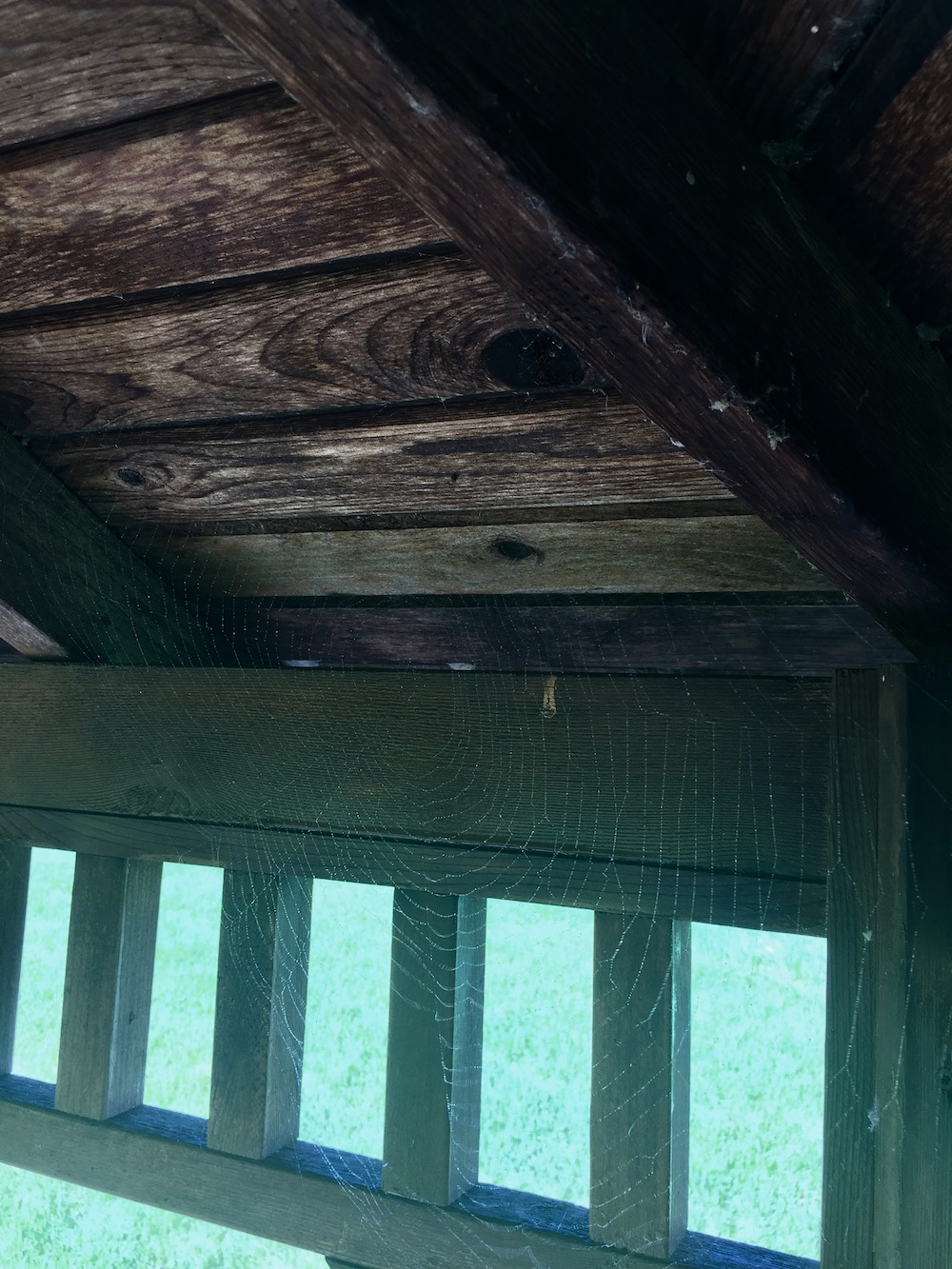
The other daaaay, we’d gone walking around the Pomme de Terre river, and just off the bike trail there is an old gazebo. It’s weathered, lichen-covered, and a bit creaky, but it’s also covered with spectacular orb webs, so we were curious to find out who was living there.

We poked around, and a couple of spiders scurried out, but I was baffled…the ones we caught didn’t look like orb weavers, they seemed to be Theridion, or social cobweb spiders. I guess they’re just lurking, taking advantage of any small prey caught in another spider’s web. The actual weavers of those webs couldn’t be found anywhere. I suspect the reason for that is that smack in the middle of the gazebo is a swallow’s nest, so any reasonably large spider is going to hide during the day an only emerge at night.

We’re tempted to revisit at night, except that another feature of the gazebo is all the hearts and INITIALS+INITIALS carved into the wood. We might interrupt more mammalian activity.

[Read more…]

Yeah, but was it a radioactive spider?

Three boys in Bolivia found a black widow spider.

“Thinking it would give them superhero powers, they prodded it with a stick until it bit each of them in turn,” the official, Virgilio Pietro, said.

The boy’s mom found them crying, so she rushed the siblings to a nearby health center, which transferred them to a nearby hospital, Telemundo said.

They’re fine now. They did not turn into spider-boys.

Note that they had to torture the spider to get it to bite them in the first place. Don’t do that. Don’t blame the spider. The spider knows that with great venom comes great responsibility, and that boys taste yucky.

Psychologists don’t really believe that, do they?

They really need to get out more, dissect a frog brain or something, if they’re still clinging to that triune brain nonsense. According to Salon, some psychologists still think that’s valid. The author summarizes an article that…

…addresses (and debunks) one of the most commonly-used metaphors in evolutionary psychology, the idea that the human brain evolved from lower life forms and hence has evolutionary remnants from those animals — akin to an onion with layers.

If you’ve ever heard someone speak of you possessing a “lizard brain” or “fish brain” that operates on some subconscious, primal level, you’ve heard this metaphor in action. This is called the triune-brain theory; as the authors write, the basic crux of it is that “as new vertebrate species arose, evolutionarily newer complex brain structures were laid on top of evolutionarily older simpler structures; that is, that an older core dealing with emotions and instinctive behaviors (the ‘reptilian brain’ consisting of the basal ganglia and limbic system) lies within a newer brain capable of language, action planning, and so on.”

Whoa. That’s silly. Of course, I have an edge: my early career in graduate school was spent studying the neuroanatomy and physiology of fish, and yes, they have a hindbrain, midbrain, and forebrain — all the pieces are there, they develop to different degrees in different lineages, and there aren’t linear ‘steps’ in evolution where, all of a sudden, there are jumps to whole new brain architectures appearing. Even before that, as an undergraduate taking neuroscience from Johnny Palka, I recall how insistent he was that we had to regard the brain of Drosophila as both existing and capable of sophisticated processing. (It’s true, some people think insects don’t have brains. They’re wrong.)

I wonder if this is another consequence of the belief in Haeckel’s erroneous ideas. I’ve skimmed through Dr Spock’s Baby Book, and was surprised to see how much rekapitulationstheorie saturates that book. The creationists love to claim that introductory biology texts teach it as fact, when my experience is that they explain how it’s wrong; they should look into the child psychology texts if they want better examples of a bad idea being promoted today.

So I had to look into the paper described in the Salon article. It’s titled “Your Brain Is Not an Onion With a Tiny Reptile Inside”, which is excellent. It gets right down to addressing the misconception from the very first words. The abstract is also succinct and clear.

A widespread misconception in much of psychology is that (a) as vertebrate animals evolved, “newer” brain structures were added over existing “older” brain structures, and (b) these newer, more complex structures endowed animals with newer and more complex psychological functions, behavioral flexibility, and language. This belief, although widely shared in introductory psychology textbooks, has long been discredited among neurobiologists and stands in contrast to the clear and unanimous agreement on these issues among those studying nervous-system evolution. We bring psychologists up to date on this issue by describing the more accurate model of neural evolution, and we provide examples of how this inaccurate view may have impeded progress in psychology. We urge psychologists to abandon this mistaken view of human brains.

Then Cesario, Johnson, and Eisthen name names. They show that this misbegotten misconception is a real issue by going through the literature and introductory textbooks.

Within psychology, a broad understanding of the mind contrasts emotional, animalistic drives located in older anatomical structures with rational, more complex psychological processes located in newer anatomical structures. The most widely used introductory textbook in psychology states that

in primitive animals, such as sharks, a not-so-complex brain primarily regulates basic survival functions. . . . In lower mammals, such as rodents, a more complex brain enables emotion and greater memory. . . . In advanced mammals, such as humans, a brain that processes more information enables increased foresight as well. . . . The brain’s increasing complexity arises from new brain systems built on top of the old, much as the Earth’s landscape covers the old with the new. Digging down, one discovers the fossil remnants of the past. (Myers & Dewall, 2018, p. 68) [no relation –pzm]

To investigate the scope of the problem, we sampled 20 introductory psychology textbooks published between 2009 and 2017. Of the 14 that mention brain evolution, 86% contained at least one inaccuracy along the lines described above. Said differently, only 2 of the field’s current introductory textbooks describe brain evolution in a way that represents the consensus shared among comparative neurobiologists. (See https://osf.io/r6jw4/ for details.)

Not to blame only psychologists, they also point out that Carl Sagan popularized the idea further in The Dragons of Eden. I hate to puncture the warm happy glow Sagan’s name brings to many of us, me included, but that was a bad book. Don’t ask an astronomer to explain brain evolution and consciousness, ever. I’m looking at you, Neil.

The authors illustrate the misconception well. It’s a combination of errors: the idea that evolution is linear rather than branching, that humans are the pinnacle of a long process of perfecting the brain, and that we possess unique cerebral substrates to produce human capabilities. It isn’t, we aren’t, we don’t.

Incorrect views (a, b) and correct views (c, d) of human evolution. Incorrect views are based on the belief that earlier species lacked outer, more recent brain structures. Just as species did not evolve linearly (a), neither did neural structures (b). Although psychologists understand that the view shown in (a) is incorrect, the corresponding neural view (b) is still widely endorsed. The evolutionary tree (c) illustrates the correct view that animals do not linearly increase in complexity but evolve from common ancestors. The corresponding view of brain evolution (d) illustrates that all vertebrates possess the same basic brain regions, here divided into the forebrain, midbrain, and hindbrain. Coloring is arbitrary but illustrates that the same brain regions evolve in form; large divisions have not been added over the course of vertebrate evolution.

I’m kind of disappointed that this obvious flawed thinking has to be pointed out, but I’m glad someone is explaining it clearly to psychologists. Can we get this garbage removed from the textbooks soon? Or at least relegated to a historical note in a sidebar, where the error is explained?

Water: scary stuff

It doesn’t look like much at the beginning, but this dam failure in Michigan led to thousands of people being evacuated, destruction of bridges and homes downstream, and some houses were flooded to a depth of 9 feet. All it took was a little rain. OK, a lot of rain.

Here’s an analysis of the failure. There was something more going on.

This video is going to be a classic in the teaching of geotechnical failures, but it also clarifies the events that led to the Edenville Dam failure. It would have been simple to ascribe this to a simple overtopping event that occurred when the capacity of the spillway was exceeded. But in reality the events are are more worrying than that – the dam appears to have undergone a slope failure; a failure of its integrity. This should never occur, and to me it suggests that the problems at the Edenville Dam went further than known issues with the spillway.

So not just rain, but also negligence by whoever had responsibility for the dam. It turns out that this dam was privately owned, by absentee landlords with a criminal history who neglected it, refused to do necessary repairs and expansion, and had their federal license to run the dam revoked for their greedy refusal to do what was needed. I guess it is unsurprising that Lee Mueller is a Randian Trumpkin who lives in Las Vegas.

America’s crumbling infrastructure isn’t helped by the parasites and rentiers who’ve taken it over.

Buttons and threads, or how to achieve criticality in a non-linear fashion

I learned something a long, long time ago, first in studying the origin of life, and then in studying the relationships within networks of genes, and now when thinking about basic epidemiology. Nothing is linear. It’s an idea that’s been discussed since at least the 1980s, when Stuart Kauffman applied it to the logic of the emergence of life on Earth. Here he is talking about the appearance of autocatalytic sets, that is, collections of interlinked enzymes (or ribozymes) that generate emergent properties, like a metabolism.

Now, the next question is how hard is it to get such systems? Does it take a careful crafting of a chemist, or can it arise by chance? The body of theory I’ve been working on now for more than a decade suggests that it’s not hard.

You see this with an analogy: suppose you take 10,000 buttons and spread them out on a hardwood floor. You have a large spool of red thread. Now, what you do is you pick up a random pair of buttons and you tie them together with a piece of red thread. Put them down and pick up another random pair of buttons and tie them together with a red thread, and you just keep doing this. Every now and then lift up a button and see how many buttons you’ve lifted with your first button. A connective cluster of buttons is called a cluster or a component. When you have 10,000 buttons and only a few threads that tie them together, most of the times you’d pick up a button you’ll pick up a single button.

As the ratio of threads to buttons increases, you’re going to start to get larger clusters, three or four buttons tied together; then larger and larger clusters. At some point, you will have a number of intermediate clusters, and when you add a few more threads, you’ll have linked up the intermediate-sized clusters into one giant cluster.

So that if you plot on an axis, the ratio of threads to buttons: 10,000 buttons and no threads; 10,000 buttons and 5,000 threads; and so on, you’ll get a curve that is flat, and then all of a sudden it shoots up when you get this giant cluster. This steep curve is in fact evidence of a phase transition.

If there were an infinite number of threads and an infinite number of buttons and one just tuned the ratios, this would be a step function; it would come up in a sudden jump. So it’s a phase transition like ice freezing.

Now, the image you should take away from this is if you connect enough buttons all of a sudden they all go connected. To think about the origin of life, we have to think about the same thing.

The pattern should also affect how we think about genes. We’ve got about 20,000 genes; each gene influences the expression of some set of other genes. You may think you know exactly which genes are directly affected by a gene you are interested in — you can do experiments and work out the connections, a process called epistasis — but because each of those genes also have multiple connections, you in effect have to consider that every single gene in some way influences the activity of every other gene. Tug on one, and every other gene in the system is affected. Each of us is a supercluster of interacting genes, being tugged on in various ways by the environment.

I’m not an epidemiologist, but this also how I think about the pandemic. I am a button. I’ve been alone for months; if I had gotten the disease, I would have suffered alone but I’d also have been a dead-end for the virus. Now my wife is home, another button, and we are tied together with a red thread such that if I get the disease, she almost certainly will, and vice versa. But also, she was living with my daughter, her husband, and my granddaughter for a few months, she was part of a four-button cluster, which I’ve now joined. If one of us had the virus, it would have readily spread within that group. But it would have ended there.

Unless…what if I cheated? I decided to go out to a bar and chat with ten friends. I’ve basically connected a red thread to each of their clusters, and increased my connectivity greatly. Maybe you think it’s still a manageable number, but that’s only because you don’t see all the red threads outside of your immediate group. The point of Kauffman’s analogy is that the expansion of the network is not linear, as you might naively expect, but jumps rapidly as the number of connections increases, and can undergo a phase transition, where just going out to a bar can achieve criticality, and suddenly you are connected to everyone in the country, and the virus has avenues to reach everyone.

So think of yourself as a button. Every time you touch someone, lean in close and breathe their air, you are tying a red thread to them, linking your fate to some degree to them. You can safely build a little network with close family, and you’re still OK — the threads tangle together just your small family unit. But if your child has a playdate with a neighbor’s kid…they have made a new thread that encompasses everyone in your family, and everyone in the neighbor’s family, and you’ll have no idea how many threads connect you all. And if you decide to take the whole family to that newly opened beach and mingle with thousands of other people, forget about it — the number of connections have shot up exponentially. You’ve lost all control.

The problem is that people don’t grasp the idea of exponential increases intuitively. I don’t. I’ve worked with enough models that I know that these kind of phenomena can produce surprisingly large effects rapidly, though, and that our current situation is a perfect example of that kind of phenomenon, and damn, stay home and stop stitching all those buttons together.

Back to the spider grind

I took a tour of my house this morning to see how the spiders were shaping up. I found lots, even more than I did last week. Some were familiar, like Attulus fasciger, who had captured a mosquito-like creature. Good work, young lady!

Of course there were lots of Salticus scenicus around.

The exciting but somewhat disappointing discovery was that Parasteatoda abounded — they’d colonized several inset corners of the house and areas around the downspouts, where they had good cover and great places to hide.

The disappointing part was my own failure: I couldn’t get a good picture of any of them! They were all living in little houses made of plant debris, and if I tapped on them to ask them to come out, they did a typical Parasteatoda thing: they’d immediately bungee straight down to the ground. They’re conveniently predictable when trying to catch them, but I just wanted to say hello and take a picture.
To see what I mean about the difficulty, I saved one photo of one tucked into a bit of dried flower petal, with just her blurry butt sticking out.

I’ve got 4 of these spider nests tagged now, and I’ll be back tomorrow and will try to get some better pictures. Except I think we’ve got thunderstorms predicted for Sunday…so maybe a little later.

You can see the photos, if you really want to, on Patreon or Instagram, as usual.

We’re all going to come out of this with new phobias

I’m starting to think I never want to be around people again, what with all their filthy, moist exhalations.

On the plus side, I’ve always wanted an excuse to wear a mask and cover this homely face. I look forward to the new support for industries that make fashionable face wear — I would like a formal mask for special occasions, a professional mask for work, and a wild & crazy mask for partying in the streets (alone, of course). I may also need a spider mask for those days I’m focused on arachnids, even though they tend not to sneeze.

My first Raspberry Pi

We put it together today, me and my nerdy daughter and my very excited granddaughter, who had to inspect each of the components.

She had to teach me a little (very little) Python, but we got it working with a little script to take time lapse images. That’s the camera at the top, and the two eyeballs are IR LEDs. The plan is to do a test run when I get back and see if we can record night-time spider activity with it. The spiders are very sneaky, and when I see them during the day they’re usually lounging about, doing little unless some prey falls into their web, but every morning I see the cages more densely matted with cobwebs, so it would be nice to watch them at work.

The images aren’t bad for such a minuscule lens. The test will be to see if I can get enough depth of field to get a sense of their 3-dimensional construction methods.

(If you’re curious, that’s the CanaKit Raspberry Pi 4 4GB Starter Kit and the UNIROI Raspberry Pi Camera Module.)