Frugal to the point of vacuity

What does it take to get Carl Zimmer to review your research in the New York Times?

I suppose it helps to be at Harvard. It also helps to have a combination of subjects — evolution and the human brain — that Zimmer has written about in the past. It helps to have a paper with lots of very pretty diagrams — the authors’ hypothesis is professionally illustrated. It’s also a good idea to have a vast sweeping explanation for the exceptionalism of the human brain. In this case, they call it the Tethering Hypothesis, and it’s supposed to explain how humans evolved all these remarkable cognitive abilities.

The human cerebral cortex is vastly expanded relative to other primates and disproportionately occupied by distributed association regions. Here we offer a hypothesis about how association networks evolved their prominence and came to possess circuit properties vital to human cognition. The rapid expansion of the cortical mantle may have untethered large portions of the cortex from strong constraints of molecular gradients and early activity cascades that lead to sensory hierarchies. What fill the gaps between these hierarchies are densely interconnected networks that widely span the cortex and mature late into development. Limitations of the tethering hypothesis are discussed as well as its broad implications for understanding critical features of the human brain as a byproduct of size scaling.

You know what you don’t need? Data, or a hypothesis that makes sense.

The paper is largely a review of neuroanatomy, describing features of the human brain that we’ve known about for a long, long time…except now we can illustrate them with lovely color diagrams and fMRI scans. Here’s an illustration of the problem in human evolution:

brainevo

There are areas of the brain that we know what they do: in red, for instance, is the primary somatosensory cortex, which is a map of muscles and sensory areas on our skins, while blue is the primary visual cortex, which is where information from our eyes is processed. In between these known areas are great beige unknowns — regions of the brain called association cortex, which integrate information from various other regions in complex ways. Our primary somatosensory and visual cortices aren’t much bigger than those of a chimpanzee, which makes logical sense, since there isn’t much difference in surface area or visual acuity between us, and most of the growth has occurred in the association cortex.

All well and good. The question is, what made our association cortex expand in our evolution, and how is that expansion related to specific human intellectual capacities? Those are good questions, and I’d be curious to see them answered. Too bad this paper doesn’t.

One problem is that it is a review paper and really doesn’t test anything — it catalogs some existing knowledge about brain organization and then throws out this Tethering Hypothesis to explain it all, which it doesn’t. I do like the fact that it suggests that most of our abilities are spandrels, not explainable as adaptations, and that what it proposes is that novel abilities arose from regions of the brain that were not constrained by ancestral functional requirements. I just don’t see how their mechanism explains that.

Here’s one short paragraph from the paper that neatly summarizes their hypothesis.

The idea of some form of radiation outward from core organizing centers is appealing because the hominin cerebral cortex vastly expanded in a short time. It seems implausible that molecular gradients could emerge fast enough to specify new cortical areas, although developmental expression patterns have clearly been modified. Building from Rosa and colleagues’ ideas about visual cortex organization, we propose a more general tethering hypothesis to explain how new features of cortical organization might have emerged during the rapid evolutionary expansion of the cerebral mantle. The word ‘tether’ is used to emphasize that the expanding cortical plate is tethered to gradients that initially evolved in a cortex with a far smaller surface area. Much as taffy, being pulled apart, thins until it breaks in the middle, the expanding cortical zones far from the strong constraints of developmental gradients and sensory input may become untethered from the canonical sensory–motor hierarchies.

OK, that begs the question: why did the hominin cerebral cortex expand in the first place? They keep talking about this “expanding cortical plate”, but not why it was expanding or why it necessitates new organizing centers. The taffy metaphor is also telling; why are they talking about things being pulled apart, when expansion of the brain is not caused by external forces pulling on it, but on internal forces of growth generating more tissue between known cortical zones?

I’m also put on edge by the phrase “It seems implausible that…”, especially when applied to something that doesn’t seem implausible at all. Why balk at a timescale of several million years to evolve a use for a bit of extra brain matter?

But even worse, nervous systems growing bigger is what I study. My Ph.D. research was on connectivity in the developing spinal cord of zebrafish, for instance.

The first neurons in the zebrafish embryo emerge at about 18 hours after fertilization, at a time when the nascent spinal cord is about 2mm long, in total. Cells in the hindbrain send axons all that distance (2mm is a long way in an embryo!), and as they grow, they make a little knot of synapses every 40-50µm with cells called primary motoneurons.

That’s in the embryo. In the adult, the spinal cord is roughly 4cm long — there’s been a 20-fold expansion in size. What do you think happened to that earlier array of cells? Did the system stretch and break?

No, it grew. In the adult, the same hindbrain neurons are still present, and their axons still reach all the way back to the tailtip. And the same motoneurons are still present, they’re just spread out more to be separated by 1-1.5mm, and they still retain the same synapses.

I also did research on the earliest neurons to differentiate in the grasshopper nervous system. I studied Q1, a neuron that established one of the commissures in the grasshopper ganglion. That story is a little different: Q1 doesn’t seem to have any function in the adult, and in fact looks to be abandoned and gone. But what it does is send the first slender thread across on a specific pathway; it pioneers a route across the nervous system, and then other axons pile on and follow it across. It’s like sending a kite string across a chasm, then using the string to pull a rope across, and then using the rope to pull a cable across, and pretty soon you’ve got a bridge — and it’s doing this as the chasm is widening, because like the zebrafish, the grasshopper is also growing substantially during these events.

Growth is an integral process in the development of the nervous system. Without specific evidence that these developmental mechanisms break down during growth (which seems implausible to me…), why would you postulate that a failure of developmental processes was an essential element of human evolution? A tripling of brain size from the human-chimpanzee common ancestor to the modern human seems like a small shift relative to the much larger expansion of the human fetal brain to the adult brain.

What I’d like to see, and did not find in this paper, are comparative developmental studies. When these various cortical regions of the brain are specified or establishing connectivity, how far apart are they in different species? Compare mouse and rat, for instance, or rhesus monkey and human. I suspect that in early embryos, the distances, and their relative differences, will be minuscule, and that signaling centers will be close enough that it will seem silly to argue that broad patterns of connectivity would be unable to form in the biggest brains, leaving gaps that need to be filled in by novel mechanisms and structures.

But again, the paper doesn’t look at any of that at all. I found one paragraph that briefly discusses other observations that association cortex matures later than other regions of the brain, and that’s about it — it is definitely not sufficient information to argue that association cortex is out of reach of intrinsic signaling gradients in the early brain.

At least the first subtitle in the paper is “A Speculative Hypothesis,” which is entirely accurate. I don’t see how it justifies the praise it was given in Carl Zimmer’s article.

Dr. Sherwood, the George Washington University expert, praised the hypothesis for being “fairly frugal.” The emergence of the human mind might not have been a result of a vast number of mutations that altered the fine structure of the brain. Instead, a simple increase in the growth of neurons could have untethered them from their evolutionary anchors, creating the opportunity for the human mind to emerge.

Oh, wait. When the best thing you can say about a hypothesis is that it is “fairly frugal”, that’s not much praise at all.


Buckner RL, Krienen FM (2013) The evolution of distributed association networks in the human brain. Trends Cogn Sci 17(12):648-65.

I could have used this last semester

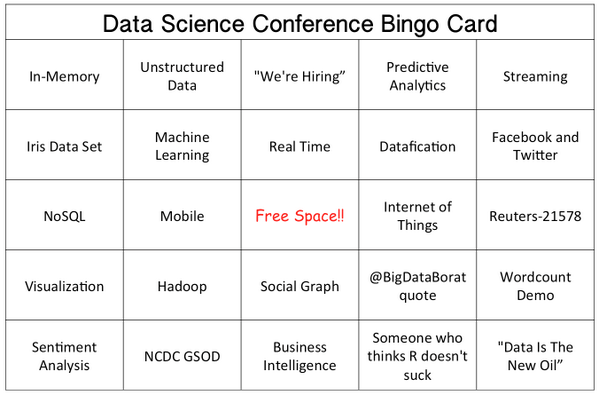
I’m on a search committee for a tenure track position in statistics and computer science — we’re looking for someone to teach a data science course, maybe a little bioinformatics on the side, and work with both our statistics and computer science disciplines. I’m the outside member of the committee — you know, the weirdo who isn’t steeped deeply in the culture of the disciplines and maybe is better able to provide the big picture perspective on how candidates will fit with the rest of the university — so I know next to nothing about this stuff. My eyes were crossing and my brain was breaking as I reviewed candidate applications. What I really needed was this bingo card. I think I saw all of those terms fly by as I was flipping through CVs and research and teaching statements.

Don’t worry, I deferred to the expertise of my colleagues on all matters dealing with the details of their work.

It’s always interesting, though, to peek into the domains outside my own, and feel a little humbled at all the stuff I don’t know.

Mary’s Monday Metazoan: A CAT??!?!

I don’t know about this. We’re at my daughter’s house for Christmas, and she and my wife obviously conspired to force this on me. Only good thing about it is that it accurately portrays the feline attitude: slitted, angry eyes, sneakily trying to get into the Christmas presents early.

Midnight making mischief

Midnight making mischief

I hate OnSwipe

This is a bit of privileged peevishness. There is this absolutely horrible piece of CSS that is widely used on many big name sites — it is used for portable devices like iPads and iPhones, and what it does is completely change the displayed formatting of the site. Suddenly, pages aren’t scrollable, but are broken up into screen-sized chunks, and you no longer change views by scrolling up and down, but by swiping side to side. And it throws a couple of cryptic icons on the bottom of the screen (do I want to know what the rocketship does? No, I do not.) It is classic too-clever-by-half web design, and I hate it.

When I’m browsing on my iPad, and I run into a site with OnSwipe enabled, I just abandon it. Nope, not worth the hassle.

What I really want to know from sites that use it is a) what made you think your readers want to abandon all the comfortable conventions of the web experience when they read your site on a portable device, because that makes no sense at all, and b) did you pay money for this piece of shit?

Tone-deaf Twitter

There are some serious problems with how Twitter handles blocking — in particular, if I block some obnoxious twit, but they post to a hashtag I follow (a conference hashtag, for instance), their messages are still displayed. This is the major reason why the BlockBot emerged — that automated widget that simply refuses to display tweets from a collection of known harassers, so that you can follow it instead of the hashtag — because Twitter won’t do the job.

Now, finally, Twitter gets around to changing the blocking behavior …and makes it worse. It used to be blocking someone also made them unfollow you, which made it very slightly harder for the harassers to stalk you. Apparently, inconveniencing assholes was intolerable to Twitter, so they’ve now changed it so blocking only mutes them, but still allows them to easily follow your every word, flag your tweets, and echo them to their clinging flock of fellow harassers. The harassers are now simply made invisible to the people they want to harass.

Imagine if the police were this helpful, and if you complained about someone and asked for protection, their response would be to magically make them invisible for you.

Why did they do this? I have no idea, except that there must be some assholes on the Twitter staff, which should surprise no one.

It’s probably futile, but there’s a petition asking them to stop making life easier for the jerks. I have no confidence they’ll listen or care, but go ahead, ask Twitter nicely.

Otherwise…hey, world, did you know there’s an available niche for a twitter-like service that also offers reasonable blocking and a little protection for users, and that doesn’t pander to misogynistic scumbags? They really could use some competition.


I found someone who likes the new policy (warning: links to creep pretending to masturbate…and just the description is enough, don’t you think?) That’s what we’re dealing with. That’s who Twitter’s policy panders to.


Twitter has reversed their changes. They’ve got a rather weird explanation for the earlier change, though.

In reverting this change to the block function, users will once again be able to tell that they’ve been blocked. We believe this is not ideal, largely due to the retaliation against blocking users by blocked users (and sometimes their friends) that often occurs. Some users worry just as much about post-blocking retaliation as they do about pre-blocking abuse. Moving forward, we will continue to explore features designed to protect users from abuse and prevent retaliation.

WTF? So I was supposed to worry that harassers I block might retaliate by…what? More online harassment? I assure you, they were going to do that anyway.