The reification of the gene

Razib Khan poked me on twitter yesterday on the topic of David Dobbs’ controversial article, which I’ve already discussed (I liked it). I’m in the minority here; Jerry Coyne has two rebuttals, and Richard Dawkins himself has replied. There has also been a lot of pushback in the comments here. I think they all miss the mark, and represent an attempt to shoehorn everything into an established, successful research program, without acknowledging any of the inadequacies of genetic reductionism.

Before I continue, let’s get one thing clear: I am saying that understanding genes is fundamental, important, and productive, but it is not sufficient to explain evolution, development, or cell biology.

But what the hell do we mean by a “gene”? Sure, it’s a transcribed sequence in the genome that produces a functional product; it’s activity is dependent to a significant degree on the sequence of nucleotides within it, and we can identify similar genes in multiple lineages, and analyze variations both as a measure of evolutionary history and often, adaptive function. This is great stuff that keeps science careers humming just figuring it out at that level. Again, I’m not dissing that level of analysis, nor do I think it is trivial.

However, I look at it as a cell and developmental biologist, and there’s so much more. That gene’s transcriptional state is going to depend on the histones that enfold it and the enzymes that may have modified it; it’s going to depend on its genetic neighborhood and other genes around it; it’s not just sitting there, doing its own thing solo. And you will cry out, but those are just products of other genes, histone genes and methylation enzymes and DNA binding proteins, and their sequences of nucleotides! And I will agree, but there’s nothing “just” about it. Expression of each of those genes is dependent on their histones and methylation state. And further, those properties are contingent on the history and environment of the cell — you can’t describe the state of the first gene by reciting the sequences of all of those other genes.

Furthermore, the state of that gene is dependent on activators and repressors, enhancer and silencer sequences. And once again, I will be told that those are just genetic sequences and we can compile all those patterns, no problem. And I will say again, the sequence is not sufficient: you also need to know the history of all the interlinked bits and pieces. What activators and repressors are present is simply not derivable from the genes alone.

And I can go further and point out that once the gene is transcribed, the RNA may be spliced (sometimes alternatively) and edited, processed thoroughly, and be subject to yet more opportunities for control. I will be told again that those processes are ultimately a product of genes, and I will say in vain…but you don’t account for all the cellular and environmental events with sequence information!

And then that RNA is exported to the cytoplasm, where it encounters other micro RNAs and finds itself in a rich and complex environment, competing with other gene products for translation, while also being turned over by enzymes that are breaking it down.

Yes, it is in an environment full of gene products. You know my objection by now.

And then it is translated into protein at some rate regulated by other factors in the cell (yeah, gene products in many cases), and it is chaperoned and transported and methylated and acetylated and glycosylated and ubiquitinated and phosphorylated, and assembled into protein complexes with all these other gene products, and its behavior will depend on signals and the phosphorylation etc. state of other proteins, and I will freely and happily stipulate that you can trace many of those events back to other genes, and that they respond in interesting ways to changes in the sequences of those genes.

But I will also rudely tell you that we don’t understand the process yet. Knowing the genes is not enough.

It’s as if we’re looking at a single point on a hologram and describing it in detail, and making guesses about its contribution to the whole, but failing to signify the importance of the diffraction patterns at every point in the image to our perception of the whole. And further, we wave off any criticism that demands a more holistic perspective by saying that those other points? They’re just like the point I’m studying. Once I understand this one, we’ll know what’s going on with the others.

That’s the peril of a historically successful, productive research program. We get locked in to a model; there is the appeal of being able to use solid, established protocols to gather lots of publishable data, and to keep on doing it over and over. It’s real information, and useful, but it also propagates the illusion of comprehension. We are not motivated to step away from the busy, churning machine of data gathering and rethink our theories.

We forget that our theories are purely human constructs designed to help us simplify and make sense of a complex universe, and most seriously we fail to see how our theories shape our interpretation of the data…and they shape what data we look for! That’s my objection to the model of evolution in The Selfish Gene: it sure is useful, too useful, and there are looming barriers to our understanding of biology that are going to require another Dawkins to disseminate.

Let me try to explain with a metaphor — always a dangerous thing, but especially dangerous because I’m going to use a computer metaphor, and those things always grip people’s brains a little bit too hard.

In the early days of home computing, we had these boxes where the input to memory was direct: you’d manually step through the addresses, and then there was a set of switches on the front that you’d use to toggle the bits at that location on and off. When a program was running, you’d see the lights blinking on and off as the processor stepped through each instruction. Later, we had other tools: I recall tinkering with antique 8-bit computers by opening them up and clipping voltmeters or an oscilloscope to pins on the memory board and watching bits changing during execution. Then as the tools got better, we had monitors/debuggers we could run that would step-trace and display the contents of memory locations. Or you could pick any memory location and instantly change the value stored there.

That’s where we’re at in biology right now, staring at the blinking lights of the genome. We can look at a location in the genome — a gene — and we can compare how the data stored there changes over developmental or evolutionary time. There’s no mistaking that it is real and interesting information, but it tells us about as much about how the whole organism works and changes as having a readout that displays the number stored at x03A574DC on our iPhone will tell us how iOS works. Maybe it’s useful; maybe there’s a number stored there that tells you something about the time, or the version, or if you set it to zero it causes the phone to reboot, but let’s not pretend that we know much about what the machine is actually doing. We’re looking at it from the wrong perspective to figure that out.

You could, after all, describe the operation of a computer by cataloging the state of all of its memory bits in each clock cycle. You might see patterns. You might infer the presence of interesting and significant bits, and you could even experimentally tweak them and see what happens. Is that the best way to understand how it works? I’d say you’re missing a whole ‘nother conceptual level that would do a better job of explaining it.

Only we lack that theory that would help us understand that level right now. It’s fine to keep step-tracing the genome right now, and maybe that will provide the insight some bright mind will need to come up with a higher order explanation, but let’s not elide the fact that we don’t have it yet. Maybe we should step back and look for it.

A little history of zebrafish research

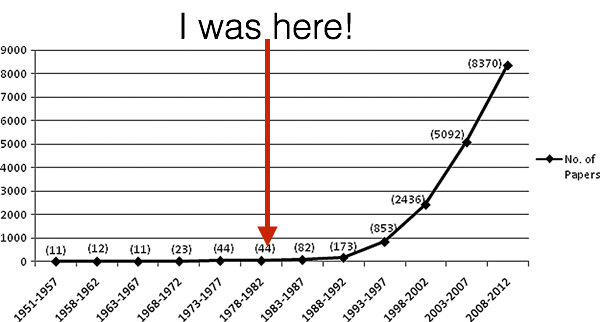
I was amused to see this review of the history of zebrafish publications. It describes some of the trends in the research (read: lots of developmental biology), and plots the number of papers published. I started working with zebrafish in 1979, so I’ve marked where I began.

zfpapers

You know, when I started out as a grad student in this field, the literature search was pretty easy. Almost all the people who had published on this model system were right there in this one collection of labs at the University of Oregon, with a few other former students scattered elsewhere, so I could just turn to all of the primary authors and ask them directly about anything. There were a few older papers, but as I recall, almost all of them had to do with zebrafish as guinea pigs in environmental toxicology studies.

It’s a little bit different now.

(Of course, that didn’t mean I didn’t have lots to read — the questions were all focused on neurobiological and developmental topics in other organisms. Even now you shouldn’t center your reading on just one experimental animal!)

Higher order thinking

The one thing you must read today is David Dobbs’ Die, Selfish Gene, Die. It’s good to see genetic accommodation getting more attention, but I’m already seeing pushback from people who don’t quite get the concept, and think it’s some kind of Lamarckian heresy.

It’s maybe a bit much to ask that the gene-centric view of evolution die; it’s still useful. By comparison, for instance, it’s a bit like Mendel and modern genetics (I’ll avoid the overworked comparison of Newton and Einstein.) You need to understand simple Mendelian genetics — it gives you a foundation in the logic of inheritance, and teaches you a few basic rules. But once you start looking at real patterns of inheritance of most traits, you discover that it doesn’t work. Very few traits work as Mendel described, and one serious concern is that we tend to select for genes to study that behave in comprehensible ways.

And every geneticist knows this. Mendel was shown to have got some things wrong within a decade of his rediscovery: Mendel’s Law of Independent Assortment, for instance, simply does not hold for linked genes, and further, linkage turns out to hold important evolutionary implications. But I still teach about independent assortment in my genetics course. Why? Because you need to understand how to interpret deviations from the simple rules; it’s an “a-ha!” moment when you comprehend how Morgan and Sturtevant saw the significance of departures from Mendel’s laws.

Most of genetics seems to be about laying a foundation, and then breaking it to take a step beyond. Teaching it is a kind of torture, where you keep pushing the students to master some basic idea, and then once they’ve got it, you test them by showing them all the exceptions, and then announcing, “But hey! Here’s this cool explanation that tells you what you know is wrong, but there’s some really great and powerful ideas beyond that.”

That’s what’s fun about genetics: compounding a series of revelations until the students’ brains break, usually right around the end of the term. Over the years I’ve learned, too. Undergraduate genetics students usually collapse in defeat once I introduce epistatic interactions — the idea that the phenotype produced by an allele at one locus is dependent on the alleles present at other loci — but it’s always great to see the few students who fully grasp the idea and see how powerful it is (future developmental biologists identified!).

And that’s how I see the gene-centric view: absolutely essential. You must understand Mendel, and Fisher, and Wright, and Hamilton, and Williams, and once you’ve mastered that toolkit, you can start looking at the real world and seeing all the cases where it’s deficient, and develop new tools that let you see deeper. The new idea that Dobb’s describes, and that is actually fairly popular with many developmental biologists, is that phenotype comes first: that organisms are fairly plastic in response to the environment in ways that can’t be simplified to pure genetic determinism, and that the genes lag behind, acting to consolidate and make more robust adaptive responses.

I’ve written about genetic assimilation/accommodation before, and have given one lovely example of phenotypic change occurring faster than the generation of new mutants can explain. It’s always baffled me about the response to those ideas: most people resist, and try to reduce them to good old familiar genes. It’s a bit like watching students wrestle with epistatic modulation of gene expression when all they understand is Mendel, and rather than try to grasp a different way of looking at the problem, they instead invent clouds of simple Mendelian factors that bring in multi-step discrete variations. They can make the evidence fit the theory — just add more epicycles!

I’m seeing the same responses to Dobbs’ article — it’s still all just genes at the bottom of it, ain’t it? Oh, sure, but the interesting parts are the interactions, not the subunits. We need to take the next step and build tools to study networks of genes, rather than reducing everything to the genes themselves.

Now you too can pretend you were at Skepticon this year

Here’s my talk on the Cambrian from Skepticon 6.

Oh, hey, I just realized I could post the content of that text-heavy slide I flashed, showing the sources I used. So here you go:

Web reviews from Donald Prothero, Nick Matzke, Larry Moran.

Briggs, D.E.G.; Fortey, R.A. (1989). The early radiation and relationships of the major arthropod groups. Science, 246(4927), 241-243.
Budd, G. E., and S. Jensen. 2000. “A critical reappraisal of the fossil record of the bilaterian phyla.” Biological Reviews 75:253-295.
Erwin D and Valentine J (2013). The Cambrian explosion : the construction of animal biodiversity. Greenwood Village, CO, Roberts and Company Publishers.
Marshall, Charles R. (2006). “Explaining the Cambrian ‘explosion’ of animals.” Annual Review of Earth and Planetary Sciences. 34: 355-384.
Smith MP, Harper DAT (2013) Causes of the Cambrian Explosion. Science 341:1355.
Long M, Betran E, Thornton K, Wang W (2003) The origin of new genes: glimpses from the young and old. Nature Rev Genet 4:865.
Knoll AH, Carroll SB (199) Early Animal Evolution: Emerging Views from Comparative Biology and Geology. Science 284:2129.
Erwin DH, Laflamme M, Tweedt SM, Sperling EA, Pisani D, Peterson KJ (2011) The Cambrian conundrum: early divergence and later ecological success in the early history of animals. Science. 334(6059):1091.
Peterson KJ, Dietrich MR, McPeek MA (2009) MicroRNAs and metazoan macroevolution: insights into canalization, complexity, and the Cambrian explosion. Bioessays. 31(7):736.

Amazon’s next attempt at world domination

They’re going to be doing deliveries by drone.

I don’t think I’ll live close enough to a distribution center for these to come buzzing by my house, so I’m not going to worry about them yet. I’m am remembering that in my younger days I was a deadly shot with a slingshot…I may have to start practicing.

I might change my pessimism about fleets of drones flitting about overhead, if they’re actually shown to represent an energy savings.

Friday Cephalopod: Black Friday

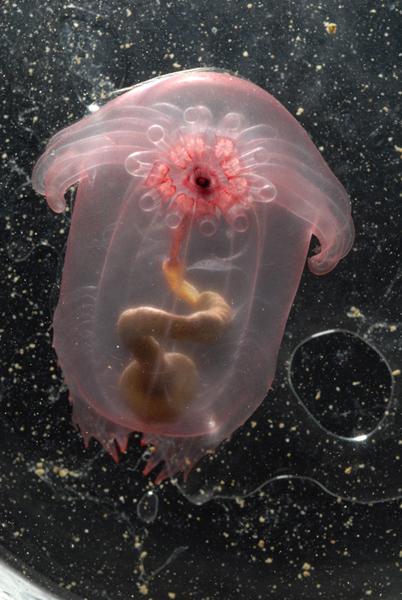
Vampyroteuthis would like you to know that it is forgivable that you visit Walmart or any of the other greedy big box stores today in search of bargains; however, the retailers who exploit their workers and gin up scarcity and treat the desperate poor as targets are going to someday find themselves dying cold, dark, hypoxic deaths, and the grim clammy bleak squid of their conscience will rise up to drag them down into oblivion. Live humanely while you can. They wait.

Casual reductionism and genetic determinism

Finally, a tiny voice of caution speaks out against the genetic testing hype.

The Food and Drug Administration has ordered DNA testing company 23andMe to stop marketing its over-the-counter genetic test, saying it’s being sold illegally to diagnose diseases, and with no proof it actually works.

The heavily marketed test includes a kit for sampling saliva, and the company promises to offer specific health advice. “Based on your DNA, we’ll provide specific health recommendations for you,” the company says on its website. "Get personalized recommendations."

In an unusually scathing letter dated Friday, the FDA says it’s been trying to work with the company to get some sort of evidence that the test can do that with any accuracy.

I had no idea that 23andMe was making any health claims, and that’s deplorable. You can’t do that. That’s naive billiard-ball-biology, and it’s never going to be as simple as testing a few markers and then declaring that you understand physiology.

I prefer the approach of the National Genographic project, where the results are used to infer relationships rather than leaping to biomedical conclusions. We have far more accurate tools for determining your medical condition — it’s direct and involves examining your health, rather than indirectly looking at genes that have a remote connection to your health.

Which brings me to an essay that had me gawping in disbelief. A neuroscientist, James Fallon, noticed the results of a PET scan of his own brain.

“I got to the bottom of the stack, and saw this scan that was obviously pathological,” he says, noting that it showed low activity in certain areas of the frontal and temporal lobes linked to empathy, morality and self-control. Knowing that it belonged to a member of his family, Fallon checked his lab’s PET machine for an error (it was working perfectly fine) and then decided he simply had to break the blinding that prevented him from knowing whose brain was pictured. When he looked up the code, he was greeted by an unsettling revelation: the psychopathic brain pictured in the scan was his own.

OK. If this happened to me, I’d place the most importance on my personal experience — if I were a successful professional with no history of unethical behavior, I’d say “uh-oh…maybe these scans aren’t such a reliable indicator of personality after all.” I would not say, “uh-oh, I must be a psychopath.”

But guess what interpretation Fallon put on it? He got genetic tests.

But when he underwent a series of genetic tests, he got more bad news. “I had all these high-risk alleles for aggression, violence and low empathy,” he says, such as a variant of the MAO-A gene that has been linked with aggressive behavior. Eventually, based on further neurological and behavioral research into psychopathy, he decided he was indeed a psychopath—just a relatively good kind, what he and others call a “pro-social psychopath,” someone who has difficulty feeling true empathy for others but still keeps his behavior roughly within socially-acceptable bounds.

Wow. And then he starts self-rationalizing. He’s aggressive when he plays games, therefore his diagnosis must be true. He admits that maybe this isn’t as clear-cut as he thinks.

But the fact that a person with the genes and brain of a psychopath could end up a non-violent, stable and successful scientist made Fallon reconsider the ambiguity of the term. Psychopathy, after all, doesn’t appear as a formal diagnosis in the Diagnostic and Statistical Manual of Mental Disorders in part because it encompasses such a wide range of symptoms. Not all psychopaths kill; some, like Fallon, exhibit other sorts of psychopathic behavior.

But one thing he doesn’t consider? That maybe PET scans and genetic tests aren’t as robust and interpretable as he thinks. What I find personally chilling is that he so blithely considers a scan or a gene so definitive that he will defend a diagnosis of psychopathy in himself; does he also judge the subjects of his research on the basis of these abstractions rather than on their behavior?