Skepticism has a serious problem, and there are a couple of reasons I’ve grown disenchanted with its current incarnation. Belief is a continuum, and I think that skepticism as it stands occupies an untenable part of that continuum.
On one side lie the extremely gullible; people who drift with the wind, and believe anything a sufficiently charismatic guru tells them, no matter how absurd. Far to the other side are the conspiracy theorists. These are people who believe fervently in something, who have a fixed ideology and will happily twist the evidence to support it, and are therefore completely refractory to reason and empiricism.
And then, somewhere in the middle lie science and skepticism. People readily conflate those two, unfortunately, and I think that’s wrong. Science is all about following the evidence. If a bit of evidence supports a hypothesis, you willingly accept it tentatively, and follow where it leads, strengthening or discarding your initial ideas appropriately with the quality of the evidence. You end up with theories that are held provisionally, as long as they provide fruitful guidance in digging deeper. It is ultimately a positive approach that winnows out bad ideas ruthlessly, but all in the cause of advancing our knowledge. I am far more comfortable with science then skepticism, because I’d rather be working towards a goal.
Skepticism is the flip side. It’s all about falsification and disproof and dismantling proposals. I think it is the wrong approach.
Consider one classic example: Bigfoot. Skepticism is all about taking apart case by case, demonstrating fakery or error, and demolishing the stories of the Bigfoot frauds. That’s useful — in fact, skepticism is most useful in dealing with malicious intent and human fakery — but it doesn’t advance our knowledge significantly. The scientific approach would involve actually studying forest ecology, understanding how the ecosystem works, and getting a handle on what lives in the forest…and at the end, you’re left with something informative about the nature of the habitat, as well as a recognition that a giant ape isn’t part of the puzzle.
Again, sure, there are good and necessary aspects of skepticism. When you’ve got a fraud like Burzynski peddling fake cancer cures, the skeptical toolbox is helpful. But in the end, when you’ve shown that injecting processed horse urine into people doesn’t help anything, what are you left with? Better to understand the nature of cancer and normal physiology, providing alternatives and useful explanations for why the cancer quacks are wrong. That’s why the best skeptics of quackery are doctors and scientists — they have positive insights to contribute in addition to simple falsification.
So far, I haven’t said anything that makes skepticism bad; it might be better regarded as a complement to the scientific approach, that clears away the garbage to unclutter the operating field. Unfortunately, the current doctrines of organized skepticism open the doors to pathology, because they so poorly define the proper domain of skepticism, and what they do say are inconsistent and incoherent. What we’re stuck with is a schema that tolerates motivated reasoning, as long as it looks like debunking.
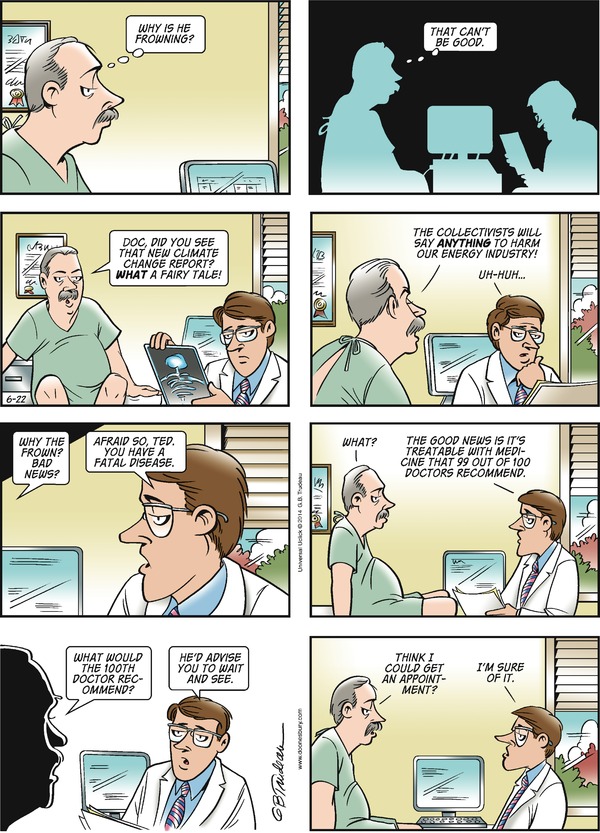
So we get skeptics who argue against the dangers of second-hand tobacco smoke, or anthropogenic climate change — it’s OK, because they’re being critical — and these same skeptical entertainers are lauded for berating an MD and throwing him out of a party, because he had criticized their pandering to a quack…and also their climate change denialism. Do I even need to get into their contemptible sexism or their Libertarian bullshit?
And then the movement as a whole has been wracked with this bizarre denial of sexual harassment, and refusal to deal with the issue. I think part of it has to be a culture of dealing with complications by rejecting them — that the movement is full of individuals whose favored approach to the deplorable messiness of human interactions and the existence of malefactors is by retreating into a Spock-like insistence that the problem does not compute, and therefore can be ignored. It’s a culture of explaining away, rather than explaining.
Also…hyperskepticism. Some people take their skepticism to such pathological extremes that they become conspiracy theorists or fanatical denialists of simple human behavior. I encountered an example of this yesterday that had me stunned with its contrarian stupidity. Not all skeptics (hah!) are this bad, but too many tolerate and approve of it.
A short while ago, I received a very nice letter from a young woman in Indiana who liked my book. I scanned it and posted it, with her name and town redacted — it was a lovely example of a phenomenon we’ve noticed for quite some time, of the way the internet and books about atheism have opened the door for many people who had previously felt isolated. It also said kind things about The Happy Atheist, so of course I was glad to share it.
Some nut named Cavanaugh, in the name of True Atheism and Skepticism, has posted a lengthy dissection of the letter. He doesn’t believe it’s real. He thinks I wrote it myself. To prove his point, all he has is the scan I posted…so he has taken it apart at excruciating and obsessive length. He has carefully snipped out all the letters “w” in the letter, lining them up so you can easily compare them. My god, they’re not identical! He has another figure in which he has sliced out a collection of ligatures — would you believe the spacing between letters, in a handwritten letter, is not consistent? She used the word “oblivious” a couple of times…a word that I also have used many times. She wrote exactly one page, not two. He mansplains the psychology of teenaged girls to assert that there’s no way a 15-year-old woman could have written the letter. You get the idea. He is being properly skeptical, accumulating a body of “facts” to disprove the possibility that someone in Indiana actually wrote a letter.
Furthermore, he lards his account with purely imaginative stories about what my correspondent was thinking — he injects his account with the most contemptible interpolations, like this one.
It’s okay, Mr. Myers, she reassures him, I think you’re cool. I’m just like you, and if I can make it through, so can you. Keep spreading the word. Oh, and come rescue me from Indiana — I’ll be legal in 2016.
That was not in the letter, of course: he made it all up. On the basis of his own foul-minded speculations, he transformed a pleasant fan letter into a come-on from a small town Lolita. It’s a disgusting spectacle of hyperskepticism gone wild. Oh, and skepticism and atheism: Jebus, but you do have a misogyny problem. Please stop pretending you don’t.
And boy, am I glad I cut out the name and hometown from that letter. Can you imagine if I’d left it in, and asshole Matt Cavanaugh thought it would be clever to do some investigative skepticism, tracked down her phone number, and called her up to slime her with innuendo directly? It would be a natural and expected step in the hyperskeptical toolbox to make such a thorough examination of all the data.
So stands movement skepticism, perfectly tuned to question the existence of chupacabras or UFOs. But also poised to doubt the existence of the US Postal Service, while simultaneously sneering at atheists who reject the biggest chupacabra of them all, god, flying in the grandest possible UFO, heaven. When your whole business model is simply about rejecting fringe claims, rather than following the evidence no matter how mainstream the target, you’ll inevitably end up with a pathologically skewed audience that uses motivated reasoning to abuse the weak. And you end up valuing flamboyance and showmanship over the contributions of science…unless, of course, the scientist has grope-worthy breasts.
So no thanks, skepticism. I’ll stick with science.
Also, if my Indiana correspondent should stumble across this faux “controversy,” I am very, very sorry. Apparently it isn’t quite safe yet for everyone to come out — the wider internet, as well as rural America, has its share of small-minded, pettily vicious shit-weasels.