Pharyngula
Evolution, development, and random biological ejaculations from a godless liberal


Oh, that’s right — that’s what philosophers are good for. They’re really good at questioning models. John Wilkins has been busily dismantling the cheap and easy metaphors we use to describe molecular biological concepts in a series of posts, taking on genes as language, other popular gene myths and metaphors, and explaining why genes aren’t information. The problem is that when we explain stuff we know well to students, we use metaphors and analogies to get across the initial ideas, and unfortunately, because scientists are human, the metaphors take on a life of their own and sometimes become the dominant paradigm for understanding the reality. And that can be hazardous.
I’ve lived through the era in which everyone started thinking of the genome as an elaborate computer program — we still have lots of people thinking that way, and in some ways it’s gotten worse as bioinformatics has brought in a synergy with computer science. But it’s not! It’s nothing like a series of instructions! This model has become a serious impediment to getting the new generation of advanced students to understand the biology, and worse, they try to shoehorn the biology into how they think a sophisticated computer program ought to work.
We’ve also got the problem of naive idiots thinking the metaphor is the thing and drawing false conclusions. The genome is a recipe, and every recipe needs a cook, therefore God, etc., etc., etc., ad nauseam.
Genes and DNA are one important component of a complex of compartmentalized biochemical reactions, in which every reaction product interacts with and influences the state of the whole. We’re seeing an excessive reductionism borne of the last 50 years of success in molecular biology, and it’s about time the pendulum swung back to a more balanced perspective. One gene tells us very little; you need to step back and look at the interactions of networks of gene products in a complex environment to understand what’s going on in the cell, and then you have to step back further to look at patterns of interactions between cells, and then further still to see how individuals interact with one another and the environment, and then you have to step way back to see how populations interact, and then, maybe then, you’re really talking about evolution.

It’s true — I’ve heard a lot more about student protests of commencement speakers this year. At the Twin Cities branch campus of my university, for instance, there was an eruption of student activism over inviting war criminal Condoleeza Rice to give the commencement address — although part of the protest may have been over the fact that she would have been paid $150,000 to spew a few platitudes for 20 minutes.
We may have been missing the point. Zach Weinersmith explains the situation.
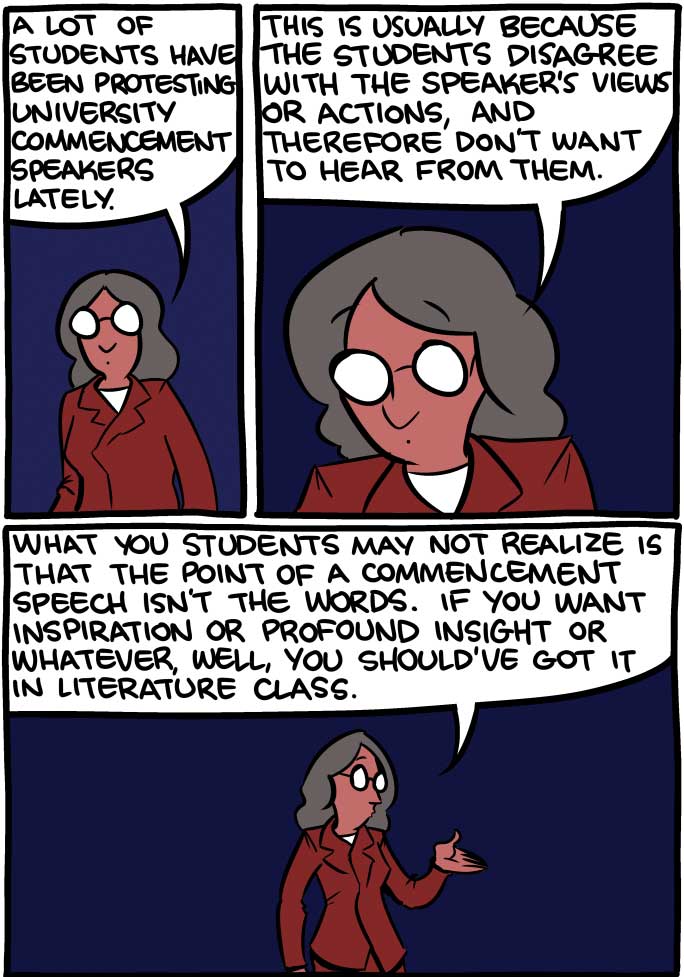
He then goes on to explain the reason behind these costly displays. I give you a choice. You can go read the rest of the comic, which is the easy way out. Or you can go read this paper by Joseph Henrich (pdf), titled “The evolution of costly displays, cooperation and religion: credibility enhancing displays and their implications for cultural evolution”, which will take rather more of your time, requires slogging through a little math and logic, but will enhance your credibility because of your investment in the subject.
The paper is also a little annoying because it will require looking at a university, or any other institution, through the same lens you would a religion. I made that sacrifice, though, so that you can see my opinion as justified and worthy by virtue of my effort.
Now I have to take my wife on a walk to the coffee shop…to help her “determine how much to commit to, or believe in, a particular representation”. I can tell that thinking this way is going to lead to a rather cynical transactional view of relationships.

I met Karl Banse, the famous oceanographer, a few times. Back when I started college, I was an oceanography major for a brief while, but then I got introduced to embryos of marine invertebrates and got seduced into developmental biology. I had no idea that he was destined to write a scientific paper on the biology of mermaids (pdf available), or I might not have drifted over to the zoology department.
Or on second thought, I might have been propelled even faster. It turns out that mermaids are nasty creatures.
Regarding mermaid behavior, a recurrent theme is the habit of the females to haul out on beaches (usually in pairs) allegedly to lure, then seduce sailors; their voices were repeatedly recorded as being “irresistible”. Perhaps they lured- but the stark fact was that they then drowned the men and devoured their flesh. Similarly, when ships broke up in gales, the females pulled sailors down into their abodes for further disposition.
Once again, Disney betrays reality. Ariel was not accurately portrayed.

Who are you going to trust, Brian Morris or your penis? Brian Earp and Robert Darby take apart all of the ardent foreskin-hater’s arguments.
As for my question, I think my penis is far more honest and forthright than Brian Morris.

I was watching this, and thinking, “Man, octopus can dance.” If I could have moved like that, I might not have sullenly sat out the disco era.


Via Mano, we get to learn what it was like working in the stem cell lab of Piero Anversa.
The day to day operation of the lab was conducted under a severe information embargo. The lab had Piero Anversa at the head with group leaders Annarosa Leri, Jan Kajstura and Marcello Rota immediately supervising experimentation. Below that was a group of around 25 instructors, research fellows, graduate students and technicians. Information flowed one way, which was up, and conversation between working groups was generally discouraged and often forbidden.
Raw data left one’s hands, went to the immediate superior (one of the three named above) and the next time it was seen would be in a manuscript or grant. What happened to that data in the intervening period is unclear.
A side effect of this information embargo was the limitation of the average worker to determine what was really going on in a research project. It would also effectively limit the ability of an average worker to make allegations regarding specific data/experiments, a requirement for a formal investigation.
The general game plan of the lab was to use two methods to control the workforce: Reward those who would play along and create a general environment of fear for everyone else. The incentive was upward mobility within the lab should you stick to message. As ridiculous as it sounds to the average academic scientist, I was personally promised money and fame should I continue to perform the type of work they desired there. There was also the draw of financial security/job stability that comes with working in a very well-funded lab.
On the other hand, I am not overstating when I say that there was a pervasive feeling of fear in the laboratory. Although individually-tailored stated and unstated threats were present for lab members, the plight of many of us who were international fellows was especially harrowing. Many were technically and educationally underqualified compared to what might be considered average research fellows in the United States. Many also originated in Italy where Dr. Anversa continues to wield considerable influence over biomedical research.
Wow. I was sure lucky. When I was in grad school, I was in a research group of about the same size, with primarily 3 people running 3 labs: Chuck Kimmel, Monte Westerfield, and Judith Eisen. They were independent and co-equal. Their post-docs and grad students and undergrads pretty much had free run of all of the labs, to the point where it was often difficult to tell who was officially associated with which lab. We had weekly lab meetings in which we’d freely share data with each other; if someone had a good idea or a set of relevant skills, we’d have collaborations. When it was time to publish a paper, the people who had done the work would get together to write it, and authorship reflected the research team, not some hierarchy…so I emerged from grad school with papers published with both Monte and Judith, but not a one with my titular lab head’s name on it, because he had these scruples about not putting his name on work to which he had not personally and directly contributed.
I thought that was how everyone did science, as an open and egalitarian process. I guess I was wrong.
If you want more examples of science being done badly, Harvard has released the full report on the Marc Hauser scientific misconduct case. It’s clear that he faked data, and demanded that his students confirm his hypotheses. Hauser’s defense: “people in his laboratory conspired against him, due to academic rivalry and disgruntlement”, a claim that did not hold up in the investigation.
I seriously cannot imagine Chuck Kimmel, or any of my academic mentors, ever tolerating any of the shenanigans Hauser was pulling. Just the idea that you’d gather data and then pass it up a hierarchy for analysis, and be told by your advisor what it meant…bizarre.
Man, was I lucky. I hope all of you who are in grad school are following these scandals, and seeing modeled how science should not operate — and are standing up for scientific integrity in your own labs. Be involved in every step of an experiment, collaborate and share ideas, question authority. It’s the only way to do good science.

I’m having a light dinner while traveling off to a visit with Humanists of Minnesota, and I thought I’d deal with a little email. I got a request to address a fairly common creationist argument–here’s the relevant part of the claim.
As a member of the Greater Manchester Humanists I was recently involved in a discussion with the Ahmadi sect of Islam with regards to evolution. They had asked me to look at a couple of chapters in a book entitled ‘Revelation, Rationality, Knowledge and Truth by their prophet Mirza Tahir Ahmad. One of those chapters was called ‘The Blind Watchmaker who is also Deaf and Dumb’ – riffing badly on Dawkins’s book, of course. Suffice it to say, there was very little of any of that in the book, but during the discussion one of their number said he did not believe in neo-Darwinism because he could not see ‘how all the supporting and connecting mult-component systems could all have evolved as, for example, the eye, as it progressed through geological time.’
He quoted the hagfish and work done by Prof Trevor Lamb to show ‘just how complex those multi-component systems are’ – but when I looked up Lamb’s work it is quite obvious that he is a supporter of evolution, and that he in no way suggests that such complexity is divine in nature….!
Yep, he’s got us. If evolution were sequential, linear, and goal-directed, this would be a serious problem. If you’re used to imagining that the only way complexity can possibly emerge is by purposeful, serial action to build an end result, rather like putting together your furniture from Ikea or building a model airplane, then gosh, it all seems so impossible.
Unfortunately for the follower of Mirza Tahir Ahmad, none of that is true, and this is just a variant of the “it’s too complicated to evolve” argument, with more sciencey sounding words and references to misinterpreted fragments of the scientific literature.
Let’s consider the major misconceptions in the question.
Evolution isn’s sequential. It’s massively parallel. Massively. Humans have about 20,000 genes, and all of them are evolving at once, with trial runs in about 7 billion individuals. New variants are arising all the time, and then they’re tested to destruction in multiple combinations over time. Scrap your weird idea that the pieces of a complex system must be developed one at a time — they can’t, and all of them are being constantly tinkered with. It is the most badly designed scientific experiment or engineering program ever, with no controls and every variable getting randomly tweaked at random intervals. So don’t be surprised that multiple elements are getting juggled.
Evolution doesn’t care how it arrives at a solution — all that matters is the final effect on the organism. In the case of the eye, the viable end result is an organ with sufficient resolution and contrast, and various special purpose detectors for things like motion or looming. The organism doesn’t know or care how that comes about — it is born with a combination of attributes, and lives or dies by their success. It may have accomplished its end by, for instance, refining the lens, or fine-tuning the receptor, or building in secondary signal processing elements…or all of the above and more. The organism doesn’t care and doesn’t have any control. And in a massively parallel system, probably every level is being tinkered with, and the final solution is going to be multi-component
. It would be weird if it wasn’t.
Evolution is not teleological. An organ like the eye is not being assembled to a set of specific, detailed instructions — it just has to work, or the organism is at a disadvantage to other organisms with better eyes. So a hodge-podge of solutions is accumulated, and the end result has all kinds of complexity. But you don’t get to argue after the fact that the details imply some specificity of purpose.
For example, here’s a number: 343767. It’s kind of big, you might be tempted to argue that it’s a fancier or more complex number than, say, 300000 (you’d be wrong), or you might want to argue for the significance of individual digits, or find a pattern in it. Humans tend to do that. But the reality is that I just went to a random number service and asked for a 6 digit number. Similarly, eyes wandered through a random space constrained by functional requirements and ended up at a somewhat arbitrarily complex configuration — and different lineages followed different paths.
OK, that’s my off-the-cuff explanation scribbled up while I nibble on a fruit salad at a cafe in Minneapolis. The whole multi-component
problem is a red herring contrived by inadequate minds that can’t see beyond their preconceptions.

Vocal fry is in the news again! Bethany Brookshire explains:
Bringing to mind celebrity voices like Kim Kardashian or Zooey Deschanel, vocal fry is a result of pushing the end of words and sentences into the lowest vocal register. When forcing the voice low, the vocal folds in the throat vibrate irregularly, allowing air to slip through. The result is a low, sizzling rattle underneath the tone. Recent studies have documented growing popularity of vocal fry among young women in the United States. But popular sizzle in women’s speech might be frying their job prospects, a new study reports. The findings suggest that people with this vocal affectation might want to hold the fry on the job market — and that people on the hiring side of the table might want to examine their biases.
I’m at a liberal arts college that is attended by at least 60% women, and I hear it all the time — and it doesn’t bother me in the slightest. People have different voices, there are patterns that mark men and women, young and old, regions and races, and it’s no big deal — I actually find that the vocal fry becomes more common as people become less formal and more friendly, so it’s more a signature of a kind of knowing familiarity.
I thought that if it were off-putting in a job interview, as that study finds, it might be because that’s a situation with an expectation of greater formality, or as Language Log suggests, it’s because the recordings used in the study were a bit forced, and people trying to use an unnatural (to them) style of speaking can easily come across as insincere. But surely we don’t judge people by small variations in their speech, do we?
I forgot. People suck.
In an article on vocal fry on NPR, the commenters persuade me that there probably actually is considerable discrimination going on.
Ms. Eveleth admitted that she “sometimes” catches herself in her own high rising terminal (“upspeak”). How could she miss it, considering the number of people it must cause to void the contents of their stomachs?
More alarming than Eveleth’s contemptible defense of creaky speak was prominent on-air talent Rachel Martin’s claim that she’d never even heard of “vocal fry”. This is the state of broadcast journalism.
Upspeak bothers you? So much that you want to vomit? I suggest that the problem isn’t so much with the speaker as it is with people who want to so thoroughly police others’ speech patterns to the degree that they feel physically ill when they hear variants. I’m wondering how this commenter reacts to a Southern accent, which I find lovely, or to a Black American accent (which I also heard all the time when I worked at Temple University), or, horrors, the pitch accent of so many people in the upper Midwest.
Vocal fry is so subtle that most people don’t recognize it as a discrete entity, but apparently it is an indictment of all of journalism that a reporter should fail to deplore it with the vigor this commenter demands.
This one is even worse.
Also funny that Rose Eveleth doesn’t think vocal fry would interfere with job performance. I’d suggest that she consider how impossible it is to work with someone who habitually scratches out the final words of every statement. Vocal fryers don’t hear each other doing it, I guess. A community of unconscious croakers.
It’s not just women, either. You hear it in interviews with young male media hipsters. Guy Raz of the Ted Radio Hour has a curious sing-song vocal fry.
Awareness is the first step toward a cure. America needs mass speech therapy in the worst way. Up speak, vocal fry, and Valley Girl princess speech all constitute a national cultural emergency.
Edit: On second listening, Ms. Eveleth is not that bad a fryer, mostly lapsing into it in the egg story. And fortunately, Rachel Martin is completely fry-free, and a full vocalizer.
It’s a national cultural emergency! Speech therapy must be administered immediately to eradicate all variation from General American!
Jebus. I’ve been all over the country, and one of the things I like is that people have their own unique ways of speaking — ways that are distinctive and regional and act as indicators of identity. I’ve been to the United Kingdom and heard the range of voices there — I don’t know what that is they speak in Scotland, but it deserves a more appropriate label than “English” — and that makes the addition of a faint growl to the end of sentences trivial.
This isn’t about language at all. These vocal variations don’t affect communication in the slightest. This is all about language as a marker for class, race, and sex, and providing the excuse of subtle differences in speech as a way to publicly air prejudices. That guy who detests “Up speak, vocal fry, and Valley Girl princess speech” isn’t actually perturbed by how they speak — he has singled out a set of patterns associated with young women.
I also notice an omission. If we’re going to have mass speech therapy for the entire country, why is it to correct everyone to the General American standard? Flat and nasal isn’t pretty. If we’re going to do this and enforce uniformity, I’m going to insist that we use Shelby Foote as a model and get everyone to talk like that, with voices like soft music. Or maybe the casual, confident, laid-back style of Snoop Dogg. I also wouldn’t mind Sarah Silverman as a voice coach.
Anything but the boringly level voice of standard radio announcers everywhere.