Goodbye Spring Break, hello Spring

It’s officially the first day of Spring. I looked outside to see if flowers had suddenly erupted, but it’s too early and too dark to see.

It’s also the end of our Spring Break, and I have to get back to work, although it’s not as if I took it easy this last week. I’m actually prepared! This is my agenda for the week:

  • Genetics: We’ve been working through chromosomal changes, and I’ve been a little concerned about some of the students not quite understanding what’s going on, so we’re going to spend the first half of class with me leading them through some visualization exercises. I’m going to give them some word problems and have them draw the answers — it should also be a gentle warm-up to the class. Then it’s all sex and mapping for a while.

  • Genetics lab: Our mapping experiment is done, we just have to collate the results and do the calculations. Simultaneously, we’re starting a new experiment, a complementation assay.

  • Ecological Development: Endocrine disruptors! That’s always a fun way to start your week. Even more fun: an exam! An oral exam! The last half of this week and the first half of next week are going to be dedicated to meeting one-on-one with students to grill them on general concepts.

  • Biological Communications: I don’t think I’ve mentioned it before, but I’m also teaching a course in science writing — this semester it’s more of an independent study sort of thing, where they’re supposed to be putting together a substantial term paper on a subject of their choice. So far, it’s been little stuff — come up with a topic, do the preliminary research, give me short writing samples to demonstrate that you’re actually working on it — but their first full rough draft is due this week, so I’m getting stacks of papers to grade over the coming weekend.

  • We also have a guest seminar this week from an immunologist, Amy Weinmann, who is going to talk to us about epigenetics and development, which will fit in just fine with my eco-devo course.

I’m actually all planned out for the next two or three weeks. I just have to do the actual work. At least I think I know what I’m doing.

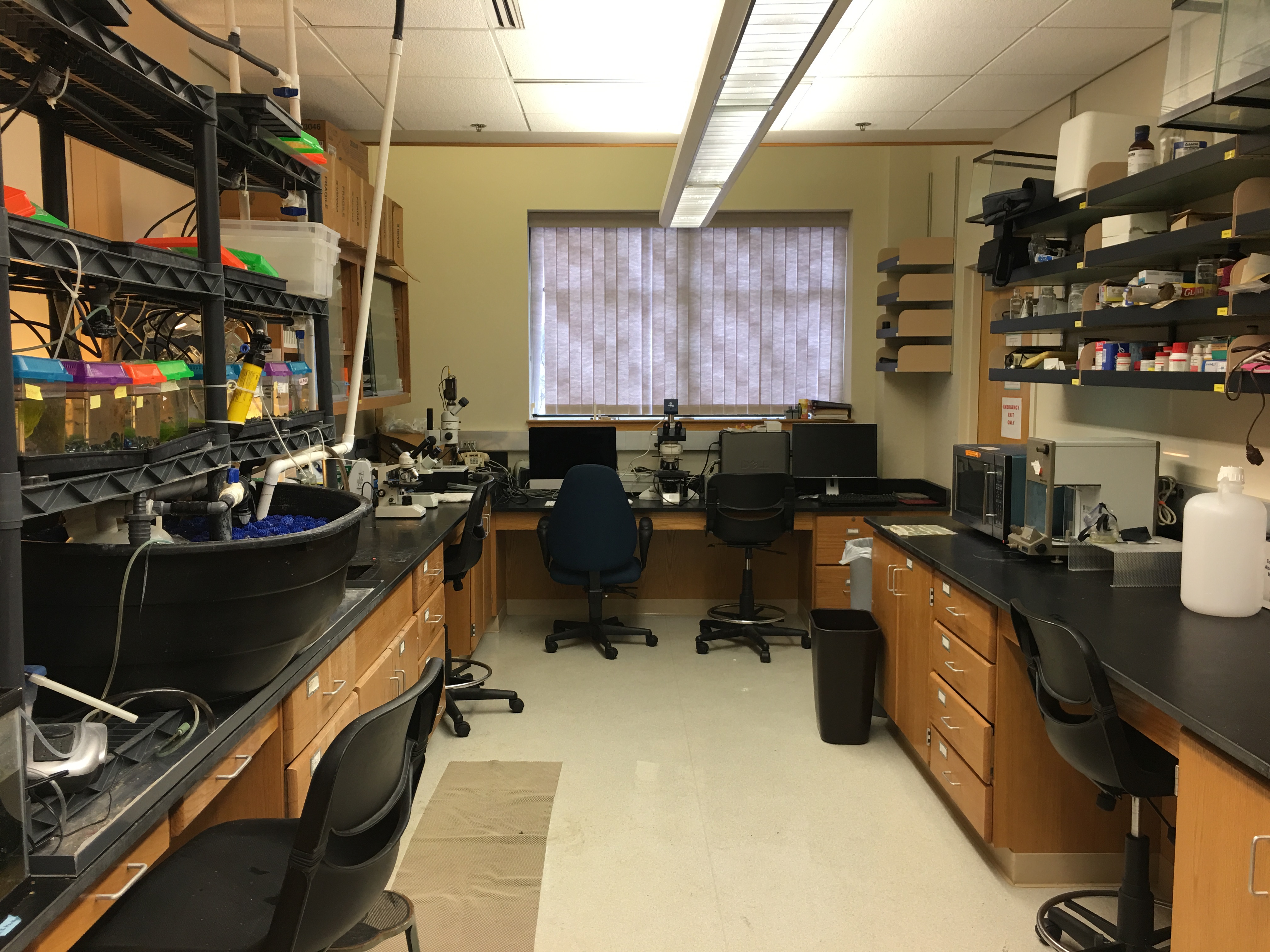
Sniny!

Got it done. My lab is all cleaned up and shiny and organized, except maybe for the bits behind the camera that you can’t see. So many beakers and flasks and bottles scrubbed! So many jagged shards of glass tidied up, pools of toxic chemicals siphoned off, untriggered bombs detonated, bones of previous adventurers interred!

LabPhotoMar2017

Tomorrow…my office. This was just the warm-up.

March for Science…in Morris!

morrismarchforscience

There will be a Morris Area March for Science, and I’m planning to be there. Especially given the announced savage cuts to science funding, it’s important that we stand up and testify to the importance of science.

The Union of Concerned Scientists interviewed a number of scientists about whether they’ll participate in the march, and the answers were overwhelmingly in the affirmative. However, there was also one naysayer, and it’s a good idea to consider the opinions of those who disagree in an intelligent way. Here’s Troy Livingstone’s opinion:

I believe strongly in the values inspiring the march. But I also believe it will be a mostly white, mostly privileged and elitist group who will not be or appear inclusive of all people.

Unintentionally, marchers may reinforce the negative stereotype that science isn’t for everyone.

Finally, I believe that the millions of dollars marchers will spend would have had more tangible benefit advocating for science if they went into the accounts of AAAS or the Union of Concerned Scientists or similar organizations.

I’m all for political activism, but I worry, just like with the women’s march, that many people will call this march their contribution to this cause and leave it at that.

What will matter most is not what happens on the day of the march but everything all of us have done and will do every other day of the year.

Those are very good points. I think he’s right that institutional science, by it’s nature, is privileged, and the people who participate will not be representative of the broader group that benefit from, and will contribute to, science (this problem was also not helped by the dudebro scientists who immediately started whining about identity politics as soon as the organizers tried to emphasize diversity). I think we need to reach out to our public schools and school teachers in addition to lab scientists to make it clear that these are issues that affect everyone. It has to be a march for all, not just working scientists, in support of science.

The concern that motivated individuals will spend “millions of dollars” on a demonstration is silly. Don’t try to police how individuals spend their personal efforts. We should be encouraging everyone to go public with their concerns.

But he’s exactly right that this can’t just be a one-shot, one-day show. This has to be the start of the work. It doesn’t immediately solve anything, but it can be a chance to get a greater commitment to working to tear down the ignoramuses in office.

Mutual harm at Middlebury

Tristero strikes exactly the right note in this letter to the professor who was injured in the protests against Charles Murray at Middlebury. There is no excusing the harm done to Professor Stanger, but there is also no excusing the harm done by Murray.

I have, in fact, read The Bell Curve, the book Charles Murray co-authored with Richard Herrnstein (who died before publication).As I recall, the book appeared to me to be little more than a spectacularly pathetic attempt to boost the low self-esteem of the authors by claiming that blacks in general had inherently lower IQs than their own ethnic groups. My heart went out to Murray and I hoped he would find a good therapist that would instill some some self-confidence in him.

But even more so, my heart went out to the people who would be surely harmed by his terrible book. I knew that The Bell Curve would be mistaken as being super-serious intellectual research (it’s got charts and things!) when it was nothing of the sort.

Here’s where you come in.

Murray is a hero to racists with pretensions to intellectuality, like college-age right-wingers. But having regular access to the Wall Street Journal’s Op-Ed pages (I’ve also read many of Murray’s op-eds and they’re as unserious as The Bell Curve) makes it difficult for Murray to complain that someone’s trying to suppress his freedom of speech. For that, he needs useful idiots who are prepared to invite him not to fawning right wing think tanks or Klan meetings, but to places where the people who his writings actually harm can confront him.

Make no mistake about it: the racism that Murray empowers is as inexcusable and irresponsible as the injuries you suffered. I’m extremely sorry that you were hurt, but I’m also extremely sorry that Murray was provided an excuse to claim the high road. Both are utterly disgraceful outcomes of this unfortunate set of circumstances.

I too read The Bell Curve way back when it first came out, although, thankfully, the details of that pile of shit have faded from my memory, leaving only the recollection of a sensation of disgust. Murray relies on baffling his audiences with the arcana of statistical analysis which neither he nor most of his readers understand, but which earns him the love and appreciation of racists who don’t really care how he gets to his conclusions, as long as those conclusions support their prejudices.

I’m only competent enough in those arcana to see the flaws in his arguments, but not to explain them well. For that, I recommend the invaluable Cosma Shalizi, who made the case against g:

To summarize what follows below (“shorter sloth”, as it were), the case for g rests on a statistical technique, factor analysis, which works solely on correlations between tests. Factor analysis is handy for summarizing data, but can’t tell us where the correlations came from; it always says that there is a general factor whenever there are only positive correlations. The appearance of g is a trivial reflection of that correlation structure. A clear example, known since 1916, shows that factor analysis can give the appearance of a general factor when there are actually many thousands of completely independent and equally strong causes at work. Heritability doesn’t distinguish these alternatives either. Exploratory factor analysis being no good at discovering causal structure, it provides no support for the reality of g.

And also argued against misinterpretations of heritability:

To summarize: Heritability is a technical measure of how much of the variance in a quantitative trait (such as IQ) is associated with genetic differences, in a population with a certain distribution of genotypes and environments. Under some very strong simplifying assumptions, quantitative geneticists use it to calculate the changes to be expected from artificial or natural selection in a statistically steady environment. It says nothing about how much the over-all level of the trait is under genetic control, and it says nothing about how much the trait can change under environmental interventions. If, despite this, one does want to find out the heritability of IQ for some human population, the fact that the simplifying assumptions I mentioned are clearly false in this case means that existing estimates are unreliable, and probably too high, maybe much too high.

Once you knock those two props out from under Murray’s claims, he flops down into a disreputable heap.

But he keeps getting invited to speak at universities. I don’t know why. Stanger claims that the protest was a result of people not reading Murray’s book, but I think the real problem is people who read Murray’s book and don’t understand what a pile of garbage it is.

Australia reassures me that it isn’t just my country full of idiots

Senator Malcolm Roberts must be Australia’s version of Louie Gohmert.

He does make a good case that he is a waste of carbon, but you know, atmospheric CO2 is the problem, not carbon bound up in proteins and carbohydrates.

Born 150 million years too late

I’m reading a few papers on cephalopod evolution, and one helped me pinpoint my happy time.

Coleoid cephalopod molluscs comprise squid, cuttlefish and octopuses, and represent nearly the entire diversity of modern cephalopods. Sophisticated adaptations such as the use of colour for camouflage and communication, jet propulsion and the ink sac highlight the unique nature of the group. Despite these striking adaptations, there are clear parallels in ecology between coleoids and bony fishes. The coleoid fossil record is limited, however, hindering confident analysis of the tempo and pattern of their evolution. Here we use a molecular dataset (180 genes, approx. 36 000 amino acids) of 26 cephalopod species to explore the phylogeny and timing of cephalopod evolution. We show that crown cephalopods diverged in the Silurian–Devonian, while crown coleoids had origins in the latest Palaeozoic. While the deep-sea vampire squid and dumbo octopuses have ancient origins extending to the Early Mesozoic Era, 242 ± 38 Ma, incirrate octopuses and the decabrachian coleoids (10-armed squid) diversified in the Jurassic Period. These divergence estimates highlight the modern diversity of coleoid cephalopods emerging in the Mesozoic Marine Revolution, a period that also witnessed the radiation of most ray-finned fish groups in addition to several other marine vertebrates. This suggests that that the origin of modern cephalopod biodiversity was contingent on ecological competition with marine vertebrates.

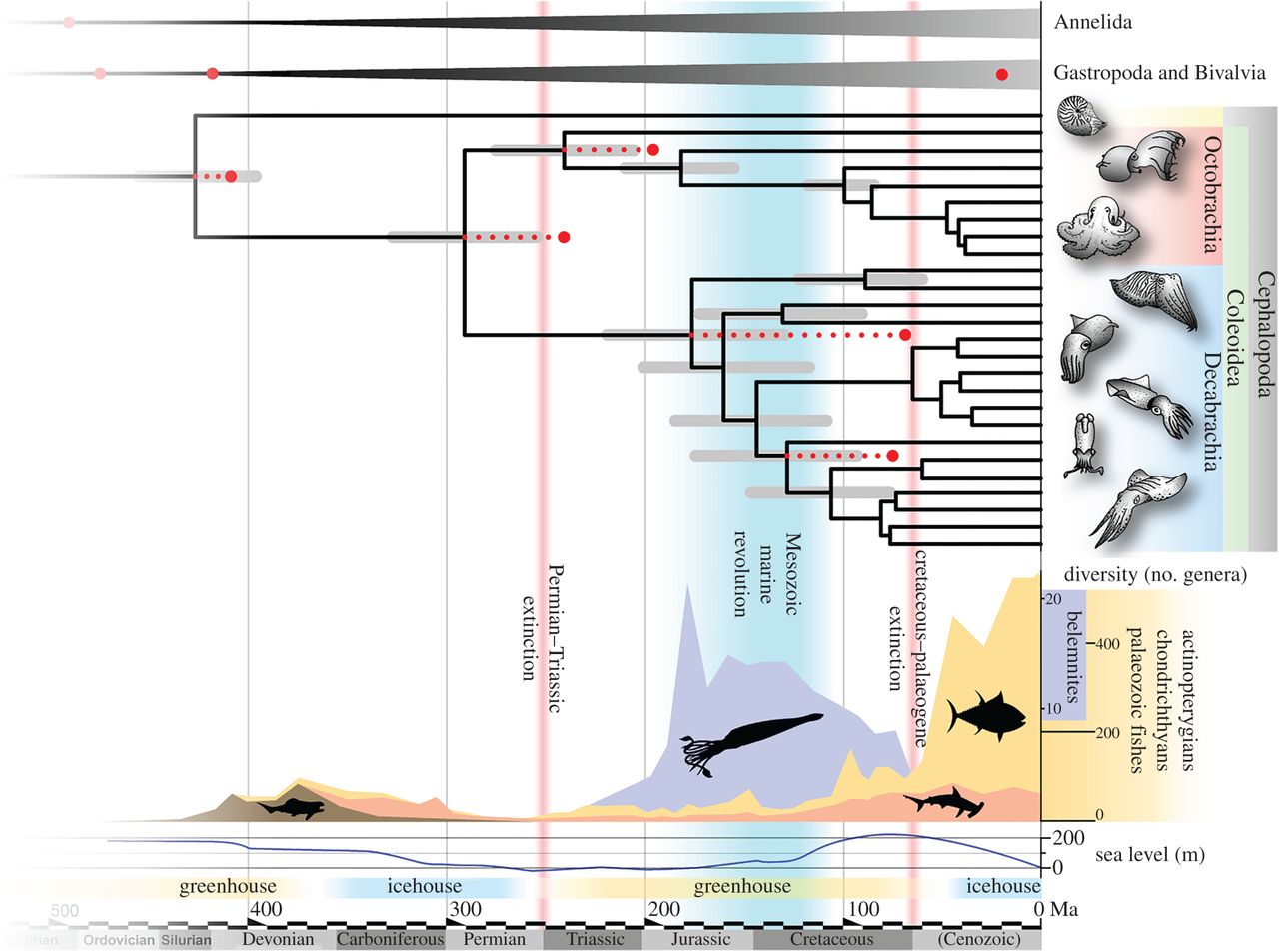
There are lots of details, but the summary is this: they’ve used the molecular data to calibrate a tree of cephalopod phylogeny to place the major diversifications of the group in context, and they’ve also looked at degrees of diversity over time. And the answer is summarized in this one diagram:

Chronogram of cephalopods, plus 26 bivalve and gastropod molluscs, one scaphopod and four annelids as outgroups and calibration nodes; 36 156 amino acid positions analysed under CAT-GTR substitution model, CIR clock model, Yule birth–death process, soft bound of 0.05, and a root prior of 565 Ma with a standard deviation of ±10 Ma. Bars at nodes represent 95% confidence intervals (recent nodes not labelled with bars to aid clarity). Red dots indicated calibrated nodes; red dotted lines represent extent of calibration minima. Environmental conditions and sea-level curve simplified from Miller et al. Curves for belemnite, actinopterygian, chondrichthyan and Palaeozoic fish diversity are based on fossil observations on diversity, data from Palaeobiology Database (pbdb.org), electronic supplementary material, table S5. Red vertical lines represent major extinction events. Aqua-blue vertical bar signifies the extent of the Mesozoic Marine Revolution.

Chronogram of cephalopods, plus 26 bivalve and gastropod molluscs, one scaphopod and four annelids as outgroups and calibration nodes; 36 156 amino acid positions analysed under CAT-GTR substitution model, CIR clock model, Yule birth–death process, soft bound of 0.05, and a root prior of 565 Ma with a standard deviation of ±10 Ma. Bars at nodes represent 95% confidence intervals (recent nodes not labelled with bars to aid clarity). Red dots indicated calibrated nodes; red dotted lines represent extent of calibration minima. Environmental conditions and sea-level curve simplified from Miller et al. Curves for belemnite, actinopterygian, chondrichthyan and Palaeozoic fish diversity are based on fossil observations on diversity, data from Palaeobiology Database (pbdb.org), electronic supplementary material, table S5. Red vertical lines represent major extinction events. Aqua-blue vertical bar signifies the extent of the Mesozoic Marine Revolution.

They’ve got a good story behind it, too. What drove the concurrent evolution of both cephalopods and bony fish was a competition to occupy the nektonic space. That is, before the Devonian, animals were primarily benthic — the lowest level of the aquatic environment than includes the floor of the body of water — and that the hot new space to occupy was the nekton, the upper levels of the water. This required new strategies, fish evolved jaws, cephalopods evolved beaks, that opened up new predator/prey relationships. Further, as these groups evolved in the nekton, there was a switch in defensive strategies from making heavy armor to stripping down and becoming more agile. Those trends are conspicuous in both groups.

Taken together, molecular divergence times and the cephalopod fossil record are consistent with a scenario in which predator–prey arms races shaped the coleoid body plan, biodiversity and ecology. The coincidence with the evolution of jawed vertebrates and teleost fishes during the Devonian Nekton Revolution and the Mesozoic Marine Revolution, suggests that nektonic marine vertebrates have been key antagonists towards cephalopods throughout most of their evolution.

So it all started with the Devonian Nekton Revolution, and reached completion in the Mesozoic Marine Revolution, which they call “the final stage in the shift from Palaeozoic ecologies into the modern structure of marine ecosystems”. What you can also see in the diagram is that there has been a shift in the diversity of the phyla occupying that nektonic niche, with cephalopods owning the Mesozoic seas, and teleosts taking over in the Cenezoic.

Which tells me that when I retire, I need to set the dials on my time machine to the late Jurassic/early Cretaceous, and settle down to start fishing/squidding. I was just checking my maps and I see that there was a big inland sea stretching from British Columbia and Calgary, down to most of North Dakota and the western part of South Dakota, so I would only have to move a few hundred miles west.

And 150 million years back.


Tanner AR, Fuchs D, Winkelmann IE, Gilbert MT, Pankey MS, Ribeiro ÂM, Kocot KM, Halanych KM, Oakley TH, da Fonseca RR, Pisani D, Vinther J. (2017) Molecular clocks indicate turnover and diversification of modern coleoid cephalopods during the Mesozoic Marine Revolution. Proc Biol Sci. 284(1850). pii: 20162818. doi: 10.1098/rspb.2016.2818.