Nancy Atkinson will be telling us Incredible Stories From Space in the Common Cup Coffeehouse in downtown Morris, tonight at 6pm. Be there!
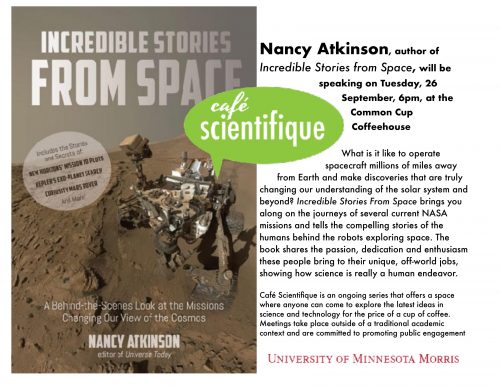

Nancy Atkinson will be telling us Incredible Stories From Space in the Common Cup Coffeehouse in downtown Morris, tonight at 6pm. Be there!

Christie Wilcox writes about the ecological experiment asking what happens to the environment of a mass die-off, done by dumping 6 tons of dead pigs in a heap in a forest. It’s impressive. The scavengers swoop in and proliferate, and you literally do get heaving, writhing rivers of maggots pouring off the rotting mass.
There is video at the link. I decided not to imbed it since I didn’t know if all of my readers would have finished lunch yet.

I hope I don’t have to sing to teach this stuff.

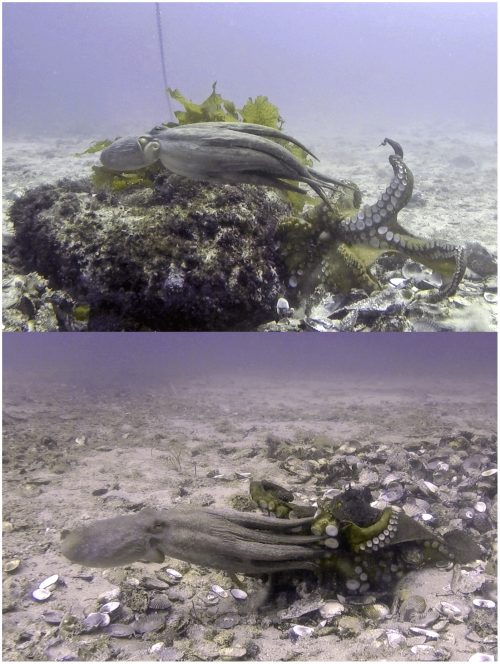
Wow. Every person on the planet saw one version or another of this “Octopolis” story and had to send it to me. It was the subject of a Friday Cephalopod a year ago, you know.
Apparently, this is the second octopus city discovered, which is interesting — they’re exhibiting more complex social behaviors.
However, I have two complaints.
A lot of the stories are describing Octopolis/Octlantis as “gloomy”. Why? Is it because the inhabitants aren’t swimming around with toothy grins? The cephalopods look quite normal to me.
A more serious complaint, about this quote:
The discovery was a surprise, Scheel told Quartz. “These behaviors are the product of natural selection, and may be remarkably similar to vertebrate complex social behavior. This suggests that when the right conditions occur, evolution may produce very similar outcomes in diverse groups of organisms.”
Nope. You don’t know that. There’s no evidence and no reason to think this behavior is the product of natural selection — quite the opposite, actually. It looks to me like the spontaneous emergence of a novel property of octopus behavior in an unusual and fortuitous environment.

Rebecca Otto is running for governor of Minnesota, and she has some good, progressive ideas for improving our energy self-reliance.
Here’s the elevator speech version: Minnesota residents get around five thousand dollars cash (over several years), monetary incentives to upgrade all their energy using devices from furnaces to cars, some 80,000 new, high paying jobs, and in the end, the state is essentially fossil fuel free.
About half of that fossil fuel free goal comes directly from the plan itself, the other half from the economy and markets passing various tipping points that this plan will hasten. The time scale for the plan is roughly 10 years, but giving the plan a careful reading I suspect some goals will be reached much more quickly. This means that once the plan takes off, Minnesotans will have an incentive to hold their elected officials accountable for holding the course for at least a decade.
I like it. It’s incremental, it provides incentives for citizens to do things that will be good for them and the state, and it’s a great long term investment. My only concerns at this point are that the sums are on the small side — I could use $5K to make some small improvements in energy efficiency in my house, but big changes require bigger capital investment — and it’s not obvious how these incremental investments will get us to the point of being free from fossil fuels. There are more details, and I’ll have to look into it.
Even if it cuts fossil fuel usage by 20%, though, that’s an improvement worth doing. I might have to vote for this person in the next election and get this plan implemented.

They do, and they always have. Here’s an interesting way to illustrate that: make reconstructions of modern animals as if we had no idea about the expected distribution of fat and other soft tissues. Here’s a baboon drawn from its bones while pretending ignorance of hair and lips and such unfossilized stuff:
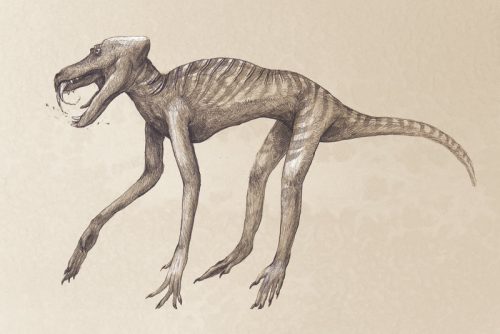
This is from a book by John Conway, CM Kosemen, and Darren Naish, called All Yesterdays: Unique and Speculative Views of Dinosaurs and Other Prehistoric Animals. I’m going to have to add it to my list.

Oh, my. Some researchers have discovered that pigments in tattoo inks can, over the years, wander out of the tattoo into places like lymph nodes. They have not, however, identified any danger or harm from this phenomenon. All I can muster is a weary, “So?”. This shouldn’t be at all surprising.
Next up: scientists will discover that the skin texture under your tattoo will change with age, that the shape of your body can distort the shape of your tattoos, and most horrifyingly, that people with tattoos have pigmented inks permanently discoloring their skin!

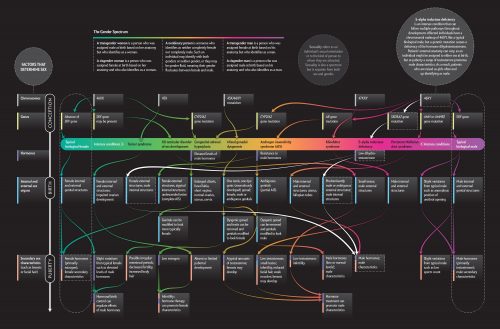
Now will you believe me? I keep saying that sex and sex determination are far more complex than just whether you have the right chromosomes or the right hormones or the right gonads, and now here’s a lovely diagram that illustrates some of the steps in sex determination.
The biology is set up to favor driving an individual to one side or the other, but there are so many detours that can be taken en route that it is ridiculous to ignore all the people who end up following a more unique path.


This is a guest post by Joshua Stein, a doctoral student at the University of Calgary and @thephilosotroll on Twitter.
Peter Godfrey-Smith’s Other Minds: The Octopus, the Sea, and the Deep Origins of Consciousness is, like it’s subject, a strange animal. It is accessible to a broad and general audience; it also deals with a lot of technical literature in comparative psychology and philosophy of mind. I think the book can be deeply enjoyable for a broad lay-audience, but it is even better with a little bit of background and explanation of where Godfrey-Smith fits into the literature and what he’s saying about consciousness. I want to provide some of that background, to illustrate why this book is so interesting and show some colleagues in philosophy and psychology why the book should be regarded as a philosophical success.
There are some things about mind and consciousness that Godfrey-Smith takes for granted. The first is that we can study and discuss consciousness as an empirical issue. Most folks are probably familiar with the claim that “we can’t study consciousness” for some reason or other. The claim comes up an awful lot, even in some philosophical literature. (The most noteworthy advocate is the disgraced Colin McGinn.) I won’t get into the objections to this position, but it is basically set aside by most philosophers.
There are two approaches to evaluating minds; one is to look directly at the nervous system and extrapolate about how it works from the internal mechanisms, while the other is to look at how the organism behaves in the environment. There’s a long history around these two approaches, often regarded as in tension; it is increasingly common, though, to use both methods in order to a build a more satisfying theory. Godfrey-Smith uses both throughout the book: he’ll often discuss the ways he sees octopuses behave, and then shift to talking about mechanisms in the central and peripheral nervous system.
Godfrey-Smith uses the book as an opportunity to offer a rich, and technically sound, story about consciousness. There are two features that he discusses at length in the book, returning to them over and over, and these two features are pretty prominent in modern theories of consciousness. The first is that consciousness involves the integration of different sorts of sensory information (pp. 88-90); the second is that consciousness involves the temporal ordering of events (91-92), and allows those orderings to be made available in action.
Godfrey-Smith writes. “I see ‘consciousness’ as a mixed-up and over-used but useful term for forms of subjective experience that are unified and coherent in various ways.” (97) Unlike many contemporaries, Godfrey-Smith doesn’t offer a specific theory of consciousness; however, he does involve existing theories and shows how they play a role in discussing consciousness in radically different minds; obviously, in the book, he’s concerned with cephalopods.
There are some other features that show up in Godfrey-Smith’s story of consciousness that make the story so satisfying, but before I get to this, I think it is useful to note that the two prominent features play a part of an old philosophical tradition. The Anglophone philosophers David Hume and John Locke each came up with stories about what consciousness is that involved rich experience and temporal ordering, respectively.
For Hume, consciousness was about the vivid and integrated character of experience; an auditory experience isn’t a two-dimensional thing. It has pitch and timbre and tone, and there’s noise that has to be filtered out. Part of what it is to have a conscious experience of a piece of music is to experience the different dimensions of that piece, all laced together into a multidimensional sensory experience.
For Locke, consciousness was about the autobiographical constitution of identity; people are continuous over time and have a unified psychological story that extends back into their pasts, and includes certain features of possible futures. This gives us something like the temporal ordering feature.
Godfrey-Smith isn’t committal to any such view being decisive. Rather, he’s open to the possibility that both of these things are true of and involved in facilitating consciousness. His story rather illustrates that many of the inherited theories (now far more technical and closely aligned with certain findings in neuroscience and cognitive psychology) are mutually reinforcing in valuable ways.
Because Godfrey-Smith isn’t committed to a particular theory about consciousness, he’s open to pointing out how different theories illustrate different features of consciousness. One instance, present from the very beginning of the book, is the role of attention; an organism that attends to a feature of its environment for a period of time illustrates both features of consciousness (because they perceive the feature over time and integrate information about changes in that feature). He notes that this is common with octopuses who see and attend to him when he is diving to watch them; it comes up regularly in his anecdotes.
Initially, I wondered if Godfrey-Smith considered that attention is instrumental in a popular theory of consciousness (actually, the one I more-or-less subscribe to). He invokes things that look curiously like classic tasks in joint-attention (57-58), only performed by octopuses instead of children or chimpanzees; the giveaway that he’s taken this into consideration is his invocation of Jesse Prinz (91-91), whose 2012 book The Conscious Brain articulates and explores the attentional theory of consciousness.
Another feature is embodiment. While Godfrey-Smith expresses skepticism of a certain view of embodiment (74-75), he also gives a lot of the stock arguments for why embodied cognition is so important. For example, cuttlefish can’t process color visually (due to a lack of individuation in light receptors used for color vision) but still respond to differences in color in their environment through features in the skin; a version of this approach (though for object-vision and not color) has been used to develop vision substitutes for the blind. (80-81) Even as a skeptic about certain strong views of embodiment, Godfrey-Smith shows how many theories that focus on embodiment as something that shapes conscious experience get certain bits right.
I could go on with the various different features that Godfrey-Smith picks up and illustrates, but at that point I would risk summarizing a huge portion of the observations he makes in the book; it’s worth reading for yourself to see how these different elements fit together and provide a broad and interesting theory of consciousness.
The last point I want to make, which is of special interest to readers here familiar with PZ’s various criticisms of evolutionary psychology, is something that I think Godfrey-Smith does particularly well.
One way of criticizing a lot of the literature in evolutionary psychology is that it puts together a specious “just-so story” about how certain features of the brain (and therefore the mind) evolved in ways that are not as responsive to things like the environment, interaction with conspecifics, and other features that we know (from developmental psychology) play a huge role in how any particular member of a species develops.
Claims about the evolutionary history of a particular behavior, for example, and selection pressures influence the development of tools and their prospective role in reproductive success (just google “sexy handaxe theory” if you’re wondering what I’m talking about) are difficult to evaluate, for both philosophical and scientific reasons, but Godfrey-Smith’s constant focus on the contemporary role of the various functions for octopuses (for example, the way that attention helps them to interact with their environment, or the way that peculiarities in the peripheral nervous system help in hunting) makes the story much more plausible, and much easier to evaluate, rather than focusing on the buried secrets.