Is that in my job description?

Lance Wallnau explains what college professors do:

Anything we do regarding abortion, prayer, marriage, he said, anything we do that doesn’t get into the educational narrative that is affecting the minds of students will be lost within eight to 10 years because you’ve got gatekeeper priests, there are priests of Baal at the top of the university mountain, poisoning the minds [of young people.] They’re like intellectual pedophiles molesting the virgin territory of your children’s imaginations.

Funny. That stuff isn’t in any of my classes. I guess Wallnau just needs to lie about us molesting brains and worshipping Baal because he thinks it sounds less idiotic than admitting that we, for instance, teach that the Earth is 4.5 billion years old rather than 6,000.

If we’re going to allow piano lessons, we must also allow penis-chopping

It must be fun-with-philosophers day, because Ron Lindsay has written an article for CFI declaring that male circumcision should not be a major concern for humanists. He has several bad arguments to support this idea.

One is that he doesn’t think it’s very important. No, really; he’s in charge of ranking our priorities.

The head of the affiliate said they were going to concentrate on making an all-out effort to ban circumcision. I remember thinking to myself: of all the ills of a society on which a humanist organization could concentrate, this organization is going to focus on saving the foreskin?

STOP EVERYTHING. I say the biggest crisis looming over our heads is climate change, so of all the ills our society faces, why is the Center for Inquiry wasting their time opposing religion? Get some perspective, people!

Another reason he gives is that the foreskin is so teeny-tiny, and people aren’t seriously harmed by lopping it off, so it’s a trivial matter, especially compared to real problems (don’t forget, Ron Lindsay is the arbiter of what matters).

For humanists who are concerned about how the bodies of children are permanently shaped by their parents, I suggest they concentrate on how children are educated. We need tougher regulation of homeschooling and we need to prevent public funding of religious schools— something which seems quite possible under the new administration. The appropriate response to male circumcision is a shrug of the shoulders; it’s just not that significant an issue. We have other work to do.

I agree that education has a greater effect on children than circumcision. But this is just the fallacy of relative privation: that problem A has more severe consequences than problem B does not mean you should ignore B until A is completely solved. There’s always other work to do. It never ends. I taught two courses this term, but when the work piled up in one I couldn’t just tell the other class to stop meeting and stop learning until I’d caught up. You make do.

I’ll also point out that Lindsay was head of an organization of many people, and that he didn’t do all of CFI’s work. Ron Lindsay could ignore one cause; that doesn’t mean the entire organization isn’t allowed to work on it.

Then he dismisses the entirety of the autonomy and consent arguments!

The other reason I think many humanists are so opposed to circumcision is their adherence to a philosophical principle which, superficially, has strong appeal, namely that no permanent changes should be made to someone’s body without that person’s consent. Seems eminently reasonable—the problem is that it is impossible to comply with this principle with respect to the most important part of our body, namely our brain, and the possible harm that may be done to us via the shaping of our brain when we are young makes the loss of a foreskin trivial.

Yes. The universe is not perfect. We have to compromise all over the place. The fact that we cannot control what people teach their children means, what the hell, let ’em make any ol’ cosmetic change to their children’s bodies that they want. They have the right to teach children that Jesus is real, so we shouldn’t complain if they want to tattoo a picture of Elvis on their forehead. Or snip off the end of their penis.

Because piano lessons.

Most developed countries do exercise some control over the training and education children receive, imposing various legal standards and restrictions, but even so, wide scope is given to parents in terms of how they raise their children. Homeschooling is permitted in the United States, for example, with minimal oversight in most states. (Interestingly, homeschooling is forbidden in some European countries, such as Germany—again a significant cultural difference.) With respect to training in music or sports, parents can subject their children to extensive training, just short of physical abuse. Hour after hour of piano practice or swimming lessons. When grown, these children might be grateful for their training, or they may resent the physical or psychic pain they had to endure while forced to pursue an activity which they never liked. On the other hand, some children will receive no training in music or sports, something which they may regard as a handicap in later life. Either way the bodies of these children will have been permanently altered by their parents.

It’s true! Excessive focus on one discipline, whether it’s football or piano, can be damaging to a child’s development, especially if they have no talent or interest in the subject. These wrongs therefore justify another itty-bitty wrong, docking their penis. Or tattooing Elvis on their forehead, as long as we’re building arguments around hypotheticals.

He wraps it up with this pile of garbage: we should impose limits on what parents can do to their children, but elective cosmetic surgery doesn’t cross that line, because maybe it helps something.

Nothing in the foregoing analysis should be interpreted as saying we should allow parents to change their children’s bodies in any way they regard as suitable just because their role in shaping these bodies is inevitable. Clearly, limits should be— and are —imposed on what parents can do. Parents cannot inflict disabling injuries on their children. But, as indicated, the evidence regarding male circumcision is that it provides some small benefits. It cannot plausibly be characterized as medically necessary, but, with appropriate use of analgesia, it’s not harmful. The energies that some devote to opposing male circumcision might be better spent lobbying for tighter regulation of homeschooling. The cerebral portion of young male bodies should receive as much attention as the genital portion.

I’ve read the CDC summary, and some of the papers that claim there are benefits to circumcision. I’m unimpressed. There are multiple reasons why those arguments of a benefit are weak.

  • They fail to show any benefit to American children. Some claim to have found significant benefits to some African populations, which are under a very different regime of infectious diseases.

  • Even those effects in African populations are inconsistent. Some claim statistically significant reductions in infection rates, others don’t.

  • The studies that do show an effect show that late, voluntary circumcisions are as effective as post-natal circumcisions. So why force it on babies?

  • All of these studies are carried out under a complicated set of biases. Americans have high rates of circumcision, Europeans don’t. Strangely, American studies say it’s not a problem, European studies find it harmful. Isn’t that odd? It’s almost as if cultural biases influence the results, although we know that can’t possibly be.

  • The CDC summary is not without strong dissent.

    The Centers for Disease Control and Prevention (CDC) have announced a set of provisional guidelines concerning male circumcision, in which they suggest that the benefits of the surgery outweigh the risks. I offer a critique of the CDC position. Among other concerns, I suggest that the CDC relies more heavily than is warranted on studies from Sub-Saharan Africa that neither translate well to North American populations nor to circumcisions performed before an age of sexual debut; that it employs an inadequate conception of risk in its benefit vs. risk analysis; that it fails to consider the anatomy and functions of the penile prepuce (i.e., the part of the penis that is removed by circumcision); that it underestimates the adverse consequences associated with circumcision by focusing on short-term surgical complications rather than long-term harms; that it portrays both the risks and benefits of circumcision in a misleading manner, thereby undermining the possibility of obtaining informed consent; that it evinces a superficial and selective analysis of the literature on sexual outcomes associated with circumcision; and that it gives less attention than is desirable to ethical issues surrounding autonomy and bodily integrity. I conclude that circumcision before an age of consent is not an appropriate health-promotion strategy.

Lindsay is comfortable with dismissing people’s objections to circumcision because he thinks it is a trivial problem, but somehow, a trivial and disputed positive effect is enough to justify disregarding any concern about an unnecessary surgery routinely performed on infants for no good reason at all. Does he even realize that circumcisions were not performed because there was evidence that they helped at all?

This makes no sense.

But then, Lindsay also put a priority on chastising women at a feminist conference. He also, as a humanist, thinks the death penalty is just fine. He knows what issues are really important.

You know what’s much more important than circumcision, or state executions, or the ongoing harassment of women, women in his own organization?

Chupacabras, that’s what. That is the other work CFI must do. Valuable and scarce resources must continue to be invested in debunking this plague on our nation, while the only appropriate response to those other nuisances is a shrug of the shoulders.

An epistemological battering

Peter Boghossian has a schtick: he presents some simple, logical rules that are great for smacking down irrational claims and getting people to engage in critical thinking, and he shows how they can be applied effectively to ideas he doesn’t like. But then he pulls a switcheroo, and starts promoting his own biases, and never applies his own tools to them. It’s weird, annoying, and inconsistent, and it means I can never take him seriously. In his case, it’s obvious who shaves the barber — it’s no one, and he runs around absurdly unkempt and shaggy.

Siobhan does a marvelous and entertaining job of tearing Boghossian down. Go read that. I could just stop here, case closed, Siobhan has hammered all the high points, but I can’t help myself: Boghossian punched a few of my buttons, so I have to be all superfluous and redundant.

  1. There’s the “It’s all the Left’s fault!” mantra, which we’ve heard from the Sam Harris wing before.

    It’s fascinating. I would be lying to you if I told that I wasn’t genuinely concerned about Trump’s presidency. I think the Left bears considerable responsibility in him being elected.

    I think Boghossian would have no problem dealing with an accusation that “it’s atheists like you who make people turn to Jesus!”, but somehow he can’t recognize the inconsistency here. People who voted for Trump got him elected, not the people who didn’t vote for Trump. You could legitimately argue that poor decision-making and over-confidence by the Left contributed to Clinton’s loss, but let’s not let the people who pulled the lever for the horrible plutocrat off the hook. Do you deny them agency?

    But here’s another thing that bugs me: what side are you on? If you yourself are a left-leaning, social justice, anti-racism and misogyny type (as they all say they are), why are the complaints always phrased as “they lost the election” rather than “we lost the election”? These guys always refer to the losers in the second or third person, distancing themselves from the outcome. If you’re aligning yourself with the right wing, be confident and say so. Again, apply your reasoning to yourself. Are you willing to bear some of the responsibility for this election? What will you do in the future? Besides blaming everyone else.

  2. Then there’s his small-minded version of post-modernism.

    Disciplines such as gender studies don’t have a dialectic. They’re not truth seeking enterprises. They think they’ve already found they truth and exist to indoctrinate students. There is no dialectic at the core of those disciplines like there is in philosophy. And there are profoundly negative consequences for peoples’ views of reality — it untethers them from what’s real.

    This is so completely, utterly the reverse of the truth. Post-modernism does have a very severe dialectic, and in fact is all about dialectics, which I’ll remind Boghossian is the discipline of investigating or discussing the truth of opinions. It is actually the very heart of skepticism, although most people who call themselves skeptics are more interested in bigoted dismissal than, you know, investigating it. I’ve written about postmodernism before, so I’ll just quote Michael Bérubé here:

    Sokal’s admirers have projected almost anything they desire–and they have desired many things. In early 1997, Sokal came to the University of Illinois, and quite graciously offered to share the stage with me so that we could have a debate about the relation of postmodern philosophy to politics. It was there that I first unveiled my counterargument, namely, that the world really is divvied up into “brute fact” and “social fact,” just as philosopher John Searle says it is, but the distinction between brute fact and social fact is itself a social fact, not a brute fact, which is why the history of science is so interesting. Moreover, there are many things–like Down syndrome, as my second son has taught me–that reside squarely at the intersection between brute fact and social fact, such that new social facts (like policies of inclusion and early intervention) can help determine the brute facts of people’s lives (like their health and well-being).

    I love that counterargument. People like Boghossian like to thunder about how they know precisely what a fact is, yet never seem to recognize how strongly shaped their version of “fact” is conditioned by their social world, and never consider the possibility that social facts can represent a significant truth. Consider race, for instance. Race is scientific nonsense; people’s perception of “race” does not coincide with the patterns of descent they purport, and ought not to be used to justify the discrimination and prejudices they endorse. But at the same time, race is a social fact, and ignoring those perceptions has “profoundly negative consequences for peoples’ views of reality”. Declaring that all humans came from Africa is true, but doesn’t do a thing to negate the harsh realities of how society’s have judged humans on the basis of their skin color.

    Denying social facts, as Boghossian does, is harmful.

  3. Boghossian’s specific rant in this case is about gender, and again, he scores an own goal by failing to perceive his own social facts. In response to a quote from a transgender studies professor who rightly points out that biological sex is a complex, messy topic that doesn’t divide neatly into the boy-girl binary, he makes this ranting non-argument.

    That is the most asinine, ridiculous, preposterous piece of ideological tripe. The only way someone could possibly believe that is they’ve been sufficiently indoctrinated by radical Leftists. I was once covering a lecture for a colleague and this topic came up. I said: “If sex were really a cultural construction, why don’t men menstruate? Why don’t men have babies? Why are there no women on professional football teams?” And an individual from the back of the class got up and started yelling, “Fuck you,” gave me the middle finger, shouted at me and stormed out of class.

    That student did the right thing, and I give them credit for speaking out. Professors are supposed to be informed on a subject, and Boghossian just outed himself as an ignoramus.

    He’s a philosopher, for dog’s sake, and he just proudly created an ontological framework and declared it to be an absolute. Women are people who menstruate, have babies, and don’t play football; men are people who don’t menstruate, don’t have babies, and play football.

    Is he even aware of how intensely socially constructed his list is? Does he consider all the exceptions? He’s blitheringly oblivious. If I declared that, for example, women have long hair and men have short hair (which is not as absurd as it sounds — Americans of my parent’s generation took that as a fact), then I have just made Rachel Maddow a man and Fabio a woman. If you bounce back and rightly explain that there are multiple factors, not just one criterion, then you have admitted that the gender binary is already false. Thanks for doing my job for me.

    And if you try to play the “biological reality!” card, I’ll just point out all the exceptions to your claims that women menstruate (not all do), women have babies (childless women aren’t men), XX chromosomes (not always), and anatomy.

    Boghossian is not a biologist, yet he’s always claiming biological authority for his narrow-minded views. He’s a lot like creationists that way.

  4. Boghossian ends by citing his supporting sources, which is a good idea, but in his case, undermines everything he says. Who supports him? Dave Rubin, a right-wing pundit on youtube. Christina Hoff Sommers, anti-feminist hack and lackey of the right-wing American Enterprise Institute. Joe Rogan, misogynistic and unfunny comedian. And a Twitter account I’d never heard of before, @RealPeerReview, which is nothing but a person loudly laughing at gender studies articles they don’t understand. Some of those papers are terrible, I agree, but I seem to have frequently found papers in biology that are terrible (it’s actually not hard to do at all), and yet I don’t think all of biology is wrong, because I understand the theory and the evidence behind what I criticize. I can’t say that for Boghossian’s sources.

    Goddamn, but organized atheism has enabled a lot of cocky asswits who like to hide behind “objective reality”.

What a wonderful endorsement!

Ken Ham has a few things to say about an upcoming movie.

The filmmakers’ recent public comments have revealed that they were not telling the truth when they insisted that AiG would be portrayed in a fair and accurate manner, Ham said. Therefore we don’t expect their finished film to feature the straightforward reporting on the Ark and Creation Museum that we were assured we would receive. It looks like their film will be more of a mock-umentary than a documentary.

Oh, baby. Take my money. Take my money now.

Hey, they can: They’re still raising money for the film.

Should be good.

I’m still hoping to make it out to the Ark Park myself, sometime this summer.

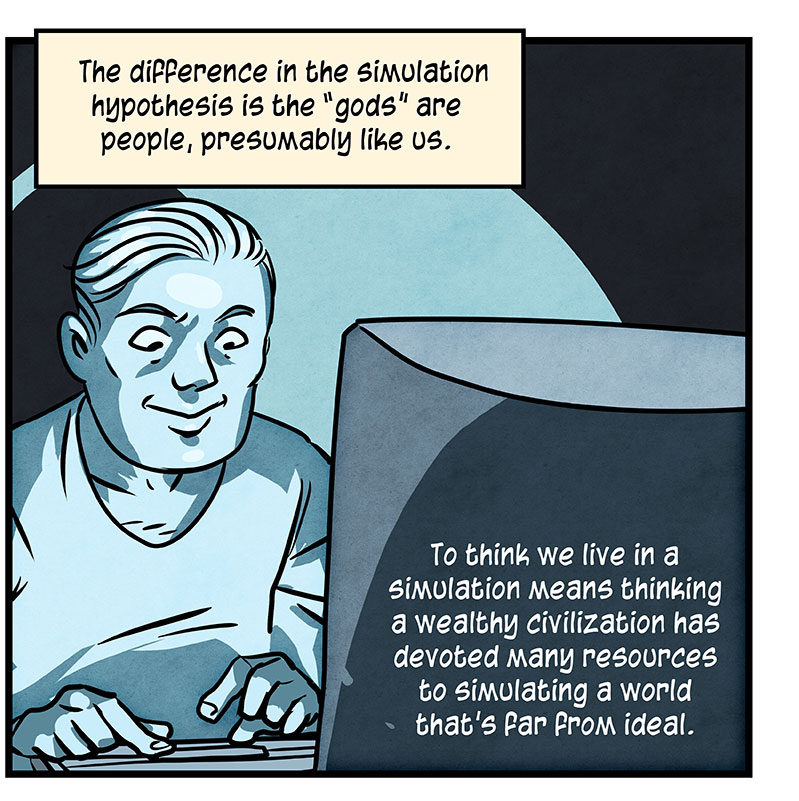
The simulation hypothesis is a bad argument

Maki Naro and Matthew Francis make an interesting argument against the simulation hypothesis, the idea that we’re all constructs living in a super-duper computer program. I don’t believe in that nonsense at all, but I don’t know that I find his argument particularly persuasive: it rests largely on the idea that the simulation hypothesis implies that undesirable consequences must be the product of intent.

farfromideal

Then I look at the crude simulations we currently produce, like, say, Call of Duty, and I’d have to argue that yeah, if we were the creators of a universal simulator, it would be a shithole universe full of helpless innocents and murderous villains, all intended to be targets of a small number of privileged a-holes with superpowers, and I think that is kind of in alignment with what we see in this world.

I’d also worry about where that argument would lead: to the idea that obviously the wealthy and well-off are the player characters for whom the world was made, while being poor and sick and helpless clearly marks one as an NPC, with no real agency and only the simulated appearance of being a ‘real’ person.

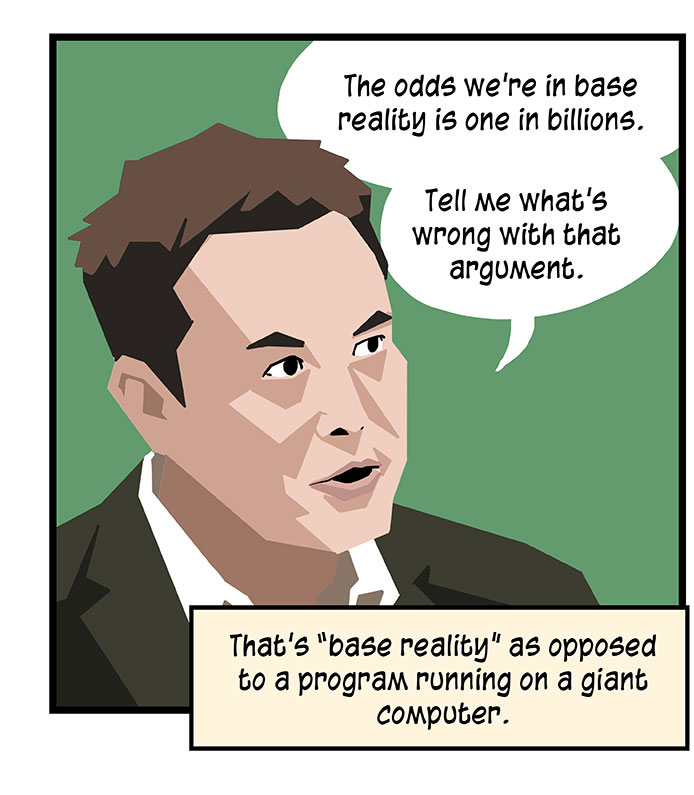
What I find the more useful argument is to go back to the beginning of Naro’s comic, where he quotes Elon Musk:

whatswrongwitharg

That is the wrong question. He asserts The odds we’re in base reality is one in billions. Instead we should ask, “what simulated ass did you pull those odds out of?”, because he’s got no rational justification for that claim. We could just as well claim that since we can imagine billions of gods, the odds that we evolved by way of natural mechanisms, rather than some divine fiat, is one in billions. It’s simply faulty reasoning. The responsibility does not lie on me to show why his fantasy is false, it’s on him and Nick Bostrom to demonstrate some actual evidence that it is true.

Then, of course, there’s some babbling about how if the simulation hypothesis is true, we should look for glitches in the matrix, little examples deep inside physics where we detect violations of natural law. This is exactly backwards. First you find observations that don’t fit predictions from existing theory, then you develop alternative theories to accommodate those observations — you don’t first invent an unfounded hypothesis and demand expensive, difficult, unlikely-to-succeed experiments to justify it. Especially since the simulation hypothesis is infinitely flexible and can be contorted to fit any observation made. Is there anything the promoters of this bullshit can imagine that would disprove their hypothesis? That’s what they ought to be discussing, rather than how they can twist quantum physics to support their model.

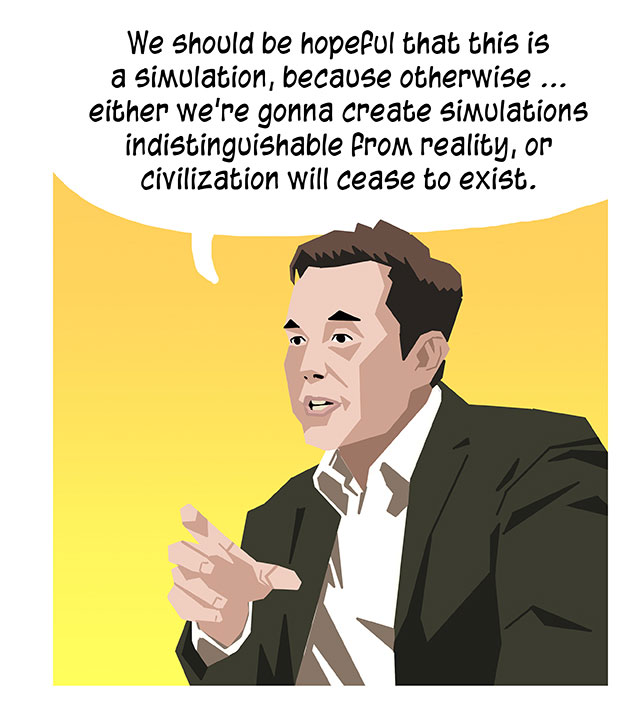
Then there’s this:

simordie

While being completely unable to imagine any test of their idea, and building it entirely on a framework of speculation, they still lock themselves into a bogus binary: civilizations will either be able to simulate a universe, or they’ll go extinct. Seriously, dude? You’re living in a non-extinct civilization that can’t simulate a universe, and you can’t imagine any other alternatives?

I also have to point out that all civilizations and species will ultimately go extinct, so this argument is basically between an inevitable and unavoidable (if undesirable) outcome, and accepting your personal, idiosyncratic, weird notion. No problem.

“You should hope that I’m right, because either we’re going to build a chrysalis made of the skins of kitty cats and puppy dogs and metamorphose into angelic beings of pure light, or you’re going to die someday.” I don’t like it, but we’re all going to die someday, and going on a rampage and slaughtering kittens and puppies is not a logical alternative at all.

One thing Naro’s comic does illustrate well, though, is the elitist psychology of tech billionaires.

I get email

Oh, joy. It’s a proof-of-god email.

I have proof that there is a God. I’ve been thinking about this for a long time. I think you are a good person who is confused. I worry for your salvation. I think the fact that as humans we share the same biology proves there’s a God. Think about it, there are racist, sexist and bigots, all who miss this point. But to God he gave us the same biology.

There is a saying “you think your shit don’t stink?” But to God everyones shit stinks. Which is the point, that were all equal in his eyes. That’s why he made humans shit and he added humor by making shit stink.

I call this your shit stinks theory proof of God. If there was no God than the queen of England wouldn’t shit. People of high status wouldn’t shit, and they would be categorically better that the rest of the shitters. Yet god made all living things shit for the most part. This is the clue he gave us of his existence. Yet people keep missing this part. If your Indian you shit, if your white you shit, if you’re an attractive woman you shit, if you’re a conservative you shit and if you’re a billionaire you shit. No matter what class of person you are your shit stink.

This can’t be a coincidence. Theologians are to polite to say this. It’s not politically correct. I know this is proof of God. I think once you think about this you will see the light Mr Myers and give yourself to Jesus. Please let me know if you convert to Christianity as a result of this proof.

I didn’t.

Alternative observation: plants don’t shit. Therefore, all the flowers are independent, godless, evolved entities.

Alternative explanation: shitting is a consequence of having a digestive tract, that is, being a particular kind of heterotroph, and the production of waste material is a necessary consequence of inefficiencies in the digestion of consumed material. We are all descendants of creatures with digestive tracts, which sufficiently explains the shared attribute without invoking supernatural entities.

Further observation: this approach will not work on the kind of person who will consider your joke seriously and dissect it dispassionately. Especially not on a day on which he is kind of grouchy.

Which is every day.

Critical thinking is more important now than ever

I just read this masterful summary of “#pizzagate”. It’s appalling. There are people all over the country who think that, because 4chan said so, a slice of pizza is a symbol of pedophilia, and they’ve been harrassing a pizzeria for harboring a child sex ring, in the complete absence of any credible evidence, and in spite of all evidence and reason to the contrary.

What was finally real was Edgar Welch, driving from North Carolina to Washington to rescue sexually abused children he believed were hidden in mysterious tunnels beneath a neighborhood pizza joint.

What was real was Welch — a father, former firefighter and sometime movie actor who was drawn to dark mysteries he found on the Internet — terrifying customers and workers with his assault rifle as he searched Comet Ping Pong, police said. He found no hidden children, no secret chambers, no evidence of a child sex ring run by the failed Democratic candidate for president of the United States, or by her campaign chief, or by the owner of the pizza place.

What was false were the rumors he had read, stories that crisscrossed the globe about a charming little pizza place that features ping-pong tables in its back room.

The story of Pizzagate is about what is fake and what is real. It’s a tale of a scandal that never was, and of a fear that has spread through channels that did not even exist until recently.

Pizzagate — the belief that code words and satanic symbols point to a sordid underground along an ordinary retail strip in the nation’s capital — is possible only because science has produced the most powerful tools ever invented to find and disseminate information.

It reminds me of the McMartin ritual abuse case: it was another set of outrageous stories that people willingly believed. Small children were induced to claim that they’d been sexually molested while at their day care; and then they also told investigators there were secret tunnels under the school, that they’d been taken on round-trips on hot air balloons, that they witnessed animals being sacrificed, that babies were killed and burned, that they saw witches flying on broomsticks. It was absurd. Under the banner of “protect the children!”, though, people accepted these ever-escalating and increasingly outrageous claims, and never considered the possibility that children are extremely suggestible and eager to please.

And now we get the same thing. In this case, though, it is intentionally fueled by malicious trolls on the chans, by conspiracy theorists like Alex Jones, and by masturbatory social media like reddit. We should appreciate that those are not trustworthy sources. They have a history of bad faith argument and ulterior motives. When an accusation is made by a victim, of course you should believe it and investigate it, open to the possibility that it will be found wrong but also that it may be a window into a serious problem…but when the accusation is made by ethically bankrupt professional instigators like 4/8chan, InfoWars, or a random reddit subforum, you should first consider the source, which should lead you to dismiss it as vicious noise.

If users of those media are distressed by the blanket rejection of their pronouncements, the responsibility is theirs to enforce the integrity of their forum and build up some credibility. That won’t happen. A haphazard collection of obsessed users united only by their antipathy to some arbitrary entity and willing to say anything to do harm aren’t going to suddenly find some scruples.

You are not entitled to your opinion

I once had an indignant student tell me that what I was teaching in class about evolution was “just my opinion” and that they had a different opinion, and therefore they were justified in rejecting a major chunk of the class subject matter. I think I just gave them the standard line — you are allowed to believe what you want, but in this class, you have to demonstrate an understanding of the science, even if you disagree with it — but over the years, I’ve evolved towards a somewhat harder stance. You don’t get to declare whatever you dislike to be an opinion. You don’t get to regard your opinions as somehow sacrosanct. I am going to give you the information that shows your opinion is wrong, and the purpose of my teaching is to get you to change your opinions to something more productive and correct, and more in line with reality. Those kinds of opinions should not survive an encounter with the facts.

So I’m already in agreement with this philosophical position that “No, you’re not entitled to your opinion”. There are different kinds of opinions, and this is a very useful explanation.

Plato distinguished between opinion or common belief (doxa) and certain knowledge, and that’s still a workable distinction today: unlike “1+1=2” or “there are no square circles,” an opinion has a degree of subjectivity and uncertainty to it. But “opinion” ranges from tastes or preferences, through views about questions that concern most people such as prudence or politics, to views grounded in technical expertise, such as legal or scientific opinions.

You can’t really argue about the first kind of opinion. I’d be silly to insist that you’re wrong to think strawberry ice cream is better than chocolate. The problem is that sometimes we implicitly seem to take opinions of the second and even the third sort to be unarguable in the way questions of taste are. Perhaps that’s one reason (no doubt there are others) why enthusiastic amateurs think they’re entitled to disagree with climate scientists and immunologists and have their views “respected.”

I have to agree. The statements “I like chocolate ice cream” and “I think the earth is 6000 years old” are both opinions all right, in a shallow and colloquial sense, but they are qualitatively different. That I respect your right to have your own taste in ice cream should not imply that I also grant you the privilege to ignore our shared reality. The author, Patrick Stokes, explains all this with examples from anti-vaxxers and climate change deniers, but it’s true for lots of phenomena.

It’s the core of the Answers in Genesis claim that they are using the same facts, but different views (they prefer to use the word “worldviews” over “opinions”, but it’s the same thing). They think they’re entitled to their own opinions and interpretations of reality, and that they can look at a Cretaceous fossil and declare that, in their opinion, that dinosaur died in the Great Flood in 2304BC…they certainly have the right to say that, but they go further and demand that you respect that opinion as equally valid to that of a scientist.

We also see it in politics. Look at this claim by Scottie Nell Hughes:

“On one hand, I hear half the media saying that these are lies. But on the other half, there are many people that go ‘No it’s true,’” Hughes said. “And so one thing that has been interesting this entire campaign season to watch, is that people who say ‘facts are facts,’— they’re not really facts.”

“Everybody has a way—It’s kind of like looking at ratings, or looking at a glass of half-full water. Everybody has a way of interpreting them to be the truth or not true. There’s no such thing, unfortunately, anymore, as facts,” she added.

I’m pretty sure Hughes would argue that the facts show that she is a mammalian humanoid, with records to show that she was born to fully human parents, but it is my opinion that she, and all the other Trump surrogates, are actually alien reptoids who hatched from eggs incubated in a dungheap. And apparently, she’d agree that her facts are useless and my interpretation is perfectly valid.

Unless, of course, we can agree that some opinions are falsifiable.

The Atheist War on Krampus

krampus1

Tonight is Krampusnacht. I just can’t muster any enthusiasm for fighting it, though; there aren’t any shared social customs that we atheists in America enjoy, and I don’t see anyone trying to force me to celebrate it in a religiously specific way.

I guess I’ll just half-heartedly say it’s a silly tradition, but you should feel free to celebrate it however you want and in any ethically reasonable way for any random reason. Hmm. That seems to be my stance on Christmas, too.

It’s that time of year again

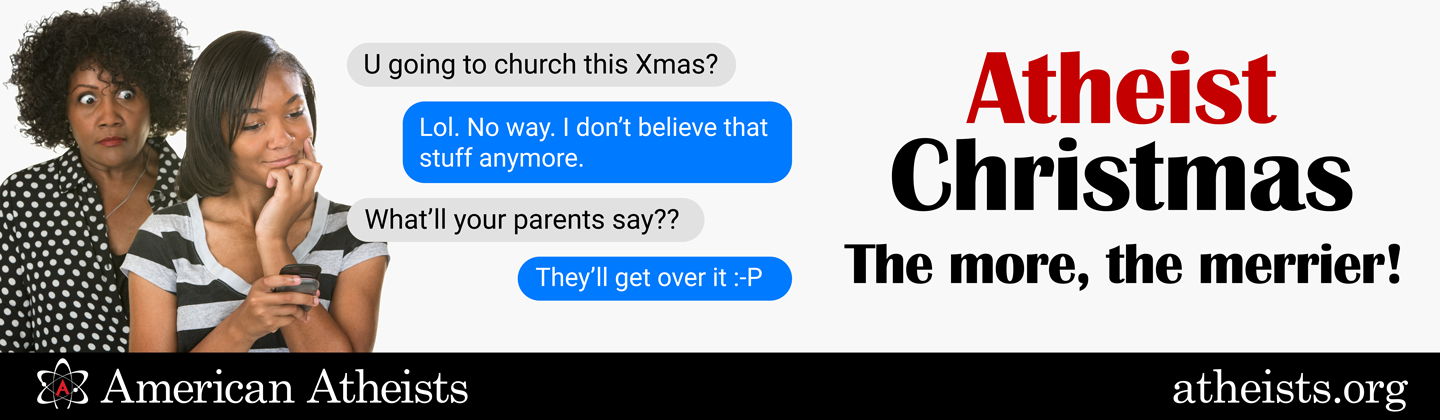
Time for the critiquing of American Atheists’ Christmas billboards! I will say this: this year, they’re emphasizing a more cheerful message with a little bit of humor, but still, they desperately need a pro to design these things.

Here’s the first one, and I think, the worst one.

2016-billboard-1

Uh, no. Way too busy. Just the text on the right would be OK, but the four small text messages on the left? No one is going to be able to read those as they’re zipping by in a car, and all they’ll see is the shocked, pop-eyed black woman (we’re treading awfully close to racist tropes here) staring at her smug daughter, which is not a particularly good or informative look. Also, it looks more like a banner ad on a website, rather than a roadside sign. Scrap it.

The second one, I like. Clear, simple, a snarky reference to our recent presidential campaign, and nicely promoting a strong anti-church message (if you don’t like anti-clericism, you aren’t going to like anything from American Atheists). I’d have gone for a sans serif font, though, and not used all caps. Otherwise, I think this is one of the best billboards American Atheists have produced yet (which is not saying a lot).

2016-billboard-2

Of course, one lesson they’ve learned, unfortunately, is that the quality of the content doesn’t matter, because no matter what it is, sanctimonious Christians will tear it down. This one lasted less than 2 hours before it was removed.

Related comment from that link: shut the fuck up about “heart of the Bible belt”. It does not justify anything, and the “Bible belt” is a meaningless, empty geographical distinction. I’ve visited communities in Washington state and Florida, Texas and Minnesota, central Pennsylvania and Oregon, that all declare themselves part of the “Bible belt”. The entire goddamn country is apparently this vaguely defined “Bible belt”, and it extends up into central Canada.

I suppose if Mexicans were this insecure about their religion and needed to say they believed in their version of god because of where they were born, the Bible belt would also extend south and be more of a Bible cup.