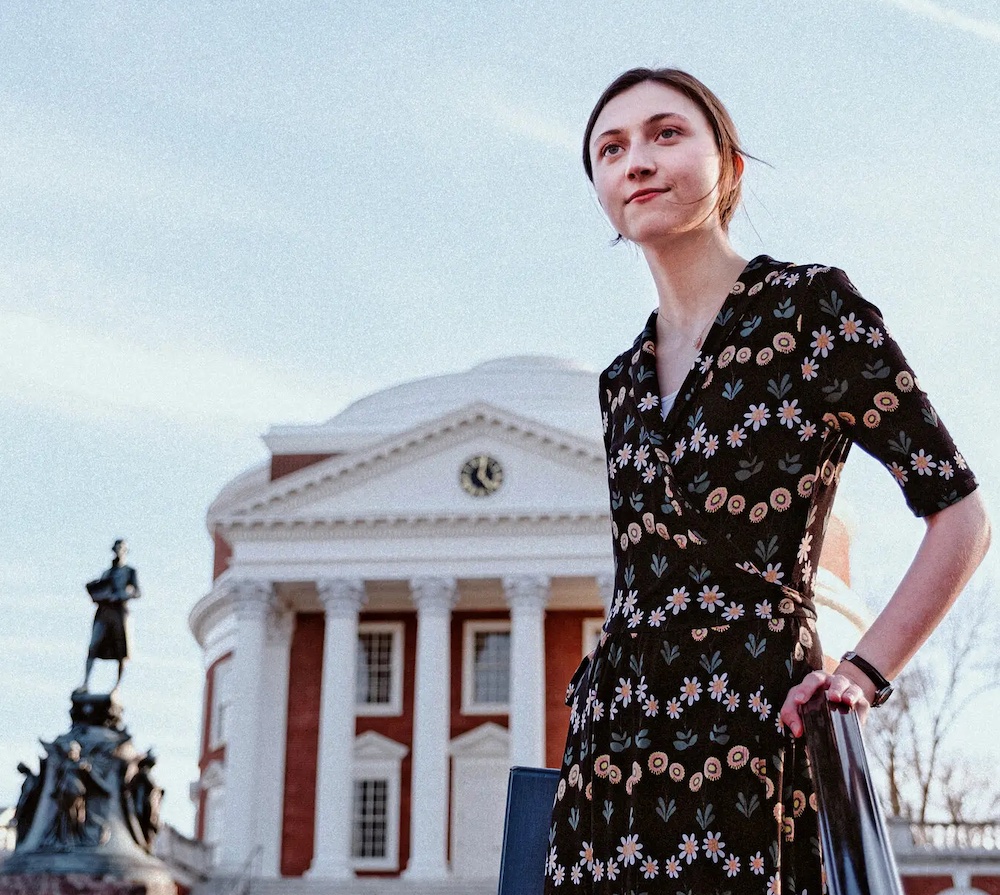
Great choice of background. Defend the right of students to carry tiki torches!
It’s easy. Pander to the editors’ opinions. Say you’re a liberal, but moan about how conservative viewpoints are suppressed on college campuses. Declare that controversial opinions are silenced. Say you want debate, you love debate, but gosh, those liberal campuses stifle the free and open discussion of ideas. That’s what Emma Camp accomplished, getting fluff called I Came to College Eager to Debate. I Found Self-Censorship Instead.. Pure conservative click bait. She announces several times that she’s a liberal, but she interned with FIRE, the organization funded almost entirely by rich conservatives.
But, you might argue, she’s going to defend her position with evidence, right? Surely she’ll get her ducks in a row and present lots of evidence that you can’t talk freely on college campuses anymore. So let’s take a look at her evidence anecdotes.
First up: office hours.
Each week, I seek out the office hours of a philosophy department professor willing to discuss with me complex ethical questions raised by her course on gender and sexuality. We keep our voices lowered, as if someone might overhear us.
Hushed voices and anxious looks dictate so many conversations on campus at the University of Virginia, where I’m finishing up my senior year.
Oh no! They weren’t shouting their discussion loudly so that everyone in the hallway could also hear them! Help, help, I’m being oppressed!
But wait, every week she is getting together with a professor to talk about ethics. How is this censorship?
This is a running theme. Speaking quietly in a one-on-one conversation is bad.
A friend lowers her voice to lament the ostracizing of a student who said something well-meaning but mildly offensive during a student club’s diversity training.
What “ostracizing”? Talk about that, if it happened, not this vague “lowers her voice” stuff.
Another friend shuts his bedroom door when I mention a lecture defending Thomas Jefferson from contemporary criticism. His roommate might hear us, he explains.
Yes? You’re talking about Thomas Jefferson on the UVa campus. You’re discussing, again in very vague terms, “contemporary criticism”. Maybe his roommate is tired of the subject? Maybe they want to study?
I went to college to learn from my professors and peers. I welcomed an environment that champions intellectual diversity and rigorous disagreement. Instead, my college experience has been defined by strict ideological conformity. Students of all political persuasions hold back — in class discussions, in friendly conversations, on social media — from saying what we really think. Even as a liberal who has attended abortion rights protests and written about standing up to racism, I sometimes feel afraid to fully speak my mind.
It’s called normal human behavior. People rarely just shout out their opinions in a typical social environment — they ease into the discussion. Sometimes you’re at a party and you don’t want to get in a fight with anyone, so you self-censor a bit, you hold back, you change the topic to something less argumentative. This is entirely ordinary, and is not a sign of a massive conspiracy to silence you.
Yeah, Ms Camp, we know, you’re a liberal interning with a conservative organization. Which side of the abortion rights protest were you on? You didn’t say. Also, you like to cite your bona fides in large strokes, but what, for instance, was your opinion of the “contemporary criticism” of Jefferson? What were you talking about with your ethics professor that compelled you to lower your voice? You seem to be remarkably shy about stating those opinions, even when you’ve got the NY Times bully pulpit. Why?
But wait — we’re about to get one paragraph of “data”.
In the classroom, backlash for unpopular opinions is so commonplace that many students have stopped voicing them, sometimes fearing lower grades if they don’t censor themselves. According to a 2021 survey administered by College Pulse of over 37,000 students at 159 colleges, 80 percent of students self-censor at least some of the time. Forty-eight percent of undergraduate students described themselves as “somewhat uncomfortable” or “very uncomfortable” with expressing their views on a controversial topic during classroom discussions. At U.Va., 57 percent of those surveyed feel that way.
Jesus. What did I just say? People self-censor all the time. I have to struggle to get students to express their uncontroversial views on uncontroversial topics all the time. Those statistics are meaningless.
When the data doesn’t help, fall back on the oppression of poor Emma Camp.
When a class discussion goes poorly for me, I can tell. During a feminist theory class in my sophomore year, I said that non-Indian women can criticize suttee, a historical practice of ritual suicide by Indian widows. This idea seems acceptable for academic discussion, but to many of my classmates, it was objectionable.
The room felt tense. I saw people shift in their seats. Someone got angry, and then everyone seemed to get angry. After the professor tried to move the discussion along, I still felt uneasy. I became a little less likely to speak up again and a little less trusting of my own thoughts.
I was shaken, but also determined to not silence myself. Still, the disdain of my fellow students stuck with me. I was a welcomed member of the group — and then I wasn’t.
Whoa, the idea that widows shouldn’t have to set themselves on fire at a funeral is too controversial for a feminist theory class? I do not believe it. This sounds exactly like the kind of thing that would make for a good discussion in such a class — the conflict between cultural values and individual autonomy. I think there’s more to it than she admits.
And then…her terrible, terrible punishment. Some people shifted in their seats. Someone disagreed angrily with her. Did Emma Camp want a debate or not? You know, that’s what happens in a debate — people might disagree strongly with you.
It’s not just Ms Camp. She has a Republican friend!
The consequences for saying something outside the norm can be steep. I met Stephen Wiecek at our debate club. He’s an outgoing, formidable first-year debater who often stays after meetings to help clean up. He’s also conservative. At U.Va., where only 9 percent of students surveyed described themselves as a “strong Republican” or “weak Republican,” that puts him in the minority.
He told me that he has often “straight-up lied” about his beliefs to avoid conflict. Sometimes it’s at a party, sometimes it’s at an a cappella rehearsal, and sometimes it’s in the classroom. When politics comes up, “I just kind of go into survival mode,” he said. “I tense up a lot more, because I’ve got to think very carefully about how I word things. It’s very anxiety inducing.”
Damn. A college student forced to “think very carefully.” Waily, waily, waily! What have we come to now? He can’t talk — loudly, no doubt — about his Republican views at an a cappella rehearsal!
We also have to acknowledge that the Republican party has literally gone mad over the years. He ought to be a little reluctant to publicly associate himself with a hate group, don’t you think?
The worst is yet to come.
This anxiety affects not just conservatives. I spoke with Abby Sacks, a progressive fourth-year student. She said she experienced a “pile-on” during a class discussion about sexism in media. She disagreed with her professor, who she said called “Captain Marvel” a feminist film. Ms. Sacks commented that she felt the film emphasized the title character’s physical strength instead of her internal conflict and emotions. She said this seemed to frustrate her professor.
Her classmates noticed. “It was just a succession of people, one after each other, each vehemently disagreeing with me,” she told me.
Her freely expressed opinion about a movie in a class “seemed to frustrate her professor”. Seemed. I don’t know what that means. Is it that he mildly disagreed with her? That he didn’t instantly conform to one student’s opinion? But I thought Ms Camp didn’t want ideological uniformity! And then, again for someone who is so desirous of debate, she is dismayed that a lot of people disagreed with her.
OK, then she talks about what she has done about this oppressive atmosphere.
I protested a university policy about the size of signs allowed on dorm room doors by mounting a large sign of the First Amendment. It was removed by the university. In response, I worked with administrators to create a less restrictive policy.
This is fairly weak tea here. The university did adjust it’s policy on signs on doors, “after signs posted on Lawn room doors last fall containing profanity such as “F—ck UVA,” as well as criticism of the University’s history of enslavement and inaccessibility, prompted calls for removal by some alumni and community members.” Policing profanity is one thing, but criticizing their history of enslavement is another. So why did Emma Camp post the First Amendment, which very few people would disagree with? Post something about your “contemporary criticism” of Thomas Jefferson instead. Make it fit within the limits of allowed signage. Force the university to dismantle it on the basis of the content, rather than just the dimensions. The university does have a legitimate interest in preventing the accumulation of ugly clutter.
She also wrote opinion pieces for the school paper.
As a columnist for the university paper, I implored students to embrace free expression. In response, I lost friends and faced a Twitter pile-on. I have been brave. And yet, without support, the activism of a few students like me changes little.
Her student paper op-eds read a lot like this NY Times op-ed. “I’m a LIBERAL! Free Speech! Liberals are too authoritarian!” Etc., etc., etc. I can fully understand why she lost friends and faced dissent — they’re just too insipid and clichéd and unaware, and a lot too self-centered. Her opinions were an empty embrace of buzzwords, and her examples of deplorable oppression were, as in this article, tepid and puerile. I predict a great future for her on the writing staff of some conservative news organization, like The Daily Caller or The Blaze or…no, she probably won’t stoop to The Epoch Times or InfoWars. She needs a place where declaiming her liberalness carries some counterfactual weight.
You know, like the NY Times.