Paleoconservatives are such an odd and scary group. They tend to be delusional, they’re often (but not necessarily Catholic), and they use lots of old, tired, dead arguments, so they aren’t even very entertaining. They also aren’t very stable. I was laughing at arguments from a group calling itself “Intellectual Takeout” years ago, but they’re gone now; they got absorbed by a right-wing think-tank called the Rockford Institute, which also splintered to form the Howard Center for Family, Religion (you can guess what they’re about), which has renamed itself the Charlemagne Institute. They were big supporters of Pat Buchanan, which should help focus their goals in your mind, because they sure are hard to track, they’re so busy covering their trails with new names and new organizations.
Anyway, they publish online something called Chronicles: A Magazine of American Culture. They’re probably not worth following unless you’re the SPLC and are tracking neo-Confederates or are just a connoisseur of stupid.
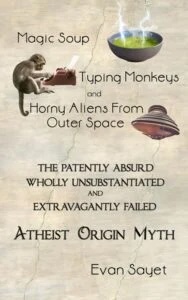
I’m the latter. How could I resist an article titled A Stand-Up Comic Stands Up for God: Evan Sayet Obliterates the Atheist Origin Myth, which is purportedly a review of the book illustrated on the right? The review starts thusly:
To be on the left is to be humorless. This makes sense when you consider how the left views the world as a perpetual occasion for an oppression fest, where the clock is ticking on their quest to free all the world’s intersectional victims before the climate apocalypse kills everyone. Sure, in line with their Manichean, comic-book ideology, they take an adolescent delight in hypocritically bullying everyone who dissents from their disordered views, and they equally detest and fear those opponents who give back in return to them more than they get. This is especially so if the opponent uses humor to buttress the case for dissent with ridicule.
I do appreciate the irony of a criticism that uses “Manichean” as an insult while simultaneously splitting the world into Left and Right and characterizing the entirety of the Left as a humorless monoculture. I was going to point out that a lot of great comedians, like George Carlin and Janeane Garofolo and Sarah Silverman and David Cross, etc. etc. etc., are godless liberals, while the conservatives limp along with the likes of Greg Gutfeld and Steven Crowder and Dennis Miller, etc. etc. etc., but then I realized that no one from the Charlemagne Institute would find George Carlin funny at all, so that argument would be pointless. Humor is a matter of personal taste.
But sure, open your review by levying baseless accusations at people you don’t like. It’ll rally the troops on your side.
Then we get to the meat of the review.
It is why the left loathes and fears people like Evan Sayet.
Who? Never heard of him.
It is with good reason. Consider his remarks about his latest book, Magic Soup, Typing Monkeys, and Horny Aliens from Outer Space: The Patently Absurd Wholly Unsubstantiated and Extravagantly Failed Atheist Origin Myth: “Trying to litigate against atheism is like trying to litigate against the Emperor’s clothes; atheism needs to not just be disproved but ridiculed for the patent absurdity that it is.”
Uh-oh. The book title gives the game away: Evan Sayet is an anti-evolutionist. Like the reviewer, he is going to mischaracterize the thing he doesn’t like, in this case science, and presumably he’s going to do it with jokes, because right-wing creationists are far funnier than left wing bullies who are competing in the oppression olympics, obviously. I hope the book is funny, although the title isn’t, and Sayet’s bona fides aren’t exactly promising.
A stand-up comic who has written for television shows such as Politically Incorrect w/Bill Maher,
A very bad sign, that.
Evan Sayet has tested and proven his mettle as a political observer and activist. Behind the scenes, Sayet has counseled and penned speeches for presidential candidates and, eventually, a president. Further, risking his livelihood in the leftist-controlled entertainment industry, Sayet has courageously and continually expressed his trenchant insights on television and with the written word. He has not shied away from rich targets for his pointed wit, no matter how powerful.
Wait wait wait — I thought it was lefties who were involved in an oppression fest
, but now we’re told that Evan Sayet has been oppressed by a leftist-controlled entertainment industry
? And simultaneously he has been counseling a president (I can guess which one)? It must be Schrodinger’s Oppressor. He’s everywhere on all sides all at once.
So what’s his argument?
Sayet refuses to let the atheists off the intellectual hook, even skewering them with science to salt the wound. Starting with teleological arguments of Intelligent Design and “Fine-Tuning,” and, ultimately, in his own inimitable fashion moving on to St. Thomas Aquinas’ “Five Ways” (Quinque Viae from the Summa Theologiae): (1) argument from motion, (2) argument from efficient cause, (3) argument from necessary being, (4) argument from gradations of goodness, and (5) argument from design. Sayet employs all of these methods and more to demonstrate the existence of God.
Great. As is typical, a conservative site considers the philosophical arguments of a 13th century theologian to be definitive. We’ve been soaking in that nonsense for eight centuries, and it’s been unpersuasive to everyone other than shallow poseurs.
(1) The unmoved mover could be a physical agent, a singularity or Big Bang, not your peculiar and specific god-thing. We don’t need to propose the Unmoved Mover was any kind of god at all.
(2) Likewise, the first cause could have been a hiccup in the firmament, a twitch in the fabric of space-time, and invoking a sentient, humanoid entity is superfluous.
(3) Again, the problem is that you think you know who the ‘necessary being’ was, and how its mind worked (if it even had one), and its intent. It could have been a cosmic fart, for all any of us know.
(4) “Goodness” is a matter of human perception. It is not a universal force. The universe, in general, seems to be a pretty nasty place, so why you would think there must be a Supreme Good Guy is a mystery.
(5) The argument from design boils down to pointing at complicated things you don’t understand and announcing that someone smarter than you must have made it. This is trivially refuted by revealing that dumb processes can make some pretty complex things.
None of those arguments demonstrate the existence of God,
a concept, I note, they don’t bother to define, probably because they just assume that God is the body of superstitious theological assumptions they already believe. Like I said, these are just old, tired, dead arguments that we’ve heard time and again; Sayet is incredibly unoriginal and uninteresting.
Thus, does Sayet proceed to plumb the shallow depths of militant atheists’ theological Sitz bath, and he drowns them with the proofs for God’s existence.
Whoa, I started reading this article warned that I was going to be obliterated, and we instead end up relaxing in a Sitz bath? How nice. It’s kind of hard to drown in a Sitz bath, you know. I suppose it could be done if you contort yourself and use it improperly, but I’ll leave the twisty delusional distortions to the Christians.